
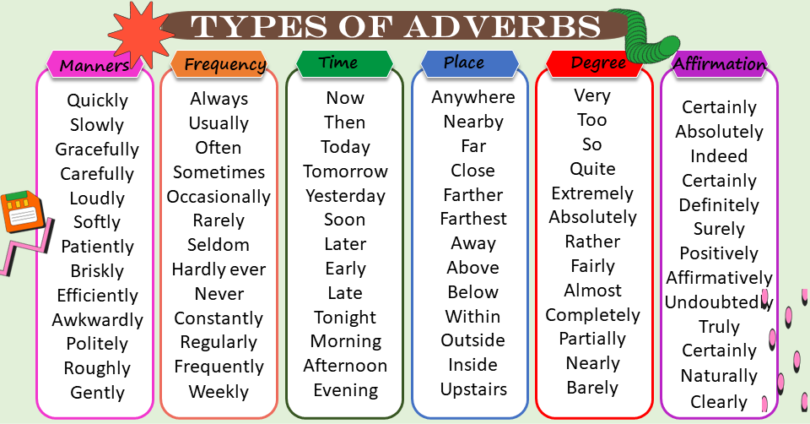
An adverb modifies a verb, an adjective, or another adverb, adding detail about how, when, where, how often, how much, or how one thing compares to another. English groups adverbs into several types of adverbs, and each type names one feature of a word rather than a fixed category for the word itself. Thirteen recognized classifications cover the full system: manner, time, frequency, place, degree, comparison, certainty, attitude, judgement, affirmation and negation, interrogative, relative, and conjunctive. Each classification answers its own question, so identifying an adverb means asking the right one.
Grammar sources count adverb types differently because they classify different features of the same word, not because grammarians disagree on what an adverb is.
Types of Adverbs in English With Examples
Grammar books split adverbs into different totals because each source classifies a different feature: what question the word answers, whether it states the speaker’s stance, whether it confirms or denies a clause, and whether it connects two clauses. This system counts 13 classifications built across six axes, including the evaluative family and the affirmation-and-negation pair that shorter lists skip or split incorrectly.
The 13 types of adverbs are:
- Manner
- Time
- Frequency
- Place
- Degree
- Comparison
- Certainty
- Attitude
- Judgement
- Affirmation and negation
- Interrogative
- Relative
- Conjunctive
Six axes organize these classifications, and a single adverb receives a label from several axes at once, since each axis measures a separate feature rather than describing the same feature twice:
- Manner: answers how an action happens.
- Time and frequency: answer when an action happens and how often.
- Place: answers where an action happens.
- Degree and comparison: answer how much and how one instance compares to another.
- Stance: names the speaker’s certainty, attitude, or judgement toward a clause.
- Connection: confirms, denies, questions, or links clauses.
One adverb receives several of these labels inside the same sentence. The question a word answers decides its label, and the identification method further on covers the rest.
How Adverb Types Work Together
Take the sentence Maya rarely speaks softly here. Three adverbs answer three different questions in one sentence:
- Frequency: rarely, because it answers how often Maya speaks
- Manner: softly, because it answers how Maya speaks
- Place: here, because it answers where Maya speaks
Three words, three labels, three separate axes, and each answers a different question about the same clause.
Adverbs of Manner
An adverb of manner answers how an action happens. It follows the main verb or the object.
- Maya sang beautifully at the concert.
- The team worked efficiently through the deadline.
- Maya carefully wrapped the gift.
A dedicated adverbs of manner lesson works through the full placement rules with more forms.
Adverbs of Time and Frequency
Time and frequency both answer a question about when, though frequency narrows the question to how often.
Time
An adverb of time answers when an action happens. A definite time adverb names a specific point, and an indefinite time adverb describes a general or ongoing point.
- Maya will arrive tomorrow. (definite)
- Maya has already finished the project. (indefinite)
A dedicated adverbs of time lesson works through both categories with more forms.
Frequency
An adverb of frequency answers how often an action happens, moving along a scale from constant to none.
- Maya always checks her email before breakfast.
- Maya rarely misses a deadline.
- Maya never arrives late.
A dedicated adverbs of frequency lesson develops the full frequency scale in more depth.
Adverbs of Place
An adverb of place answers where an action happens. A static-location adverb names a fixed position, and a direction adverb names a path or a movement.
- Maya waited here for the bus. (static location)
- Maya walked away after the meeting. (direction)
A dedicated adverbs of place lesson works through both categories with more forms.
Adverbs of Degree and Comparison
Degree and comparison share one intensity axis: degree measures how much, and comparison measures how one instance compares to another.
Degree
An adverb of degree intensifies a verb, an adjective, or another adverb.
- Maya is extremely tired after the trip.
- The building was completely renovated.
A quantity word such as many modifies a noun and functions as a quantifier, not as an adverb. In She has too many books, too is the degree adverb, since it intensifies many.
Comparison
A comparative adverb compares two instances, and a superlative adverb compares three or more.
- Maya runs faster than her brother. (comparative)
- Maya runs the fastest on the team. (superlative)
Evaluative Adverbs
Certainty, attitude, and judgement form one evaluative family. Each states the speaker’s stance toward the whole clause rather than describing the action itself.
Certainty
A certainty adverb states how sure the speaker is about a claim.
- Maya will certainly arrive on time.
- Obviously, the meeting ran long.
Attitude
An attitude adverb states the speaker’s feeling about the clause as a whole.
- Fortunately, Maya arrived early.
- Honestly, the presentation needed more detail.
Judgement
A judgement adverb evaluates the action described in the clause.
- Maya wisely left early to beat the traffic.
- He foolishly ignored the warning.
Affirmation and Negation Adverbs
An affirmation adverb confirms that a statement is true, and a negation adverb denies it. The two form one paired category rather than two unrelated types.
- Indeed, Maya finished the report early. (affirmation)
- Maya did not finish the report. (negation)
Interrogative and Relative Adverbs
Interrogative and relative adverbs share most of the same words, but they do not overlap completely. Interrogative adverbs use four words, when, where, why, and how. Relative adverbs use three of the same words, when, where, and why, but never how.
Interrogative
An interrogative adverb opens a direct or an indirect question.
- When will Maya arrive?
- She asked where the meeting was held.
- How did Maya finish the report so quickly?
Relative
A relative adverb introduces a clause that describes a noun already named in the sentence, using when, where, or why.
- This is the day when Maya arrives.
- That is the reason why she left early.
- Maya visited the office where she once worked.
Conjunctive Adverbs
A conjunctive adverb connects two independent clauses and needs a semicolon or a period before it and a comma after it.
- Maya finished early; however, she stayed to help.
A conjunctive adverbs lesson covers the full punctuation system and meaning categories in more depth.
Types of Adverbs Comparison Chart
The comparison chart organizes all 13 classifications by axis, type, test, and example, keeping every cell to one short phrase so the chart stays readable on a small screen.
| Axis | Type | Test | Example |
|---|---|---|---|
| Manner | Manner | Answers how | Softly in Maya spoke softly |
| Time | Time | Answers when | Tomorrow in Maya will arrive tomorrow |
| Time | Frequency | Answers how often | Rarely in Maya rarely speaks |
| Place | Place | Answers where | Here in Maya waited here |
| Intensity | Degree | Answers how much | Extremely in Maya is extremely tired |
| Intensity | Comparison | Compares one instance to another | Faster in Maya runs faster than her brother |
| Stance | Certainty | States how sure the speaker is | Certainly in Maya will certainly arrive |
| Stance | Attitude | States the speaker’s feeling about the clause | Fortunately in Fortunately, Maya arrived early |
| Stance | Judgement | States the speaker’s judgement of the action | Wisely in Maya wisely left early |
| Polarity | Affirmation and negation | Confirms or denies the clause | Indeed, or not |
| Question | Interrogative | Opens a question | When in When will Maya arrive |
| Clause link | Relative | Introduces a descriptive clause | When in the day when Maya arrives |
| Clause link | Conjunctive | Connects two independent clauses | However in Maya finished early; however, she stayed |
How to Identify Adverb Types
Five steps convert the classifications into a method you run on any sentence:
- Find the adverb and the word it modifies.
- Check which question it answers: how, when, where, how often, or how much.
- Check whether it expresses the speaker’s stance toward the whole clause.
- Check whether it confirms, denies, questions, or connects two clauses.
- Confirm whether the same sentence gives the word more than one label.
Running a sentence through all five steps names every classification the adverb qualifies for, rather than forcing it into one box.
Common Mistakes With Adverb Types
Four confusions repeat across worksheets and grammar sites, and catching them keeps you from mislabeling an adverb you already understand.
Certainly and indeed mean the same thing and belong to the same type. ❌ Certainly expresses how sure the speaker is, while indeed confirms that a statement is true; the two belong to different families, certainty and affirmation. ✅
Many functions as a degree adverb in she has many books. ❌ Many functions as a quantifier modifying the noun books, not as an adverb; too in too many books is the actual degree adverb. ✅
When always functions as an interrogative adverb. ❌ When functions as an interrogative adverb only inside a question, such as When will Maya arrive, and as a relative adverb when it introduces a descriptive clause, such as the day when Maya arrives. ✅
Maya runs more faster than her brother. ❌ Maya runs faster than her brother, since a comparative adverb takes either -er or more, never both together. ✅
Adverb Types Practice Questions
Test the five-step method against eight sentences before checking your answers.
- Name the type of adverb rarely represents in Maya rarely speaks softly here.
- Name the type of adverb softly represents in the same sentence.
- Is certainly an adverb of certainty or affirmation in Maya will certainly arrive on time?
- Classify wisely in Maya wisely left early.
- Is when interrogative or relative in This is the day when Maya arrives?
- Correct the error in Maya runs more faster than her brother.
- Identify the adverb type in Fortunately, Maya arrived early.
- Explain why many is not the degree adverb in She has too many books.
Answers
- Rarely functions as an adverb of frequency, since it answers how often Maya speaks.
- Softly functions as an adverb of manner, since it answers how Maya speaks.
- Certainly functions as an adverb of certainty, since it states how sure the speaker is rather than confirming or denying the statement.
- Wisely functions as an adverb of judgement, since it evaluates the wisdom of Maya’s action.
- When functions as a relative adverb here, since it introduces a descriptive clause about the day rather than opening a question.
- The correct sentence is Maya runs faster than her brother, since a comparative adverb takes only one comparative marker.
- Fortunately functions as an adverb of attitude, since it expresses the speaker’s feeling about the whole clause.
- Too functions as the degree adverb, since it intensifies many; many itself functions as a quantifier modifying the noun books, not as an adverb.
FAQs
Q1. How many types of adverbs are there?
Grammar sources report different totals because each one classifies a different feature of the adverb rather than disagreeing on what an adverb is. Counting manner, time, frequency, place, degree, comparison, the evaluative family, affirmation and negation, interrogative, relative, and conjunctive classifications together produces 13 adverb types, a fuller and more accurate count than lists that split certainty from affirmation or quantity from degree.
Q2. What are the main types of adverbs?
The five most commonly taught types are manner, time, place, frequency, and degree, since they answer the questions how, when, where, how often, and how much. The complete system adds comparison, the evaluative family, affirmation and negation, interrogative, relative, and conjunctive adverbs as separate classification axes with their own rules.
Q3. What is the difference between an interrogative adverb and a relative adverb?
An interrogative adverb opens a direct or an indirect question, as in When will Maya arrive? A relative adverb introduces a descriptive clause about a noun already named in the sentence, as in the day when Maya arrives. Interrogative adverbs include how, but relative adverbs use only when, where, and why.
Q4. What is the difference between an adverb of certainty and an adverb of affirmation?
An adverb of certainty states how confident the speaker is about a claim, as in Maya will certainly arrive. An adverb of affirmation confirms that a statement is true rather than measuring confidence, as in Indeed, Maya arrived on time. The two belong to related but separate families.
Q5. What is an evaluative adverb?
An evaluative adverb states the speaker’s stance toward an entire clause rather than describing the action itself. The family splits into three branches: certainty (how sure the speaker is), attitude (how the speaker feels about the clause), and judgement (how the speaker evaluates the action).
You May Also Like

Leave a Comment