
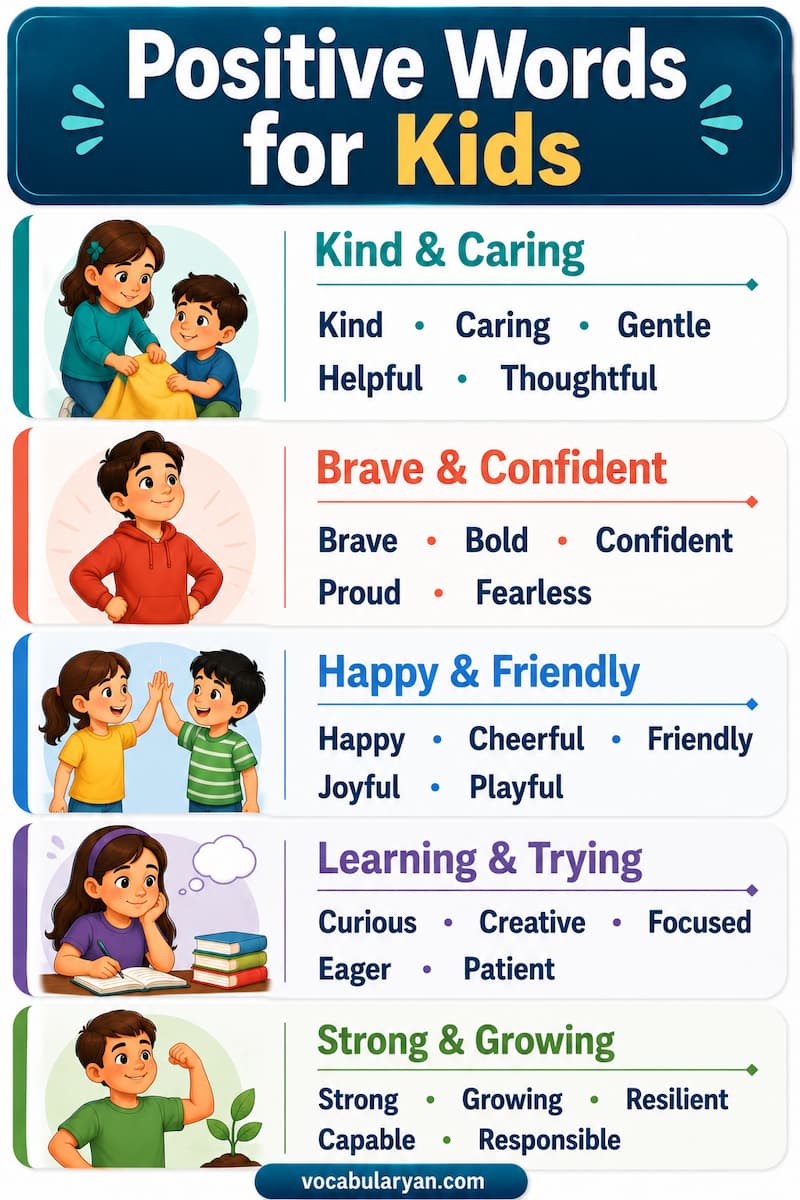
Children soak up the words adults use around them. “You’re brave” and “You’re brilliant” settle into a child’s inner voice long before they can explain why. The words below are grouped by what they name and who uses them: words parents reach for to describe their child, words a teacher puts on a classroom wall, words a child learns to say to themselves on a hard day. Each one carries a meaning and an example sentence short enough for a child to understand and remember. Choose the one that fits your child right now, and it may stay with them for years.
Positive Words for Kids at a Glance
Short on time? Grab the word for the moment you need, then read the fuller groups below.
| When you want to… | Try these words |
|---|---|
| Describe who they are | Kind, brave, curious, creative |
| Praise effort and trying | Hardworking, persistent, trying, improving |
| Build confidence | Capable, smart, enough, valued |
| Encourage through hard moments | Resilient, strong, determined, steady |
| Celebrate growth | Growing, learning, proud, thriving |
| Name their heart | Loving, caring, generous, warm |
Words That Describe a Child’s Best Qualities
These are the words that name who a child is at their core. Said often, they become part of how the child sees themselves.
- Kind: caring and gentle toward others.
- “You were so kind when you shared with her today.”
- Brave: doing something even when it feels scary.
- “It was brave of you to try that for the first time.”
- Curious: always wanting to learn and explore.
- “Your curious mind asks the best questions.”
- Creative: full of fresh, original ideas.
- “That drawing shows how creative your thinking is.”
- Caring: noticing when others need help or comfort.
- “You’re a caring friend, you noticed he was upset.”
- Thoughtful: pausing to think about how others feel.
- “That was really thoughtful, you remembered she doesn’t like loud noises.”
- Honest: telling the truth even when it’s hard.
- “I’m really proud of you for being honest.”
- Gentle: careful and soft with people, animals, and feelings.
- “You were so gentle with the puppy.”
- Funny: making others laugh in a warm, good way.
- “Your funny stories make everyone smile.”
- Unique: one of a kind in the very best way.
- “There’s no one else in the world exactly like you.”
Words That Praise Effort in Kids
Praising a child for trying rather than for results builds a mindset that lasts. These words name the effort, not just the outcome.
- Hardworking: putting in real effort without giving up.
- “You were so hardworking on that puzzle today.”
- Persistent: keeping at it even when it gets hard.
- “You kept going even when it was difficult. That’s persistent.”
- Trying: making a genuine attempt, which is everything.
- “I love that you kept trying.”
- Improving: getting better with every practice.
- “Look how much you’re improving with every go.”
- Focused: staying with the task and not giving up.
- “You stayed so focused the whole way through.”
- Dedicated: committing to something and seeing it through.
- “You’ve been really dedicated to learning this song.”
- Disciplined: sticking to a habit or routine.
- “It takes a disciplined person to practice every day.”
- Thorough: doing the whole job without cutting corners.
- “Your thorough approach meant nothing was missed.”
- Energetic: bringing real drive and enthusiasm.
- “You brought such energetic effort to the whole project.”
- Enthusiastic: genuinely excited and happy to be doing it.
- “Your enthusiasm made the whole thing more fun.”
Words That Build a Child’s Confidence
Confidence grows from being told what is true about you. These words name a child’s worth, not just their performance.
- Capable: able to handle what’s in front of them.
- “You are more capable than you think right now.”
- Smart: quick to understand and full of good thinking.
- “Your brain is so smart the way it connected those ideas.”
- Enough: already complete and worthy as they are.
- “You are already enough, exactly as you are.”
- Valued: genuinely important and appreciated.
- “You are so valued in this family.”
- Special: holding something that no one else has.
- “You are special in ways the world needs.”
- Worthy: deserving of love, joy, and good things.
- “You are worthy of every good thing.”
- Loved: held in deep, steady care.
- “You are loved today, tomorrow, and always.”
- Brilliant: showing a sparkling, impressive mind.
- “That was a brilliant idea, I never would have thought of that.”
- Gifted: carrying real talent in their own special way.
- “You have a gifted way of seeing the world.”
- Seen: fully noticed and known by those who love them.
- “I see you and I’m proud of who you are.”
Words to Encourage a Child Through Hard Moments
Hard days need honest words. These land best when they’re tied to something real the child is doing.
- Resilient: bouncing back from a fall or setback.
- Strong: carrying a hard feeling without being overwhelmed.
- Determined: not quitting when it would be easier to stop.
- Steady: staying calm when things feel wobbly.
- Safe: held and protected through the hard thing.
- Brave-enough: brave enough to ask for help when needed.
- Recovering: coming back, even if it takes time.
- Supported: never alone in the difficult moment.
- Believed-in: trusted to get through this by the people they love.
- Growing: getting stronger through every hard thing.
Words About a Child’s Heart and Character
These words name the inside of a child, the goodness and warmth that no grade or score can measure.
- Loving: full of warmth and real care.
- Generous: giving freely without keeping score.
- Empathetic: feeling what a friend feels.
- Forgiving: letting go of upset and moving forward.
- Grateful: noticing and enjoying the good.
- Joyful: carrying real happiness that lights up the room.
- Playful: full of fun and easy laughter.
- Imaginative: building whole worlds in the mind.
- Sensitive: feeling deeply, which is a strength.
- Compassionate: wanting to help when others hurt.
Kind Words to Say to a Child Every Day
Some words don’t need an occasion. These are worth saying often.
- “I love you exactly as you are.”
- “I’m proud of the effort, not just the result.”
- “You can come to me with anything.”
- “You made me smile today.”
- “I see how hard you’re working.”
- “You are so good to have around.”
- “Your feelings are always allowed here.”
- “I believe in you, especially on the hard days.”
The most powerful line is the one that names something specific. Instead of “you’re great,” try “I loved how you helped your brother without being asked.” That detail shows the child you were watching, and children are lifted by being seen.
Affirmations Kids Can Say to Themselves
Short, warm, and specific lines a child can repeat on a hard morning, before a test, or when another voice tries to tell them they’re not enough.
- “I am brave enough.”
- “I can do hard things.”
- “I am loved.”
- “Mistakes help me learn.”
- “I am getting better every day.”
- “I am enough just as I am.”
- “I am a good friend.”
- “My feelings make sense.”
The best affirmation for a child is one they believe. Start with the true ones, the ones they already know. A child who hears “I am loved” and feels it is building a foundation nothing can easily take away.
Positive Words for Kids A to Z
One word and meaning for each letter, short and at the right level for a classroom wall or a journal.
| Letter | Word | Meaning |
|---|---|---|
| A | Amazing | Doing something that fills others with wonder |
| B | Brave | Doing it even when it feels scary |
| C | Curious | Always wanting to learn more |
| D | Dedicated | Keeping at it until it’s done |
| E | Enough | Already whole and worthy |
| F | Friendly | Warm and open with others |
| G | Generous | Giving freely without keeping score |
| H | Hardworking | Giving real effort every day |
| I | Imaginative | Full of fresh, original ideas |
| J | Joyful | Carrying real happiness |
| K | Kind | Caring and gentle toward others |
| L | Loved | Held in deep, steady care |
| M | Mindful | Noticing what’s happening right now |
| N | Nurturing | Taking care of others |
| O | Open-hearted | Ready to feel and share |
| P | Persistent | Keeping at it even when it’s hard |
| Q | Quick-thinking | Fast to come up with new ideas |
| R | Resilient | Bouncing back after a fall |
| S | Smart | Full of good thinking |
| T | Thoughtful | Pausing to think of others |
| U | Unique | One of a kind in the very best way |
| V | Valued | Genuinely important and appreciated |
| W | Warm | Full of friendly, caring energy |
| X | (e)Xcellent | Doing something really well |
| Y | Yourself | The best version of who you already are |
| Z | Zestful | Full of lively, happy energy |
FAQs
Positive words for kids name who a child is and what they do well: brave, kind, curious, creative, persistent, and loved are among the most powerful. The strongest ones name a real and specific quality. Instead of “you’re good,” try “you were kind when you waited for her to catch up.” That specificity is what makes a word land.
Words that name love, capability, and effort work best daily: “I love you,” “I’m proud of your effort,” “you are enough,” and “I see how hard you’re trying.” Research consistently shows that children who hear effort praised rather than fixed ability develop stronger resilience and a longer-lasting willingness to take on challenges.
Short, true, present-tense lines work best for children: “I am brave enough,” “I can do hard things,” “I am loved,” and “mistakes help me learn.” The most effective affirmations are ones the child already partly believes. A line they can hold onto in a hard moment is worth more than a grand one they can’t quite trust.
Words shape a child’s inner voice. Children who hear consistent, specific encouragement from trusted adults develop stronger self-esteem, greater resilience, and a more flexible response to failure. The effect is strongest when the word names a specific behavior rather than a general quality, “you kept trying even when it was hard” lands deeper than “you’re great.”
Name what you see, not what you hope. If they’re trying, say determined. If they’re hurting, say safe and supported. If they’ve fallen and got back up, say resilient. Avoid dismissing the struggle (“it’s fine”). Instead, name the feeling and name the quality: “That was really hard, and you stayed brave through it.”
Kind, caring, warm, gentle, generous, empathetic, and loving all name a child’s goodness toward others. Tie any of them to a real moment: “You were so gentle when she was upset” tells a child what kindness looks like in action, which is far more memorable than “you’re a nice person.”