
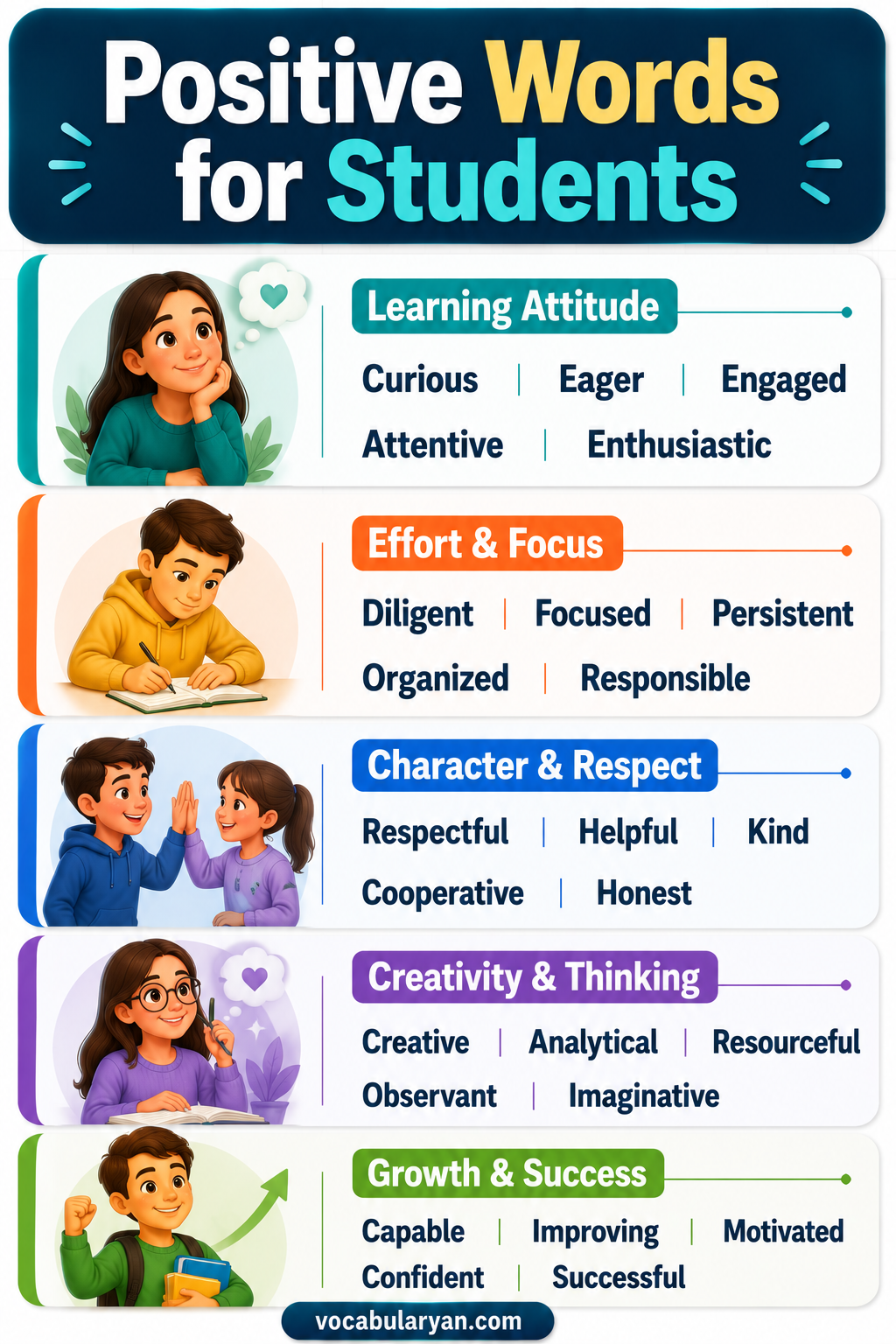
A student’s inner voice is shaped early by the words the adults around them use. The right word at the right moment, a teacher saying capable instead of struggling, a parent saying determined instead of distracted, stays long after the moment passes. The words below are grouped by what they name and when to use them: words that describe a student’s best qualities, words that praise effort over grades, words that steady someone before an exam, and words a student reaches for when the inner voice goes quiet. Each one carries a meaning and an example to borrow. Choose the one that fits the moment, and your words will carry the student further than the lesson will.
Positive Words for Students at a Glance
Short on time? Grab the word for the moment you’re in, then read the fuller groups below.
| When you want to… | Try these words |
|---|---|
| Describe a student’s qualities | Capable, curious, diligent, thoughtful |
| Praise effort and work | Hardworking, dedicated, persistent, thorough |
| Encourage through struggle | Resilient, brave, determined, steadfast |
| Build confidence | Capable, worthy, gifted, valued |
| Celebrate progress | Proud, accomplished, growing, thriving |
| Name a growth mindset | Curious, adaptable, open, reflective |
Words That Describe a Student’s Qualities
These words name the genuine strengths a student brings to their learning. Use them specifically, and the student will believe them.
- Capable: having the ability to handle what’s asked.
- “You’re more capable than this grade is showing right now.”
- Curious: naturally driven to learn and understand more.
- “Her curious mind turned every question into an investigation.”
- Diligent: thorough and attentive in their work.
- “His diligent approach meant no part of the task was left half-done.”
- Thoughtful: pausing to consider before responding.
- “Her thoughtful answer showed she’d really wrestled with the idea.”
- Creative: bringing fresh approaches to problems.
- “His creative solution was the one nobody else had considered.”
- Focused: locking attention on what matters.
- “She stayed focused through the whole session without being reminded.”
- Perceptive: noticing what others miss.
- “His perceptive observation changed the whole direction of the discussion.”
- Insightful: seeing the deeper meaning beneath the surface.
- “That was an insightful response, you connected two ideas most students don’t.”
- Articulate: expressing thoughts with precision and confidence.
- “She gave an articulate presentation that surprised everyone in the room.”
- Independent: working through challenges on their own.
- “His independent thinking showed real intellectual confidence.”
Words That Praise Effort and Work
Research confirms that praising effort rather than ability builds lasting motivation. These words name the work behind the result.
- Hardworking: giving real effort day after day.
- “Her hardworking approach through the semester showed in every assignment.”
- Dedicated: committed to seeing the work through.
- “He was dedicated enough to come back after every setback.”
- Persistent: pressing on through difficulty without giving up.
- “Persistent practice turned a weakness into one of her strengths.”
- Thorough: completing work with care and attention to detail.
- “His thorough notes showed he was genuinely engaged.”
- Disciplined: steady and consistent in study habits.
- “A disciplined routine made the exam feel less threatening.”
- Committed: fully invested in the goal.
- “She was committed to improving, not just to passing.”
- Conscientious: careful and thorough in meeting every standard.
- “His conscientious submission meant no detail was left to chance.”
- Motivated: fueled by a genuine reason to act.
- “She arrived motivated and stayed that way long after the bell.”
- Industrious: productive and active in every session.
- “An industrious student finds something to learn in every moment.”
- Enthusiastic: genuinely excited about the learning.
- “His enthusiastic participation raised the energy of the whole class.”
Words to Encourage a Student Through Struggle
Hard moments need specific words, not general ones. These name the quality that gets a student through.
- Resilient: bouncing back from setbacks without losing direction.
- Brave: facing the hard task without waiting for confidence to arrive.
- Determined: settled on seeing it through, whatever the cost.
- Steadfast: holding firm when the difficulty stretches long.
- Tenacious: holding on when others would let go.
- Persevering: moving forward through repeated difficulty.
- Strong: carrying the weight without breaking under it.
- Unshakeable: steady inside when everything outside is difficult.
- Patient: willing to wait while the understanding builds.
- Courageous: raising a hand, asking for help, or trying again.
Words That Build Student Confidence
Confidence grows from being seen accurately. These words name what the student is, not just what they did.
- Able: fully equipped with what the challenge demands.
- “You are able to do this. You’ve handled harder.”
- Worthy: deserving of the seat, the grade, and the opportunity.
- “Your voice is worthy of being heard in this room.”
- Gifted: carrying real talent, whether or not it shows in grades.
- “You’re gifted in the way you see connections others miss.”
- Valued: genuinely important to the class and the conversation.
- “Your contribution is valued here.”
- Brilliant: showing a sharp, fast, impressive mind.
- “That was a brilliant move. You saw it when no one else did.”
- Smart: quick to understand and apply what they learn.
- “You’re smart enough to know when you need help. That’s a strength.”
- Ready: prepared for what comes next.
- “You’re more ready than you feel right now.”
- Empowered: in real control of their own learning path.
- “Once she understood the method, she felt genuinely empowered.”
- Respected: genuinely held in regard by those around them.
- “Your classmates respect your opinion more than you realize.”
- Enough: already complete as a person, whatever the result.
- “Your grade does not decide whether you are enough. You already are.”
Growth Mindset Words for Students
A growth mindset believes that ability grows with effort. These words build that belief into a student’s vocabulary.
- Growing: getting better with every attempt.
- Learning: gaining something from every experience, including failures.
- Improving: moving forward from where they were.
- Developing: building skill and understanding steadily over time.
- Progressing: making real forward movement toward the goal.
- Trying: making the attempt, which is where growth begins.
- Adapting: adjusting approach when the first one doesn’t work.
- Reflecting: pausing to examine what worked and what didn’t.
- Exploring: testing ideas and not waiting for certainty first.
- Open: willing to consider new approaches and new ideas.
Words to Say to a Student Before an Exam
The right word before an exam steadies nerves without dismissing them. These land best when they’re specific and honest.
- “You’re prepared. Trust what you’ve done.”
- “Breathe first. Then read. Then answer.”
- “You know more than the anxiety is letting you see.”
- “One question at a time. That’s all.”
- “This exam doesn’t decide who you are. It just measures one moment.”
- “You’ve shown up every day for this. That counts.”
- “Nervous means you care. Caring is what gets you through.”
- “Do your best. That’s the only requirement.”
The best pre-exam word is the one that meets the student where they are. A student who’s underprepared needs honesty and a plan. A student who’s overprepared needs permission to trust themselves. Name what you actually see, not what you hope to see.
Positive Words for a Student’s Report Card Or Recommendation
These words translate into formal writing while still carrying real warmth.
| For a report card | For a recommendation letter |
|---|---|
| Capable | Accomplished |
| Diligent | Conscientious |
| Curious | Intellectually engaged |
| Persistent | Resilient |
| Thoughtful | Reflective |
| Growing | Demonstrating clear development |
| Enthusiastic | Self-motivated |
| Independent | Demonstrates initiative |
A strong recommendation names the quality and ties it to a real moment: “She is persistently curious, the first to ask a follow-up question and the last to accept a surface answer.” That specificity is what makes a recommendation genuinely useful.
Affirmations Students Can Say to Themselves
When the inner voice goes quiet or turns harsh, these lines give students something to reach for.
- “I am capable of learning this.”
- “Progress, not perfection.”
- “I’ve handled hard things before.”
- “One step at a time is still moving forward.”
- “Struggling means I’m learning.”
- “My effort today is building my skill for tomorrow.”
- “I am allowed to not know something yet.”
- “I belong in this room as much as anyone.”
A good affirmation is specific and believable. Instead of “I’m brilliant at everything,” try “I’m capable of understanding this if I keep working at it.” The honest version holds up under pressure better than the inflated one.
Positive Words for Students A to Z
One word and meaning for each letter, so you scan and choose at once.
| Letter | Word | Meaning |
|---|---|---|
| A | Accomplished | Having achieved something real |
| B | Brave | Facing the challenge without waiting |
| C | Capable | Equal to what’s being asked |
| D | Dedicated | Committed to seeing it through |
| E | Enthusiastic | Genuinely excited about learning |
| F | Focused | Locked onto what matters |
| G | Growing | Getting better with every attempt |
| H | Hardworking | Giving real effort day after day |
| I | Industrious | Productive and active in learning |
| J | Joyful-learner | Finding real pleasure in understanding |
| K | Knowledgeable | Building real understanding over time |
| L | Learner | Genuinely engaged in growing |
| M | Motivated | Fueled by a real reason to act |
| N | Notable | Standing out through real effort |
| O | Open | Willing to receive new ideas |
| P | Persistent | Pressing on through difficulty |
| Q | Quick-thinking | Fast to connect and apply ideas |
| R | Resilient | Bouncing back from setbacks |
| S | Smart | Quick to understand and apply |
| T | Thoughtful | Pausing to consider before responding |
| U | Unstoppable | Too determined to give up |
| V | Valued | Genuinely important to the class |
| W | Worthy | Deserving of the opportunity |
| X | (e)Xceptional | Beyond the ordinary in some real way |
| Y | Yearning | Genuinely wanting to understand more |
| Z | Zealous | Full of genuine drive to learn |
FAQs
Positive words for students name what a student genuinely is or does: capable, curious, persistent, diligent, and resilient are among the most powerful. The strongest ones are specific to the student and tied to a real behavior: “You’re persistent, you’ve come back to this problem every day this week.” That specificity is what makes the word land.
Research from the American Montessori Society and Bloomsburg University confirms that encouragement tied to effort, not just ability, builds lasting motivation. Words like hardworking, persistent, improving, and growing point to what the student did, which they control, rather than to talent, which they feel they can’t change.
Name what you see, not what you wish. If they’re trying, say determined. If they’re showing up, say brave. If they’re holding steady under difficulty, say resilient. Avoid hollow positivity (“you’ll be fine”) and anchor the word to something real: “You came back to this after failing it twice. That’s determined.”
Curious, diligent, thoughtful, persistent, focused, and independent describe a student whose qualities go beyond grades. A good student is one who keeps working, keeps asking, and keeps showing up. Those behaviors deserve names that outlast the report card.
Specific, believable ones work best: “I am prepared for this” and “One question at a time” hold up better under pressure than sweeping ones. The most useful affirmation names what is already true, not what the student hopes will happen.
Studies show that verbal encouragement from teachers and parents significantly improves student motivation, confidence, and academic outcomes. The effect is strongest when the word is specific, tied to a real behavior, and repeated consistently. A student who hears capable from a trusted adult often carries that word into their own thinking long after the classroom is behind them.