
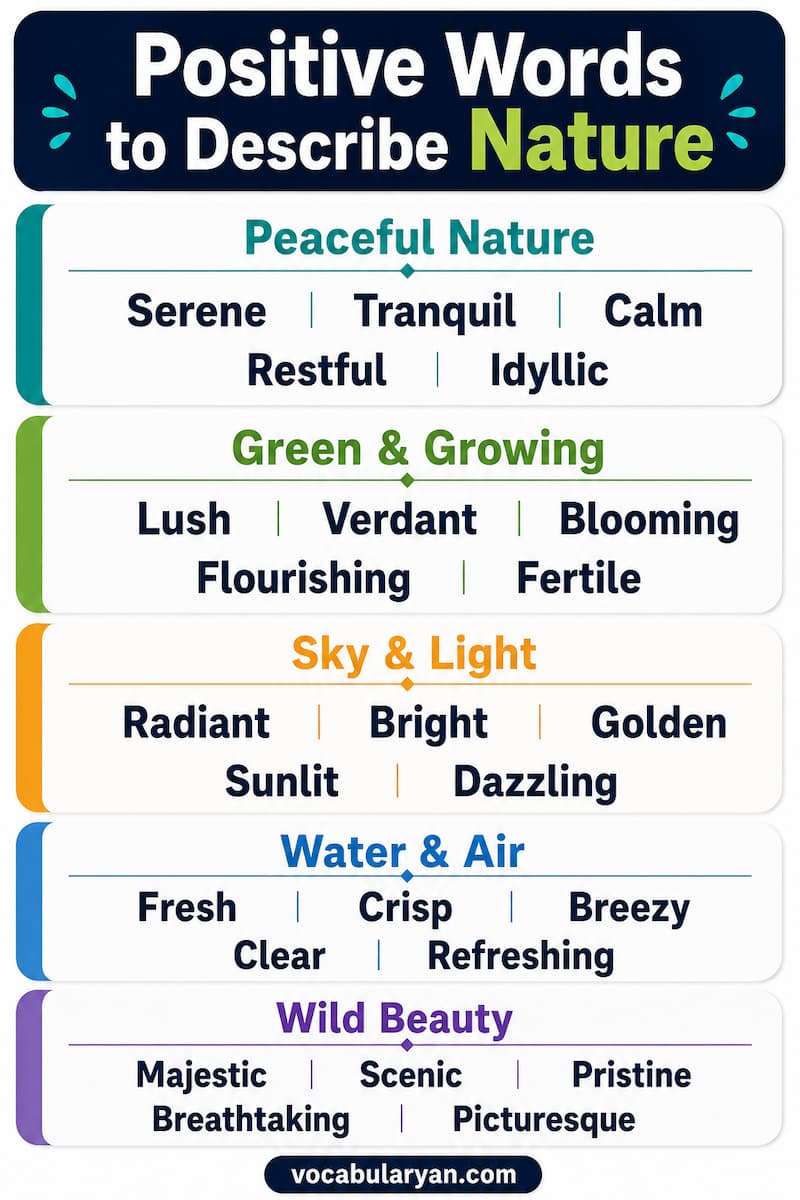
“Beautiful” does the job, but barely. Nature earns a richer vocabulary than one tired adjective, whether you’re writing a poem, a travel caption, a scene in a story, or an IELTS essay about the environment. The words below are grouped by what quality of nature they name, from visual beauty to living energy to grand scale, so you reach the right one for the moment. Each word carries a meaning and an example sentence to borrow. Name the exact quality, and your writing puts the reader outdoors.
Positive Words to Describe Nature at a Glance
Short on time? Grab a word for the quality you mean, then read the fuller groups below.
| If nature looks or feels… | Try these words |
|---|---|
| Beautiful | Breathtaking, scenic, picturesque, stunning |
| Full of life | Lush, verdant, teeming, flourishing |
| Calm and still | Tranquil, serene, hushed, placid |
| Grand and vast | Majestic, sublime, sweeping, towering |
| Fresh and alive | Crisp, dewy, fragrant, vibrant |
| Rare and poetic | Sylvan, bucolic, idyllic, ethereal |
Beautiful Words to Describe Nature
Beauty is the first quality most people reach for when nature stops them. These words name what the eye takes in.
- Breathtaking: so beautiful it stops you short.
- “The view from the ridge was breathtaking at dawn.”
- Scenic: full of beautiful natural views.
- “We followed the scenic path along the cliff edge.”
- Picturesque: charming and lovely as a painting.
- “The picturesque valley spread out like a watercolor below.”
- Stunning: strikingly, impressively beautiful.
- “The sunset over the lake was stunning.”
- Gorgeous: rich and deeply lovely to look at.
- “A gorgeous rainbow arched over the wet fields.”
- Dazzling: brilliantly bright and impressive.
- “The dazzling snow reflected every ray of morning light.”
- Radiant: glowing with warm, bright light.
- “The meadow was radiant in the late afternoon sun.”
- Splendid: grand and impressively beautiful.
- “The splendid autumn canopy blazed red and gold.”
- Captivating: holding your full attention.
- “The captivating play of light on the water kept her there for an hour.”
- Wondrous: filling you with wonder and delight.
- “The night sky was wondrous with a thousand stars.”
Words for Life and Growth in Nature
Nature is not just still and pretty. These words name the energy of living, growing, thriving things.
- Lush: richly green and full of healthy growth.
- “A lush fern canopy lined both sides of the trail.”
- Verdant: deep green and thick with vegetation.
- “The verdant hillsides glowed after weeks of rain.”
- Teeming: overflowing with life and activity.
- “The rock pool was teeming with tiny creatures.”
- Flourishing: growing strongly and healthily.
- “A flourishing forest stretched to the horizon.”
- Blooming: full of open, living flowers.
- “The blooming meadow filled the air with color.”
- Vibrant: bright, alive, and pulsing with energy.
- “The reef was vibrant with fish and coral.”
- Thriving: growing and alive in the best way.
- “A thriving ecosystem takes centuries to build.”
- Abundant: rich with more life than expected.
- “The estuary was abundant with birds every spring.”
- Fertile: producing rich growth and new life.
- “The fertile riverbank burst with wildflowers.”
- Alive: vivid and unmistakably full of living things.
- “The forest at dusk felt entirely alive.”
Calm and Still Words to Describe Nature
Some of nature’s best qualities are quiet ones. These words name the peace that comes with stillness.
- Tranquil: deeply calm and free of disturbance.
- “A tranquil pool reflected the whole sky.”
- Serene: clear, bright, and unclouded.
- “The serene lake held a perfect mirror of the peaks.”
- Hushed: gently and deeply quiet.
- “The hushed forest held its breath before the storm.”
- Placid: smooth, mild, and undisturbed.
- “A placid river ran between the willows.”
- Peaceful: calm in contrast to the busyness of the world.
- “The woodland path was peaceful in the early morning.”
- Still: unmoving and perfectly quiet.
- “The air was still and the birds were silent.”
- Soothing: gently calming to the senses.
- “The soothing sound of the stream followed them down the path.”
- Restful: easing tiredness and inviting calm.
- “An afternoon in the garden was restful after a long week.”
- Undisturbed: untouched and left in perfect peace.
- “The cove was undisturbed and impossible to find by road.”
- Mellow: warm, soft, and unhurried in feel.
- “The mellow afternoon light turned the fields amber.”
Grand and Vast Words to Describe Nature
Other moments in nature make you feel very small in the best way. These words name scale and power.
- Majestic: grand, dignified, and awe-inspiring.
- Sublime: beautiful in a way that overwhelms you.
- Sweeping: wide and extending far in every direction.
- Towering: rising high and dominating the landscape.
- Vast: enormous and stretching beyond sight.
- Immense: huge and beyond ordinary measure.
- Spectacular: dramatic and visually powerful.
- Awe-inspiring: filling you with wonder and reverence.
- Dominant: commanding the whole landscape with presence.
- Infinite: seeming to stretch without any end.
Fresh and Sensory Words to Describe Nature
Not all nature description is visual. These words name what you smell, feel, and breathe.
- Crisp: fresh, cool, and sharp on the skin.
- “Crisp mountain air cleared her head in an instant.”
- Dewy: covered in fresh morning moisture.
- “The dewy grass sparkled under the early light.”
- Fragrant: sweetly and naturally scented.
- “The fragrant pine forest smelled of resin and rain.”
- Fresh: clean, cool, and full of life.
- “The fresh sea breeze carried salt and possibility.”
- Invigorating: filling you with energy and life.
- “An invigorating walk through the frost woke him completely.”
- Balmy: warm, gentle, and pleasant in the air.
- “A balmy evening breeze rolled in off the water.”
- Brisk: pleasantly cool and energizing.
- “A brisk autumn morning made the colors look sharper.”
- Earthy: rich and grounded in the smell of soil and growth.
- “After the rain, the garden was warm and earthy.”
- Aromatic: naturally and strongly scented.
- “The aromatic herbs grew wild along the cliff path.”
- Pure: untouched and free of any pollution.
- “The pure air of the highlands stung the lungs in the best way.”
Rare and Poetic Words to Describe Nature
When the everyday words feel too worn, reach for these rarer ones. Each names a special quality that only nature delivers.
| Word | Meaning |
|---|---|
| Sylvan | Wooded, leafy, and full of trees |
| Bucolic | Pleasantly rural and pastoral |
| Ethereal | Delicate and otherworldly in beauty |
| Halcyon | Calm, peaceful, and golden |
| Verdure | The lush greenness of growing plants |
| Petrichor | The scent of earth after rain |
| Abloom | Covered in open, living flowers |
| Vernal | Fresh and full of early spring growth |
| Resplendent | Brilliantly bright and beautiful |
| Pristine | Pure, untouched, and perfectly unspoiled |
| Arcadian | Idyllically rural and peaceful |
| Luminous | Glowing with soft, beautiful light |
Nature Description Phrases for Writing and Captions
A full phrase often names what nature does better than a single word. Borrow any of these for a caption, essay, or story.
- “The kind of quiet that only exists far from any road.”
- “A landscape that makes the rest of the week feel very small.”
- “Where the sky meets the water and you can’t tell them apart.”
- “Old trees that remember more than any of us will.”
- “The light at that hour made everything look briefly perfect.”
- “A place untouched long enough to forget it was ever discovered.”
- “The world in its original state, before we got hold of it.”
- “Nature on a scale that puts everything else in perspective.”
A strong nature description names one true detail. Instead of “the forest was beautiful,” try “the forest floor was thick with ferns and the light came through in long, slow beams.” The specific image is what pulls a reader in.
How to Describe Nature Well: Show the Detail, Not the Label
The strongest nature writing names one quality and proves it with a detail you can picture. A concrete image beats a row of adjectives.
- ❌ “The mountains were majestic, stunning, and breathtaking.”. Three labels, no image.
- ✅ “The mountains were majestic. Their white peaks cut a jagged line against a blue that had no bottom.”. One word, one image, and the reader can see it.
Pick one word that names what the scene is, then prove it with the smallest true detail. Pair serene with the one sound that proved the silence. Pair teeming with the one creature you noticed first. That habit turns a flat description into one that brings the outdoors onto the page.
Positive Words to Describe Nature A to Z
One word and meaning for each letter, so you scan and choose at once.
| Letter | Word | Meaning |
|---|---|---|
| A | Abundant | Rich with more life than expected |
| B | Breathtaking | So beautiful it stops you short |
| C | Crisp | Fresh, cool, and sharp on the skin |
| D | Dewy | Covered in fresh morning moisture |
| E | Ethereal | Delicate and otherworldly in beauty |
| F | Flourishing | Growing strongly and healthily |
| G | Gorgeous | Rich and deeply lovely to look at |
| H | Halcyon | Calm, peaceful, and golden |
| I | Idyllic | Picture-perfect and peaceful |
| J | Jeweled | Bright and richly colored as a gem |
| K | Kaleidoscopic | Dazzlingly varied in color and pattern |
| L | Lush | Richly green and full of growth |
| M | Majestic | Grand, dignified, and awe-inspiring |
| N | Natural | Pure and shaped only by nature |
| O | Overgrown | Wildly full of untamed growth |
| P | Pristine | Pure, untouched, and unspoiled |
| Q | Quiet | Still and free of noise |
| R | Radiant | Glowing with warm, bright light |
| S | Serene | Bright, peaceful, and unclouded |
| T | Tranquil | Deeply calm and undisturbed |
| U | Unspoiled | Pure and free of human damage |
| V | Verdant | Deep green and thick with vegetation |
| W | Wondrous | Filling you with wonder and delight |
| X | (e)Xquisite | Finely and beautifully formed |
| Y | Youthful | Fresh, new, and full of spring energy |
| Z | Zenith | At the very peak of natural beauty |
FAQs
The best words name the exact quality you observe: breathtaking and stunning for visual beauty, lush and verdant for green growth, tranquil and serene for stillness, and majestic and sublime for grand scale. A precise word always paints a clearer picture than a flat “beautiful.”
Use breathtaking, picturesque, stunning, radiant, dazzling, and wondrous. These point to what the eye and heart take in at once. To make any of them land, tie the word to a real detail: “The breathtaking ridge turned orange and pink as the sun dropped.”
Try sylvan (wooded and leafy), petrichor (the scent of earth after rain), halcyon (calm and golden), ethereal (delicate and otherworldly), and vernal (fresh with early spring). These feel fresh when the common words start to repeat, and each one names something nature does that everyday language misses.
Use tranquil, serene, hushed, placid, undisturbed, and still. These name the quality of quiet that good natural places hold. Pair any of them with a sensory detail: “A tranquil cove where the only sound was water on stone.”
Name one quality, then prove it with a detail the reader can picture. Instead of “the forest was beautiful and peaceful,” try “the forest held a deep green quiet, and the only movement was a shaft of light shifting across the floor.” One quality, one image, and the reader is there.
Use scenic, pristine, flourishing, abundant, and breathtaking for formal writing. For a stronger essay, pair each word with a fact or statistic: “Pristine rainforests cover less than 10% of the earth’s surface today.” A strong vocabulary word anchored to a real fact scores well.