
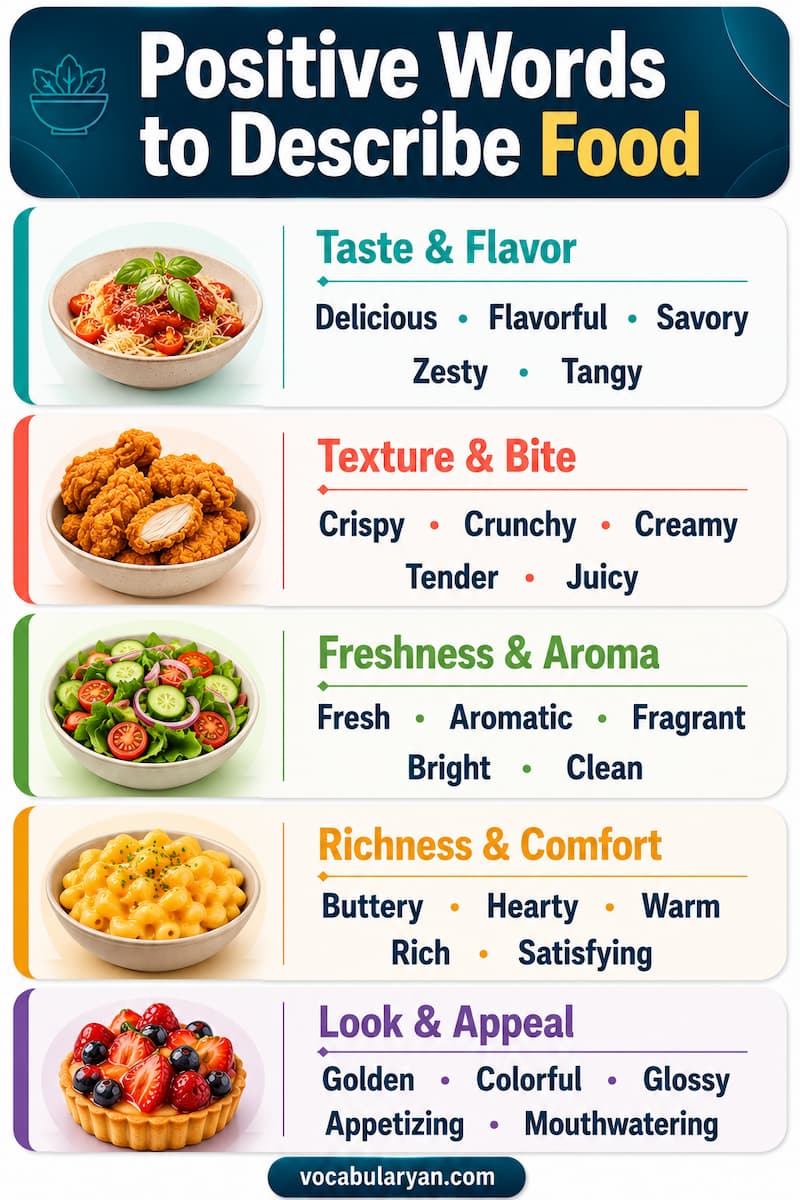
“Delicious” does the work, barely. It tells someone food tastes good, but it gives them nothing to picture, nothing to want, nothing to remember. The words below are grouped by which sense they name, how food looks, how it smells, how it tastes, how it feels in the mouth, and the warm feeling it leaves, so you reach the right one for a restaurant review, a recipe post, a menu, or a caption. Each word carries a meaning and an example sentence to borrow. Name the exact quality, and your reader can taste it before they arrive.
Positive Words to Describe Food at a Glance
Short on time? Grab a word for the sense you want to name, then read the fuller groups below.
| If the food is… | Try these words |
|---|---|
| Looks appealing | Golden, vibrant, glazed, appetizing |
| Smells wonderful | Aromatic, fragrant, smoky, heady |
| Tastes great | Savory, tangy, rich, zesty |
| Great texture | Crispy, tender, velvety, creamy |
| Warm and comforting | Hearty, wholesome, nourishing, satisfying |
| Impressive | Exquisite, decadent, succulent, luscious |
Words for How Food Looks
Food is eaten with the eyes first. These words name what makes a dish visually irresistible.
- Golden: beautifully cooked to a warm, amber shade.
- “The golden crust on the bread crackled as it came out of the oven.”
- Vibrant: bright, fresh, and full of natural color.
- “A vibrant salad of red, orange, and green filled the plate.”
- Glazed: shining with a smooth, polished coating.
- “The glazed salmon reflected the light like lacquer.”
- Appetizing: looking so good it makes you hungry.
- “The appetizing spread of mezze covered the whole table.”
- Rustic: homemade-looking, hearty, and unpretentious.
- “The rustic loaf sat thick and uneven on the board.”
- Luscious: rich and visually tempting.
- “A luscious chocolate tart glistened in the center of the plate.”
- Plentiful: generous and abundant on the plate.
- “The plentiful bowl of pasta left nothing to want.”
- Colorful: richly varied and bright with natural hues.
- “A colorful stir-fry brought the whole dish to life.”
- Inviting: warm and appealing to look at.
- “The inviting bowl of soup steamed gently on the table.”
- Garnished: finished with a careful, beautiful touch.
- “The garnished dish arrived with fresh herbs and a curl of zest.”
Words for How Food Smells
The right aroma word pulls a reader in before the first bite. These describe what rises from a dish.
- Aromatic: full of pleasant, complex fragrance.
- “The aromatic curry filled the whole kitchen.”
- Fragrant: sweetly and naturally scented.
- “Fragrant jasmine rice steamed beside the main.”
- Smoky: carrying the deep, rich scent of wood smoke.
- “The smoky aroma of the grilled ribs drifted from the kitchen.”
- Heady: rich and powerfully scented.
- “A heady mix of garlic and herbs hit them at the door.”
- Fresh: clean, light, and naturally scented.
- “The fresh scent of lemon lifted the whole dish.”
- Earthy: deep and grounded, like warm soil and mushrooms.
- “The earthy aroma of black truffle filled the room.”
- Spiced: warmly scented with layers of spice.
- “The spiced lamb sent a trail of cinnamon through the air.”
- Toasty: warm and nutty like freshly baked bread.
- “A toasty smell drifted from the oven all morning.”
- Sweet-scented: carrying a soft, pleasant sweetness.
- “The sweet-scented vanilla cream chilled on the counter.”
- Caramelized: sweetly rich with the scent of browned sugar.
- “A caramelized aroma drifted from the onions in the pan.”
Words for How Food Tastes
Taste is what food writers reach for most. These words go beyond “good” and name the exact flavor.
- Savory: rich and satisfying, not sweet.
- “The savory broth warmed her from the inside out.”
- Tangy: sharp and bright, with a lively bite.
- “A tangy yogurt dressing cut through the richness.”
- Rich: deep, full, and satisfying in flavor.
- “The rich chocolate mousse needed only a spoonful.”
- Zesty: fresh and lively, with a citrus kick.
- “A zesty lemon glaze brought the cake to life.”
- Umami: deeply savory, satisfying at a base level.
- “The miso added an umami depth no other ingredient could.”
- Bright: fresh, vivid, and acidic in a good way.
- “A bright squeeze of lime pulled the dish together.”
- Buttery: smooth, mellow, and rich like butter.
- “The buttery sauce coated every strand of pasta.”
- Mellow: gently flavored and pleasantly mild.
- “Slow cooking gave the onions a mellow sweetness.”
- Robust: full-bodied and bold in flavor.
- “A robust red wine reduction deepened the stew.”
- Complex: layered, with more than one flavor working together.
- “The complex spice blend rewarded every bite.”
Words for How Food Feels (Texture)
Mouthfeel matters as much as taste. These words name what happens when you bite.
- Crispy: light and firm with a satisfying crunch.
- “The crispy skin shattered at the first touch of the fork.”
- Tender: soft and yielding, with no resistance.
- “The tender lamb fell from the bone without effort.”
- Velvety: deeply smooth and luxuriously soft.
- “A velvety bisque coated the spoon without dripping.”
- Creamy: rich, smooth, and dairy-soft.
- “Creamy mashed potato soaked up the gravy beautifully.”
- Fluffy: light, airy, and gently soft.
- “Fluffy rice grains stayed separate on the plate.”
- Silky: smooth and fine with no roughness at all.
- “The silky custard slipped easily off the spoon.”
- Crunchy: firm and audibly crisp with every bite.
- “Crunchy roasted nuts finished the salad perfectly.”
- Juicy: full of natural liquid that releases as you eat.
- “A juicy peach ran down her wrist at the first bite.”
- Flaky: breaking into light, thin layers.
- “The flaky pastry shattered in all the right ways.”
- Chewy: pleasantly firm and springy under the teeth.
- “Chewy sourdough had a crust that pulled and tore.”
Words for Comfort and Warmth in Food
Some food does more than feed. These words name the feeling a dish leaves behind.
- Hearty: filling, warming, and deeply satisfying.
- Wholesome: natural, nourishing, and good for you.
- Nourishing: feeding the body with real goodness.
- Satisfying: leaving you full and content.
- Comforting: warm and reassuring like a home-cooked meal.
- Homely: simple, generous, and full of care.
- Warming: gently heating from the inside.
- Indulgent: a little more than you needed, in the best way.
- Soul-warming: reaching past the stomach to the mood.
- Generous: large, giving, and full of goodness.
Impressive and High-Praise Food Words
When a dish surpasses all expectation, these words carry the weight of it.
- Exquisite: beautiful and perfectly crafted in every detail.
- Decadent: richly indulgent beyond everyday measure.
- Succulent: so moist and full of juice it shines.
- Mouthwatering: making you hungry before it even arrives.
- Sublime: beautiful in a way that goes beyond taste.
- Heavenly: so good it feels almost unreal.
- Superb: outstanding in every sense.
- Divine: exceptional enough to stop conversation.
- Spectacular: dramatic in flavor or presentation.
- Transcendent: so fine it stays with you long after the meal.
Food Writing Phrases for Reviews and Menus
A full phrase captures what a single word leaves to guesswork. Borrow any of these for a review, menu, or caption.
- “The kind of dish that makes a table go quiet.”
- “Every bite tasted like something remembered from childhood.”
- “Rich enough to satisfy but balanced enough to want more.”
- “The crispy exterior gives way to a tender, juicy center.”
- “Flavors that build slowly and finish long after the last bite.”
- “Deceptively simple on the plate, extraordinary in the mouth.”
- “The sort of thing you think about on the drive home.”
- “Fresh ingredients that taste exactly like what they are.”
A strong food description names one quality and proves it with a specific sensation. Instead of “the steak was delicious,” try “the steak had a charred crust that cracked open to reveal a blush-pink, buttery center.” That single image does more than a dozen adjectives.
How to Describe Food Well: Name the Sense, Not the Score
The sharpest food writing names what a sense experiences, not a rating.
- ❌ “The pasta was delicious. The sauce was amazing. The dessert was incredible.”. Three ratings, no food.
- ✅ “The pasta was silky, the sauce rich with slow-cooked tomato and basil, and the dessert arrived cold and dark, a velvety chocolate tart dusted with sea salt.”. Three senses, three images.
Pick one sense for each element and prove it with the smallest true detail. Pair crispy with the sound it made. Pair rich with the ingredient behind it. Pair bright with the thing that lifted it. That habit turns a food review into something a reader wants to follow.
Positive Words to Describe Food A to Z
One word and meaning for each letter, so you scan and choose at once.
| Letter | Word | Meaning |
|---|---|---|
| A | Aromatic | Full of pleasant, complex fragrance |
| B | Buttery | Smooth, mellow, and rich |
| C | Crispy | Light and firm with a satisfying crunch |
| D | Decadent | Richly indulgent beyond everyday measure |
| E | Exquisite | Beautiful and perfectly crafted |
| F | Flaky | Breaking into light, thin layers |
| G | Golden | Beautifully cooked to a warm amber shade |
| H | Hearty | Filling, warming, and satisfying |
| I | Inviting | Warm and appealing to look at |
| J | Juicy | Full of natural liquid that releases as you eat |
| K | Knockout | Impressively outstanding in flavor |
| L | Luscious | Rich and deeply tempting |
| M | Mouthwatering | Making you hungry before it arrives |
| N | Nourishing | Feeding the body with real goodness |
| O | Opulent | Richly and luxuriously presented |
| P | Plentiful | Generous and abundant on the plate |
| Q | Quintessential | The perfect, truest version of its kind |
| R | Rich | Deep, full, and satisfying in flavor |
| S | Savory | Rich and satisfying, not sweet |
| T | Tender | Soft and yielding with no resistance |
| U | Umami | Deeply savory and satisfying at the base |
| V | Velvety | Deeply smooth and luxuriously soft |
| W | Wholesome | Natural, nourishing, and good for you |
| X | (e)Xquisite | Exceptionally fine in taste and form |
| Y | Zesty | Fresh and lively with a citrus kick |
| Z | Zingy | Bright, sharp, and lively in flavor |
FAQs
The best words name a specific sense rather than a vague rating. For taste, use savory, tangy, rich, and zesty. For texture, use crispy, tender, velvety, and juicy. For aroma, use aromatic, smoky, and fragrant. A precise word always beats a flat “delicious” because it gives the reader something to picture.
For impressive flavor, try savory, luscious, exquisite, or mouthwatering. For warmth and comfort, try hearty, wholesome, or soul-warming. For rare occasions, sublime, transcendent, and divine carry the most weight. Each names what “delicious” leaves blank.
Use crispy, tender, velvety, creamy, fluffy, silky, crunchy, juicy, flaky, and chewy. Each names a specific mouthfeel. The difference between crispy and crunchy, for instance, is force: crispy breaks lightly, crunchy breaks audibly and with resistance.
Name one quality per element and prove it with a real detail. Instead of “the chicken was great,” try “the chicken had a crispy, spiced skin and a juicy interior that ran with good stock.” One word, one image, and the review becomes worth reading.
Use aromatic, fragrant, smoky, heady, earthy, toasty, spiced, and buttery. Aroma words are among the most powerful in food writing because smell is the sense most directly tied to memory. A single well-chosen aroma word can bring a whole dish back to the reader’s mind.
Use hearty, wholesome, nourishing, comforting, warming, homely, and soul-warming. These name the feeling a dish leaves behind, which is what comfort food is really about. The best comfort food word names both the texture and the emotion: a hearty broth is warm in the bowl and in the chest.