
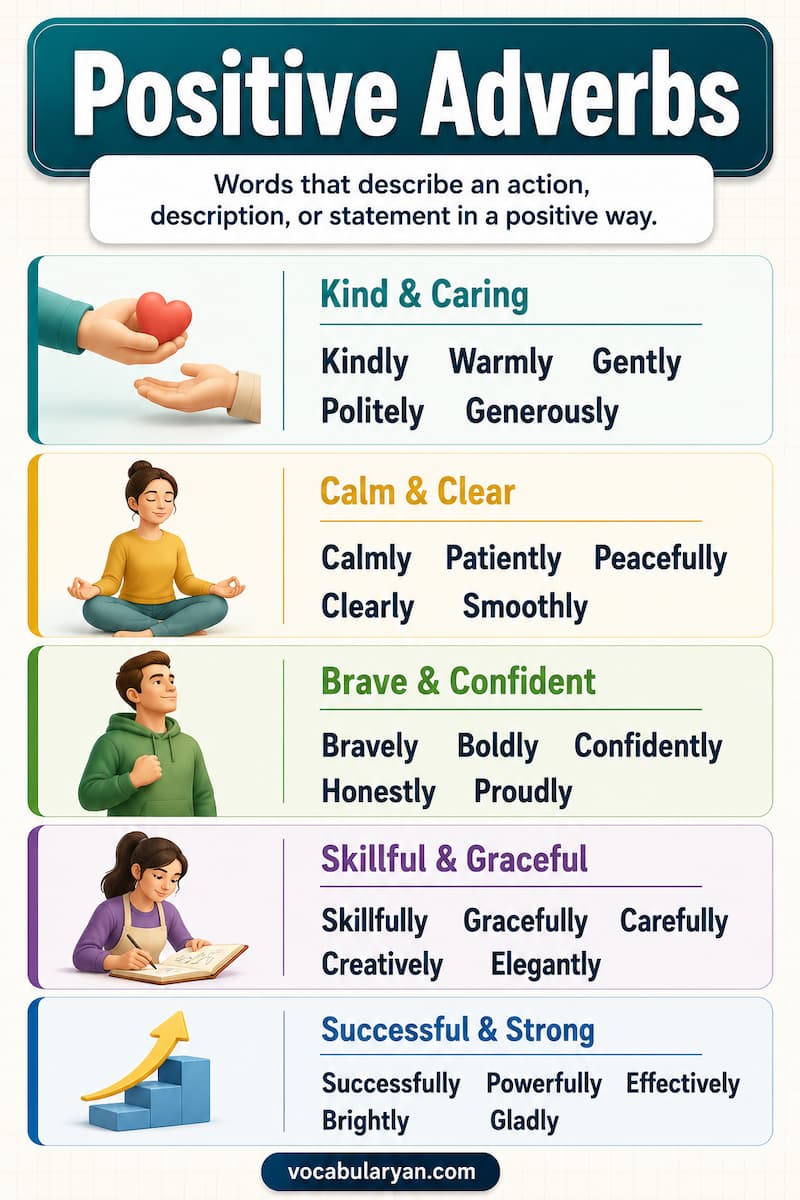
A positive adverb tells you how an action is done in a good way. Read these two: She spoke. Now: She spoke warmly. The second one shows kindness, and only one word changed. Positive adverbs are the words that describe a verb, an adjective, or another adverb with a warm, kind, or admiring meaning. You use them in thank-you notes, in compliments, in stories, at work, and in everyday talk. The lists ahead group them by type, by manner, emotion, degree, frequency, and attitude, and every word comes with a meaning and an example. A full A-to-Z table closes the page.
What Are Positive Adverbs?
An adverb is a word that describes a verb, an adjective, or another adverb. It tells you how, when, how often, or how much something happens. A positive adverb does the same job with a good meaning: it shows warmth, skill, kindness, or admiration. Compare these two. Quickly only tells you the speed. Gracefully tells you the action looked good. That extra warmth is what makes an adverb positive.
Most positive adverbs come from a positive adjective plus -ly: kind becomes kindly, cheerful becomes cheerfully, brilliant becomes brilliantly. A few common ones, like always and well, do not take -ly, so you learn those one by one. Both kinds matter, and the best writers pick the exact adverb, not the first one that comes to mind.
Why Positive Adverbs Strengthen Writing
One positive adverb changes how a whole sentence feels. Watch the same action three ways:
- She answered. ❌ Flat. You learn nothing about her.
- She answered patiently. ✅ Now you see her character.
- She answered graciously. ✅ Warmth, plus calm and good manners.
The verb stays the same each time. The adverb adds the feeling. Which version sounds warmest to you? That is the work a positive adverb does: it gives the reader the emotion the verb leaves out, in one word. This is why these adverbs matter so much in a thank-you note, a job reference, a wedding speech, or a story.
Common Positive Adverbs List
A core set covers most everyday needs across writing, speech, and conversation.
- Gladly: in a willing, happy way.
- Cheerily: in a bright, lighthearted way.
- Boldly: with confidence and courage.
- Smoothly: in an easy, effortless way.
- Brightly: in a vivid, cheerful way.
- Readily: willingly and without hesitation.
- Surely: with certainty and confidence.
- Steadily: in a firm, even way.
- Keenly: with sharp eagerness or interest.
- Fondly: with tender affection.
- Openly: in a frank, honest way.
- Freely: without restriction or reluctance.
- Helpfully: in a way that gives useful support.
- Nobly: in a way showing fine character.
- Devotedly: with loyal dedication.
Positive Adverbs Of Manner (How Something Is Done)
Adverbs of manner are the biggest group. They tell you the way someone does an action. Notice how each one adds warmth or skill to a plain verb.
- Kindly: in a warm, considerate way.
- She kindly offered her seat to the elderly passenger.
- Gently: in a soft, careful way.
- He gently lifted the sleeping child from the car.
- Gracefully: with smooth, elegant movement.
- The dancer moved gracefully across the stage.
- Generously: in a giving, openhanded way.
- They generously donated their weekend to the project.
- Politely: with good manners.
- She politely declined the second helping.
- Patiently: with calm endurance.
- He patiently explained the rules a third time.
- Carefully: with close attention and caution.
- She carefully wrapped each gift by hand.
- Honestly: in a truthful, open way.
- He answered every question honestly.
- Bravely: with courage in the face of fear.
- The volunteers bravely entered the smoke-filled building.
- Diligently: with steady, careful effort.
- She worked diligently until every detail was right.
- Skillfully: with great ability.
- He skillfully repaired the antique clock.
- Tenderly: with gentle affection.
- She tenderly cared for the injured bird.
- Courteously: with polite respect.
- The staff treated every guest courteously.
- Humbly: with modesty and without arrogance.
- He humbly accepted the praise.
- Faithfully: with loyalty and reliability.
- She faithfully kept every promise she made.
- Compassionately: with deep care for others.
- The nurse spoke compassionately to the frightened patient.
- Elegantly: with refined grace.
- The room was elegantly arranged for the evening.
- Warmly: in a friendly, affectionate way.
- She warmly welcomed the new neighbors.
Positive Adverbs For Emotions And Feelings
These adverbs show the good feeling a person has while they act. They tell you the mood behind the action.
- Happily: in a joyful, contented way.
- The children played happily in the garden.
- Joyfully: with great happiness.
- They joyfully announced the good news.
- Cheerfully: in a bright, good-humored way.
- He cheerfully took on the extra work.
- Merrily: in a lively, festive way.
- They sang merrily around the fire.
- Blissfully: in a state of perfect happiness.
- The couple sat blissfully watching the sunset.
- Gleefully: with delighted excitement.
- She gleefully opened every present.
- Enthusiastically: with intense, eager interest.
- The team enthusiastically welcomed the new plan.
- Excitedly: with lively anticipation.
- He excitedly shared the results.
- Hopefully: with expectation of good things.
- She looked hopefully toward the future.
- Lovingly: with deep affection.
- He lovingly restored his grandfather’s workshop.
- Gratefully: with thankfulness.
- They gratefully accepted the help.
- Contentedly: in a satisfied, peaceful way.
- The cat slept contentedly by the fire.
- Delightedly: with great pleasure.
- She delightedly discovered the surprise.
- Heartily: with genuine, full warmth.
- He heartily agreed with the proposal.
- Passionately: with intense, deep feeling.
- She passionately defended the cause.
Positive Adverbs Of Degree And Intensity
These adverbs tell you how good or how strong something is. They make a positive quality bigger.
| Adverb | Meaning |
|---|---|
| Wonderfully | In a way that inspires delight |
| Remarkably | To a striking, impressive degree |
| Brilliantly | With outstanding skill or brightness |
| Beautifully | In a lovely, pleasing way |
| Perfectly | In a flawless way |
| Splendidly | In a magnificent, excellent way |
| Exceptionally | To an unusually high degree |
| Superbly | With outstanding quality |
| Marvelously | In an extraordinary, wonderful way |
| Impressively | In a way that earns admiration |
| Magnificently | With grand excellence |
| Extraordinarily | To a remarkable degree |
| Outstandingly | In a way that stands above the rest |
Positive Adverbs Of Frequency
Adverbs of frequency tell you how often something happens. These ones show that a good thing happens again and again, which builds trust.
- Always: at all times, without exception.
- Consistently: in a steady, dependable way.
- Reliably: in a way that can be counted on.
- Regularly: at steady, repeated intervals.
- Predictably: in a dependable, expected way.
- Dependably: in a trustworthy, steady way.
- Frequently: happening often.
- Habitually: as a settled, positive routine.
- Perpetually: continuing without interruption.
- Unfailingly: without ever falling short.
- Routinely: as a regular, dependable practice.
- Continually: again and again over time.
Positive Adverbs For Attitude And Evaluation
These are called comment adverbs. They give a good opinion about the whole sentence, not just one action. They often come first.
- Fortunately: by good luck; happily for those involved.
- Fortunately, everyone arrived home safely.
- Luckily: by good fortune.
- Luckily, the repairs cost far less than feared.
- Thankfully: with relief and gratitude.
- Thankfully, the rain held off for the ceremony.
- Promisingly: in a way that suggests a good result.
- The trial began promisingly, with strong early signs.
- Admirably: in a way that deserves admiration.
- She handled the crisis admirably.
- Rightly: correctly and justly.
- He was rightly praised for his honesty.
- Wisely: showing good judgment.
- Wisely, they saved part of the windfall.
- Mercifully: in a way that brings welcome relief.
- Mercifully, the long delay finally ended.
- Refreshingly: in a pleasantly new, welcome way.
- She was refreshingly direct in the meeting.
- Encouragingly: in a way that gives hope.
- Encouragingly, the early results were strong.
- Notably: in a way worth special attention.
- The team performed notably well under pressure.
- Commendably: in a way deserving praise.
- He acted commendably throughout the difficult year.
Positive Adverbs For Encouragement And Praise
Use these when you want to lift someone up. They show warmth and support straight away.
- Supportively: in a way that gives strength and backing.
- Affirmingly: in a way that confirms someone’s worth.
- Approvingly: with clear approval.
- Wholeheartedly: with complete sincerity and commitment.
- Genuinely: in a real, heartfelt way.
- Earnestly: with sincere seriousness.
- Graciously: with warmth and courtesy.
- Respectfully: with regard for someone’s worth.
- Sincerely: in a genuine, heartfelt way.
- Hearteningly: in a way that gives renewed courage.
- Wholesomely: in a healthy, good-natured way.
Positive Adverbs In Professional And Everyday Use
At work and in daily talk, a few positive adverbs make your message warmer without sounding fake. Place one well and you sound both kind and clear.
In emails and reviews, words like constructively, collaboratively, proactively, and professionally name good work in a precise way. In conversation, gladly, happily, and certainly turn a plain yes into a warm one. Compare I’ll help with I’ll gladly help, the second sounds friendlier. In feedback, consistently, reliably, and noticeably make your praise specific: she consistently meets deadlines says more than she is good at deadlines. Notice the pattern in all three. The adverb gives the warmth or the detail the verb alone leaves out.
Positive Adverbs A To Z (Quick Reference With Meanings)
Every competitor offers an A-to-Z list; this one defines a representative adverb for each letter, so the reference teaches rather than just lists.
| Letter | Positive adverb | Meaning |
|---|---|---|
| A | Admirably | In a way deserving respect |
| B | Bravely | With courage |
| C | Cheerfully | In a bright, good-humored way |
| D | Diligently | With steady, careful effort |
| E | Eagerly | With keen enthusiasm |
| F | Faithfully | With loyalty and reliability |
| G | Gracefully | With smooth elegance |
| H | Happily | In a joyful way |
| I | Impressively | In a way that earns admiration |
| J | Joyfully | With great happiness |
| K | Kindly | In a warm, considerate way |
| L | Lovingly | With deep affection |
| M | Merrily | In a lively, festive way |
| N | Nobly | In a way showing greatness of character |
| O | Optimistically | With a hopeful outlook |
| P | Patiently | With calm endurance |
| Q | Quietly (calmly) | In a peaceful, gentle way |
| R | Reliably | In a way that can be counted on |
| S | Sincerely | In a genuine, heartfelt way |
| T | Thoughtfully | With care and consideration |
| U | Unfailingly | Without ever falling short |
| V | Valiantly | With great courage |
| W | Warmly | In a friendly, affectionate way |
| X | (e)Xceptionally | To an unusually high degree |
| Y | Yearningly (fondly) | With heartfelt longing |
| Z | Zealously | With great energy and devotion |
How To Use Positive Adverbs Without Overusing Them
Positive adverbs are strong, so a little goes a long way. Watch out for stacking. She spoke warmly, kindly, gently, and graciously uses four adverbs and the reader feels none of them. Rule one: pick one adverb, the best one, and stop.
Rule two: choose a strong verb when one exists. She walked gracefully is fine, but she glided is sharper, because glided already means moving with grace. Keep the adverb for times when the verb cannot show the feeling on its own. He agreed reluctantly needs the adverb, because agreed alone hides that he did not want to.
Rule three: watch the position. A comment adverb comes first and sets the mood for the sentence: Fortunately, the plan worked. A manner adverb goes next to the verb it describes: she answered patiently. Use positive adverbs this way and they do the one thing no other word can: they tell the reader what happened and how to feel about it. Pick one with care today and your next sentence will sound warmer at once.
FAQs
Positive adverbs are words that describe how an action is done in a good, kind, or admiring way, such as warmly, gracefully, eagerly, and brilliantly. They describe a verb, an adjective, or another adverb, and they add the good feeling that the verb alone leaves out.
Common examples by type are kindly and gracefully for manner, happily and joyfully for emotion, wonderfully and brilliantly for degree, and reliably and consistently for frequency. Each describes an action with a favorable charge rather than simply reporting it.
Most positive adverbs are formed by adding -ly to a positive adjective: kind becomes kindly, cheerful becomes cheerfully, and brilliant becomes brilliantly. Some common adverbs, especially those of frequency and degree such as always and well, do not follow the -ly pattern and must be learned individually.
An adverb of manner describes how one action is done, and it goes next to the verb: she answered patiently. A comment adverb gives an opinion about the whole sentence, and it often comes first: fortunately, everyone was safe. The first describes the verb; the second describes the whole idea.
Use one precise adverb rather than several competing ones, since stacking them dilutes their effect. Prefer a strong verb when one exists, since glided already contains the grace that walked gracefully spells out. Reserve adverbs for moments where they add something the verb genuinely cannot, which keeps them powerful rather than cluttering.