
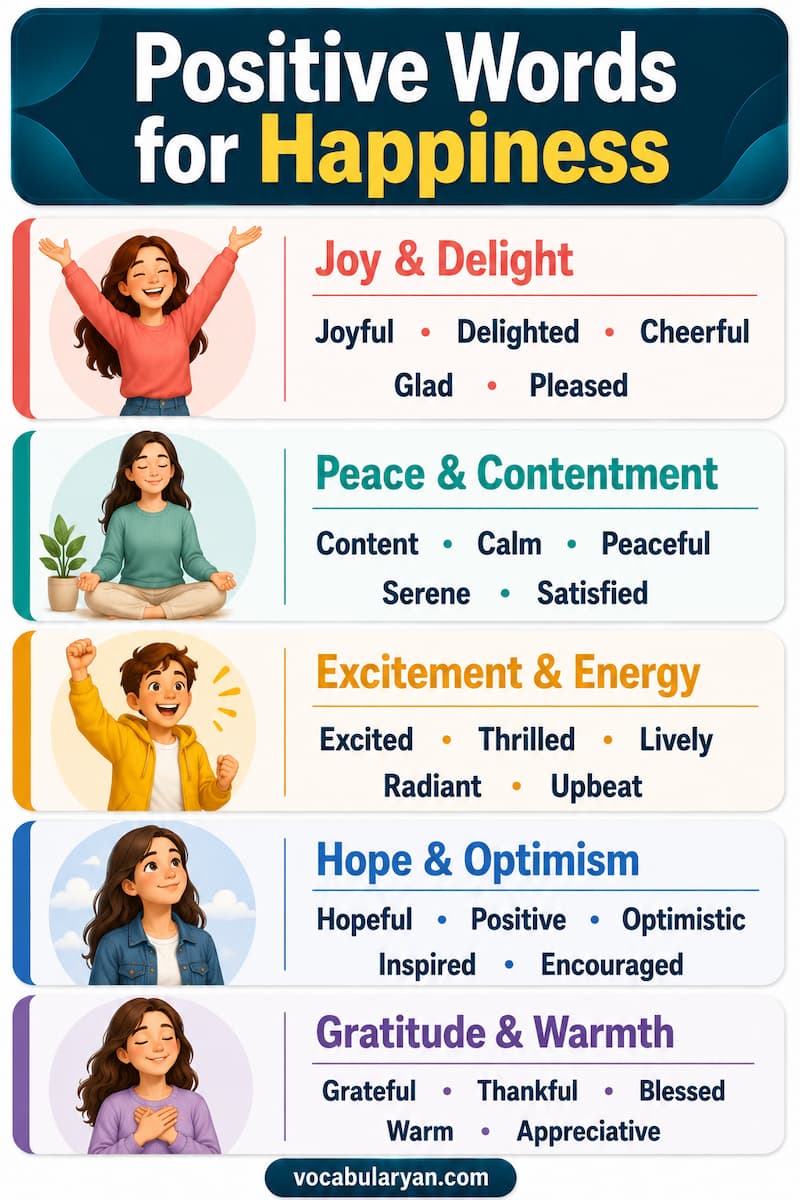
“Happy” is a small word for a big feeling. The quiet contentment of a slow morning is not the same as the wild joy of good news, and the right word names exactly which one you mean. The words below are grouped by the kind of happiness they describe, from calm and steady to bright and bursting, so you can pick the perfect one for a story, a journal, a caption, or a card. Each word comes with a meaning and an example you can borrow. Choose by the shade you feel, and your writing will say more than “happy” ever could.
Positive Words for Happiness at a Glance
Short on time? Grab a word for the kind of happiness you mean, then read the fuller groups below.
| The kind of happiness… | Try these words |
|---|---|
| Calm and quiet | Content, serene, peaceful, at ease |
| Everyday and bright | Cheerful, merry, chipper, glad |
| Strong and intense | Elated, ecstatic, overjoyed, thrilled |
| Shared and loud | Jubilant, gleeful, festive, exuberant |
| Deep and lasting | Fulfilled, blissful, grateful, flourishing |
| Light and carefree | Lighthearted, breezy, buoyant, sunny |
Words for Calm, Quiet Happiness (Contentment)
This is the gentle, settled kind of happiness, no fireworks, just a quiet sense that all is well. These words name calm joy.
- Content: quietly satisfied with how things are.
- “She felt content as she watched the rain from the window.”
- Serene: calm, peaceful, and untroubled.
- “A serene smile crossed his face by the still lake.”
- Peaceful: free of worry and at rest.
- “The evening left her feeling peaceful and whole.”
- At ease: relaxed and comfortable in the moment.
- “He felt completely at ease among old friends.”
- Tranquil: deeply calm and steady.
- “The garden filled her with a tranquil kind of joy.”
- Satisfied: pleased that enough has been done.
- “She felt satisfied after a long, good day’s work.”
- Comfortable: warm, settled, and unworried.
- “There’s a comfortable happiness in a quiet Sunday.”
- Grounded: calm and steady in oneself.
- “He felt grounded and glad, sure of where he stood.”
- Mellow: gently relaxed and pleasant.
- “The music left the whole room mellow and warm.”
- Settled: calm and free of restlessness.
- “After the move, she finally felt settled and happy.”
Words for Everyday Cheerfulness
This is the bright, visible happiness you can see in a person, the smile, the spring in the step. These words name everyday cheer.
- Cheerful: visibly happy and bright.
- “She gave a cheerful wave from across the street.”
- Merry: full of good humor and fun.
- “The whole room was merry well into the night.”
- Glad: simply and warmly happy.
- “I’m so glad you came today.”
- Chipper: lively, cheerful, and upbeat.
- “He was chipper all morning after the good news.”
- Sunny: warm and bright in mood.
- “She has a sunny way that lifts everyone around her.”
- Bright: full of light, energy, and good spirits.
- “His bright mood made the dull day better.”
- Jolly: cheerful and full of warmth.
- “The jolly old man laughed at every joke.”
- Upbeat: positive and full of good energy.
- “She stayed upbeat even when plans changed.”
- Beaming: smiling widely with happiness.
- “He came home beaming after the interview.”
- Chirpy: lively, happy, and talkative.
- “She was chirpy and full of news this morning.”
Words for Intense Joy And Elation
This is happiness at full strength, the kind that takes over. These words name strong, soaring joy.
- Elated: thrilled and lifted high with joy.
- “She was elated when she got the call.”
- Ecstatic: overwhelmed with intense happiness.
- “The fans were ecstatic at the final whistle.”
- Overjoyed: filled with more joy than words allow.
- “They were overjoyed to be reunited at last.”
- Thrilled: buzzing with excitement and delight.
- “He was thrilled to open the door and see them.”
- Euphoric: swept up in pure, intense bliss.
- “She felt euphoric crossing the finish line.”
- Exhilarated: charged with energy and joy.
- “The ride left them breathless and exhilarated.”
- Delighted: warmly and brightly pleased.
- “I’m delighted you could make it.”
- Rapturous: lost in overwhelming joy.
- “The crowd gave a rapturous cheer.”
- Jubilant: triumphant and full of joy.
- “The team was jubilant after the win.”
- Giddy: dizzy and light with excitement.
- “She felt giddy with happiness all evening.”
Words for Shared And Celebratory Joy
This is the happiness of a crowd, a party, a celebration, joy that’s bigger because it’s shared. These words name festive joy.
- Gleeful: full of bright, bubbling delight.
- Festive: joyful in a celebratory way.
- Exuberant: overflowing with energy and joy.
- Merrymaking: joining in happy celebration.
- Lively: full of energy and shared fun.
- Boisterous: loud, happy, and full of life.
- Triumphant: glowing with the joy of a win.
- Animated: bright, busy, and full of spirit.
- Buoyant: light and bouncing with cheer.
- Spirited: full of lively, happy energy.
Words for Deep Fulfillment And Bliss
This is the lasting kind of happiness that comes from meaning, not just a good moment. These words name deep joy.
- Fulfilled: deeply satisfied with a meaningful life.
- “She felt fulfilled in work that helped others.”
- Blissful: in a state of perfect, complete joy.
- “They spent a blissful week by the sea.”
- Grateful: warmly thankful for what one has.
- “He felt grateful for the small, good things.”
- Flourishing: thriving and full of life.
- “She’s flourishing in her new chapter.”
- Joyful: full of deep and lasting joy.
- “There’s a joyful steadiness to how she lives.”
- Radiant: glowing from happiness within.
- “She looked radiant on her wedding day.”
- Wholehearted: happy with the whole of oneself.
- “He threw himself wholeheartedly into the day.”
- Thankful: glad and appreciative deep down.
- “She felt thankful for every ordinary blessing.”
- Heartwarmed: gently moved by something good.
- “The reunion left them all heartwarmed.”
- Blessed: deeply fortunate and glad.
- “He felt blessed to have them all together.”
Happy Adjectives vs Happiness Nouns
It helps to know whether you need a word that describes a person (an adjective) or names the feeling itself (a noun). Use an adjective to describe someone, and a noun to name the feeling.
| Adjective (describes a person) | Noun (names the feeling) |
|---|---|
| Happy | Happiness |
| Joyful | Joy |
| Blissful | Bliss |
| Content | Contentment |
| Cheerful | Cheer |
| Elated | Elation |
| Gleeful | Glee |
| Merry | Merriment |
| Serene | Serenity |
| Jubilant | Jubilation |
Notice the pattern: She is joyful describes the person, while Her joy was clear names the feeling. Both are useful, just for different jobs in a sentence.
The Happiness Intensity Scale (From Pleased to Euphoric)
Happiness words have strength, and matching the strength to the moment is what makes writing ring true. Here’s the same feeling, from gentle to overwhelming:
- Pleased: mildly happy about something. “I’m pleased with the result.”
- Glad: warmly happy. “I’m glad it worked out.”
- Cheerful: visibly, brightly happy. “She’s cheerful today.”
- Happy: the steady middle of the scale. “I feel happy here.”
- Joyful: full of deep happiness. “It was a joyful morning.”
- Elated: lifted high with joy. “He was elated by the news.”
- Ecstatic: overwhelmed with happiness. “They were ecstatic.”
- Euphoric: the very top, pure intense bliss. “She felt euphoric.”
Save the strongest words for the strongest moments. If everything is “ecstatic,” nothing is.
Happiness Idioms And Phrases
Sometimes a phrase captures happiness better than a single word. These idioms all mean very happy.
- On cloud nine: completely, blissfully happy.
- Over the moon: thrilled and delighted.
- In seventh heaven: in a state of perfect joy.
- On top of the world: elated and unstoppable.
- Walking on air: light and floating with happiness.
- Tickled pink: delighted and amused.
- Grinning from ear to ear: smiling with pure joy.
- Jumping for joy: too happy to stay still.
- Bursting with happiness: too full of joy to contain it.
- Happy as can be: as content as a person could wish.
Words to Describe Your Own Happiness (for Journaling And Captions)
When you’re writing about your own joy, in a journal, a gratitude list, or a caption, the right word makes the feeling real. Borrow any of these openers.
- “Today I felt content, the quiet kind that needs nothing more.”
- “I’m grateful beyond words for this ordinary, perfect day.”
- “Pure joy. The kind that catches you off guard.”
- “Found my calm. Found my happy.”
- “Over the moon doesn’t even cover it.”
- “Soaking up every bit of this. So blessed.”
- “Heart full. Cup overflowing.”
- “This is what flourishing feels like.”
A good line names the exact shade. Instead of “so happy,” try “so content I could stay here forever.” The precise word is what makes the feeling land.
Joy vs Happiness: What’s the Difference?
People use these two words for each other, but they carry a subtle difference worth knowing. Happiness often comes from outside, a good result, a sunny day, a kind surprise, and tends to come and go with circumstances. Joy runs deeper. It’s a steadier, inner state that can stay even when life is hard.
You can feel happy about a single good moment, and you can feel joy through a whole difficult season. That’s why people speak of finding joy in small things even on a bad day. When you write, reach for happiness for a passing bright mood, and joy for something deeper and more lasting.
How to Pick the Right Word for Happiness
The best word matches the exact strength and shade of the feeling. A precise word paints a picture that “happy” leaves blank.
- ❌ “She was happy. The party was happy. It was a happy day.” — One word, doing too much work.
- ✅ “She was content before the party, giddy during it, and grateful by the end.” — Three shades, one real day.
See the difference. The first repeats a flat word; the second names how the feeling changed and grew. Ask two quick questions: How strong is it, calm or overwhelming? And where does it come from, a passing moment or something deep? Then pick the word that fits both. Try it now: think of a happy moment, and name its exact shade instead of just “happy.” That habit turns plain writing into writing that feels true.
Positive Words for Happiness A to Z
Most lists give A to Z with no meanings. This one gives a clear word and a meaning for each letter, so you can scan and choose at once.
| Letter | Word | Meaning |
|---|---|---|
| A | At ease | Relaxed and unworried |
| B | Blissful | In perfect, complete joy |
| C | Content | Quietly satisfied |
| D | Delighted | Warmly and brightly pleased |
| E | Ecstatic | Overwhelmed with happiness |
| F | Fulfilled | Deeply satisfied and meaningful |
| G | Grateful | Warmly thankful |
| H | Happy | Feeling good and glad |
| I | Inspired | Lifted and uplifted |
| J | Joyful | Full of deep joy |
| K | Keen | Bright and eager |
| L | Lighthearted | Carefree and easy |
| M | Merry | Full of fun and good humor |
| N | Neighborly | Warm and good-spirited |
| O | Overjoyed | Filled with more joy than words |
| P | Peaceful | Calm and at rest |
| Q | Quietly happy | Content without fuss |
| R | Radiant | Glowing with joy |
| S | Serene | Calm and untroubled |
| T | Thrilled | Buzzing with delight |
| U | Upbeat | Positive and bright |
| V | Vibrant | Full of life and cheer |
| W | Wholehearted | Happy with all of oneself |
| X | (e)Xuberant | Overflowing with joy |
| Y | Yearning-free | Content, wanting for nothing |
| Z | Zestful | Full of lively joy |
FAQs
It depends on the strength of the feeling. For calm happiness, use content, serene, or peaceful. For everyday joy, use cheerful, merry, or glad. For intense happiness, use elated, ecstatic, or euphoric. Matching the word to the strength of the feeling is what makes writing ring true.
For strong happiness, use elated, ecstatic, overjoyed, thrilled, or euphoric. These sit at the top of the intensity scale, well above plain “happy.” Save them for the biggest moments, if everything is “ecstatic,” the word loses its power.
Use content, serene, peaceful, tranquil, or at ease. These name the quiet, settled kind of happiness that comes without excitement, the feeling of a slow morning or a still evening when all feels well.
Happiness often comes from outside and shifts with circumstances, a good result or a sunny day. Joy runs deeper and steadier, and it can stay even through hard times. You can feel happy about one good moment, yet feel joy across a whole difficult season.
Common ones include on cloud nine, over the moon, in seventh heaven, on top of the world, and walking on air. Each means very happy, and they bring color to writing or speech. “I was over the moon” feels warmer and more vivid than simply “I was happy.”