
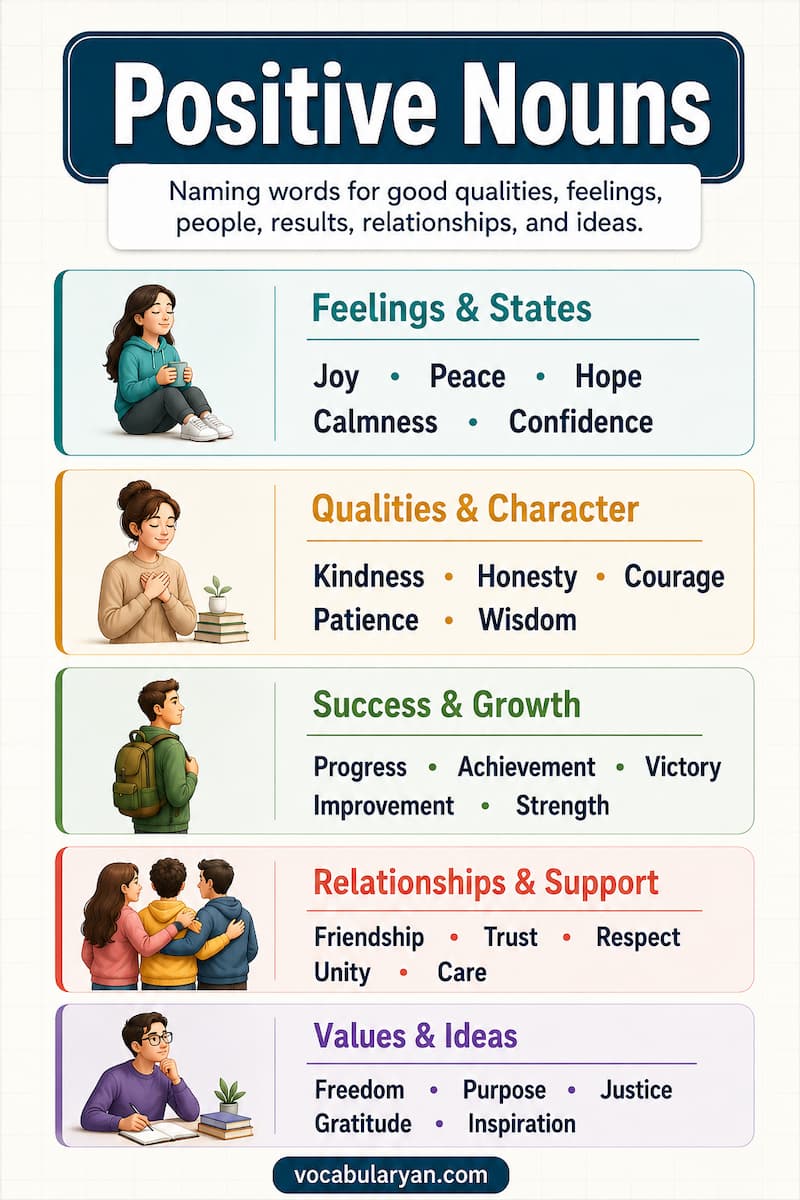
Nouns name the things a sentence is built around, and the ones we choose decide whether a sentence lifts or sits flat. Gratitude, courage, triumph, and harmony are not just pleasant words; they name the qualities, feelings, people, and moments that make language warm, hopeful, and worth reading. Positive nouns are the naming words that carry a favorable charge, and English has hundreds of them spread across every part of life: character and virtue, emotion, relationships, achievement, nature, and the concrete things that simply feel good to picture. The nouns ahead are grouped by what they name, each carries a meaning, the main sections include example sentences, and a full A-to-Z reference closes the page.
What Are Positive Nouns?
A noun names a person, place, thing, or idea. A positive noun names one of these with a favorable charge built into the word: it points to something good, hopeful, or admirable. Where a neutral noun like person or place simply identifies, a positive noun like hero or paradise identifies and approves at the same time.
Positive nouns come in two grammatical kinds. Abstract positive nouns name ideas and qualities that cannot be touched: courage, freedom, joy. Concrete positive nouns name physical things that carry a good feeling: sunshine, garden, gift. Both matter, and the strongest writing uses them together, pairing an abstract quality with a concrete image so the idea has something solid to stand on.
Why Positive Nouns Matter In Writing And Speech
The right positive noun makes a sentence more precise and more felt at once. Compare she showed good qualities with she showed courage, patience, and grace: the second names exactly what the first only gestures at. Positive nouns let a writer be specific about what is good, and specificity is what makes praise believable and description vivid.
They also shape tone. A speech built on words like progress, opportunity, and unity reads as hopeful before a single argument is made, because the nouns carry the feeling. This is why positive nouns matter in everything from a thank-you note to a wedding toast to a cover letter: they set the emotional temperature of the whole piece.
Common Positive Nouns List
A core set covers most everyday needs and works across writing, speech, and conversation.
- Goodwill: friendly, helpful feeling toward others.
- Charm: the power to delight and attract.
- Encouragement: support that gives someone confidence.
- Confidence: belief in one’s own ability.
- Inspiration: something that motivates and uplifts.
- Blessing: a thing one is grateful for.
- Brilliance: exceptional brightness or talent.
- Calm: a state of quiet and stillness.
- Cheerfulness: a bright and hopeful mood.
- Generosity of spirit: openhanded goodwill toward others.
- Honor: high respect and moral standing.
- Radiance: glowing warmth or brightness.
- Vitality: energy and liveliness.
- Welcome: a warm reception of someone.
- Abundance: a plentiful supply of good things.
Positive Nouns For Qualities And Virtues
These abstract nouns name the qualities of good character, the virtues a person can hold and show.
- Integrity: firm adherence to moral principles.
- Her integrity meant she returned the extra change without a second thought.
- Honesty: the quality of being truthful.
- His honesty made him the person everyone went to for a straight answer.
- Compassion: deep awareness of and care for others’ suffering.
- She treated every patient with compassion, not just competence.
- Generosity: willingness to give freely.
- Their generosity kept the food bank stocked through the winter.
- Patience: the capacity to wait or endure calmly.
- Teaching the class took more patience than skill.
- Humility: a modest view of one’s own importance.
- He accepted the award with genuine humility.
- Loyalty: faithfulness to people and principles.
- Her loyalty to old friends never wavered with success.
- Resilience: the ability to recover from difficulty.
- The team’s resilience carried them through a brutal season.
- Diligence: careful and persistent effort.
- His diligence showed in every checked detail.
- Courage: the strength to face fear or hardship.
- It took courage to speak first in a hostile room.
- Dignity: the quality of being worthy of respect.
- She faced the diagnosis with quiet dignity.
- Sincerity: the quality of being genuine.
- The apology carried real sincerity.
- Wisdom: deep understanding and sound judgment.
- Age had given her a wisdom the younger staff relied on.
- Tolerance: willingness to accept difference.
- The community’s tolerance made newcomers feel at home.
- Devotion: deep commitment and loyalty.
- His devotion to the work never dimmed.
- Fortitude: courage in the face of pain or adversity.
- Her fortitude during recovery inspired the whole ward.
Positive Nouns For Emotions And Feelings
These name the good feelings, the inner states worth reaching for and worth describing precisely.
- Joy: a deep and active happiness.
- Happiness: a state of contentment and wellbeing.
- Delight: a high degree of pleasure.
- Contentment: peaceful satisfaction with what one has.
- Hope: expectation of good things to come.
- Bliss: perfect happiness.
- Serenity: a state of calm and peace.
- Elation: great happiness and excitement.
- Gratitude: the warm feeling of thankfulness.
- Affection: a gentle feeling of fondness.
- Enthusiasm: intense and eager enjoyment.
- Excitement: a feeling of lively anticipation.
- Comfort: a state of ease and freedom from worry.
- Cheer: a feeling of brightness and good spirits.
- Pride: satisfaction in one’s own or another’s achievement.
- Wonder: a feeling of awe and admiration.
- Zest: great energy and enthusiasm.
- Warmth: a feeling of affection and kindness.
Positive Nouns For People And Character
English is rich in nouns that name admirable people, the roles and types worth aspiring to or celebrating in others.
- Hero: a person admired for courage or noble acts.
- The firefighter was the hero of the whole street that night.
- Mentor: an experienced person who guides another.
- A good mentor changed the direction of her career.
- Leader: a person who guides and inspires others.
- He grew into a leader the team actually wanted to follow.
- Ally: a person who supports another’s cause.
- She found an ally in the one manager who listened.
- Visionary: a person with bold, forward-looking ideas.
- The founder was a visionary who saw the shift years early.
- Achiever: a person who accomplishes much through effort.
- She was a quiet achiever who let results speak.
- Champion: a person who fights for a cause or wins a contest.
- He became a champion for fair pay across the company.
- Optimist: a person who expects good outcomes.
- The team needed an optimist to keep morale alive.
- Peacemaker: a person who reconciles others.
- She was the peacemaker in every family dispute.
- Luminary: a person of brilliance and inspiration.
- The conference drew every luminary in the field.
- Benefactor: a person who gives help, often financial.
- An anonymous benefactor funded the new library wing.
- Confidant: a person trusted with private matters.
- He was the one confidant she told everything.
- Role model: a person others look to as an example.
- Her grandmother was the role model she measured herself against.
- Prodigy: a young person with remarkable talent.
- The violinist was a prodigy who performed at twelve.
- Stalwart: a loyal, reliable, hard-working supporter.
- He was a stalwart of the volunteer team for thirty years.
Positive Nouns For Success And Achievement
These name the milestones, wins, and rewards of effort, the vocabulary of progress and accomplishment.
- Success: the accomplishment of an aim.
- The launch was a success beyond anyone’s projections.
- Achievement: something accomplished through effort.
- Finishing the degree while working was a real achievement.
- Triumph: a great victory or success.
- The comeback was a triumph nobody had predicted.
- Victory: success in a struggle or contest.
- The ruling was a victory for every family involved.
- Progress: forward movement toward a goal.
- Each week showed measurable progress.
- Breakthrough: a sudden, important advance.
- The research reached a breakthrough in its third year.
- Accomplishment: a completed achievement.
- The bridge was the engineering accomplishment of the decade.
- Milestone: a significant point of progress.
- The thousandth customer was a milestone worth marking.
- Excellence: the quality of being outstanding.
- The school built a reputation for excellence.
- Mastery: complete command of a skill.
- Her mastery of the language came after years abroad.
- Reward: something given in recognition of effort.
- The promotion was a fitting reward for the work.
- Prosperity: a state of flourishing and success.
- The reforms brought a decade of prosperity.
- Distinction: excellence that sets one apart.
- She graduated with distinction.
- Recognition: acknowledgment of achievement.
- The award brought long-overdue recognition.
Positive Nouns For Relationships And Community
The bonds between people have their own warm vocabulary. These nouns name connection, belonging, and the good that grows between people.
| Noun | Meaning |
|---|---|
| Friendship | A bond of mutual affection between people |
| Trust | Confident reliance on another |
| Unity | The state of being joined as a whole |
| Belonging | The feeling of being accepted and at home |
| Solidarity | Unity based on shared interests and support |
| Companionship | The comfort of having company |
| Kinship | A sense of close connection, like family |
| Fellowship | Friendly association around shared interests |
| Bond | A close connection between people |
| Support | Help and encouragement given to others |
| Cooperation | The act of working together |
| Harmony | Peaceful agreement between people |
| Devotion | Deep loyalty and love |
| Rapport | A relationship of mutual understanding |
| Community | A group united by place or shared values |
| Togetherness | The warmth of being close to others |
Positive Nouns For Nature And Places
Nature gives us some of the warmest concrete nouns in the language, words that name the places and natural things that lift the spirit.
- Sunshine: direct light from the sun, often a symbol of warmth and cheer.
- Paradise: a place of perfect happiness and beauty.
- Haven: a place of safety and refuge.
- Sanctuary: a place of peace and protection.
- Oasis: a fertile, restful place amid harshness.
- Meadow: an open field of grass and flowers.
- Garden: a cultivated place of growth and beauty.
- Horizon: the line of possibility where earth meets sky.
- Dawn: the first light of day, a symbol of new beginnings.
- Breeze: a gentle, refreshing wind.
- Spring: the season of renewal and growth.
- Blossom: a flower, especially as a sign of new life.
- Summit: the highest point, a symbol of achievement.
- Shelter: a place that protects and comforts.
- Retreat: a quiet place for rest and renewal.
- Grove: a small, peaceful group of trees.
Positive Concrete Nouns That Feel Positive
Beyond nature, many everyday concrete nouns carry a built-in warmth, the tangible things associated with comfort, celebration, and care.
- Gift: something given freely to bring joy.
- Treasure: something precious and valued.
- Melody: a pleasing sequence of musical notes.
- Feast: a large, joyful meal.
- Bouquet: a bunch of flowers given in affection.
- Keepsake: an object kept for the memories it holds.
- Hearth: a fireplace, a symbol of home and warmth.
- Lantern: a light that guides and comforts.
- Harvest: the gathered reward of growth and work.
- Token: a small object given as a sign of affection.
- Masterpiece: a work of outstanding skill.
- Banquet: a lavish celebratory meal.
- Heirloom: a treasured object passed through generations.
- Beacon: a guiding light or source of hope.
Abstract vs. Concrete Positive Nouns
The clearest way to understand positive nouns is to see the two kinds side by side. Abstract positive nouns name qualities, feelings, and ideas; concrete positive nouns name things you can see or touch. Strong writing pairs them, anchoring an abstract idea to a concrete image so the reader has something to hold.
| Abstract positive noun | Concrete positive noun |
|---|---|
| Hope | Dawn |
| Warmth | Hearth |
| Achievement | Trophy |
| Peace | Sanctuary |
| Love | Bouquet |
| Guidance | Beacon |
| Memory | Keepsake |
| Growth | Blossom |
| Joy | Sunshine |
| Reward | Harvest |
The pairing is a practical writing tool. She felt hope is abstract and quiet; she watched the dawn and felt hope gives the feeling a place to live. Reaching for a concrete positive noun to ground an abstract one is one of the simplest ways to make writing vivid.
Positive Nouns A To Z (Quick Reference)
Every competitor offers an A-to-Z list; this one gives a defined example for each letter so the reference actually teaches rather than just lists.
| Letter | Positive noun | Meaning |
|---|---|---|
| A | Abundance | A very large quantity; plenty |
| B | Bliss | Perfect happiness |
| C | Courage | Strength to face fear or difficulty |
| D | Delight | Great pleasure |
| E | Empathy | The ability to share others’ feelings |
| F | Freedom | The state of being free |
| G | Gratitude | Thankfulness |
| H | Harmony | Peaceful agreement |
| I | Integrity | Firm moral principle |
| J | Joy | Deep happiness |
| K | Kindness | Warm, considerate behavior |
| L | Loyalty | Faithfulness to others |
| M | Mercy | Compassion shown to others |
| N | Nobility | Greatness of character |
| O | Optimism | A hopeful outlook |
| P | Prosperity | Flourishing success |
| Q | Quintessence | The most perfect example of a quality |
| R | Resilience | The ability to recover |
| S | Serenity | A state of calm |
| T | Triumph | A great victory |
| U | Unity | The state of being joined as one |
| V | Victory | Success in a struggle |
| W | Wisdom | Deep understanding and judgment |
| X | Xenial | The friendliness shown to guests |
| Y | Yearning (positive) | A heartfelt longing for something good |
| Z | Zeal | Great energy and enthusiasm |
How To Use Positive Nouns Effectively
Positive nouns work hardest when they are specific and when they are grounded. Two habits make the difference. First, choose the precise noun over the general one: she showed courage says more than she showed good character, because the precise noun names exactly what was admirable. A reader believes the specific and skims the general.
Second, pair abstract with concrete. An abstract noun states a value; a concrete noun gives it an image. He spoke of freedom is a statement; he spoke of freedom, of open roads and unlocked doors gives the idea something the reader can see. This pairing is the engine behind memorable speeches, vows, and descriptions, and it is the single most useful technique for turning a flat positive noun into a vivid one.
A final note on tone: positive nouns set the emotional temperature of a piece before any argument arrives. A paragraph built on opportunity, progress, and possibility reads as hopeful by its vocabulary alone, which is why the nouns chosen at the start of a piece shape how everything after them is received.
FAQs
Positive nouns are naming words with a favorable or uplifting meaning, such as gratitude, courage, hero, triumph, and harmony. They name qualities, emotions, people, achievements, and things that carry a good feeling, and they add warmth, hope, and precision to writing and speech.
Common examples by type are courage and integrity for qualities, joy and hope for emotions, mentor and hero for people, success and triumph for achievement, and sunshine and garden for concrete things. Each names something good rather than simply identifying it.
Abstract positive nouns name ideas, qualities, and feelings that cannot be touched, such as hope, courage, and joy. Concrete positive nouns name physical things that carry a good feeling, such as sunshine, gift, and garden. Strong writing pairs them, grounding an abstract idea in a concrete image so the reader has something solid to picture.
Strong positive nouns for people include hero, mentor, leader, ally, visionary, champion, peacemaker, and role model. Each names an admirable type or role, which makes them useful for praise, recommendations, character description, and celebrating the people who matter.
They make writing more precise and more felt. Naming exactly what is good, courage rather than good character, triumph rather than result, makes praise believable and description vivid. Positive nouns also set the tone of a piece, since vocabulary built on hope, progress, and unity reads as uplifting before any argument is made.