
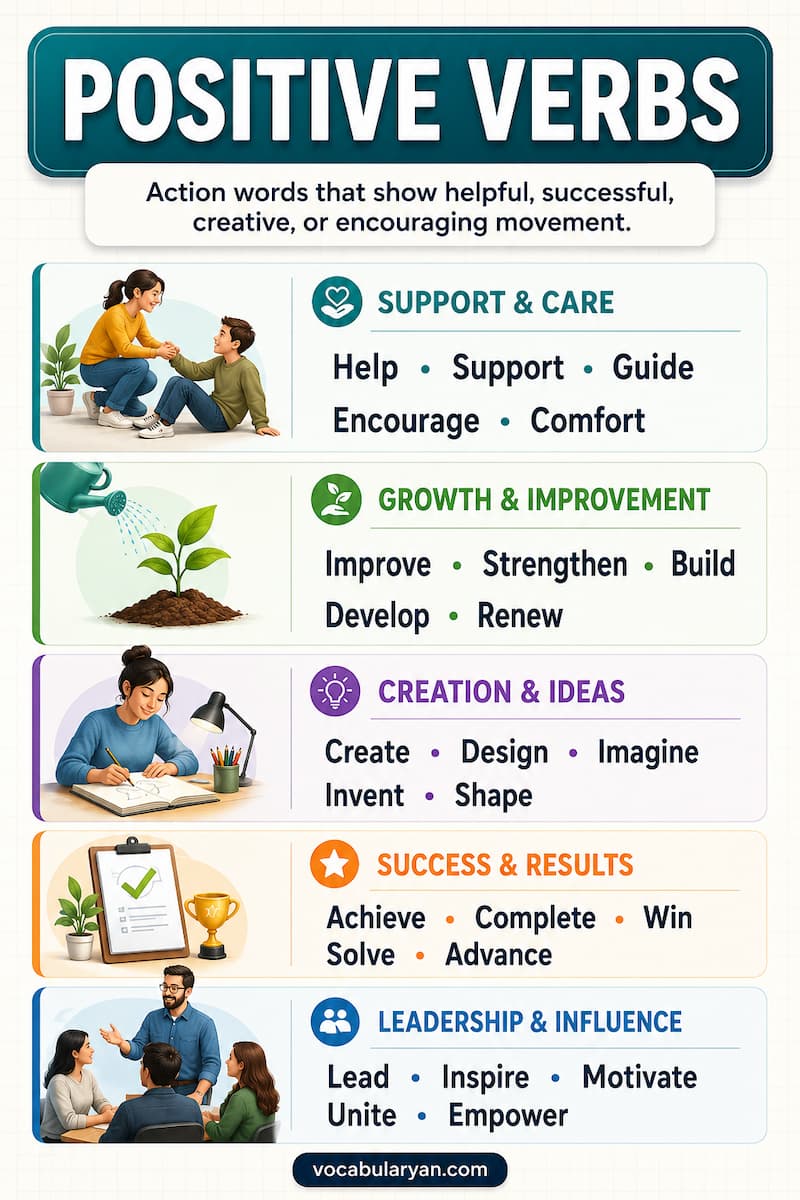
A verb decides how an action feels. To help and to rescue describe similar acts, but one is quiet and the other is heroic. Positive verbs are the action words that carry a constructive, uplifting, or kind meaning, the words that build people up, move things forward, and make writing feel alive rather than flat. They matter for everyday conversation, for resumes and professional writing, and for anyone who wants their language to land with energy and warmth. The verbs ahead are grouped by type, physical, mental, emotional, and communication, with meanings and natural examples throughout, plus a section on replacing weak phrases with single sharp positive verbs.
What Are Positive Verbs?
A positive verb is an action word whose meaning carries a favorable charge: it names something constructive, kind, successful, or uplifting. Where a neutral verb like move or say simply reports an action, a positive verb like advance or praise reports the same kind of action with approval built in. Positive verbs do three jobs especially well: they describe good actions precisely, they bring energy to writing that would otherwise feel flat, and they shape how a reader feels about the subject performing the action. A character who comforts is read differently from one who merely speaks, and a resume that says led, built, and improved lands harder than one that says was responsible for.
Common Positive Verbs List
A core set of positive verbs covers most everyday needs across all four types.
- Help: to make something easier for someone.
- Support: to give strength, assistance, or encouragement.
- Achieve: to reach a goal through effort.
- Improve: to make something better.
- Care: to feel concern and act on it.
- Give: to provide something freely.
- Grow: to develop and increase over time.
- Succeed: to accomplish what was intended.
- Enjoy: to take pleasure in something.
- Trust: to rely on with confidence.
- Nurture: to care for and encourage growth.
- Contribute: to give a useful part to something shared.
- Value: to regard as worthwhile and important.
- Flourish: to grow and thrive vigorously.
- Benefit: to bring advantage or good to.
Positive Physical Action Verbs
These verbs name constructive or beneficial physical actions, things done with the body, hands, or in the physical world.
- Build: to construct or bring something into being.
- They built a shelter for the stray animals over the weekend.
- Create: to make something that did not exist before.
- She created a garden from an abandoned lot.
- Restore: to return something to its original or better condition.
- Volunteers restored the old community hall room by room.
- Rescue: to save someone or something from harm.
- The team rescued three hikers before the storm closed in.
- Repair: to fix something that was broken.
- He repaired the bikes and gave them to the school.
- Plant: to put seeds or plants in the ground to grow.
- They planted two hundred trees along the riverbank.
- Protect: to keep safe from harm.
- The fence protected the seedlings from the wind.
- Strengthen: to make physically stronger or more secure.
- The new supports strengthened the entire structure.
- Heal: to make or become healthy again.
- Rest and care healed the injury within weeks.
- Cultivate: to prepare and care for land or growth.
- She cultivated the soil until it could support a harvest.
- Rebuild: to construct again after damage.
- The town rebuilt the bridge stronger than before.
- Deliver: to bring something to where it is needed.
- They delivered supplies to the families cut off by the flood.
- Energize: to give vitality and physical energy to.
- The fresh air energized the whole group for the climb.
- Revive: to restore strength, life, or activity.
- Water and shade revived the exhausted runners.
- Construct: to build by putting parts together.
- The students constructed a working model in an afternoon.
Positive Mental And Cognitive Verbs
These verbs name positive actions of the mind, learning, understanding, solving, and creating ideas.
- Discover: to find or learn something for the first time.
- Understand: to grasp the meaning of something.
- Learn: to gain knowledge or skill.
- Master: to gain complete command of a skill or subject.
- Solve: to find an answer to a problem.
- Imagine: to form a new idea or picture in the mind.
- Realize: to become fully aware of something true.
- Design: to plan and create with intention.
- Plan: to think through how to achieve something.
- Invent: to create something entirely new.
- Analyze: to examine something carefully to understand it.
- Focus: to concentrate attention and effort.
- Recognize: to identify something known or true.
- Appreciate: to understand the full value of something.
- Reflect: to think carefully and deeply.
- Envision: to picture a future possibility clearly.
- Comprehend: to understand something fully.
- Resolve: to decide firmly on a course of action.
Positive Emotional Verbs
These verbs name actions that lift, comfort, or strengthen another person’s feelings, the strongest area of positive vocabulary.
- Inspire: to fill someone with the urge to do or feel something good.
- Her story inspired the whole room to act.
- Encourage: to give someone the confidence to continue.
- He encouraged her to apply despite her doubts.
- Comfort: to ease someone’s distress.
- She comforted the child until the crying stopped.
- Reassure: to remove someone’s worry or doubt.
- The doctor reassured them that the recovery was on track.
- Cheer: to lift someone’s mood with warmth or energy.
- Their visit cheered him through a difficult week.
- Uplift: to raise someone’s spirits.
- The message uplifted everyone who read it.
- Motivate: to give someone a reason to act.
- The coach motivated the team to push through the final round.
- Soothe: to calm and bring relief.
- The quiet music soothed the restless ward.
- Console: to give comfort in a time of grief.
- Friends consoled her in the days after the loss.
- Delight: to give someone great pleasure.
- The surprise delighted the entire family.
- Embrace: to accept or hold with warmth.
- She embraced the challenge instead of avoiding it.
- Cherish: to hold something dear and care for it.
- They cherished every visit with their grandparents.
- Empower: to give someone confidence and control.
- The training empowered staff to make their own decisions.
- Hearten: to give someone renewed courage.
- The early results heartened the whole campaign.
- Welcome: to receive someone warmly.
- The neighbors welcomed the new family on the first day.
Positive Communication Verbs
These verbs name positive acts of speaking, writing, and expression.
- Praise: to express warm approval and admiration.
- The manager praised the team in front of the whole office.
- Thank: to express gratitude.
- She thanked each volunteer by name.
- Compliment: to express admiration directly to someone.
- He complimented her on the clarity of the report.
- Reaffirm: to state support for something once more.
- The note reaffirmed his belief in the project.
- Congratulate: to express good wishes on an achievement.
- They congratulated her on the promotion.
- Affirm: to state positively and support.
- The feedback affirmed that the approach was working.
- Acknowledge: to recognize someone’s effort or worth.
- The report acknowledged everyone who had contributed.
- Express: to communicate thoughts or feelings openly.
- She expressed her gratitude in a short, warm speech.
- Share: to give a part of something to others.
- He shared the credit with the entire team.
- Recommend: to speak in favor of someone or something.
- Her mentor recommended her for the role.
- Endorse: to declare public approval and support.
- Several leaders endorsed the new initiative.
- Greet: to address someone with warmth on meeting.
- She greeted every guest at the door.
- Commend: to praise formally and publicly.
- The mayor commended the firefighters for their courage.
- Applaud: to express strong approval, in words or by clapping.
- The committee applauded her decision to speak up.
- Celebrate: to mark and honor an achievement aloud.
- The whole team celebrated the milestone together.
Strong Positive Verbs That Replace Weak Phrases
A single positive verb often carries more force than a whole weak phrase. Replacing the phrase sharpens the writing and gives it energy. This matters most in resumes, professional writing, and any sentence that needs to land.
| Weak phrase | Strong positive verb |
|---|---|
| Gave help to | Assisted, supported |
| Made better | Improved, enhanced |
| Said in a happy way | Cheered, exclaimed |
| Made something new | Created, designed |
| Was in charge of | Led, directed |
| Gave money or support to | Funded, backed |
| Made someone feel better | Comforted, reassured |
| Helped something grow | Nurtured, cultivated |
| Made bigger or stronger | Strengthened, expanded |
| Told someone they did well | Praised, commended |
| Brought back to a good state | Restored, revived |
| Gave someone confidence | Empowered, encouraged |
| Worked together on | Collaborated, partnered |
| Made a problem go away | Resolved, solved |
| Reached a goal | Achieved, accomplished |
How To Use Positive Verbs In Writing
Positive verbs do their best work when they carry the sentence on their own, without needing an adverb to prop them up. He spoke encouragingly is weaker than he encouraged, because the strong verb already contains the warmth. The same principle drives effective resumes and reports: led a team lands harder than was responsible for leading a team, and improved results is sharper than helped to make results better. Two habits make the difference. First, replace a weak verb-plus-adverb pair with a single precise verb wherever possible, since reassured says more than said calmly. Second, match the verb to the exact action: comfort, console, soothe, and reassure all ease distress, but each fits a slightly different moment, and choosing the precise one is what makes writing feel considered rather than generic.
FAQs
Positive verbs are action words whose meaning carries a constructive, kind, successful, or uplifting charge, such as inspire, encourage, build, achieve, and praise. They describe good actions with approval built into the word itself, which makes them useful for warm communication, motivating writing, and strong professional language.
Common examples by type are build, create, and restore for physical action; discover, understand, and master for mental action; comfort, inspire, and uplift for emotional action; and praise, thank, and encourage for communication. Each names a positive action precisely rather than generally.
Strong resume verbs are led, built, created, improved, achieved, launched, strengthened, and delivered. They replace weak phrases like was responsible for or helped with, giving each accomplishment energy and ownership. A single strong verb at the start of a bullet point lands harder than a passive description of the same work.
A neutral verb reports an action without emotional charge: move, say, make, do. A positive verb reports a similar action with a favorable meaning built in: advance, praise, create, accomplish. The neutral verb is factual; the positive verb adds approval, warmth, or a sense of achievement to the same basic action.
They replace weak verb-and-adverb combinations with single precise words, which makes sentences tighter and more energetic. Encouraged is stronger than spoke supportively, and built is stronger than was responsible for building. Positive verbs also shape how a reader feels about the subject, since a person who comforts, leads, or inspires reads very differently from one who merely acts.