
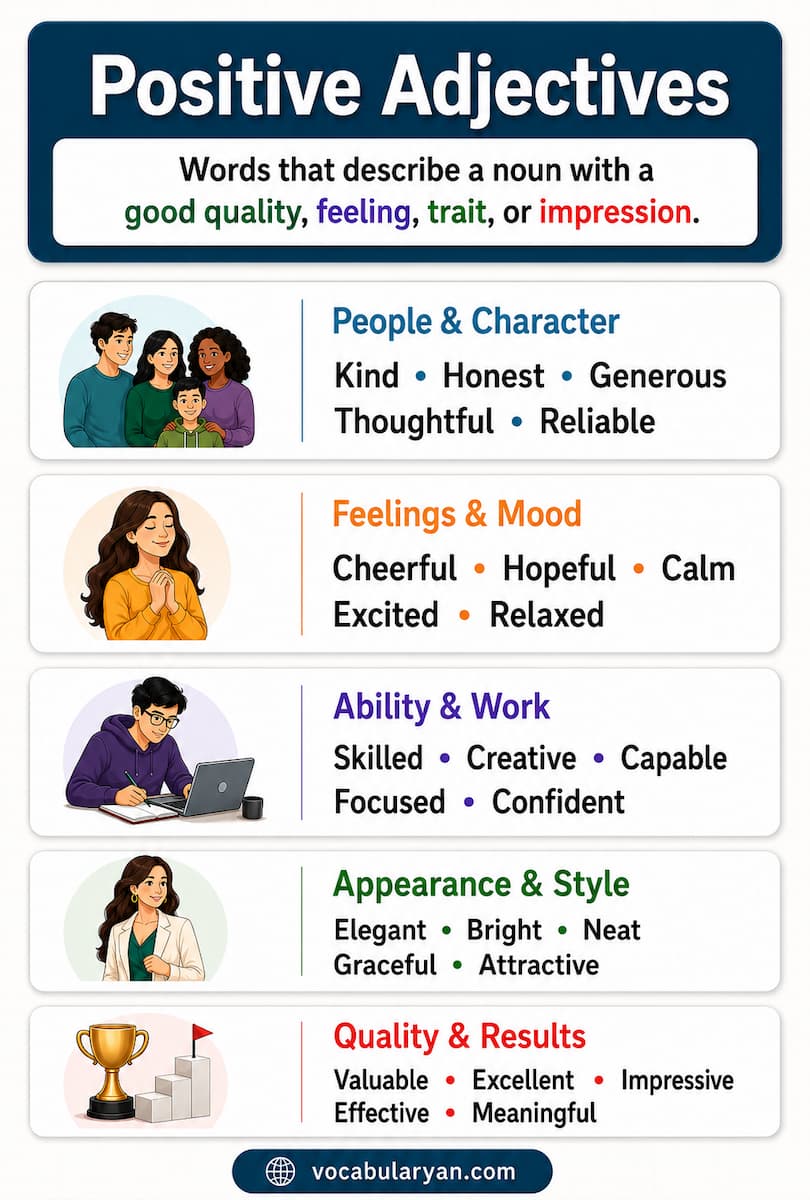
The right positive adjective does more than compliment: it names something precisely enough to make the person or thing feel seen. Generous is different from charitable, and radiant is different from pretty, and perceptive is different from smart. Positive adjectives are the words that describe people, places, experiences, and qualities in a favorable light, each one carrying a slightly different shade of approval or admiration. They matter in writing, conversation, professional communication, and creative work, wherever the goal is to capture something good with the accuracy it deserves. The adjectives ahead are grouped by what they describe, with meanings and sentence examples throughout, so the right one is always within reach.
Positive Adjectives For Character And Personality
Character adjectives name what is admirable in a person, the qualities that endure across time and circumstance.
- Generous: giving freely without expecting in return.
- A generous spirit that extended to time and attention as well as money.
- Honorable: guided by strong moral principles.
- An honorable decision that cost him something but was right.
- Resilient: recovering strength and composure after difficulty.
- A resilient person who did not let the setback define the year.
- Compassionate: feeling and acting on genuine concern for others’ suffering.
- A compassionate response that made the family feel less alone.
- Courageous: acting rightly despite fear.
- A courageous choice made without certainty of the outcome.
- Honest: truthful and straightforward without deception.
- An honest answer that was harder to give than a flattering one.
- Loyal: faithful to people and principles under pressure.
- A loyal friend who stayed when staying was inconvenient.
- Patient: able to wait and endure without complaint.
- A patient teacher who explained the same thing eight different ways.
- Humble: aware of one’s limits without self-deprecation.
- A humble acknowledgment of how much he still had to learn.
- Principled: acting according to a clear moral code.
- A principled refusal that surprised everyone who expected compliance.
- Tenacious: persisting through obstacles without losing purpose.
- A tenacious campaigner who did not stop when the first attempt failed.
- Thoughtful: careful in considering others before acting.
- A thoughtful gesture that showed she had been paying attention.
- Authentic: genuinely and consistently oneself.
- An authentic presence that made people feel no performance was required.
- Generous-spirited: extending goodwill beyond the immediate and the expected.
- A generous-spirited reading of a difficult situation.
- Steadfast: remaining firm in commitment regardless of pressure.
- A steadfast ally who held her position when everyone else shifted.
- Virtuous: possessing and practicing high moral standards.
- A virtuous path that was neither easy nor naive.
Positive Adjectives For Emotions And Feelings
- Joyful: filled with great happiness.
- Content: at ease and satisfied with what is.
- Serene: calm and undisturbed.
- Elated: in a state of great happiness and excitement.
- Grateful: feeling and expressing thankfulness.
- Hopeful: expecting good outcomes with reason.
- Peaceful: free from anxiety and conflict.
- Optimistic: inclined to expect positive outcomes.
- Excited: energized by anticipation or new experience.
- Enthusiastic: showing intense, eager interest.
- Inspired: energized by a creative or motivating influence.
- Fulfilled: experiencing deep satisfaction from achievement.
- Moved: emotionally affected in a meaningful way.
- Lighthearted: free from worry or heaviness.
- Warm: showing friendly, affectionate feeling.
- Uplifted: raised in spirit by an experience or encounter.
- Exhilarated: filled with a strong sense of happiness and energy.
- Appreciative: aware of and thankful for value in something.
Positive Adjectives For Intelligence And Ability
Intelligence adjectives work best when they name a specific kind of mental strength rather than general cleverness.
- Perceptive: noticing things others miss; quick to understand.
- A perceptive question that reframed the whole discussion.
- Astute: sharp in practical judgment and analysis.
- An astute observer of how power operates in a room.
- Inventive: producing novel solutions and original ideas.
- An inventive approach that nobody had considered before.
- Articulate: expressing ideas clearly and effectively.
- An articulate argument that made the complex feel accessible.
- Analytical: applying systematic, logical thinking to problems.
- An analytical mind that found the flaw in the third line.
- Curious: motivated by a genuine desire to understand.
- A curious intelligence that followed questions wherever they led.
- Diligent: persistent and careful in work and effort.
- A diligent student who found the sources nobody else had checked.
- Resourceful: finding practical solutions with what is available.
- A resourceful engineer who fixed the problem with what was on hand.
- Versatile: able to adapt across a range of tasks and contexts.
- A versatile writer who moved between genres without losing quality.
- Incisive: going directly to the heart of a matter.
- An incisive summary that cut through three hours of discussion.
- Discerning: showing good judgment and fine perception.
- A discerning editor who knew exactly where the draft lost its thread.
- Imaginative: producing vivid, original mental pictures and ideas.
- An imaginative solution that worked precisely because it was unexpected.
- Capable: having the ability to do what is required.
- A capable team that delivered without needing to be managed.
- Sharp: mentally quick and accurate.
- A sharp mind that caught the error in a single reading.
- Methodical: following a careful, orderly approach.
- A methodical researcher who traced every claim to its source.
Positive Adjectives For Appearance And Physical Presence
- Radiant: glowing with light, health, or happiness.
- Elegant: graceful and refined in form or movement.
- Striking: noticeably impressive in appearance.
- Vibrant: full of energy and vividness.
- Distinguished: having an appearance of dignity and importance.
- Graceful: moving or appearing with smooth ease.
- Luminous: radiating a soft, beautiful light.
- Statuesque: impressively tall and well-proportioned.
- Poised: carrying oneself with composure and balance.
- Vivid: intensely bright, colorful, and alive.
- Immaculate: perfectly clean and well-kept.
- Polished: refined and well-presented.
- Healthy: showing signs of physical vitality.
- Spirited: showing liveliness in expression and movement.
- Wholesome: giving an impression of natural health and goodness.
- Magnetic: drawing attention and interest through presence.
- Arresting: immediately drawing and holding the eye.
Positive Adjectives For Social And Interpersonal Qualities
Social adjectives describe how a person moves through the world with others, the qualities that make relationships easier and better.
- Empathetic: able to understand and share others’ feelings.
- An empathetic response that made the other person feel understood.
- Diplomatic: skilled at handling situations tactfully.
- A diplomatic approach that kept both sides at the table.
- Gregarious: enjoying and thriving in the company of others.
- A gregarious personality that lit up any room it entered.
- Charismatic: compelling through natural charm and presence.
- A charismatic speaker who made the message feel personal.
- Welcoming: creating a sense of warmth and belonging.
- A welcoming manner that made visitors feel they had been expected.
- Supportive: providing encouragement and practical help.
- A supportive colleague who noticed when things were difficult.
- Considerate: thinking of others’ needs before acting.
- A considerate guest who left the place as they had found it.
- Inclusive: ensuring all people feel part of the group.
- An inclusive approach that brought the quietest voices into the discussion.
- Reliable: consistently doing what was promised.
- A reliable partner who met every deadline without a reminder.
- Trustworthy: worthy of confidence and faith.
- A trustworthy confidant who kept what was shared in confidence.
- Magnanimous: generous and forgiving, especially toward rivals or opponents.
- A magnanimous response to the criticism that disarmed the room.
- Encouraging: actively supporting others toward their potential.
- An encouraging word at the right moment changed the direction.
- Sociable: at ease and pleasant in social situations.
- A sociable presence that made shared spaces more comfortable.
- Warm-hearted: naturally kind and affectionate.
- A warm-hearted welcome that made the newcomer feel at ease.
- Tactful: aware of how words land and adjusting accordingly.
- A tactful correction that preserved everyone’s dignity.
Positive Adjectives For Places And Things
- Resplendent: dazzlingly attractive and impressive.
- Tranquil: peacefully calm and quiet.
- Magnificent: impressively beautiful on a grand scale.
- Charming: pleasantly attractive in an unassuming way.
- Breathtaking: so beautiful it briefly removes the capacity for speech.
- Unspoiled: not damaged or diminished by human interference.
- Majestic: having grandeur and impressive dignity.
- Picturesque: visually attractive in a way that could be painted.
- Idyllic: pleasantly peaceful and simple.
- Lush: rich and abundant in growth or color.
- Pristine: immaculately clean and uncorrupted.
- Inviting: making one want to enter or experience.
- Cozy: comfortably warm and sheltered.
- Thriving: growing and developing vigorously.
- Inspiring: producing a sense of motivation and admiration.
- Immersive: drawing one fully into an environment or experience.
- Verdant: green and lush with vegetation.
Positive Adjectives For Experiences And Situations
- Enriching: adding value and depth to one’s knowledge or life.
- An enriching experience that broadened how she understood the subject.
- Rewarding: providing satisfaction in proportion to the effort.
- A rewarding project that left the team proud of what they had made.
- Memorable: remaining clearly in the mind long after the event.
- A memorable evening that came up in conversation for years.
- Transformative: producing a lasting, significant change.
- A transformative year that redefined what she thought was possible.
- Stimulating: producing interest, thought, or excitement.
- A stimulating conversation that continued the whole drive home.
- Invigorating: producing energy and renewed enthusiasm.
- An invigorating morning that set the tone for the week.
- Uplifting: raising the spirits and improving the mood.
- An uplifting performance that left nobody in the same state as they had arrived.
- Fulfilling: satisfying in a deep and lasting way.
- A fulfilling role that made every difficult day worthwhile.
- Auspicious: giving a favorable sign that things will go well.
- An auspicious start that made everyone optimistic about the rest.
- Celebratory: marked by joy and recognition of achievement.
- A celebratory atmosphere from the moment the results came in.
- Empowering: giving a sense of agency and confidence.
- An empowering workshop that changed how participants saw their options.
- Revitalizing: restoring energy and enthusiasm.
- A revitalizing break that made the second half of the year easier.
The Connotation Spectrum: From Positive To Neutral
Every positive adjective has a neutral or negative counterpart that covers the same basic fact with a different charge. Knowing where a word sits on the spectrum gives a writer precise control over tone.
| Positive | Neutral | Negative connotation |
|---|---|---|
| Confident | Self-assured | Arrogant |
| Thrifty | Careful with money | Stingy |
| Determined | Persistent | Stubborn |
| Assertive | Direct | Aggressive |
| Idealistic | Optimistic | Naive |
| Passionate | Enthusiastic | Obsessive |
| Spirited | Lively | Excitable |
| Selective | Discerning | Picky |
| Independent | Self-reliant | Aloof |
| Principled | Consistent | Rigid |
| Tenacious | Persistent | Obstinate |
| Forthright | Direct | Blunt |
| Spontaneous | Flexible | Impulsive |
FAQs
Positive adjectives are words that describe a person, place, thing, or experience in a favorable or uplifting way, such as generous, resilient, radiant, empathetic, and vibrant. They carry an approving or admiring emotional charge and are used to highlight good qualities, create warmth in communication, and give precise shape to what is admirable or pleasing.
Strong character adjectives are generous, honorable, resilient, compassionate, courageous, loyal, and tenacious. For social qualities, empathetic, charismatic, supportive, and trustworthy all describe a person’s effect on others. For intelligence, perceptive, astute, inventive, and articulate name specific kinds of mental strength.
A positive adjective is a word that carries a favorable charge: generous, brilliant, serene. A compliment is a statement that uses a positive adjective to express admiration to someone. Your work is incisive uses the positive adjective incisive as a compliment, but incisive itself is simply a precise adjective that can appear in any context.
Strong positive place adjectives are vibrant, tranquil, magnificent, breathtaking, serene, majestic, idyllic, and lush. Each names a different quality: vibrant suggests energy and color, tranquil suggests calm, magnificent suggests scale, and idyllic suggests peaceful simplicity. Matching the word to the specific quality makes the description feel precise rather than generic.
A positive adjective carries an approving emotional charge: confident, thrifty, spirited. A neutral adjective states a fact without pushing the reader toward approval or disapproval: self-assured, careful with money, lively. The neutral version reports; the positive version endorses. Many adjectives exist at all three levels, positive, neutral, and negative, covering the same fact with very different effects.