
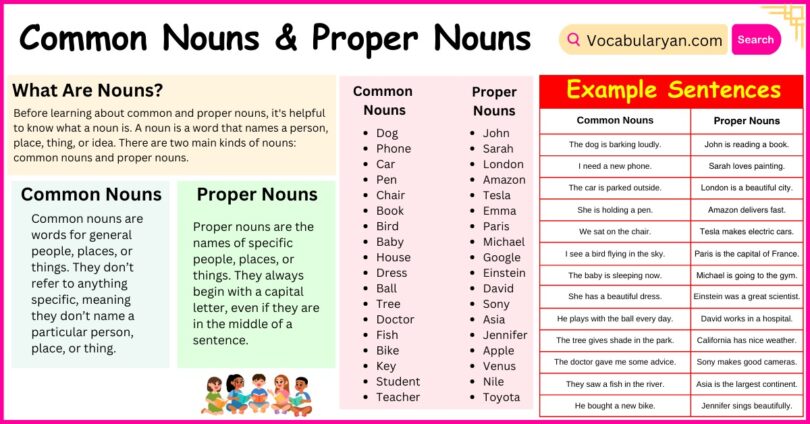
Common nouns and proper nouns differ in function: class labels versus names. In city and Lahore, city is a common noun and Lahore is a proper noun. Capitalization marks this difference, but the noun’s function in the sentence decides its class.
Quick Check
Do not judge a noun by its capital letter alone. Sentence position, family roles, titles, directions, dates, and school subjects affect the capitalization decision.
What Are Common Nouns and Proper Nouns?
A common noun labels a class of people, places, objects, actions, qualities, or ideas. A proper noun functions as the name of a particular person, place, organization, work, event, or product. The same word changes class when its use changes, as in earth for soil and Earth for the planet.
Common noun: a general class name such as teacher, river, company, or honesty. It stays lowercase unless sentence position or title style requires a capital.
Proper noun: a name such as Aisha, the Nile, Microsoft, or Eid al-Fitr. A proper noun does not require worldwide uniqueness. Several people share the name Aisha, but the word still functions as a name.
When you classify a noun, ask one question: Is this word functioning as a name in this sentence? If yes, it is proper. If it labels a class, it is common.
Common Nouns vs Proper Nouns
Common nouns and proper nouns refer at different levels. River identifies a class of geographic features; the Nile names one river. The same relationship applies across people, places, organizations, works, and dates.
| Category | Common Noun | Proper Noun |
|---|---|---|
| Person | teacher | Ms. Ali |
| Place | city | Lahore |
| Country | country | Pakistan |
| Organization | university | Oxford University |
| Company | company | Microsoft |
| Landmark | tower | the Eiffel Tower |
| Book | novel | Pride and Prejudice |
| Holiday | holiday | Eid al-Fitr |
| Day | weekday | Monday |
| Month | month | July |
| Language | language | English |
| River | river | the Nile |
A capital letter provides evidence, not the full answer. In “Teachers support students,” Teachers begins with a capital because it starts the sentence. It remains a common noun because it names a class rather than a teacher’s name.
Capitalization Rules for Nouns
Common nouns: write them in lowercase in ordinary sentence position.
The doctor called the patient.
A common noun takes a capital at the start of a sentence or under title-case rules. Its grammatical class does not change.
Proper nouns: capitalize names of people, places, organizations, days, months, holidays, languages, books, films, and named events.
Mina studies English at Oxford University.
Multiword names: capitalize the main words in a name. Short function words remain lowercase where the name or title requires them, as in University of Oxford and Pride and Prejudice. Keep official brand styling in names such as iPhone.
Articles with names: personal names and city names stand without an article, as in Aisha and Lahore. Rivers, oceans, and mountain ranges take the, as in the Nile, the Pacific Ocean, and the Himalayas. Country names such as the United States and the Netherlands also take the.
Common and Proper Noun Examples
Each sentence uses the noun’s role to establish its class.
Person and name: The teacher thanked Aisha.
Teacher labels a profession, while Aisha names the person.
Place and city: We visited a museum in London.
Museum names a class of buildings. London names the city.
Organization and class: The company opened an office near Oxford University.
Company is general. Oxford University names an organization.
Work and writer: I borrowed a novel by Jane Austen.
Novel labels a type of book. Jane Austen names the writer.
Event and month: The festival begins in July.
Festival is common because no festival is named. July is a proper noun.
Geographic feature and name: The river flows north toward Cairo.
River is common. Cairo names a city. Naming the river would require a proper noun, such as the Nile.
Tricky Noun Capitalization Cases
Some nouns change capitalization when their function changes. Check whether the noun acts as a name, forms part of a name, or labels a general class.
Family roles: capitalize a family word when it replaces the person’s name. Keep it lowercase after a possessive such as my, your, or her.
I called my Mom after lunch. ❌
I called my mom after lunch. ✅
In “I called Mom after lunch,” Mom functions as the person’s name.
Job titles: capitalize a title directly before a person’s name. Keep it lowercase when it names the position alone.
The President addressed the council. ❌
The president addressed the council. ✅
Write “President Khan addressed the council” when the title comes before the name.
Directions and regions: write compass directions in lowercase. Capitalize a recognized region or a direction inside a proper name.
We drove North for two hours. ❌
We drove north for two hours. ✅
Use capitals in names such as South America and in regional terms such as the West.
Days months and seasons: days, months, and holidays are proper nouns. Seasons are common nouns unless they form part of a name or title.
The course starts in Summer. ❌
The course starts in summer. ✅
Write Monday, July, and Eid al-Fitr with capitals.
School subjects and languages: write ordinary school subjects in lowercase. Capitalize languages and official course names.
I study Mathematics and English. ❌
I study mathematics and English. ✅
An official course name takes capitals, as in Mathematics 201.
Geographic names with articles: use the with the established names of rivers, oceans, seas, and mountain ranges.
We sailed on Nile at sunset. ❌
We sailed on the Nile at sunset. ✅
Noun Practice Questions
Use the naming test and the capitalization rules to answer each question.
- In “Maya visited a museum in London,” which nouns are common and which are proper?
- Choose the correct form: “My uncle / Uncle Omar lives in Karachi.”
- Correct the capitalization: “We drove West in April.”
- Choose the correct form: “I asked Mom / my Mom to call.”
- Is Teachers common or proper in “Teachers plan the lessons”?
- Correct the capitalization: “sara studies french and history.”
Answers:
- Maya and London are proper nouns. Museum is a common noun.
- Write Uncle Omar. The family title forms part of the name.
- Write “We drove west in April.” West names a direction there, while April is a proper noun.
- Write “I asked Mom to call.” Mom replaces the person’s name.
- Teachers is a common noun. Its capital comes from its position at the start of the sentence.
- Write “Sara studies French and history.” Sara and French are proper nouns; history is a common noun.
FAQs
Q1. What is the difference between common and proper nouns?
A common noun labels a general class, while a proper noun functions as a name. Write city for the general class and Lahore for the named city.
Q2. Can a noun be both common and proper?
The same word belongs to either class according to its use. Earth names the planet, while earth means soil. President forms part of the name in President Khan, while president labels the job in the president.
Q3. Are seasons common nouns or proper nouns?
Season names are common nouns, so write spring, summer, autumn, and winter in lowercase. Days, months, and holidays are proper nouns, as in Monday, July, and Eid al-Fitr.
Q4. Is Mom a common noun or a proper noun?
Mom is proper when it replaces a person’s name: “Mom called.” It is common after a possessive or article: “My mom called.”