
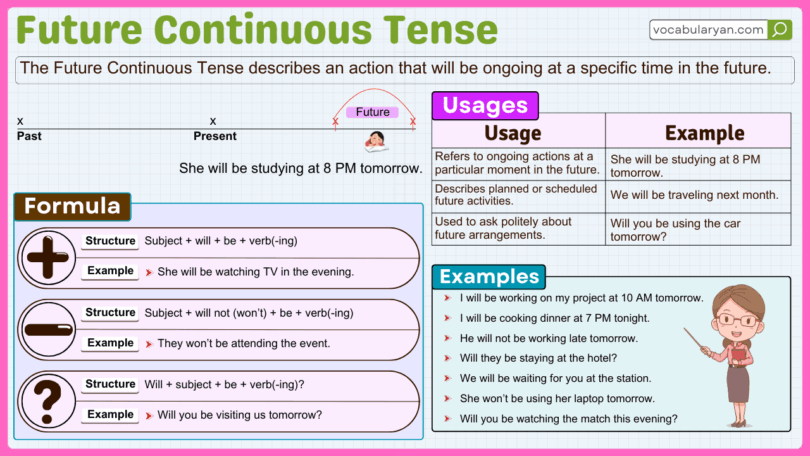
The future continuous tense describes an action in progress at a stated or understood future time. Form it with will be + present participle: “At 8 tomorrow, I will be working.” The verb phrase stays the same with every subject, so the main decision is whether you want to present the future action as activity in progress.
What Is the Future Continuous Tense?
The future progressive tense is another name for the future continuous. It describes a future activity already in progress at the reference time rather than one complete event.
Compare “I will work at 8” with “I will be working at 8.” Both sentences are grammatical. In the second sentence, the activity is in progress at 8.
Future Continuous Tense Formula
Formula: subject + will be + present participle
The present participle is the main verb ending in -ing, such as working, studying, or traveling. The auxiliary phrase will be remains unchanged with every subject.
| Sentence Form | Structure | Example |
|---|---|---|
| Affirmative | Subject + will be + verb-ing | She will be studying at 8. |
| Negative | Subject + will not be + verb-ing | She will not be studying at 8. |
| Yes/No Question | Will + subject + be + verb-ing? | Will she be studying at 8? |
| Wh-Question | Wh-word + will + subject + be + verb-ing? | Where will she be studying? |
Affirmative Sentences With Will Be
- I will be working from home tomorrow.
- They will be traveling during the school break.
In speech and informal writing, pronouns join with will: I’ll be working, she’ll be studying, and they’ll be traveling.
Negative Sentences and Contractions
The negative form uses not between will and be. The contraction won’t replaces will not.
- Omar will not be attending the meeting.
- We won’t be using the office this weekend.
Questions and Short Answers
In a yes/no question, will comes before the subject: “Will you be driving tomorrow?” A wh-question begins with a question word: “What will you be doing at noon?”
Short answers omit be and the main verb:
- Yes, I will.
- No, I won’t.
When to Use the Future Continuous Tense
The future reference time is the time from which you view the action. It is either stated directly, as in at 9 tomorrow, or understood from the conversation.
Actions in Progress at a Future Time
Use the future continuous for an unfinished action at a named future time.
“At 10 tomorrow, Lena will be taking her exam” places the exam around 10. The sentence does not state when the exam starts or ends.
Interrupted Future Actions
Use the future continuous for the longer action in progress and a present form for the event that interrupts it.
“I will be preparing dinner when you arrive” means the preparation starts before your arrival and remains in progress at that moment.
Simultaneous Future Actions
Two actions occurring during the same future period form simultaneous future actions.
“While I am preparing the slides, Noor will be checking the figures” presents both activities during the same work period. The clause after while uses the present continuous.
Expected Future Events
The future continuous also expresses an expected event in the normal course of a plan or schedule.
“The train will be leaving at 6” reports the expected departure without emphasizing a new decision.
Polite Questions About Plans
A future continuous question asks about an expected plan rather than the listener’s willingness.
“Will you be using the meeting room this afternoon?” checks the room schedule. “Will you use the meeting room?” sounds more like a request or a decision about use.
Future Continuous Time Expressions
A time expression identifies the future moment or period connected to the action.
| Time Expression | Example |
| At 8 Tomorrow | At 8 tomorrow, I will be meeting the client. |
| This Time Next Week | This time next week, we will be flying to Rome. |
| From 2 to 5 | She will be teaching from 2 to 5. |
| All Morning Tomorrow | They will be testing the software all morning tomorrow. |
| When You Arrive | I will be waiting when you arrive. |
| While We Work | The system will be recording data while we work. |
Place adverbs such as still and definitely between will and be: “He will still be working at 9.” Place an adverb of manner or frequency before the participle or at the end: “They will be constantly checking the results.”
Time warning: At 8 asks what is in progress at 8. By 8 introduces a deadline, so use the future perfect when completion is the focus.
Time Clauses With When and While
A future time clause introduced by when or while uses a present form. Do not repeat will inside that dependent clause.
I will be cooking when you will arrive. ❌
I will be cooking when you arrive. ✅
While I will be cooking, Hamza will be setting the table. ❌
While I am cooking, Hamza will be setting the table. ✅
Use the future continuous in the main clause. The present simple tense or present continuous tense marks the future time inside the dependent clause.
Stative Verbs and Dynamic Meanings
Stative verbs describe states such as knowledge, possession, belief, or need. Their stative meanings use a simple form rather than a continuous form.
I will be knowing the answer tomorrow. ❌
I will know the answer tomorrow. ✅
Several verbs also have dynamic meanings. “We will be having dinner at 7” uses have to mean eating. “She will be seeing the dentist tomorrow” uses see to mean meeting or visiting.
Future Continuous vs Future Simple
The future simple presents an event, decision, promise, or prediction. The future continuous presents activity in progress or an expected arrangement.
- “I will call you at 8” presents one future event.
- “I will be calling clients at 8” presents an activity underway at that time.
- “We will arrive at 6” focuses on the arrival.
- “We will be arriving around 6” presents the arrival as an expected arrangement.
Both forms are grammatical. Choose the tense that matches the viewpoint you need.
Future Continuous vs Future Perfect
The future continuous describes what will be in progress. The future perfect tense describes what will be complete before a future deadline.
- At 8, I will be writing the report.
- By 8, I will have written the report.
For duration measured up to a future time, use the future perfect continuous tense: “By June, I will have been studying medicine for two years.”
Common Future Continuous Mistakes
Most form errors come from omitting be, using the base verb after be, or adding will inside a future time clause.
They will playing football at 5. ❌
They will be playing football at 5. ✅
She won’t coming to the meeting. ❌
She won’t be coming to the meeting. ✅
I will be work when you call. ❌
I will be working when you call. ✅
By next year, he will be studying medicine for three years. ❌
By next year, he will have been studying medicine for three years. ✅
Do not mark every future-simple sentence as an error. “He will go to school at 9” is grammatical. “He will be going to school at 9” changes the viewpoint to an activity or expected routine around that time.
Practice With Will Be
Complete each sentence with the correct verb form.
- At 9 tomorrow, Maya ________ her exam. (take)
- We ________ the office this weekend. (not use)
- ________ you ________ to Karachi next week? (travel)
- I will be waiting when the train ________. (arrive)
- By 6, I ________ the report. (finish)
- Correct the sentence: “He will be knowing the answer tomorrow.”
Answer key:
- Maya will be taking her exam.
- We won’t be using the office.
- Will you be traveling to Karachi?
- The train arrives.
- I will have finished the report.
- He will know the answer tomorrow.
FAQs
Q1: What Is the Future Continuous Tense?
The future continuous tense presents an action in progress at a future time. Its form is will be + present participle, as in “At noon, I will be working.”
Q2: What Is the Formula for the Future Continuous Tense?
Use subject + will be + present participle. Add not after will for negatives, or move will before the subject for questions.
Q3: When Should You Use the Future Continuous Tense?
Use it for activity in progress at a future time, overlapping future actions, expected events, and polite questions about plans.
Q4: What Is the Difference Between Future Simple and Future Continuous?
Future simple presents an event or decision. Future continuous presents activity in progress or an expected arrangement at a stated or understood future time.
Q5: What Is the Difference Between Future Continuous and Future Perfect?
Future continuous describes an action in progress at a future time. Future perfect describes an action completed before a future deadline.
Q6: Which Tense Follows When or While in a Future Time Clause?
Use the present simple or present continuous after when or while. Keep will be + verb-ing in the main clause: “I will be working when you arrive.”
You May Also Like

Leave a Comment