
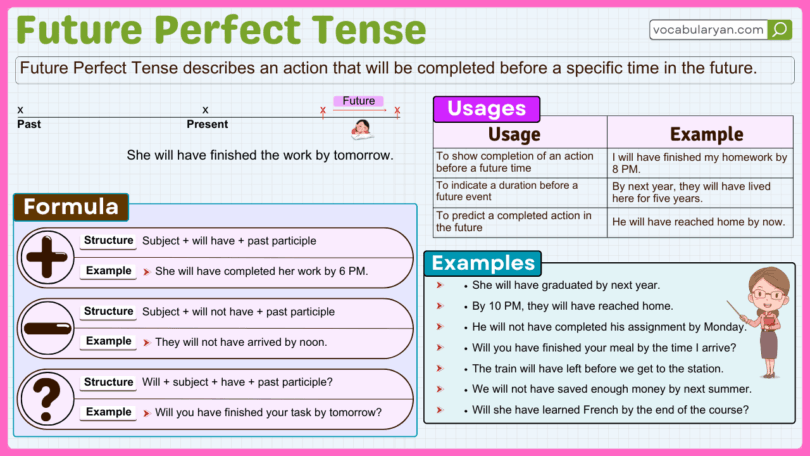
The future perfect tense describes an action complete before a stated or understood future time. It uses will have plus the past participle: By Friday, you will have finished the report. The finish comes before Friday. Identify the deadline first, then choose the form.
What Is the Future Perfect Tense?
The future perfect combines future time with perfect aspect. It places completion before a later future time or action. In “By 6 p.m., Mara will have left the office,” leaving is complete before six. The later time gives the tense its viewpoint. The completed action is earlier than the viewpoint you choose.
Quick check:
- Will have stays the same with every subject.
- After by the time, when, or before, the time clause uses the present simple.
- By marks a deadline; until describes continuation to a time.
How to Form Will Have Plus Past Participle
Formula: subject + will have + past participle
Will have stays unchanged with every subject. Word order and not create the four forms.
| Form | Structure | Example |
|---|---|---|
| Affirmative | Subject + will have + past participle | She will have signed the contract by noon. |
| Negative | Subject + will not have + past participle | The team will not have completed the test by Tuesday. |
| Yes or no question | Will + subject + have + past participle? | Will Amir have returned before dinner? |
| Wh question | Wh word + will + subject + have + past participle? | How many chapters will you have read by Monday? |
Affirmative Form With Will Have
Regular participles end in -ed. Irregular verbs use forms such as written, gone, seen, and frozen.
- By June, I will have worked here for ten years.
- By dawn, the river will have frozen.
Negative Form With Will Not Have
Put not between will and have. The contraction is won’t have.
- Nadia won’t have packed before the taxi arrives.
- We will not have saved enough by August.
Questions and Short Answers With Will Have
Move will before the subject. Put the wh word first for the missing information.
- Will the guests have arrived by 8 p.m.?
- When will you have completed the training?
Short answers: Yes, they will. No, they won’t.
Question tag: Rina will have submitted the form by Friday, won’t she?
When to Use the Future Perfect Tense
Completion before a deadline: The action finishes no later than a future time.
- By 10 a.m., the plumber will have repaired the pipe.
- She will have submitted her application by Friday.
Completion before another future action: The perfect form marks the earlier action. The time clause uses the present simple.
- Before the committee meets, the clerk will have checked every application.
- By the time you call, I will have boarded the train.
A state measured up to a future time: The completed duration of a state matters.
- Next April, they will have owned the house for twenty years.
- By 2030, Dr. Shah will have taught chemistry for three decades.
A confident deduction with by now: Will have also expresses a firm deduction about a completed event.
- Leah will have reached the station by now.
- The courier will have delivered the parcel by now.
Time Expressions for Future Completion
By means “no later than.” Completion occurs before or at the deadline.
| Time expression | Example |
| By tomorrow | I will have edited the proposal by tomorrow. |
| By the end of the week | We will have tested the new system by the end of the week. |
| By the time | By the time class starts, you will have printed the worksheet. |
| Before | They will have cleared the hall before the guests enter. |
| In two hours | The battery will have charged fully in two hours. |
| By then | The museum will have closed by then. |
| By now | Sam will have heard the news by now. |
| At noon | At noon, the plane will have crossed the coast. |
Use until for continuation to a time. Use by for completion.
You will have finished until Friday. ❌
You will have finished by Friday. ✅
Future meaning does not put will inside a time clause.
By the time you will arrive, we will have served dinner. ❌
By the time you arrive, we will have served dinner. ✅
Where Adverbs Go With Will Have
Mid-position adverbs sit after will or after have. Put never after will; already works in either position; just reads most naturally after have.
- By noon, Kai will already have posted the invitations.
- The laboratory will have already released the report before the meeting.
- When you call, we will have just finished rehearsal.
- By retirement, he will never have taken a sick day.
Put only directly before the meaning it limits.
- By Friday, Mei will have reviewed only three files.
- By Friday, Mei will have only reviewed the files, not approved them.
When Not to Use the Future Perfect Tense
Choose another future form when earlier completion is not the intended meaning.
No earlier deadline: Use the simple future without an earlier completion.
- I will call you tomorrow.
- By noon, I will have called you.
Action in progress: Use the future continuous for activity underway at that time.
- At 9 a.m., I will be driving.
- By 9 a.m., I will have driven one hundred miles.
Ongoing duration in focus: Use the future perfect continuous when the activity and its duration matter.
- By June, Ana will have managed the shop for a year.
- By June, Ana will have been managing the shop for a year.
How Completed Actions Differ From Other Future Forms
The same time frame makes each difference visible.
Future Perfect vs Simple Future
The simple future names a future action. The perfect form marks earlier completion.
- Noah will finish the design on Friday.
- By Friday, Noah will have finished the design.
Future Perfect vs Future Continuous
The future continuous marks activity in progress. The perfect form marks completion.
- At 3 p.m., Lila will be presenting the budget.
- By 3 p.m., Lila will have presented the budget.
Future Perfect vs Future Perfect Continuous
The future perfect simple emphasizes completion. The continuous form emphasizes duration.
- By noon, the crew will have repaired the roof.
- By noon, the crew will have been repairing the roof for four hours.
Common Mistakes With Will Have
Using has after will
She will has completed the application by noon. ❌
She will have completed the application by noon. ✅
Using the base verb instead of the past participle
They will have finish the audit before Monday. ❌
They will have finished the audit before Monday. ✅
Leaving out have
We will submitted the files by 5 p.m. ❌
We will have submitted the files by 5 p.m. ✅
Keeping statement order in a question
You will have arrived by six? ❌
Will you have arrived by six? ✅
Using will in the time clause
By the time he will get home, the children will have eaten dinner. ❌
By the time he gets home, the children will have eaten dinner. ✅
Using until for an intended deadline
The report will have been ready until Friday. ❌
The report will have been ready by Friday. ✅
Choosing completion for an action in progress
At noon, Priya will have presented the proposal, and she will still be speaking. ❌
At noon, Priya will be presenting the proposal. ✅
Putting only before the wrong phrase
By July, he only will have completed two modules. ❌
By July, he will have completed only two modules. ✅
Examples Using Will Have and Past Participles
Deadlines:
- By sunrise, the hikers will have reached the shelter.
- The chef will have prepared every dish by 7 p.m.
- By December, the city will have reopened the bridge.
Earlier future actions:
- Before the alarm rings, Maya will have backed up the files.
- By the time the concert begins, the ushers will have checked every ticket.
- Will the train have left before we reach the platform?
Negatives and questions:
- We won’t have painted the room by Saturday.
- Will the doctor have reviewed the test report before the appointment?
- Why will they have closed the road by dawn?
States and deductions:
- Next September, Omar will have lived in Toronto for five years.
- The manager will have read your message by now.
- In two months, you will have completed one hundred hours of practice.
Practice With Will Have and Past Participles
1. Complete the sentence: By 7 p.m., she ___ the final chapter. (finish)
2. Make it negative: They ___ the payment by Monday. (receive)
3. Form a question: ___ Kareem ___ the keys before lunch? (return)
4. Form a wh question: How many lessons ___ you ___ by Friday? (complete)
5. Choose the time-clause verb: By the time the bus will arrive / arrives, we will have waited for an hour.
6. Choose the deadline word: The work will have been finished by / until Tuesday.
7. Choose the tense: I will send / will have sent the email tomorrow.
8. Choose the tense: By tomorrow, I will send / will have sent the email.
9. Choose the tense: At 4 p.m., Dana will be meeting / will have met the client. The meeting starts at 4 p.m.
10. Correct the verb phrase: He will has written the reply by noon.
11. Place already: By six, the shop ___ closed. (will / have / already)
12. Complete the deduction: The flight ___ by now. (land)
Answers:
- 1: will have finished.
- 2: will not have received or won’t have received.
- 3: Will Kareem have returned.
- 4: will you have completed.
- 5: arrives.
- 6: by.
- 7: will send.
- 8: will have sent.
- 9: will be meeting.
- 10: will have written.
- 11: will already have closed.
- 12: will have landed.
FAQs
Q1. Is a time expression required with the future perfect?
Context supplies the deadline when no time expression is stated. In “Call after six; I will have finished by then,” by then refers to six. Without an understood future time, use the simple future.
Q2. Is the future perfect used in spoken English?
Yes. A deadline makes completion relevant: “By the time you get here, we’ll have eaten.” Contractions such as I’ll have, she’ll have, and won’t have sound natural.
Q3. Why does will have occur with by now?
Will have with by now expresses a confident deduction: “Nora will have received the email by now.” The viewpoint is present rather than future.
You May Also Like

Leave a Comment