
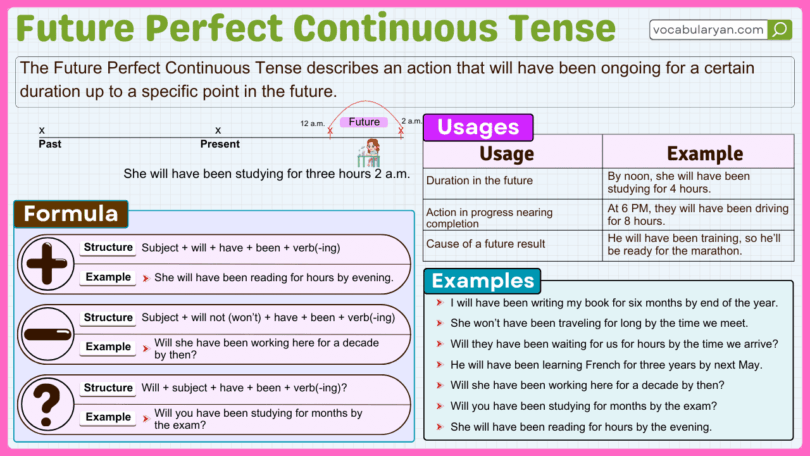
The future perfect continuous tense shows how long an action will have been going on when a future moment arrives. You build it with will have been plus the -ing form of the verb, as in by June, she will have been teaching here for twenty years. The future perfect reports a finish. This one reports a running clock, and that single difference decides almost every choice you make with it.
What Is the Future Perfect Continuous Tense
Every sentence in this form starts from the same mental position. You place yourself at a moment that has not happened yet, then look backward at an activity still in progress when you get there.
At 6 p.m., I will have been working for eight hours.
Six o’clock is the vantage point, and the eight hours are counted backward from it. The activity began earlier, and English does not ask you to say whether that beginning was past, present, or future.
The future perfect continuous tense measures duration up to a future point. The future perfect measures completion by a future point.
Grammar books also call this the future perfect progressive. Both names describe the same form, so choose one and stay with it.
One honest warning before you go further. This is the rarest verb form in English, used in a fraction of one percent of all verbs in written texts. You will meet it in reading passages and exam questions far more than in conversation.
Formula and Sentence Structure for Will Have Been
The formula never changes with the subject. I, you, he, she, it, we, and they all take will have been, so no third-person -s appears anywhere in the string. The present participle is the -ing form of the main verb: teach becomes teaching, run becomes running.
Subject + will have been + present participle
| Form | Pattern | Example |
|---|---|---|
| Affirmative | Subject + will have been + -ing | She will have been teaching for twenty years. |
| Negative | Subject + will not have been + -ing | She will not have been teaching for twenty years. |
| Question | Will + subject + have been + -ing | Will she have been teaching for twenty years? |
| Negative question | Won’t + subject + have been + -ing | Won’t she have been teaching for twenty years? |
British English allows shall have been with I and we in formal writing: by Friday, I shall have been waiting a week. Questions built on shall are rare enough that will is the safer choice in every register.
Affirmative Sentences
Pattern: subject + will have been + present participle.
- The workers will have been building the bridge for a year by next spring.
- By 2030, scientists will have been researching this vaccine for fifteen years.
In speech, will contracts to ‘ll: she’ll have been teaching for twenty years. The contraction is standard in conversation and informal writing, and it disappears in exam answers and formal reports.
Negative Sentences and Contractions
Pattern: not goes between will and have.
- They will not have been living here for a year in March.
- Contracted: They won’t have been living here for a year in March.
Watch one trap here. In January, we will not have been living in California for twenty years has two readings: the twenty years is short, or the place is wrong. The negative attaches to the whole idea rather than one part of it, so rewrite when the meaning has to be exact. In January, we will have been living in California for only nineteen years removes the ambiguity.
Questions and Wh Questions
Pattern: move will in front of the subject and leave have been in place.
- Will you have been waiting long by the time the plane lands?
For a wh-question, put the question word first and keep the same inversion. How long opens most of these questions, since duration is what the sentence measures.
- How long will she have been waiting when we arrive?
- Why will he have been driving for ten hours straight?
Negative Questions and Short Answers
Pattern: won’t + subject + have been + present participle.
- Won’t they have been traveling for two days by then?
Short answers repeat will have rather than the whole verb string.
Will you have been cooking for long? Yes, I will have. / No, I won’t have.
Question tags follow the same rule and reverse the polarity of the statement.
- You will have been working late, won’t you?
- She will not have been eating junk food, will she?
When to Use the Future Perfect Continuous Tense
Three situations call for this form. Outside them, a shorter future tense does the job better and sounds more natural.
Duration Up to a Future Moment
Use it when the sentence answers how long at a future deadline. A duration phrase such as for six hours or since morning has to appear, or the sentence loses its reason to exist in this form.
- By midnight, the team will have been coding for twelve hours straight.
- Next month, they will have been running the shop for five years.
Remove the duration and the sentence stops working. By midnight, the team will have been coding leaves the reader waiting for a number that never comes.
The Cause of a Future Result
Use it to explain why a future state will exist. Two clauses split the work. The result clause: future simple or present simple. The cause clause: future perfect continuous.
- He will be exhausted tonight because he will have been driving all day.
- Her feet will hurt by the end of the shift. She will have been standing for nine hours.
You can reverse the order of the two halves. What stays fixed is which half takes which tense.
Annoyance and Emphasis
The same duration meaning turns critical when the length of time is the complaint.
- By six o’clock, he will have been calling me for eight hours straight.
- By Sunday, that dog will have been barking every night for a month.
What changes: nothing in the grammar. The irritation comes from the length of time, not from the verb form.
Time Expressions That Signal Duration
Two kinds of expression appear in these sentences, and they do different jobs. One marks the deadline. The other measures the stretch of time reaching it.
| Expression | Job | Example |
|---|---|---|
| By 6 p.m. | Sets the deadline | By 6 p.m., I will have been working for eight hours. |
| By next year | Sets the deadline | By next year, she will have been leading the project for five years. |
| By the time you arrive | Sets the deadline as an event | By the time you arrive, I will have been cooking for hours. |
| By then | Sets the deadline from earlier context | By then, she will have been preparing for the test for weeks. |
| Before noon | Sets the deadline | Before noon, she will have been exercising for an hour. |
| For five hours | Measures the duration | They will have been playing for five hours. |
| For a decade | Measures the duration | They will have been living here for a decade. |
| Since morning | Fixes the starting moment | By noon, she will have been studying since morning. |
| Since 2010 | Fixes the starting moment | Next June, he will have been working there since 2010. |
A strong sentence uses one expression from each job.
For or since: for takes a length of time, since takes a starting moment. For three hours and since nine o’clock describe the same stretch from two directions. Mixing them produces since three hours, wrong in every variety of English.
By or by the time: by takes a clock time or a date. By the time takes a whole clause with a verb inside it.
By or until: by names the moment the counting stops, so it gives you a total. Until says the activity keeps going up to that moment and gives no total. By 6 p.m. I will have been waiting three hours reports a number. I will wait until 6 p.m. reports a plan.
Why Time Clauses Never Take a Future Verb
This is the rule that breaks the most sentences. A time clause opens with when, before, after, by the time, as soon as, until, if, or unless, and no future verb goes inside it. The future meaning already comes from the main clause, so repeating it is an error rather than extra precision.
- You won’t get a promotion until you will have been working here as long as Tim. ❌
- You won’t get a promotion until you have been working here as long as Tim. ✅
- By the time you will arrive, I will have been cooking for hours. ❌
- By the time you arrive, I will have been cooking for hours. ✅
The verb inside the time clause goes into a present form, and the reader still reads the whole sentence as future. Check every sentence you write with by the time: the verb straight after it stays present.
Verbs That Cannot Take the Continuous Form
Stative verbs describe a state rather than an activity, and they do not appear in any continuous tense. Know, believe, own, understand, love, seem, and be all belong to this group. When a sentence needs one of them with a duration, the future perfect is the correct form instead.
- On Thursday, I will have been knowing you for a week. ❌
- On Thursday, I will have known you for a week. ✅
- By Friday, I will have been owning this laptop for a year. ❌
- By Friday, I will have owned this laptop for a year. ✅
A handful of stative verbs shift meaning when they describe something temporary, and those versions take the continuous form. Stay, live, feel, and have in the sense of experiencing all work this way.
- She will have been staying at her friend’s place for a month by the time her apartment is ready.
- By next month, she will have been having headaches daily for a year.
The test is whether the verb names an activity with a visible beginning and end. Own has neither. Stay has both.
Future Perfect vs Future Perfect Continuous
Both forms look back from the same future moment. They report different facts about the activity.
| Question | Future perfect | Future perfect continuous |
|---|---|---|
| What it reports | Completion | Duration |
| Typical partner phrase | By 5 p.m. | For three hours |
| Example | By 5 p.m., she will have finished the report. | By 5 p.m., she will have been working for three hours. |
| Says the activity is over | Yes | No |
The decision rule is short. If the sentence answers how long, use the continuous. If it answers what will be done, use the future perfect. By 2030, scientists will have discovered a cure announces a result. By 2030, scientists will have been researching a cure for twenty years announces twenty years of work and promises no result.
Future Continuous vs Future Perfect Continuous
The future continuous puts an activity in progress at one future moment. The future perfect continuous measures the run-up to that moment.
- At 8 p.m., she will be cooking. (in progress at eight)
- By 8 p.m., she will have been cooking for three hours. (three hours completed by eight)
Duration is the deciding factor. Take the duration phrase out of a future perfect continuous sentence and most English speakers switch to the future continuous, because the longer form then adds nothing.
- He will be tired because he will be exercising so hard. (tired at that moment, still exercising)
- He will be tired because he will have been exercising so hard. (tired from the accumulated effort)
Adverb Placement With Will Have Been
Mid-position adverbs go straight after will and in front of have been. That covers always, never, only, just, still, and already.
- You will only have been waiting a few minutes when her plane lands.
- By then, they will just have been finishing their shift.
- She will already have been working for six hours when you get there.
In a question, the adverb keeps the same position after the subject.
- Will you only have been waiting a few minutes when her plane lands?
Adverbs of manner go at the end, after the main verb and anything that follows it.
- The kids will have been playing happily all afternoon.
Going to Have Been as a Second Form
Be going to builds the same tense with no change in meaning.
Pattern: subject + am / is / are going to have been + present participle.
- We are going to have been driving for three days straight when we reach Anchorage.
- She is going to have been working at that company for three years when it closes.
The form is correct and almost nobody says it. Four auxiliaries in a row make a heavy sentence, so will is the version you will hear and the version to write.
Passive Voice With Will Have Been Being
The passive does exist. It is built with will have been being plus the past participle.
- The mural will have been being painted for six months by the time it is finished.
That sentence is grammatical, and almost no one writes it. Searches of real English turn up a handful of genuine uses outside grammar teaching. Five auxiliaries in a row give the reader nothing extra, so writers choose the active version or a plain future perfect passive: the mural will have been painted by June.
Common Mistakes With Will Have Been
1. Dropping been:
- He will have working here for five years. ❌
- He will have been working here for five years. ✅
2. Using the past participle instead of the -ing form:
- She will have been played for an hour. ❌
- She will have been playing for an hour. ✅
3. Changing the auxiliary for the subject:
- They will has been working all day. ❌
- They will have been working all day. ✅
4. Choosing the duration form for a completed action:
- By next year, I will have been finishing my project. ❌
- By next year, I will have finished my project. ✅
Finish names a completed action, so the duration form contradicts the meaning of the verb.
5. Putting a future verb inside the time clause:
- Until she will have been studying for two hours, she won’t stop. ❌
- Until she has been studying for two hours, she won’t stop. ✅
6. Using a stative verb:
- By May, we will have been knowing them for ten years. ❌
- By May, we will have known them for ten years. ✅
Future Perfect Continuous Exercises With Answers
Fill each gap with the correct form of the verb in brackets. The answers follow.
- By 10 a.m., John __________ (work) for four hours.
- Until you __________ (live) here for a year, you won’t understand the winters.
- By May, we __________ (know) each other for ten years.
- She __________ (not attend) the course for long by the end of this week.
- __________ they __________ (travel) for two days by the time they land?
- By the time the guests __________ (arrive), I __________ (cook) for hours.
- By Friday, I __________ (own) this car for exactly a year.
- He’ll be exhausted tonight because he __________ (drive) since dawn.
Answers
- Will have been working
- Have been living, because the time clause takes a present form
- Will have known, because know is stative
- Will not have been attending
- Will they have been traveling
- Arrive, then will have been cooking, with no future verb in the time clause
- Will have owned, because own is stative
- Will have been driving
FAQs
Q1. What is the difference between the future perfect continuous and the present perfect continuous?
The vantage point moves. The present perfect continuous measures a duration up to now, while the future perfect continuous measures a duration up to a chosen future moment. Compare I have been waiting for two hours with by six o’clock, I will have been waiting for two hours.
Q2. Can shall have been replace will have been?
Yes, with I and we, in formal British writing: by Friday, we shall have been working on this for a month. It carries a noticeably formal register, and questions built on shall in this form are rare, so will fits every other situation.
Q3. Does every future perfect continuous sentence need a time expression?
It needs a duration phrase to earn the form. Without for six hours, since morning, or something equivalent, the sentence gives no length to measure and the future continuous becomes the better choice.
Q4. Which tenses go alongside the future perfect continuous in one sentence?
Two pairings cover almost every case. A time clause takes a present form: by the time you arrive, I will have been cooking for hours. A stated result takes the future simple: he will be tired because he will have been driving all day. A future verb never goes inside the time clause itself.

Leave a Comment