
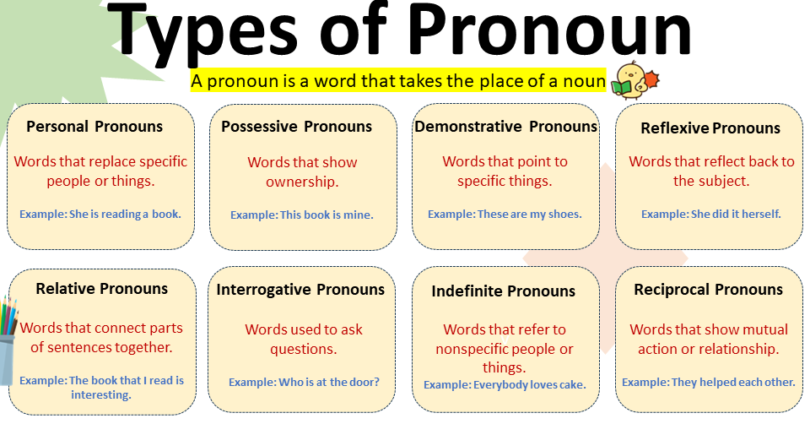
A pronoun replaces a noun or identifies someone or something already understood from context. In “Maya lost Maya’s keys, so Maya retraced Maya’s steps,” the repeated name distracts from the message. Pronouns fix the repetition: “Maya lost her keys, so she retraced her steps.” The types of pronouns show the grammatical job each form performs.
What Is a Pronoun?
A pronoun is a word that functions in place of a noun phrase or identifies a person, object, place, or idea understood from context. The noun or noun phrase it refers to is its antecedent. In “Lena said she was ready,” Lena is the antecedent of she. Pronouns also mark person, number, and grammatical role.
Not every pronoun refers back to a named antecedent. In “I trust you,” the speaker and listener are identified by the conversation. When you identify a pronoun, check what it refers to and whether it acts as a subject, object, or possessive form.
9 Types of Pronouns
The nine types are personal, possessive, demonstrative, interrogative, relative, indefinite, reflexive, intensive, and reciprocal pronouns. Grammar frameworks differ because one framework separates a subgroup that another places inside a broader type. This classification treats distributive forms such as each and neither as indefinite pronouns.
| Pronoun Type | Main Job | Examples |
|---|---|---|
| Personal | Identifies a grammatical person or named referent. | I, me, she, them. |
| Possessive | Shows ownership without a following noun. | Mine, yours, hers, ours. |
| Demonstrative | Points to a specific referent. | This, that, these, those. |
| Interrogative | Asks about a person, choice, or ownership. | Who, whom, what, which, whose. |
| Relative | Introduces a relative clause. | Who, whom, whose, which, that. |
| Indefinite | Refers without naming a specific person or amount. | Someone, nobody, many, none. |
| Reflexive | Refers back to the subject as an object. | Myself, herself, themselves. |
| Intensive | Adds emphasis to a noun or pronoun. | Myself, herself, themselves. |
| Reciprocal | Expresses a mutual relationship or action. | Each other, one another. |
Personal Pronouns
Personal pronouns identify the speaker, the listener, or someone being discussed. Their forms change according to grammatical role. Subject forms perform the verb, while object forms receive the action or follow a preposition.
Rina called me, and I answered immediately. In this sentence, I is the subject of answered, while me is the object of called.
Possessive Pronouns
Possessive pronouns show ownership and stand without a noun: mine, yours, his, hers, ours, and theirs. The form his works both before a noun and independently.
That blue bicycle is hers. The word its occurs before a noun as a possessive determiner, as in “The dog wagged its tail.” It does not serve as a standard independent possessive pronoun.
Demonstrative Pronouns
Demonstrative pronouns point to a specific person, object, or idea. This and these refer to near referents; that and those refer to more distant referents.
These belong to Omar. The word stands alone, so it is a pronoun. In “these books belong to Omar,” these modifies books and functions as a determiner.
Interrogative Pronouns
Interrogative pronouns introduce questions: who, whom, whose, what, and which. Their grammatical role depends on the question.
Who called the office? Here, who is the subject of called. In “Whom did the office call?” whom is the object. The form whom remains standard after a preposition, as in “To whom did you speak?”
Relative Pronouns
Relative pronouns introduce a relative clause and connect it to a noun or pronoun.
The teacher who called yesterday left a message. The antecedent of who is teacher, and the clause “who called yesterday” identifies that teacher. In the school-grammar analysis used here, when and where function as relative adverbs.
Indefinite Pronouns
Indefinite pronouns refer to people, objects, or amounts without naming a specific referent. Singular forms include anyone, each, either, everyone, neither, and nobody. Plural forms include both, few, many, and several.
Everyone has submitted their work. Everyone takes a singular verb, while singular their refers to a person without specifying gender. The agreement of all, any, more, most, none, and some depends on meaning: “All is ready” refers to one total situation, while “All are ready” refers to several people.
Distributive pronouns such as each, either, and neither consider members separately. Some school systems teach them as a tenth type; their grammatical behavior places them within the indefinite group.
Reflexive Pronouns
Reflexive pronouns end in -self or -selves and act as objects that refer back to the subject.
Nora taught herself to code. Nora performs and receives the action, so herself is required for the intended meaning. Removing it leaves “Nora taught,” which does not express what she learned or whom she taught.
Intensive Pronouns
Intensive pronouns use the same -self and -selves forms to emphasize a noun or pronoun. They do not act as required objects.
Nora herself fixed the error. Remove herself, and “Nora fixed the error” keeps the same core meaning. That removal test separates an intensive pronoun from a reflexive pronoun.
Reciprocal Pronouns
Reciprocal pronouns express an action or relationship shared by two or more participants. English uses each other and one another.
The teammates encouraged one another before the match. Modern standard English does not require each other only for two participants or one another only for larger groups.
Pronoun Chart With Subject Object And Possessive Forms
Personal pronouns change according to person and case. Person identifies the speaker, listener, or other referent. Case identifies whether the pronoun functions as a subject, object, or possessive form.
Subject and object forms:
| Person | Subject Pronoun | Object Pronoun |
| First Person Singular | I | me |
| Second Person Singular or Plural | you | you |
| Third Person Singular Masculine | he | him |
| Third Person Singular Feminine | she | her |
| Third Person Singular Neutral | it | it |
| First Person Plural | we | us |
| Third Person Singular or Plural | they | them |
Possessive and self forms:
| Person | Possessive Determiner | Possessive Pronoun | Reflexive or Intensive |
| First Person Singular | my | mine | myself |
| Second Person Singular | your | yours | yourself |
| Second Person Plural | your | yours | yourselves |
| Third Person Singular Masculine | his | his | himself |
| Third Person Singular Feminine | her | hers | herself |
| Third Person Singular Neutral | its | Not used independently | itself |
| First Person Plural | our | ours | ourselves |
| Third Person Singular | their | theirs | themself or themselves |
| Third Person Plural | their | theirs | themselves |
Use singular they when a person’s gender is unknown, irrelevant, or identified with they. The reflexive form themself emphasizes a singular referent, while themselves also remains established in singular use.
Pronouns Versus Determiners
A pronoun stands independently as a subject, object, or complement. A determiner comes before a noun and limits or identifies it. The presence of a following noun provides the fastest test.
| Form | Pronoun Use | Determiner Use |
| This | This is heavy. | This box is heavy. |
| Possessive | The red bag is mine. | My bag is red. |
| Which | Which do you prefer? | Which route do you prefer? |
In “This is mine,” both this and mine stand independently. In “This notebook is my property,” this and my modify nouns.
Pronoun Rules And Common Mistakes
Match the pronoun with its antecedent: A pronoun must agree with its antecedent in person and number. Singular they supplies a gender-neutral form for a singular person.
Every applicant must submit their form by Friday. The singular antecedent every applicant takes a singular verb, while their refers to the applicant.
Choose the correct pronoun case: Use a subject pronoun for the performer of a verb and an object pronoun after a verb or preposition.
The manager invited Sara and I. ❌
The manager invited Sara and me. ✅
Remove Sara and to test the form: “The manager invited me” is correct.
Keep the antecedent unmistakable: A pronoun should identify one clear noun or noun phrase.
When Aisha called Sara, she was waiting outside. ❌
Sara was waiting outside when Aisha called her. ✅
The corrected sentence identifies Sara as the person outside.
Use reflexive forms only when they refer back or add emphasis: Do not replace an ordinary object pronoun with myself to sound formal.
Please email the report to Daniel or myself. ❌
Please email the report to Daniel or me. ✅
Match indefinite pronouns by form and meaning: In formal written English, everyone, each, either, and neither take singular verbs. Both, few, many, and several take plural verbs. The meaning of all, any, most, none, and some determines agreement.
Neither of the answers are correct. ❌
Neither of the answers is correct. ✅
Pronoun Practice Questions
- In “Amir gave her the folder,” what type of pronoun is her, and what role does it perform?
- Choose the correct form: “Mina and I” or “Mina and me” finished first.
- Identify the demonstrative pronoun in “Those are expensive.”
- Is herself reflexive or intensive in “The chef herself served the meal”?
- Is himself reflexive or intensive in “The child dressed himself”?
- Choose the correct verb: “Neither of the routes (is/are) open.”
- Identify the roles of this and mine in “This notebook is mine.”
- Rewrite “When Bilal met Hamza, he was carrying a laptop” so the pronoun reference is unmistakable.
Answer key:
- Her is an object personal pronoun. It receives the action of gave.
- “Mina and I finished first.” The pronoun is part of the subject.
- Those is a demonstrative pronoun because it stands without a following noun.
- Herself is intensive. Removing it leaves the core meaning unchanged.
- Himself is reflexive. The child performs and receives the action.
- “Neither of the routes is open.” Neither takes a singular verb.
- This is a demonstrative determiner because it modifies notebook. Mine is a possessive pronoun because it stands independently.
- One precise revision is “Bilal was carrying a laptop when he met Hamza.”
FAQs
Q1: How Many Types of Pronouns Are There?
English school grammar commonly teaches nine main types of pronouns. Totals differ because some systems separate distributive pronouns as a tenth type, while others place each, either, and neither inside indefinite pronouns.
Q2: What Is an Antecedent in Grammar?
An antecedent is the noun or noun phrase a pronoun refers to. In “Leila found her phone,” Leila is the antecedent of her.
Q3: What Is the Difference Between Reflexive and Intensive Pronouns?
A reflexive pronoun acts as an object and refers back to the subject. An intensive pronoun adds emphasis and remains removable without changing the sentence’s core meaning.
Q4: What Is the Difference Between a Possessive Pronoun and a Possessive Determiner?
A possessive pronoun stands independently, as in “The seat is ours.” A possessive determiner comes before a noun, as in “That is our seat.”