
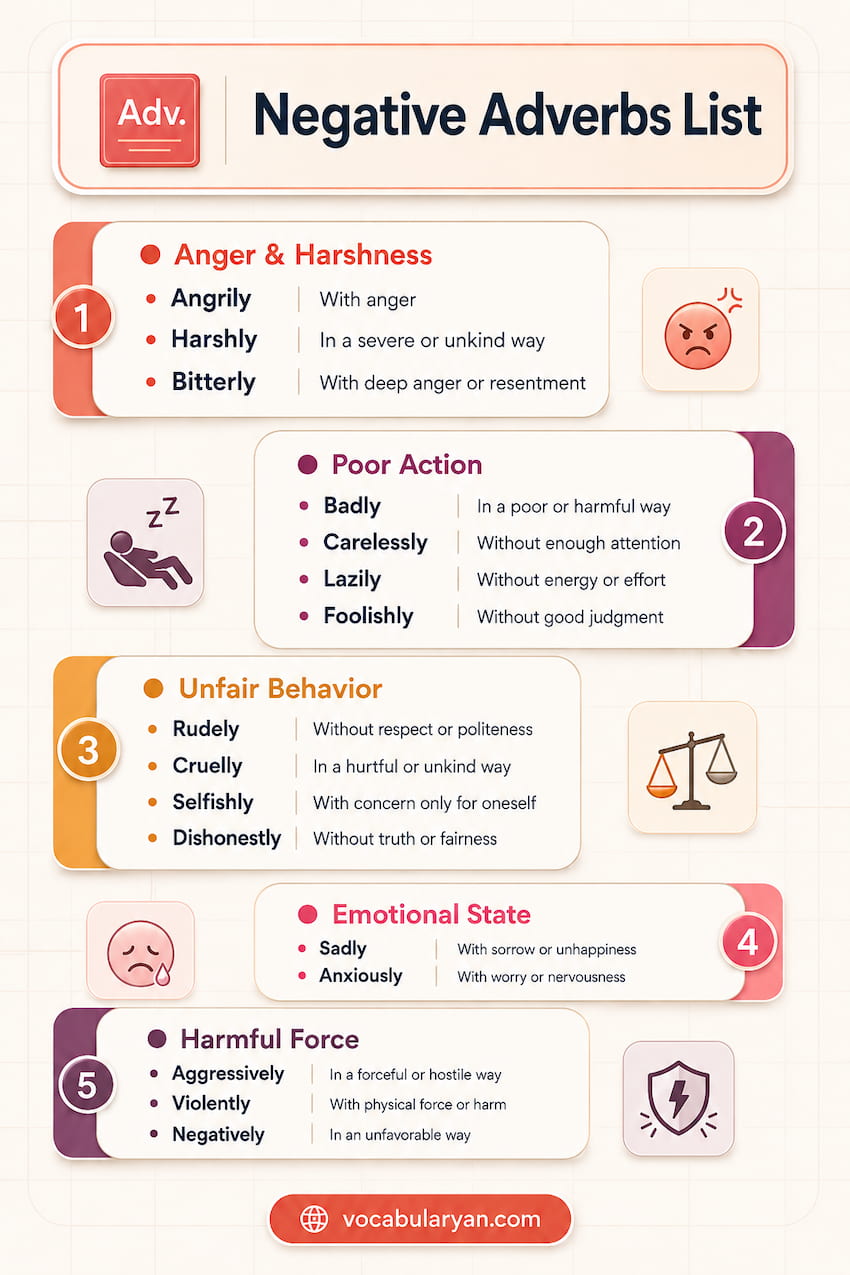
Adverbs decide how an action feels. The same sentence shifts from neutral to damning the moment he answered becomes he answered cruelly, coldly, or contemptuously. Negative adverbs describe an action, tone, or feeling in an unfavorable way, sharpening exactly how something was done and how much it should sting. Most end in -ly and grow straight from negative adjectives: rude becomes rudely, cruel becomes cruelly, lazy becomes lazily. The words ahead are grouped by the sense they convey, with meanings throughout and examples wherever the adverb earns its force in a sentence. One short note keeps them separate from grammar’s negators, such as never and hardly.
💡 Quick answer
A negative adverb describes how an action is done in an unfavorable, harmful, or critical way. Most end in -ly, such as cruelly, angrily, lazily, and miserably, and they grow from negative adjectives. They sharpen tone and judgment, which is different from grammar’s negators like never and hardly.
Negative Adverbs For Cruel And Unkind Actions
Cruelty in action has a vocabulary all its own, from cold indifference to open savagery.
- Cruelly: In a way that causes pain or suffering.
- She cruelly mocked the new recruit until he left the room.
- Brutally: With savage, violent force.
- The regime brutally crushed every protest.
- Viciously: With fierce, spiteful intent to harm.
- He viciously tore apart her work in front of the board.
- Savagely: With wild, merciless ferocity.
- The dog had been savagely beaten before the rescue.
- Mercilessly: Without any pity or relief.
- Critics mercilessly panned the film for weeks.
- Ruthlessly: Without compassion or scruple.
- She ruthlessly cut anyone who slowed the project.
- Callously: With cold disregard for others’ feelings.
- He callously announced the layoffs by group email.
- Heartlessly: Without compassion or remorse.
- They heartlessly turned the family away at midnight.
- Maliciously: With a desire to harm.
- Someone had maliciously spread the rumor before the vote.
- Spitefully: Out of petty resentment.
- He spitefully deleted the shared files on his last day.
- Vindictively: With a craving for revenge.
- She vindictively blocked his promotion twice.
- Sadistically: While taking pleasure in another’s pain.
- The guard sadistically prolonged every inspection.
- Coldly: Without warmth or sympathy.
- He coldly dismissed her apology and walked out.
- Harshly: With severe, punishing roughness.
- The judge spoke harshly to the careless driver.
- Violently: With physical force meant to harm.
- The door was violently kicked off its hinges.
- Inhumanely: With a cruelty unworthy of decency.
- The animals had been kept inhumanely for years.
- Wickedly: With deliberate evil.
- He wickedly schemed to ruin his own brother.
- Nastily: In a mean, unpleasant way.
- She nastily reminded everyone of his old mistake.
- Abusively: With insult or violence.
- He spoke abusively to the staff whenever he lost.
- Tyrannically: With oppressive, domineering cruelty.
- The manager tyrannically controlled every tiny decision.
Negative Adverbs For Anger And Hostility
- Angrily: In a way that reveals strong displeasure.
- She angrily slammed the report on the desk.
- Furiously: With intense, boiling anger.
- He furiously demanded a refund at the counter.
- Bitterly: With deep resentment and hurt.
- They spoke bitterly about the favoritism on the team.
- Resentfully: With sullen, simmering ill will.
- She resentfully agreed to cover yet another shift.
- Aggressively: In a forceful, attacking manner.
- He aggressively cut off everyone who disagreed.
- Belligerently: In a quarrelsome, combative way.
- He belligerently challenged the referee’s call.
- Irritably: With short-tempered annoyance.
- She answered irritably after the tenth interruption.
- Grumpily: In a sullen, bad-humored way.
- He grumpily waved the visitors away.
- Indignantly: With anger at unfairness.
- She indignantly refused to apologize for the truth.
- Scornfully: With contemptuous disdain.
- He scornfully dismissed their best idea.
- Contemptuously: With open scorn.
- She glanced contemptuously at the cheap imitation.
- Venomously: With bitter, poisonous hostility.
- He venomously attacked his former partner online.
- Sullenly: In a silently resentful way.
- The teenager sullenly pushed the food around his plate.
- Snappishly: In a curt, sharp-tempered way.
- She replied snappishly to the simple question.
- Menacingly: In a threatening manner.
- He stepped menacingly toward the smaller man.
- Defiantly: In open, bold resistance.
- She defiantly ignored the new rule.
- Testily: In a short-tempered, touchy way.
- He answered testily when the topic came up again.
- Acrimoniously: With bitter, angry sharpness.
- The talks ended acrimoniously and nobody shook hands.
- Crossly: In an annoyed, peevish way.
- He crossly told the children to be quiet.
- Hostilely: With open antagonism.
- The crowd reacted hostilely to the announcement.
Negative Adverbs For Dishonesty And Deceit
Deceit hides in the manner of an act as much as the act itself.
- Dishonestly: In a way that involves lying or cheating.
- Deceitfully: With intent to mislead.
- Deceptively: In a way that creates a false impression.
- Slyly: In a cunning, secretive way.
- Cunningly: With clever deception.
- Craftily: With shrewd trickery.
- Sneakily: In a furtive, underhanded way.
- Furtively: In a secretive, guilty manner.
- Surreptitiously: In a stealthy, hidden way.
- Treacherously: In a way that betrays trust.
- Falsely: In a way that is untrue.
- Insincerely: Without truly meaning what one says.
- Hypocritically: While condemning what one does oneself.
- Manipulatively: Through unfair control of others.
- Underhandedly: In a secret, dishonest manner.
- Fraudulently: Through deliberate deception for gain.
- Evasively: By dodging the truth.
- Shiftily: In an evasive, untrustworthy way.
- Disingenuously: With feigned sincerity.
- Speciously: In a misleadingly plausible way.
- Calculatingly: With cold, self-serving planning.
- Conspiratorially: In a secretive, plotting way.
- Mendaciously: In a habitually lying way.
- Cynically: With a sour exploitation of others’ trust.
Negative Adverbs For Laziness And Carelessness
- Lazily: Without energy or effort.
- Idly: While doing nothing useful.
- Listlessly: Without energy, interest, or drive.
- Lethargically: In a sluggish, drained way.
- Sluggishly: Slowly and without vigor.
- Drowsily: In a sleepy, dull way.
- Carelessly: Without proper attention or caution.
- Negligently: With a harmful lack of care.
- Sloppily: In a messy, careless way.
- Haphazardly: Without order or planning.
- Recklessly: With careless disregard for danger.
- Heedlessly: While paying no attention to risk.
- Thoughtlessly: Without regard for others or consequences.
- Absentmindedly: While forgetful and inattentive.
- Aimlessly: Without purpose or direction.
- Halfheartedly: Without real effort or conviction.
- Perfunctorily: With minimal effort, as a mere formality.
- Lackadaisically: Without enthusiasm or care.
- Indifferently: With no interest or concern.
- Apathetically: Without feeling or motivation.
- Complacently: With smug, unearned contentment.
- Wastefully: In a way that squanders resources.
- Clumsily: In an awkward, mishandled way.
- Inattentively: Without paying due attention.
Negative Adverbs For Sadness And Distress
Grief colors not just what is done but how, dragging the whole motion down.
- Sadly: In a way that reveals unhappiness.
- She sadly packed up the last of his books.
- Miserably: In a state of wretched unhappiness.
- He sat miserably in the rain waiting for a tow.
- Sorrowfully: With deep grief.
- They sorrowfully lowered the flag to half-mast.
- Mournfully: In a grieving, lamenting way.
- The dog howled mournfully at the locked gate.
- Gloomily: In a dark, low-spirited way.
- He stared gloomily out at the flooded yard.
- Despondently: With dejection and lost hope.
- She despondently filed the fourth rejection.
- Despairingly: With a total loss of hope.
- He looked despairingly at the rising water.
- Dejectedly: In low spirits after disappointment.
- He shuffled off dejectedly when his name was skipped.
- Wretchedly: In deep misery and discomfort.
- She felt wretchedly alone that first winter abroad.
- Forlornly: In a lonely, abandoned way.
- The child waited forlornly by the empty gate.
- Grievously: In a way that causes deep grief or harm.
- The town was grievously wounded by the closures.
- Tearfully: While crying or close to tears.
- She tearfully thanked the rescue crew.
- Disconsolately: Beyond comfort or consolation.
- He wandered the empty house disconsolately.
- Glumly: In a sullen, downcast way.
- They sat glumly through the long rain delay.
- Heartbrokenly: With crushing grief.
- She heartbrokenly read the final letter.
- Helplessly: While powerless to change a bad situation.
- She watched helplessly as the deal fell apart.
- Regretfully: With sorrow over a choice.
- He regretfully declined the offer he had once chased.
- Wearily: In a tired, worn-out way.
- She wearily explained the rules for the third time.
- Bleakly: In a cheerless, hopeless way.
- He spoke bleakly about the months ahead.
- Hopelessly: Without any hope of improvement.
- They were hopelessly behind by halftime.
Negative Adverbs For Fear And Anxiety
- Fearfully: With fear or dread.
- They crept fearfully past the darkened house.
- Nervously: In a tense, jittery way.
- He nervously checked the clock every minute.
- Anxiously: With worried unease.
- She waited anxiously for the test results.
- Apprehensively: With nervous expectation of trouble.
- He eyed the steep trail apprehensively.
- Timidly: In a shy, fearful way.
- The new intern timidly raised a question.
- Warily: With cautious distrust.
- She approached the strange offer warily.
- Frantically: In a wild, panicked rush.
- He searched frantically for the missing passport.
- Desperately: With reckless urgency born of fear.
- They desperately bailed water from the sinking boat.
- Hesitantly: With nervous reluctance.
- She hesitantly agreed to speak first.
- Tremblingly: While shaking with fear.
- He tremblingly opened the official letter.
- Uneasily: With vague discomfort.
- The crowd shifted uneasily as the lights flickered.
- Restlessly: While unable to settle from worry.
- He paced restlessly outside the operating room.
- Suspiciously: With distrust and doubt.
- She eyed the late arrival suspiciously.
- Skittishly: In a jumpy, easily startled way.
- The horse moved skittishly at every sound.
- Fretfully: In a worried, fussing way.
- The baby slept fretfully through the storm.
- Gingerly: With cautious, fearful care.
- He stepped gingerly across the icy porch.
- Distractedly: In an anxious, unfocused way.
- She answered distractedly, her eyes on the door.
- Worriedly: In a troubled, anxious way.
- He worriedly reread the doctor’s note.
Negative Adverbs Of Degree And Intensity
Some adverbs add nothing but intensity, pushing a bad situation toward the extreme.
- Terribly: To a very bad or extreme degree.
- Horribly: In a shockingly bad way.
- Dreadfully: To a distressing, very bad degree.
- Awfully: To an unpleasant or extreme degree.
- Painfully: In a way that causes or reveals suffering.
- Woefully: To a regrettably inadequate degree.
- Tragically: In a way marked by disaster or loss.
- Dismally: In a gloomy, failing way.
- Severely: To a harsh, serious degree.
- Gravely: To a dangerously serious degree.
- Hideously: In a repulsively bad way.
- Appallingly: To a shockingly bad degree.
- Atrociously: In a horrifyingly bad way.
- Disastrously: With ruinous results.
- Catastrophically: To a devastating degree.
- Alarmingly: To a worrying degree.
- Distressingly: In a way that causes distress.
- Frightfully: To an extreme, dismaying degree.
- Excessively: To an unhealthy or harmful excess.
- Unbearably: To a degree too unpleasant to tolerate.
- Pathetically: In a feeble, contemptible way.
- Shamefully: To a disgraceful degree.
- Ruinously: In a way that causes ruin.
- Crushingly: To an overwhelming, defeating degree.
Negative Adverbs For Speech And Manner
Tone of voice turns plain words hostile, and English marks each unpleasant manner of speaking.
- Rudely: In a disrespectful, ill-mannered way.
- He rudely interrupted the speaker mid-sentence.
- Curtly: In a rudely brief way.
- She answered curtly and hung up.
- Bluntly: In a direct, tactless way.
- He bluntly told her the plan would never work.
- Sarcastically: With cutting, mocking irony.
- “Nice of you to join us,” she said sarcastically.
- Mockingly: With scornful ridicule.
- They mockingly repeated his nervous stutter.
- Condescendingly: In a patronizing, superior way.
- He explained the basics condescendingly, as if to a child.
- Patronizingly: While treating others as less capable.
- She smiled patronizingly at the junior staff.
- Dismissively: In a way that brushes others aside.
- He waved the complaint away dismissively.
- Icily: In a cold, unfriendly tone.
- “We are done here,” she said icily.
- Scathingly: With severe, withering criticism.
- The review scathingly dismissed the whole album.
- Coarsely: In a crude, vulgar way.
- He spoke coarsely in front of the guests.
- Crudely: In a rough, offensive manner.
- The joke was crudely told and fell flat.
- Brusquely: In an abrupt, blunt way.
- She brusquely cut the meeting short.
- Snidely: With sly, sneering disrespect.
- He snidely questioned her qualifications.
- Disparagingly: In a belittling way.
- They spoke disparagingly of the old design.
- Derisively: With mocking contempt.
- The crowd laughed derisively at the excuse.
- Tactlessly: Without sensitivity to others’ feelings.
- He tactlessly raised the divorce at dinner.
- Boastfully: While bragging.
- He spoke boastfully about a deal that never closed.
- Insolently: With bold, contemptuous disrespect.
- The recruit answered insolently and drew a reprimand.
- Impatiently: In a restless, irritable way.
- She tapped the desk impatiently during the delay.
- Pompously: In a self-important, inflated way.
- He pompously corrected everyone’s grammar.
- Petulantly: In a sulky, childish way.
- He petulantly refused to share the credit.
Negative Adverbs And Their Gentler Alternatives
The same manner reads as a fault or a virtue depending on the writer’s sympathy.
| Negative adverb | Gentler alternative |
|---|---|
| Stubbornly | Firmly |
| Bossily | Decisively |
| Nosily | Inquisitively |
| Rashly | Boldly |
| Cockily | Confidently |
| Stingily | Frugally |
| Pushily | Persuasively |
| Obstinately | Resolutely |
| Fussily | Carefully |
| Smugly | Assuredly |
| Naively | Trustingly |
| Gullibly | Openly |
| Rigidly | Steadily |
| Impulsively | Spontaneously |
| Showily | Stylishly |
| Pedantically | Precisely |
How To Use Negative Adverbs Without Weakening Your Writing
A strong verb often beats a weak verb propped up by an adverb, so he snapped hits harder than he said angrily. Save the negative adverb for when the manner itself is the point and no single verb captures it. Stacking several -ly words in one sentence drains their force, so one well-aimed adverb does more than three. Tone also shifts with context, since a word that suits sharp criticism reads as cruelty in a kind conversation.
FAQs
Q1. What is a negative adverb?
A negative adverb describes an action, manner, or degree in an unfavorable or critical way. Most end in -ly and grow from negative adjectives, so cruel gives cruelly and rude gives rudely. The word adds an unpleasant judgment to the verb it modifies.
Q2. What are some examples of negative adverbs?
Common ones name cruel action such as cruelly and viciously, anger such as angrily and bitterly, dishonesty such as slyly and deceitfully, laziness such as lazily and carelessly, and sadness such as miserably and gloomily. Degree adverbs such as terribly, horribly, and woefully push a bad situation further.
Q3. Are words like never and hardly negative adverbs?
In grammar, yes: never, hardly, seldom, and rarely are negative adverbs that make a clause negative and can trigger inversion when fronted. In a vocabulary sense, they differ from connotation adverbs like cruelly or bitterly, which describe the tone of an action rather than negate it.
Q4. What is the difference between a negative adverb and a negative adjective?
A negative adjective describes a noun, while a negative adverb describes a verb, adjective, or other adverb. Cruel is the adjective for a person, and cruelly is the adverb for how they act. Most negative adverbs grow from negative adjectives by adding -ly.
Q5. How do I form negative adverbs?
Most form from a negative adjective plus -ly, so harsh becomes harshly and bitter becomes bitterly. Adjectives ending in -y switch to -ily, as angry becomes angrily and lazy becomes lazily. Those ending in -le drop the e for -ly, as in feebly and idly.