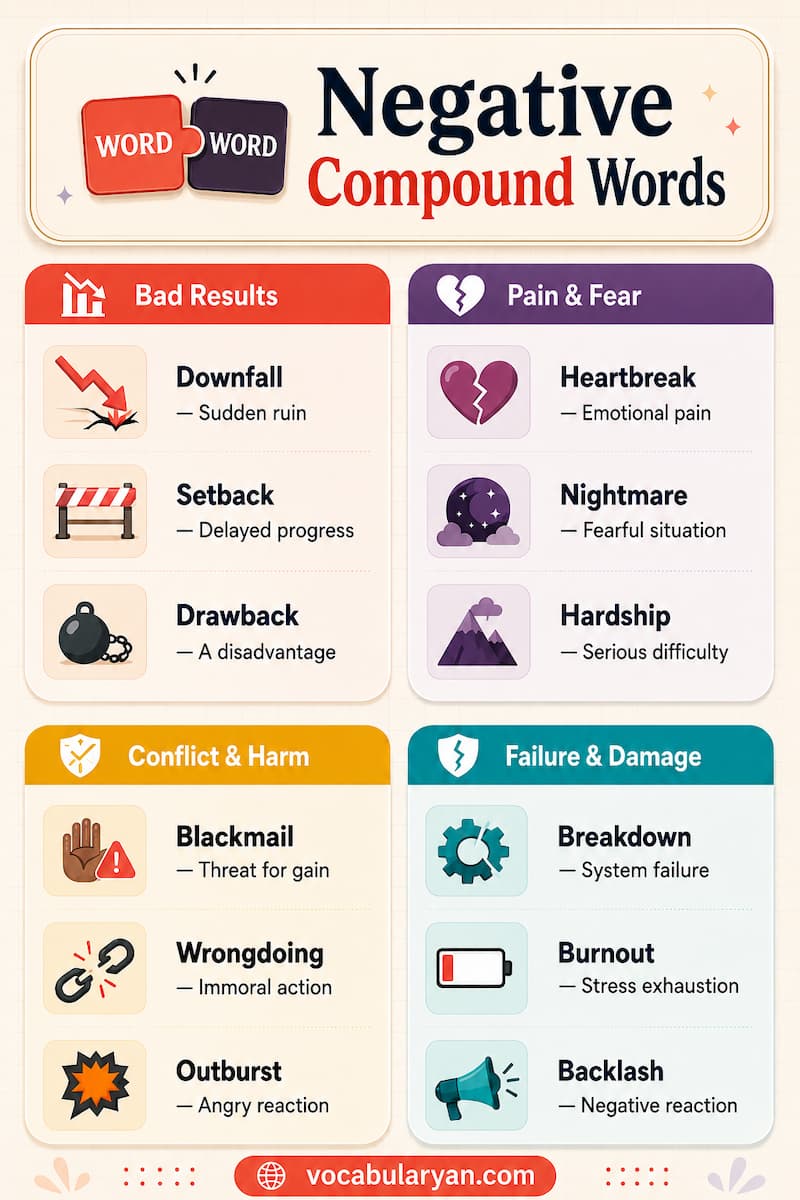
Some words are built to wound. When English joins two ordinary words into one, the result turns darker than either word alone, and that is how heartbreak, downfall, and bad-tempered came about. Negative compound words give a writer a fast, exact way to name grief, conflict, failure, or a flawed character without reaching for a whole phrase. There are more than 140 worth knowing, and the ones that follow are sorted by the feeling they carry, from quiet sadness to open cruelty. Learning them sharpens how you read other people, and it tightens the tone of your own writing.
💡 Quick answer
A negative compound word joins two smaller words into one whose meaning turns painful, hostile, or destructive. Heartbreak, bloodbath, and cold-hearted all work this way. Such words show up closed, hyphenated, or as open pairs, and they cover nouns, adjectives, and verbs alike.
Negative Compound Words with meanings and examples
Negative Compound Words With Meanings
English keeps its harshest words in a few recognizable groups. Grief gathers in one place, violence in another, and slow decline in a third. Whatever the group, the pattern holds: two plain words come together, and the meaning ends up bleaker than either one started.
Emotional Pain And Heartache
Sadness comes in more than one shade, and English has a word for each. Some name a fresh, sudden grief, while others carry the dull ache that settles in and stays. A few sit closer to longing than to loss.
Heartbreak: Overwhelming grief, especially after lost love or deep disappointment.
The slow heartbreak of selling the family home stayed with him long after the keys changed hands.
Heartache: Sustained emotional pain that lingers rather than spikes.
Every unanswered letter added to the quiet heartache she carried for a decade.
Heartbroken: Crushed by sorrow or loss.
She was heartbroken when the rescue dog she had fostered went back to its owner.
Heartsick: Despondent from longing or unresolved loss.
He grew heartsick waiting for news that never came from the front.
Heavy-hearted: Weighed down by sadness or reluctance.
The captain gave the order to retreat heavy-hearted, knowing what it cost his crew.
Downhearted: Discouraged and low in spirit.
Three rejections in a week left the young author thoroughly downhearted.
Downcast: Dejected, with a visibly lowered mood.
His downcast expression told the whole team the verdict before he spoke.
Downbeat: Gloomy and pessimistic in mood or outlook.
The forecast ended on a downbeat note, warning of cuts no one wanted to hear.
Lovesick: Miserable with longing for someone out of reach.
Too lovesick to focus, he reread the same paragraph for an hour.
Homesick: Distressed by being away from home and familiar people.
By the second month abroad she felt deeply homesick for her mother’s kitchen.
Lovelorn: Unhappy because love is unreturned or lost.
The lovelorn poet filled notebooks with verses no one would ever read.
Crestfallen: Suddenly dejected after hope or pride collapses.
He looked crestfallen when his name was skipped on the promotion list.
Woebegone: Looking thoroughly sorrowful and worn down.
A woebegone stray waited by the shuttered diner long after closing.
World-weary: Drained by the troubles and routines of life.
The world-weary detective had stopped expecting anyone to tell the truth.
Soul-crushing: So bleak it drains all hope or motivation.
Years of soul-crushing overtime finally pushed her to quit without a backup plan.
Conflict, Violence, And Disaster
When the subject turns to violence, the words grow heavier. In most of them the first half names the cause and the second half names the harm, which is why they hit so hard. The same shape carries everything from a single death to the ruin of a whole place.
Bloodbath: A massacre or scene of mass killing.
What started as a border skirmish turned into a bloodbath by nightfall.
Bloodshed: Violence that results in killing or injury.
The treaty was signed only after months of pointless bloodshed.
Bloodthirsty: Eager for violence or cruelty.
The mob grew bloodthirsty as rumors spread faster than facts.
Bloodlust: A craving for violence and killing.
Once the riot began, sheer bloodlust drowned out every voice calling for calm.
Manslaughter: The unlawful killing of a person without premeditation.
The driver was charged with manslaughter after the crash on the icy bend.
Doomsday: A day of catastrophe or final reckoning.
The cult’s doomsday prophecy passed quietly, and nothing happened at all.
Nightmare: A terrifying dream, or a waking ordeal that feels like one.
The botched renovation became a financial nightmare that dragged on for years.
Cutthroat: Ruthless and fiercely competitive, with no concern for others.
The cutthroat bidding war left even the winner deep in debt.
Shootout: A violent gun battle between opposing sides.
A late-night shootout outside the warehouse drew every patrol car in the district.
Standoff: A tense deadlock where neither side will give way.
The hostage standoff stretched past dawn before negotiators broke through.
Crossfire: Gunfire from two directions, or a clash that traps bystanders.
Innocent commuters were caught in the crossfire of the rival gangs.
Backlash: A strong hostile reaction against an action or idea.
The price hike triggered a backlash that wiped out a month of goodwill.
Backfire: To produce the opposite, damaging result of what was intended.
His attempt to silence critics backfired and drew ten times the attention.
Firestorm: A sudden, intense outburst of controversy or outrage.
One careless post set off a firestorm that reached the evening news.
Onslaught: A fierce, overwhelming attack.
The small garrison held for three days against a relentless onslaught.
Uproar: Loud public outrage or chaotic protest.
The council’s secret vote caused an uproar at the next town meeting.
Outcry: A loud public expression of anger or protest.
Public outcry forced the studio to recast the role within a week.
Outbreak: A sudden start or spread of something harmful.
An outbreak of food poisoning shut the festival down on its opening day.
Crackdown: A harsh enforcement campaign against an activity.
The new crackdown on unlicensed rentals emptied half the market overnight.
Showdown: A decisive, hostile confrontation.
The budget meeting turned into a showdown between the two department heads.
Lockdown: An enforced confinement or shutdown for safety or control.
The prison went into lockdown the moment the alarm sounded.
Witch-hunt: An unfair campaign to punish people cast as guilty.
The inquiry soon felt less like justice and more like a witch-hunt.
Deathtrap: A place or object that poses a serious danger to life.
Inspectors condemned the old theater as a deathtrap with one blocked exit.
Hellhole: A wretched, miserable place.
The recruits described the flooded barracks as an unlivable hellhole.
Wasteland: A barren, ruined, or desolate stretch of land.
Decades of mining had turned the green valley into a poisoned wasteland.
Quicksand: A trap that pulls you deeper the more you struggle.
Each new loan became quicksand, sinking the business further with every payment.
Failure, Loss, And Setbacks
Not every disaster arrives with a bang. Some losses are quiet: a budget that falls short, a project that stalls, a decline that creeps in over months. That slow kind of damage outlasts the loud kind, and English has a precise word for every stage of it.
Downfall: The ruin or collapse of someone’s power or reputation.
Breakdown: A collapse of a machine, system, or mental state.
Meltdown: A disastrous and uncontrolled collapse.
Fallout: The harmful aftermath of an event or decision.
Setback: A reversal that halts or undoes progress.
Drawback: A disadvantage that weakens an otherwise sound choice.
Shortfall: A deficit between what is needed and what exists.
Downturn: A decline in activity, especially in business or the economy.
Letdown: A disappointment after raised expectations.
Washout: A complete failure or a ruined event.
Downgrade: A drop in status, rank, or quality.
Shutdown: A forced stop or closure of operations.
Slowdown: A deliberate or forced drop in pace and output.
Cutback: A reduction in spending, staff, or services.
Layoff: The dismissal of workers for financial reasons.
Burnout: Exhaustion and collapse caused by prolonged stress.
Comedown: A humbling fall from a better position or mood.
Stalemate: A deadlock where no side can advance.
Deadlock: A total standstill in talks or conflict.
Gridlock: Complete blockage, in traffic or in decision-making.
Pitfall: A hidden danger or trap that catches the unwary.
Shortcoming: A flaw or weakness in a person or plan.
Holdup: A frustrating delay, or an armed robbery.
Downside: The negative aspect of an otherwise appealing choice.
Standstill: A complete halt in movement or progress.
Negative Compound Adjectives For Character And Mood
A single hyphenated word sums up a whole personality flaw. Rather than saying someone loses their temper at the smallest thing, you reach for bad-tempered, and the verdict lands in one stroke. Each entry here comes paired with the sort of phrase it naturally keeps company with.
Bad-tempered: Quick to anger and hard to please. (a bad-tempered reply)
Short-tempered: Easily provoked into irritation. (short-tempered under pressure)
Ill-tempered: Habitually sour and irritable. (an ill-tempered clerk)
Hot-headed: Rash and quick to lose control. (a hot-headed outburst)
Hot-tempered: Prone to sudden, fierce anger. (a hot-tempered rival)
Close-minded: Shut off from new ideas or evidence. (a close-minded board)
Cold-hearted: Lacking warmth, sympathy, or remorse. (a cold-hearted verdict)
Hard-hearted: Unfeeling and unwilling to show mercy. (a hard-hearted refusal)
Two-faced: Friendly to your face but disloyal behind your back. (a two-faced colleague)
Self-centered: Concerned only with one’s own needs. (a self-centered toast)
Self-serving: Acting only to benefit oneself. (a self-serving apology)
Self-righteous: Smugly convinced of one’s own moral superiority. (self-righteous lectures)
Thin-skinned: Easily wounded by criticism. (thin-skinned about reviews)
Big-headed: Conceited and full of self-importance. (a big-headed rookie)
Pig-headed: Stubborn past the point of reason. (pig-headed about directions)
Headstrong: Determined to have one’s own way, regardless of advice. (a headstrong heir)
Foul-mouthed: Given to crude or offensive language. (a foul-mouthed referee)
Sharp-tongued: Cuttingly critical in speech. (a sharp-tongued critic)
Mean-spirited: Unkind, petty, and spiteful. (a mean-spirited prank)
Stuck-up: Arrogantly aloof and superior. (stuck-up senior partners)
Heavy-handed: Harsh, clumsy, or overbearing in approach. (heavy-handed edits)
High-handed: Domineering and dismissive of others. (a high-handed memo)
Hard-nosed: Tough, practical, and unsympathetic. (a hard-nosed negotiator)
Absent-minded: Forgetful and inattentive to the present. (an absent-minded professor)
Half-witted: Foolish and slow to understand. (a half-witted scheme)
Short-sighted: Blind to long-term consequences. (a short-sighted policy)
Faint-hearted: Timid and lacking nerve. (not for the faint-hearted)
Lily-livered: Cowardly and easily frightened. (a lily-livered rival)
Half-hearted: Done without real effort or conviction. (a half-hearted apology)
Tight-fisted: Reluctant to spend or share money. (a tight-fisted landlord)
Power-hungry: Driven by an excessive desire for control. (a power-hungry deputy)
Ill-fated: Doomed to misfortune or failure. (an ill-fated expedition)
Ill-mannered: Rude and lacking basic courtesy. (an ill-mannered guest)
Ham-fisted: Clumsy and lacking finesse. (a ham-fisted cover-up)
Trigger-happy: Too eager to use force or take drastic action. (a trigger-happy manager)
Bloodcurdling: So horrifying it chills you to the core. (a bloodcurdling scream)
Nerve-racking: Causing intense anxiety or tension. (a nerve-racking wait)
Backbreaking: Physically exhausting and grueling. (backbreaking labor)
Mind-numbing: Dull to the point of deadening the mind. (a mind-numbing video)
Gut-wrenching: Causing deep distress or anguish. (a gut-wrenching interview)
Hair-raising: Terrifying or alarming. (a hair-raising shortcut)
Negative Compound Words For People And Behavior
People earn these labels through their behavior, not bad luck. English keeps a blunt noun ready for the betrayer, the meddler, the coward, and the miser, and none of them needs explaining. A short example beside each one brings the type to life.
Backstabber: Someone who betrays a person who trusted them.
He smiled through every meeting, but the leaked emails marked him a backstabber.
Backbiter: Someone who slanders others when they are absent.
The office backbiter praised you in person and shredded you by text.
Troublemaker: Someone who deliberately stirs up conflict.
Management branded the union rep a troublemaker for asking hard questions.
Rabble-rouser: Someone who whips up anger in a crowd.
A practiced rabble-rouser turned a calm rally into a shoving match.
Fearmonger: Someone who spreads alarm to manipulate others.
The fearmonger sold survival kits by inventing a fresh crisis every month.
Warmonger: Someone who pushes for war or aggression.
Critics painted the minister as a warmonger chasing a fight abroad.
Naysayer: Someone who reflexively rejects or doubts every plan.
Every meeting had one naysayer who killed ideas before they breathed.
Doomsayer: Someone who constantly predicts disaster.
The market doomsayer had forecast ten of the last two recessions.
Killjoy: Someone who drains the fun out of any moment.
Don’t be a killjoy and cancel the trip over a little rain.
Spoilsport: Someone who ruins the enjoyment of others.
The neighborhood spoilsport reported the kids’ lemonade stand to the council.
Busybody: Someone who pries into matters that are not theirs.
A busybody at the front desk logged every visitor’s business as her own.
Tattletale: Someone who reports others’ minor faults to authority.
No one trusted the class tattletale with a single secret.
Wrongdoer: Someone guilty of an offense or immoral act.
The policy punished whistleblowers as harshly as the actual wrongdoers.
Lawbreaker: Someone who violates the law.
Jaywalkers were treated as serious lawbreakers under the strict new code.
Outlaw: A person who lives outside the law as a criminal.
The frontier town hired its meanest outlaw as sheriff and hoped for the best.
Turncoat: Someone who betrays a cause by switching sides.
Old comrades spat the word turncoat when he joined the rival party.
Scapegoat: Someone blamed for faults that are not their own.
He played the scapegoat for decisions he never even made.
Slumlord: A landlord who exploits tenants in neglected housing.
The slumlord collected rent on flats he refused to heat or repair.
Freeloader: Someone who takes from others without contributing.
Every shared house has one freeloader who never buys the milk.
Pickpocket: A thief who steals from people’s pockets and bags.
A skilled pickpocket worked the crowded platform without a soul noticing.
Conman: A swindler who cheats people through deception.
The charming conman sold the same vacant lot to four different buyers.
Hitman: A killer hired to murder a target.
Prosecutors claimed the businessman had paid a hitman to silence a witness.
Tightwad: A person unwilling to part with money.
Such a tightwad, he reused the same birthday card for years.
Cheapskate: A stingy person who avoids spending at any cost.
Their cheapskate boss split one pizza among the whole night shift.
Hothead: An impulsive person who loses temper easily.
Coaches benched the hothead before his temper drew another foul.
Loudmouth: A tactless person who talks too much and too boldly.
The party loudmouth announced everyone’s salaries before the appetizers arrived.
Windbag: A person who talks at length and says little.
The keynote windbag ran an hour over and never reached his point.
Showoff: A person who flaunts abilities to impress others.
The pool showoff attempted a backflip and belly-flopped in front of everyone.
Know-it-all: Someone who claims to know everything and ignores correction.
The team know-it-all rewrote the manual the engineers had spent months testing.
Sourpuss: A habitually gloomy, sullen person.
Even at the surprise party, the family sourpuss complained about the cake.
Crybaby: Someone who complains or weeps over small troubles.
Calling a teammate a crybaby for being injured cost the captain his armband.
Pushover: A person too weak-willed to resist pressure.
Vendors saw the new buyer as a pushover and padded every invoice.
Outcast: A person rejected or excluded by a group.
One honest review turned the critic into an industry outcast overnight.
Lowlife: A disreputable, morally degraded person.
The bar drew every lowlife within ten miles after midnight.
Good-for-nothing: A lazy, worthless person.
His uncle dismissed him as a good-for-nothing until the business took off.
How Negative Compound Words Are Spelled
Spelling depends on how settled a word has become. The oldest ones are written closed, as a single solid word. Newer or more descriptive pairings hold on to their hyphen, and a few stubborn ones stay split into two words even after the meaning fixes. One rule is worth remembering: a compound adjective takes a hyphen before its noun, then drops it afterward, so you write a short-sighted plan but the plan was short sighted.
Closed
Hyphenated
Open
Heartbreak
Bad-tempered
Witch hunt
Downfall
Cold-hearted
Dead end
Bloodshed
Self-centered
Sob story
Busybody
Short-sighted
Hard luck
Positive And Negative Compound Words Compared
The same two halves swing either way. Swap one piece for its opposite and the whole mood flips, and that is why these pairs line up so neatly side by side.
Positive compound
Negative compound
Heartwarming
Heartbreaking
Lighthearted
Downhearted
Open-minded
Narrow-minded
Warm-hearted
Cold-hearted
Easygoing
Hot-headed
Self-assured
Self-centered
Outgoing
Standoffish
Good-natured
Mean-spirited
FAQs
Q1. What are negative compound words?
Negative compound words are single words formed from two smaller words whose combined sense is painful, hostile, harmful, or critical. Heartbreak, bloodbath, downfall, and cold-hearted all qualify. The negativity comes from the merged meaning, not from any prefix, which separates them from words like unkind or dislike.
Q2. What are some examples of negative compound words?
Common examples include heartbreak, heartache, downfall, breakdown, backlash, nightmare, bloodbath, and meltdown among nouns, and bad-tempered, cold-hearted, two-faced, and narrow-minded among adjectives. Words for people include backstabber, troublemaker, killjoy, and scapegoat.
Q3. Is unhappy a compound word?
No. Unhappy is built from the prefix un- attached to the adjective happy, which makes it a derived word rather than a compound. A true compound joins two standalone words, as heartbreak joins heart and break. The same logic rules out dislike, unkind, and impolite.
Q4. Are negative compound words always written as one word?
No. They take three forms: closed as one word, as in downfall and bloodshed; hyphenated, as in bad-tempered and self-centered; and open as two words, as in witch hunt. A compound adjective before a noun almost always takes a hyphen.
Q5. What are negative compound adjectives?
Negative compound adjectives are two-word descriptors, normally hyphenated, that assign an unfavorable trait. Bad-tempered, cold-hearted, narrow-minded, thin-skinned, and pig-headed each condense a flaw of mood, attitude, or character into one judgment placed before a noun.
I’m Ethan Walker, cofounder of Vocabularyan.com. Over 12 years in ESL and English learning, I’ve worked closely with vocabulary practice, learner writing, phrase use, and the sentence habits that shape fluent expression. I write with a practical eye for the English learners meet every day, from study notes to conversations and online writing.