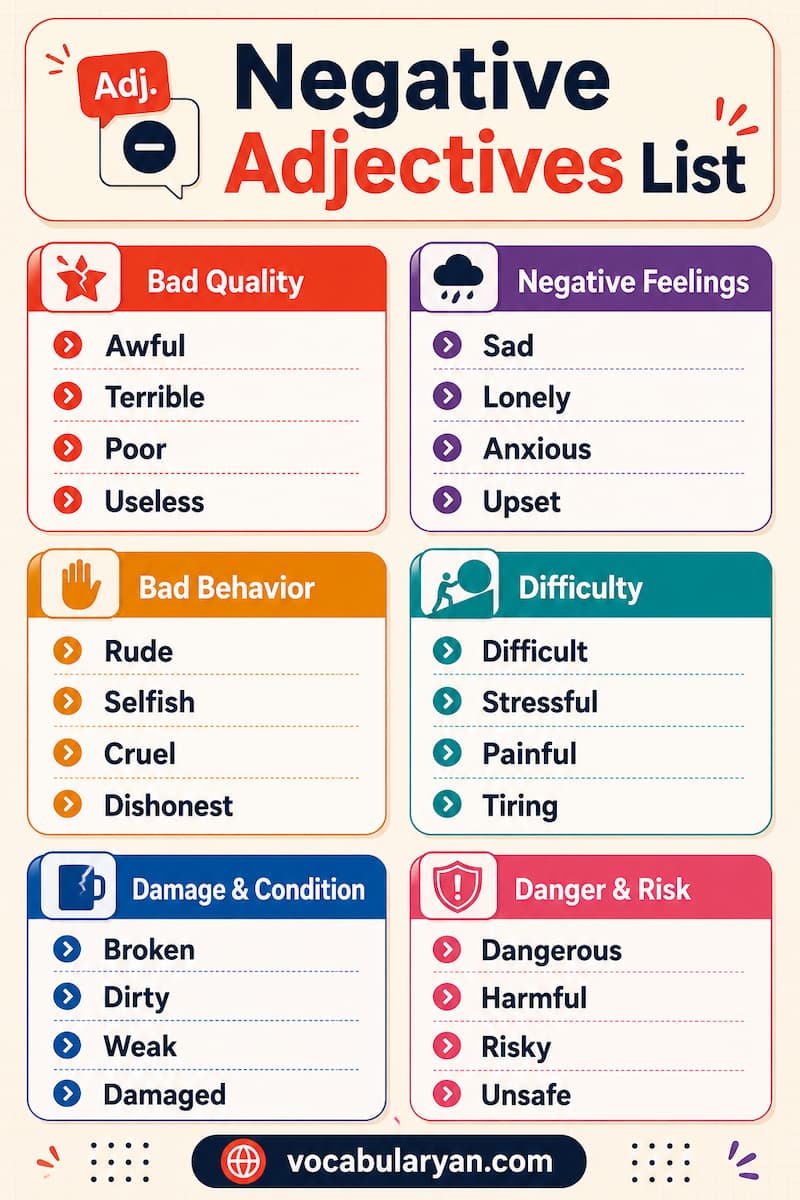
Verbs do the heavy lifting in any sentence, and the harshest ones strike before an adjective gets a chance. He ruined it, she betrayed them, the storm destroyed everything: each verb names damage on its own. Negative verbs describe harmful, hostile, or distressing actions, the things people and forces do to wreck, wound, deceive, or grieve. Choosing the exact one, rather than a flat did something bad, gives a sentence force and momentum. The verbs ahead are grouped by the kind of harm they name, with meanings throughout and examples wherever the verb works best in motion.
💡 Quick answer
A negative verb names a harmful, hostile, or unpleasant action, such as destroy, betray, abuse, mock, or suffer. Their negative meaning lives in the action itself, which differs from grammatical negation like do not or never. Grouping them by the kind of harm makes the right one quick to reach.
Negative Verbs List for harmful actions
Verbs Of Harm And Destruction
These verbs do not bruise; they break, ruining what they touch.
Destroy: To ruin or wreck completely.
The fire destroyed the archive in under an hour.
Damage: To harm so that value or function drops.
Salt water damaged the engine beyond repair.
Wreck: To smash or ruin entirely.
One bad decision wrecked the whole project.
Ruin: To spoil or bring to collapse.
The scandal ruined a thirty-year career.
Demolish: To tear down or flatten.
Crews demolished the old stadium overnight.
Shatter: To break violently into pieces.
The news shattered every plan they had made.
Devastate: To lay waste or overwhelm.
The flood devastated the coastal villages.
Crush: To press or defeat with overwhelming force.
The verdict crushed the family’s last hope.
Sabotage: To wreck deliberately and in secret.
A rival had sabotaged the launch from inside.
Corrupt: To spoil or make rotten.
Power slowly corrupted the once-honest official.
Spoil: To impair or render useless.
Heat had spoiled the entire shipment.
Mar: To disfigure or detract from.
A single error marred an otherwise flawless record.
Wither: To dry up and decay.
Neglect withered the garden to brown stalks.
Poison: To contaminate or harm with toxins.
Runoff had poisoned the village well.
Tarnish: To stain a reputation or surface.
The leak tarnished the brand for years.
Undermine: To weaken from beneath.
Constant doubt undermined her confidence.
Erode: To wear away gradually.
Inflation eroded their savings month by month.
Annihilate: To destroy utterly.
The blast annihilated the outpost.
Verbs Of Violence And Attack
When force enters the sentence, the verb itself draws blood.
Attack: To set upon with force.
Looters attacked the shuttered store at dawn.
Assault: To strike violently.
He was charged after he assaulted a steward.
Strike: To hit with a blow.
The boxer struck before the bell finished.
Beat: To hit repeatedly.
Guards had beaten the prisoners for sport.
Stab: To pierce with a sharp point.
The victim was stabbed in a crowded square.
Slay: To kill violently.
Legend says the knight slew the beast at dawn.
Murder: To kill unlawfully and deliberately.
He was convicted of having murdered two rivals.
Maim: To wound so as to cripple.
The blast maimed three bystanders.
Choke: To strangle or block the airway.
Smoke choked the trapped workers.
Pummel: To strike repeatedly with heavy blows.
Waves pummeled the little boat for hours.
Trample: To crush underfoot.
The stampede trampled the front rows.
Batter: To strike with heavy, repeated force.
The storm battered the harbor wall.
Ambush: To attack from hiding.
Raiders ambushed the convoy at the pass.
Invade: To enter by force and seize.
The army invaded at first light.
Wound: To injure the body.
Shrapnel wounded half the platoon.
Threaten: To promise harm.
He threatened the witness before the trial.
Verbs Of Conflict And Opposition
Argue: To dispute angrily.
Quarrel: To fall into a heated dispute.
Fight: To struggle against by force or words.
Clash: To collide or conflict openly.
Oppose: To resist or stand against.
Resist: To fight off or refuse to yield.
Defy: To boldly refuse to obey.
Reject: To refuse or cast aside.
Refuse: To decline firmly.
Object: To express strong disapproval.
Protest: To object publicly and forcefully.
Rebel: To rise against authority.
Provoke: To stir up anger or trouble.
Antagonize: To turn someone hostile.
Contradict: To assert the opposite.
Confront: To face down in hostility.
Verbs Of Deception And Betrayal
Dishonesty has its own active vocabulary, the verbs of the lie and the long con.
Lie: To say what is untrue.
He lied about his whereabouts that night.
Deceive: To mislead deliberately.
The ads deceived thousands of buyers.
Cheat: To act dishonestly for gain.
She cheated her partners out of their share.
Betray: To break faith with someone.
He betrayed the friend who had vouched for him.
Trick: To fool by cunning.
Scammers tricked the elderly couple by phone.
Swindle: To cheat out of money.
The broker swindled clients for a decade.
Mislead: To lead into error.
Vague labels mislead shoppers daily.
Manipulate: To control by unfair means.
He manipulated the vote behind closed doors.
Con: To defraud after winning trust.
She conned her way into the building.
Defraud: To cheat through deception.
They defrauded the fund of millions.
Double-cross: To betray a partner in deceit.
His own crew double-crossed him at the border.
Frame: To incriminate falsely.
Fresh evidence suggests he was framed.
Forge: To make a fraudulent copy.
She forged the signatures on every form.
Pretend: To feign falsely.
He pretended a sympathy he did not feel.
Scam: To defraud through a dishonest scheme.
Bots scammed users with fake refunds.
Dupe: To deceive a trusting person.
Investors were duped by doctored figures.
Verbs Of Cruelty And Abuse
Abuse: To treat with cruelty or violence.
The report found staff had abused residents.
Torment: To inflict prolonged suffering.
Bullies tormented him through every grade.
Torture: To inflict severe pain to punish or coerce.
Prisoners were tortured for confessions.
Bully: To intimidate the weaker.
He bullied anyone who would not flatter him.
Oppress: To keep down by harsh power.
The regime oppressed every minority.
Exploit: To use unfairly for gain.
Factories exploited child labor for years.
Mistreat: To handle cruelly or unfairly.
Witnesses said the animals were mistreated.
Persecute: To harass relentlessly.
The sect was persecuted for its beliefs.
Harass: To pester with hostile attention.
Callers harassed her at all hours.
Intimidate: To frighten into submission.
Thugs intimidated witnesses before the hearing.
Terrorize: To fill with terror.
Raids terrorized the border towns.
Humiliate: To strip of dignity.
He humiliated the intern in front of clients.
Degrade: To reduce in dignity or worth.
The work degraded everyone forced to do it.
Enslave: To force into bondage.
Debt enslaved the migrant workers.
Victimize: To single out for harm.
Scammers victimize the most trusting.
Brutalize: To treat with savage cruelty.
War brutalized a whole generation.
Verbs Of Decline And Failure
Some verbs trace a slow slide rather than a single blow.
Fail: To fall short of success.
Collapse: To break down or cave in.
Crumble: To break apart gradually.
Decay: To rot or deteriorate.
Deteriorate: To grow steadily worse.
Decline: To weaken or fall away.
Worsen: To become worse.
Sink: To drop or go under.
Falter: To lose strength or steadiness.
Stumble: To trip or err.
Flounder: To struggle helplessly.
Stall: To lose momentum and stop.
Wane: To dwindle or fade.
Dwindle: To shrink steadily.
Lapse: To slip into a worse state.
Backfire: To produce a harmful, opposite result.
Slump: To drop suddenly in value or spirit.
Regress: To revert to a worse condition.
Verbs Of Loss And Taking
Steal: To take what is not yours.
Rob: To take by force or threat.
Plunder: To loot, often in war.
Loot: To steal amid chaos.
Seize: To take hold of forcibly.
Snatch: To grab suddenly.
Embezzle: To steal entrusted funds.
Lose: To be deprived of.
Squander: To waste recklessly.
Waste: To use up pointlessly.
Deprive: To strip of something needed.
Strip: To remove or rob entirely.
Confiscate: To seize by authority.
Extort: To obtain by threat.
Pilfer: To steal small amounts.
Forfeit: To lose as a penalty.
Verbs Of Negative Emotion And Suffering
Suffering is something a person does, and English gives each shade its own verb.
Hate: To feel intense dislike.
Loathe: To detest deeply.
Despise: To regard with contempt.
Resent: To feel bitter about.
Dread: To fear greatly.
Fear: To be afraid of.
Suffer: To endure pain or hardship.
Grieve: To mourn deeply.
Mourn: To sorrow over a loss.
Lament: To express grief.
Despair: To lose all hope.
Worry: To dwell anxiously.
Agonize: To suffer mental anguish.
Brood: To dwell darkly on troubles.
Sulk: To withdraw in silent resentment.
Envy: To resent another’s good fortune.
Pine: To waste away with longing.
Cringe: To shrink in fear or embarrassment.
Tremble: To shake with fear.
Weep: To cry from grief.
Verbs Of Criticism And Verbal Harm
Words wound too, and these verbs name the harm done by the tongue.
Insult: To offend with contempt.
He insulted the host before the soup arrived.
Mock: To ridicule scornfully.
Classmates mocked her accent for weeks.
Ridicule: To make fun of cruelly.
Critics ridiculed the early prototype.
Belittle: To make seem small or worthless.
He belittled every idea but his own.
Criticize: To judge harshly.
Reviewers criticized the rushed ending.
Condemn: To denounce as wrong.
Leaders condemned the attack at once.
Blame: To hold responsible for a fault.
Management blamed the intern for the outage.
Scold: To rebuke angrily.
She scolded the children for the mess.
Berate: To rebuke at length and loudly.
The coach berated the team at halftime.
Slander: To defame by spoken lies.
He slandered a rival on the broadcast.
Disparage: To speak of as worthless.
They disparaged the old methods openly.
Taunt: To provoke with mockery.
The crowd taunted the visiting keeper.
Sneer: To express open scorn.
He sneered at their modest budget.
Nag: To pester with complaints.
She nagged him about the unpaid bill.
Curse: To swear at or wish harm on.
He cursed the driver who cut him off.
Accuse: To charge with wrongdoing.
They accused her without a shred of proof.
Denounce: To publicly declare wrong.
The board denounced the leaked memo.
Heckle: To interrupt with jeers.
Protesters heckled the speaker offstage.
Verbs Of Neglect And Avoidance
Neglect: To fail to care for.
Ignore: To refuse to notice.
Abandon: To desert or leave behind.
Forsake: To give up on entirely.
Desert: To abandon a duty or person.
Avoid: To keep away from.
Evade: To escape by cleverness.
Dodge: To slip out of.
Shun: To deliberately exclude.
Disregard: To pay no attention to.
Dismiss: To brush aside as unworthy.
Overlook: To fail to notice or act on.
Withhold: To keep back what is owed.
Snub: To rebuff coldly.
Exclude: To shut out.
Procrastinate: To put off needlessly.
Strong Negative Verbs That Replace Weak Phrases
One sharp verb can replace a whole weak phrase.
Weak phrase
Strong verb
Looked angrily
Glared
Said sharply
Snapped
Said harshly
Barked
Walked heavily
Trudged
Walked angrily
Stormed
Held tightly
Clutched
Pushed roughly
Shoved
Pulled hard
Yanked
Threw carelessly
Hurled
Stared rudely
Gawked
Cried loudly
Wailed
Ate greedily
Devoured
Spoke on and on
Droned
Laughed cruelly
Jeered
How To Use Negative Verbs For Stronger Writing
A single strong verb often beats a verb propped up by an adverb, so glared hits harder than looked angrily and snapped beats said sharply. The sharp verb names the action and its tone at once, which keeps prose lean and vivid. Reserve plainer verbs for moments that need no heat, and let the strong negative verb do the work where the action itself sets the tone. One precise verb also reads cleaner than a string of adjectives piled onto a weak one.
FAQs
Q1. What is a negative verb?
A negative verb names an action or state that is harmful, hostile, or distressing, such as destroy, betray, abuse, or grieve. The negativity lives in the verb’s meaning, not in any added word, which sets it apart from grammatical negation like do not or never.
Q2. What are some examples of negative verbs?
Common ones name harm such as destroy and ruin, violence such as attack and stab, deception such as lie and betray, cruelty such as abuse and torment, and suffering such as grieve and despair. Verbs of criticism such as mock and belittle name the harm words can do.
Q3. Are words like do not and never negative verbs?
No. Those belong to grammatical negation, which turns a verb negative with not, never, or n’t, as in did not go. Negative verbs in the vocabulary sense already mean something harmful on their own, like betray or destroy, with no helper word required.
Q4. How do negative verbs make writing stronger?
A precise negative verb replaces a weak verb-and-adverb pair, so glared beats looked angrily and snapped beats said sharply. The sharp verb states the action and its tone together, keeping prose lean. Strong verbs also do more than piled-on adjectives, since the action itself supplies the feeling.
Q5. What is the difference between a negative verb and a negative adjective?
A negative verb names a harmful action, while a negative adjective describes a quality. Betray and destroy are verbs; cruel and dishonest are adjectives. The verb captures the harm as it happens; the adjective labels the person or thing behind it.
I’m Ethan Walker, cofounder of Vocabularyan.com. Over 12 years in ESL and English learning, I’ve worked closely with vocabulary practice, learner writing, phrase use, and the sentence habits that shape fluent expression. I write with a practical eye for the English learners meet every day, from study notes to conversations and online writing.