
Add the right two or three letters to the front of a word and you flip its meaning. Happy becomes unhappy, possible becomes impossible, and honest becomes dishonest. Negative prefix words are built this way, with a prefix such as un-, in-, im-, dis-, or mis- that turns a root into its opposite, or marks it as wrong, missing, or reversed. The hard part is choosing the right prefix, since unhappy works but inhappy does not. The words ahead are grouped by prefix, with meanings throughout, plus a section on which prefix to pick and the traps where the letters look negative but are not.
💡 Quick answer
A negative prefix word is a root with a prefix that gives it a negative meaning, such as unfair, impossible, dishonest, or misuse. The common negative prefixes are un-, in-, im-, il-, ir-, dis-, mis-, non-, de-, a-, anti-, and dys-. Each marks the root as not, opposite, wrong, without, or against.
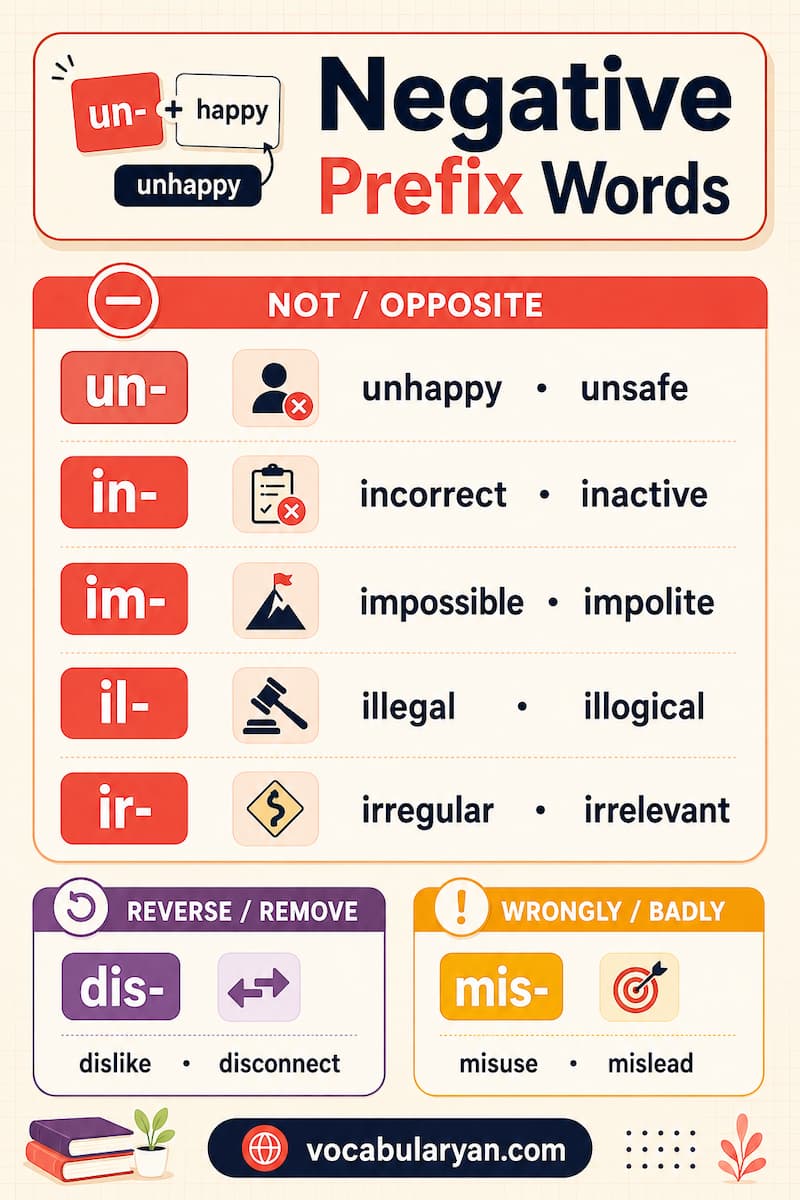
Negative Words With Un-
Un- is the most flexible negative prefix, attaching to adjectives, participles, and many verbs to mean not or the reverse.
- Unhappy: sad or discontented.
- Unfair: unjust or one-sided.
- Unkind: harsh or unsympathetic.
- Unable: lacking the power or skill to do something.
- Unsafe: dangerous or risky.
- Unhealthy: harmful to health, or in poor health.
- Unaware: having no knowledge of something.
- Unclear: confusing or hard to follow.
- Uncertain: doubtful or not settled.
- Uncomfortable: causing unease in body or mind.
- Unconscious: not awake or not aware.
- Unavoidable: impossible to prevent.
- Unbelievable: too extreme to be believed.
- Unbearable: too unpleasant to tolerate.
- Unbreakable: impossible to break.
- Undeniable: too obvious to be denied.
- Unemployed: out of work.
- Unequal: not matched in size, value, or fairness.
- Unexpected: surprising or unforeseen.
- Unfinished: not brought to completion.
- Unfriendly: cold or hostile toward others.
- Ungrateful: failing to show thanks.
- Unjust: unfair or undeserved.
- Unlucky: dogged by bad fortune.
- Unnecessary: not needed; avoidable.
- Unpleasant: disagreeable or off-putting.
- Unpopular: disliked by many.
- Unreliable: not to be depended on.
- Unwilling: reluctant or resistant.
- Unusual: rare or out of the ordinary.
Negative Words With In-
In- means not and pairs mainly with Latin-rooted adjectives, keeping its form before most consonants and vowels.
- Incorrect: wrong or mistaken.
- Incomplete: lacking parts; unfinished.
- Invisible: impossible to see.
- Inactive: idle or not in use.
- Inadequate: insufficient for the need.
- Inability: a lack of power or skill.
- Incapable: lacking the ability required.
- Incompetent: lacking the skill to do a job well.
- Inconvenient: causing trouble or awkward timing.
- Indirect: roundabout rather than straight.
- Inexpensive: low in cost.
- Infrequent: happening rarely.
- Informal: relaxed and unofficial.
- Insecure: anxious, or not safely fixed.
- Insane: severely mentally disturbed.
- Intolerant: unwilling to accept difference.
- Invalid: not legally or logically sound.
- Inaccurate: containing errors.
- Incredible: too remarkable to believe.
- Indecisive: unable to make up one’s mind.
Negative Words With Im-
Im- is the form of in- used before a root beginning with m, p, or b.
- Impossible: unable to happen or be done.
- Impatient: unwilling to wait calmly.
- Imperfect: flawed or faulty.
- Impolite: rude or discourteous.
- Immature: childish or underdeveloped.
- Immoral: violating accepted standards of right.
- Immobile: unable to move.
- Impure: contaminated or mixed with something else.
- Improper: unsuitable or indecent.
- Impractical: not sensible or workable.
- Impassable: blocked and impossible to cross.
- Impartial: fair and free of bias.
- Immodest: lacking decency or humility.
- Immeasurable: too vast to measure.
- Impenetrable: impossible to enter or understand.
- Imbalance: a lack of proportion or fairness.
Negative Words With Il- And Ir-
Before an l or an r, in- assimilates to il- or ir- for smoother pronunciation.
- Illegal: against the law.
- Illegible: impossible to read.
- Illiterate: unable to read or write.
- Illogical: contrary to sound reasoning.
- Illicit: forbidden or unlawful.
- Illiberal: narrow-minded or intolerant.
- Illegitimate: not lawful or properly authorized.
- Irregular: uneven or not following a pattern.
- Irresponsible: careless about duties.
- Irrational: not based on reason.
- Irrelevant: not connected to the matter.
- Irreversible: impossible to undo.
- Irreplaceable: too valuable to be replaced.
- Irreconcilable: impossible to bring into agreement.
- Irredeemable: beyond saving or correction.
- Irreverent: lacking proper respect.
Negative Words With Dis-
Dis- both negates and reverses, undoing an action or denying a quality.
- Disagree: to hold a different opinion.
- The experts disagree on the cause of the crash.
- Disappear: to vanish from sight.
- The keys seemed to disappear overnight.
- Disapprove: to regard as wrong or unworthy.
- Her parents disapprove of the late hours.
- Disbelief: a refusal or inability to believe.
- He stared in disbelief at the final score.
- Disconnect: to break a link or connection.
- Storms disconnect the village from the grid each winter.
- Discontinue: to stop or end something.
- The brand will discontinue the older model.
- Discourage: to sap confidence or deter.
- Early failure should not discourage a beginner.
- Dishonest: prone to lying or cheating.
- A dishonest seller hid the car’s history.
- Dislike: to regard with distaste.
- He made no secret of his dislike for meetings.
- Disloyal: unfaithful to a person or cause.
- They branded him disloyal for leaking the memo.
- Disobey: to refuse to follow orders.
- Soldiers who disobey a direct order face charges.
- Disorder: a lack of order, or an illness.
- Papers lay in complete disorder across the desk.
- Disorganized: lacking order or planning.
- The disorganized filing slowed every audit.
- Disqualify: to bar from a contest or role.
- A false start can disqualify a sprinter.
- Disregard: to ignore or pay no attention to.
- He chose to disregard the warning signs.
- Disrespect: to treat without due regard.
- Talking over elders is seen as disrespect.
- Dissatisfied: not content with something.
- Customers were dissatisfied with the slow service.
- Distrust: to doubt or have no confidence in.
- Years of broken promises bred deep distrust.
- Disadvantage: an unfavorable circumstance.
- Poor transport puts rural pupils at a disadvantage.
- Discomfort: mild pain or unease.
- The injection causes only brief discomfort.
- Discontent: restless dissatisfaction.
- Low pay stirred discontent across the floor.
- Disgrace: a loss of honor or respect.
- The scandal brought disgrace on the firm.
- Displease: to annoy or upset.
- The verdict seemed to displease both sides.
- Disprove: to show to be false.
- One experiment was enough to disprove the claim.
- Disallow: to refuse to permit.
- The referee will disallow a goal scored offside.
- Disengage: to detach or withdraw.
- Tired voters began to disengage from the debate.
Negative Words With Mis-
Mis- does not mean not; it means wrongly or badly.
- Misbehave: to act badly or improperly.
- The puppy tends to misbehave when left alone.
- Miscalculate: to work out wrongly.
- They miscalculated the budget by thousands.
- Misconduct: improper or unethical behavior.
- The officer was dismissed for misconduct.
- Misguided: based on faulty judgment.
- His misguided loyalty cost him dearly.
- Mishandle: to manage badly or roughly.
- Movers mishandled the antique mirror.
- Misinform: to give wrong information.
- The leaflet misinformed voters about the date.
- Misinterpret: to understand wrongly.
- She misinterpreted his silence as anger.
- Misjudge: to form a wrong opinion of.
- Critics misjudged the film on its first night.
- Mislead: to cause to believe something false.
- Vague labels can mislead shoppers.
- Mismanage: to handle badly.
- The fund was mismanaged for a decade.
- Misplace: to lose track of temporarily.
- He always misplaces his glasses.
- Mispronounce: to say a word incorrectly.
- Newcomers often mispronounce the town’s name.
- Misread: to read or interpret wrongly.
- She misread the timetable and missed the train.
- Misspell: to spell incorrectly.
- The banner misspelled the guest’s name.
- Mistreat: to treat cruelly or unfairly.
- The report found staff had mistreated patients.
- Mistrust: to regard with suspicion.
- He came to mistrust every glowing review.
- Misunderstand: to fail to grasp correctly.
- They misunderstood the terms of the deal.
- Misuse: to use wrongly or improperly.
- Fines apply to anyone who misuses the badge.
- Misfire: to fail to function as intended.
- The marketing stunt misfired badly.
- Misfortune: bad luck or an unlucky event.
- A run of misfortune drained their savings.
Negative Words With Non-
Non- is the neutral negator, marking plain absence without the judgment that un- or dis- can carry.
- Nonsense: words or ideas with no meaning.
- Nonsensical: absurd and making no sense.
- Nonfiction: writing based on fact.
- Nonstop: without pause or interruption.
- Nonexistent: not real or present at all.
- Nonprofit: not run to make money.
- Nonviolent: free of physical force.
- Nonverbal: not using spoken words.
- Nonnegotiable: not open to change or bargaining.
- Nonrefundable: not eligible for a refund.
- Nonessential: not strictly necessary.
- Noncompliance: a failure to follow rules.
- Nonpayment: a failure to pay what is owed.
- Nonalcoholic: containing no alcohol.
- Nonconformist: a person who rejects accepted norms.
- Nonresident: not living in a particular place.
- Nonflammable: not able to catch fire.
- Nonliving: not alive.
Negative Words With De-
De- strips away or reverses, removing whatever the root put in place.
- Deactivate: to switch off or render inactive.
- Decode: to convert from code into plain form.
- Decompose: to rot or break down.
- Decrease: to grow smaller or fewer.
- Defrost: to thaw what was frozen.
- Dehydrate: to remove water from.
- Demotivate: to drain enthusiasm.
- Derail: to throw off track or off course.
- Destabilize: to upset the stability of.
- Devalue: to reduce in worth.
- Deregulate: to remove rules and controls.
- Defuse: to make a tense or dangerous situation safe.
- Demote: to lower in rank.
- Depopulate: to reduce the population of.
- Decommission: to take out of active service.
- Detach: to separate or unfasten.
- Deform: to spoil the shape of.
- Decay: to rot or fall into ruin.
Negative Words With A-, Anti-, And Dys-
These rarer prefixes mean without, against, and badly in turn.
- Amoral: indifferent to right and wrong.
- A purely amoral machine weighs no ethics at all.
- Atypical: not representative of the usual type.
- Snow in April is atypical for the coast.
- Apolitical: not interested or involved in politics.
- The charity stays strictly apolitical.
- Asymmetrical: lacking balance between sides.
- The haircut was deliberately asymmetrical.
- Anonymous: of unknown name or identity.
- An anonymous donor funded the new wing.
- Anarchy: a state without government or order.
- The power vacuum slid into anarchy.
- Antisocial: harmful to others, or avoiding company.
- Loud parties at 3 a.m. count as antisocial behavior.
- Anticlimax: a disappointing end after a buildup.
- The quiet final episode was an anticlimax.
- Antibiotic: a drug that fights bacterial infection.
- The doctor prescribed a week of antibiotics.
- Antifreeze: a fluid that stops liquid from freezing.
- He topped up the antifreeze before winter.
- Antivirus: software that blocks malicious programs.
- Keep your antivirus updated weekly.
- Antihero: a lead character lacking heroic virtues.
- The series follows a charming antihero.
- Dysfunctional: not working properly, often of a system or relationship.
- Meetings exposed a deeply dysfunctional team.
- Dystopia: an imagined society of great suffering.
- The novel paints a bleak dystopia.
- Dyslexia: a difficulty with reading and spelling.
- Early support helps children with dyslexia.
- Dyspepsia: indigestion and stomach discomfort.
- Rich food triggers his dyspepsia.
Choosing The Right Negative Prefix
Un- is the safe default, since it attaches to most adjectives and many verbs, and it signals the everyday sense of not or the reverse. The in- family handles many Latin-rooted words and changes shape to match the next sound: im- before m, p, or b, il- before l, and ir- before r. Dis- both denies a quality and reverses an action, so it suits verbs and nouns alike. Mis- never means not; it means wrongly, as in misread and misjudge. De- strips something away, and non- states a plain absence without scorn. The real traps are the false friends, where the letters only look negative: invaluable means extremely valuable, famous and infamous are both well known, flammable and inflammable both burn, and everyday words like understand, imagine, illuminate, and discuss have no negative sense at all.
FAQs
Q1. What is a negative prefix word?
A negative prefix word is a root word with a prefix that gives it a negative meaning, such as unfair, impossible, or dishonest. The prefix flips the root to mean not, the opposite, wrong, without, or against, while the root itself keeps its usual spelling in most cases.
Q2. What are the most common negative prefixes?
The most common are un-, in-, im-, il-, ir-, and dis-, all meaning not or the opposite. Others add nuance: mis- means wrongly, de- means remove or reverse, non- marks plain absence, a- and an- mean without, anti- means against, and dys- means bad or faulty.
Q3. How do I know whether to use un- or in-?
Un- suits most words, especially those of Germanic origin and adjectives ending in -ed or -able, as in unfounded and unbreakable. In- and its variants pair with many Latin-rooted words, as in invisible and impossible. When unsure, un- is the more reliable guess, though some roots accept only one form.
Q4. Are all words starting with un- or in- negative?
No. Many words only look negative. Understand, uniform, invite, inspire, and imagine take these letters without any negative sense. A few even reverse the trap, since invaluable means extremely valuable and inflammable means easy to set alight.
Q5. Does the prefix dis- always make a word negative?
Often, but not always. Dis- negates or reverses in dishonest, disagree, and disconnect. Yet in words like distribute, discuss, and display, dis- is simply part of the root and adds no negative meaning. The root’s history decides which is which.