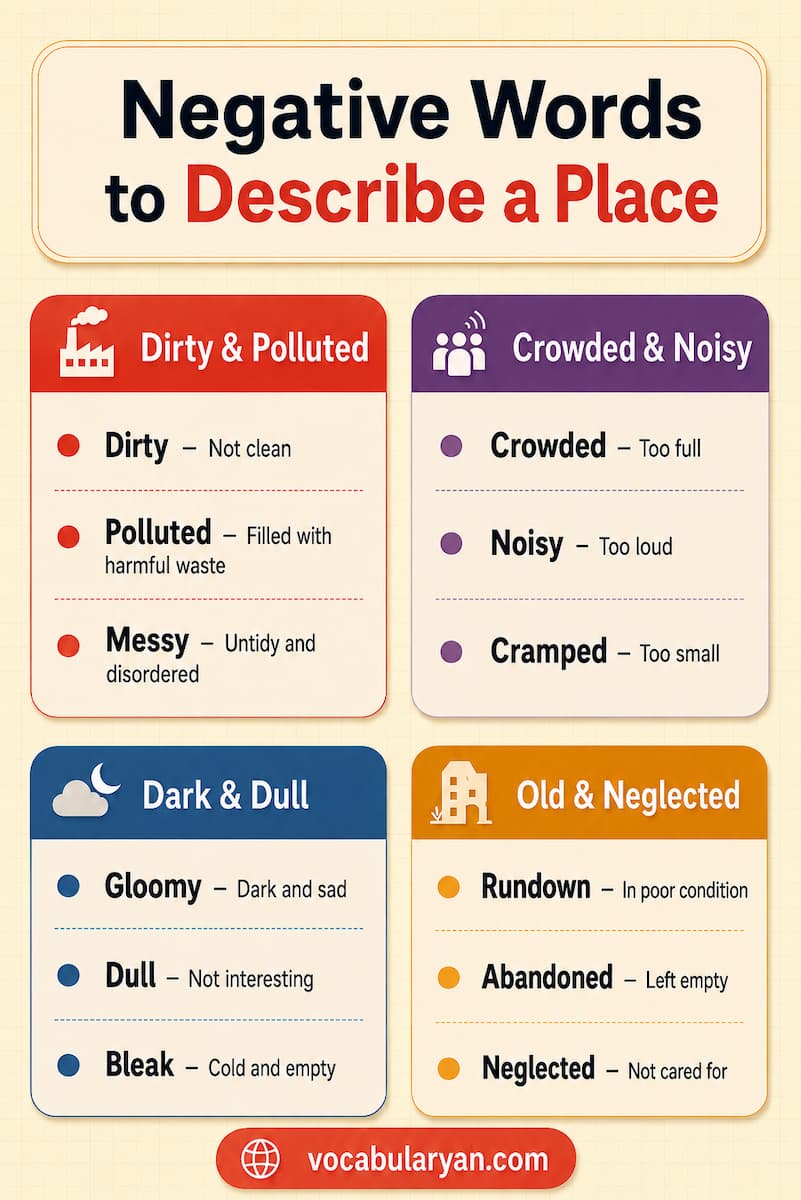
The right word for a place does more than locate a reader; it tells them how to feel before anyone speaks. Dilapidated, desolate, and oppressive each describe a different kind of unpleasant, and choosing between them is the difference between a scene that informs and one that immerses. Negative words to describe a place cover the full range of what makes a setting unwelcoming: physical decay, threatening atmosphere, poor conditions, isolation, danger, and the emotional weight that certain spaces carry simply by existing. The words ahead are grouped by the quality of place they describe, with meanings and examples throughout, and a closing note on how place vocabulary creates mood in writing.
💡 Quick answer
Negative words to describe a place are adjectives and nouns for unpleasant, threatening, or oppressive settings, such as dilapidated, desolate, eerie, squalid, and claustrophobic. They cover physical condition (crumbling, neglected), atmosphere (ominous, forbidding), space (cramped, overcrowded), and emotional impression (bleak, haunting). The right one names what is wrong with a place precisely enough for a reader to feel it.
Negative Words to Describe a Place with examples
Words For Physical Condition And Decay
The most concrete place words describe what a space looks like and what has happened to it.
Dilapidated(adj.): falling apart through neglect and age.
A dilapidated warehouse at the end of the street had stood empty for years.
Derelict(adj.): abandoned and left to deteriorate.
The derelict hotel had not had a guest in over a decade.
Crumbling(adj.): falling apart in pieces.
The crumbling façade dropped stone onto the pavement below.
Decrepit(adj.): worn out and broken down by age or neglect.
A decrepit building that should have been condemned years ago.
Run-down(adj.): in poor condition from neglect.
A run-down neighborhood where half the shops had closed.
Neglected(adj.): not maintained or cared for over time.
A neglected garden that had reclaimed itself from the path.
Ramshackle(adj.): loosely constructed and poorly maintained.
A ramshackle collection of sheds at the back of the property.
Squalid(adj.): filthy and extremely unpleasant in condition.
The squalid flat had no heating and broken windows throughout.
Grimy(adj.): covered in ingrained dirt and grime.
A grimy underpass that nobody walked through after dark.
Dingy(adj.): dark, dull, and dirty in a depressing way.
A dingy room with one bare bulb and no natural light.
Filthy(adj.): extremely dirty and unclean.
The filthy stairwell smelled of damp and uncollected rubbish.
Deteriorating(adj.): getting worse in condition over time.
A deteriorating structure that the council had promised to repair.
Rotting(adj.): decaying and breaking down organically.
The rotting floorboards made every step uncertain.
Ruined(adj.): destroyed or reduced to wreckage.
The ruined abbey had stood open to the sky for two centuries.
Weathered(adj.): worn and damaged by prolonged exposure to the elements.
A weathered door that swung open at a touch.
Decayed(adj.): broken down through rot and neglect.
A decayed pier that jutted into the water at a dangerous angle.
Words For Atmosphere And Feeling
A place’s atmosphere is what it does to the person standing in it, and these words name that effect.
Eerie(adj.): strange and unsettling in a way that cannot easily be named.
An eerie quiet had settled over the village after the storm.
Ominous(adj.): suggesting something threatening is near.
The ominous building at the end of the lane made visitors uneasy.
Foreboding(adj.): producing a heavy sense of coming harm.
A foreboding atmosphere hung over the house from the first visit.
Oppressive(adj.): weighing down on the spirit with unrelenting pressure.
The heat and the silence made the room oppressive by midday.
Menacing(adj.): conveying clear threat through presence alone.
A menacing alley that tourists were advised to avoid.
Sinister(adj.): suggesting hidden evil or dark purpose.
Something sinister lay behind the perfectly maintained hedges.
Bleak(adj.): cold, bare, and stripped of any comfort or hope.
A bleak industrial estate on a gray afternoon in February.
Desolate(adj.): empty, abandoned, and utterly without warmth.
A desolate stretch of coast where no one came in winter.
Haunting(adj.): lingering with a sad or unsettling beauty.
A haunting ruin that stayed with visitors long after the visit.
Unsettling(adj.): quietly disturbing without obvious cause.
Something unsettling about the proportions of the room.
Chilling(adj.): producing cold fear through atmosphere alone.
The chilling stillness of the cellar made nobody want to stay.
Claustrophobic(adj.): oppressively enclosed, producing a sensation of confinement.
A claustrophobic corridor that forced people to walk single file.
Suffocating(adj.): so close and airless it feels impossible to breathe.
A suffocating room with sealed windows and no ventilation.
Forbidding(adj.): stern and unwelcoming in appearance.
A forbidding gate at the top of the drive turned most people away.
Grim(adj.): harsh, dark, and without any softening.
A grim Victorian institution that had outlasted its purpose.
Words For Size, Space, And Crowding
Cramped(adj.): uncomfortably small, leaving no room to move.
A cramped studio flat where the bed was also the sofa.
Confined(adj.): restricted to a small, enclosed space.
The confined waiting area held far too many people.
Overdeveloped(adj.): built on to the point of losing character.
Industrial(negative sense): functional, harsh, and without human warmth.
Forsaken(adj.): abandoned without any sign of care or return.
Seedy(adj.): squalid and associated with vice or crime.
Soulless(adj.): without character, warmth, or human scale.
Monotonous(adj.): uniform and relentlessly featureless.
Impersonal(adj.): without any human warmth or individuality.
Words For Natural And Outdoor Settings
Barren(adj.): without vegetation, life, or fertility.
A barren hillside where nothing had grown in years.
Arid(adj.): dry and without moisture, hostile to life.
An arid landscape that stretched to the horizon without color.
Inhospitable(adj.): offering no shelter, warmth, or welcome.
An inhospitable mountain terrain that turned back experienced climbers.
Windswept(adj.): exposed and battered by constant wind.
A windswept headland with nothing to break the force.
Waterlogged(adj.): saturated with water and impossible to cross.
Waterlogged fields that swallowed boots with every step.
Boggy(adj.): soft, wet, and treacherous underfoot.
A boggy path that turned an hour’s walk into an ordeal.
Overgrown(adj.): covered with unchecked vegetation.
An overgrown garden that had not been touched in a decade.
Swampy(adj.): wet, marshy, and difficult to move through.
A swampy lowland that bred mosquitoes in summer.
Parched(adj.): dried out and cracked from lack of moisture.
A parched riverbed in the middle of a drought.
Harsh(adj.): unforgivingly severe in its conditions.
A harsh moor that offered no shelter in any direction.
Godforsaken(adj.): remote, bleak, and entirely without comfort.
A godforsaken shore where the wind was the only sound.
Unstable(adj.): liable to collapse or shift without warning.
An unstable cliff edge that crumbled without warning.
Words For Indoor Spaces And Rooms
Dim(adj.): dark with very little light, dreary to occupy.
A dim basement flat with damp running down the walls.
Cluttered(adj.): filled with so much that movement is difficult.
A cluttered office where nothing could be found.
Poky(adj.): uncomfortably small and confining.
A poky kitchen where two people could not stand at once.
Damp(adj.): unpleasantly wet and cold in the air or walls.
A damp hallway that smelled of mold and old coats.
Musty(adj.): smelling of dampness and long disuse.
A musty attic that had not been opened for years.
Stuffy(adj.): lacking fresh air and circulation.
A stuffy meeting room with no windows that opened.
Gloomy(adj.): dark and without cheerful light.
A gloomy corridor that never caught any natural light.
Cheerless(adj.): without warmth, color, or anything comforting.
A cheerless low-ceilinged room that made everyone speak quietly.
Sparse(adj.): furnished to a degree that feels cold and empty.
A sparse waiting room with three chairs and nothing else.
Unwelcoming(adj.): failing to make a person feel at ease.
An unwelcoming reception with no seating and no warmth.
Stale(adj.): smelling of old, unmoving air.
A stale smell hit everyone who opened the door.
Wretched(adj.): in a state of misery and very poor condition.
A wretched interior that matched the ruined exterior.
Negative Place Description Nouns
Sometimes a noun names the place itself with all the needed negative charge built in.
Slum(n.): an overcrowded urban area in very poor condition.
The factory had been built on the edge of a slum.
Dump(n.): an unpleasant, disorganized, or filthy place.
The flat turned out to be a complete dump.
Hovel(n.): a small, miserable, and poorly maintained dwelling.
He had grown up in a hovel with a leaking roof.
Ruin(n.): the remains of a building destroyed by time or force.
Nothing was left but a ruin open to the weather.
Wasteland(n.): land devastated or left without use.
The old industrial site had become a wasteland.
Wreckage(n.): the debris left after destruction.
Only wreckage remained where the building had stood.
Labyrinth(n.): a confusing, maze-like place difficult to navigate.
The old hospital was a labyrinth of corridors and locked wards.
Hellhole(n.): an extremely unpleasant or difficult place.
The prison had been described as a hellhole in every inspection.
Pit(n.): a deeply unpleasant or sunken place.
The town had become a pit of unemployment and despair.
Abyss(n.): a deep void or seemingly bottomless darkness.
The cave opened into an abyss beyond the first chamber.
Ghetto(n.): an area of a city where a marginalized group is confined.
The policy had effectively created a ghetto in the east of the city.
Quagmire(n.): a soft, boggy area of land difficult to cross.
The building site had turned into a quagmire after the rains.
How To Use Place Words To Create Atmosphere
Place description does its strongest work when it conveys feeling without naming it. A dilapidated building at the end of an otherwise normal street creates unease before anything happens there; a squalid room tells the reader something about the person who lives in it without a word of character description. Three principles guide effective negative place vocabulary. First, choose the specific word over the general one, since eerie places something strange and unnamed in the air, where simply bad or unpleasant leaves nothing to feel. Second, use the place word to prepare for what follows: a foreboding corridor before a confrontation, a desolate beach before a revelation. Third, let one or two strong adjectives carry the scene rather than stacking them, since a crumbling, grimy, dilapidated, run-down room piles on so much that nothing lands. One precise word, placed before the noun it describes, sets the tone and leaves room for the action to fill the rest.
FAQs
Q1. What are negative words to describe a place?
Negative words to describe a place are adjectives and nouns for unpleasant, threatening, or oppressive settings, such as dilapidated, desolate, eerie, cramped, squalid, and foreboding. They cover physical condition, atmosphere, safety, space, and the emotional impression a setting creates, giving a reader or listener a felt sense of what is wrong with the place.
Q2. What are some adjectives to describe a bad place?
Strong choices by quality are dilapidated and decayed for physical condition, eerie and ominous for atmosphere, cramped and suffocating for space, dangerous and treacherous for safety, and bleak and desolate for emotional impression. Each belongs to a different dimension of what makes a place unpleasant rather than to badness in general.
Q3. What is the difference between bleak and desolate?
Both describe emptiness and lack of comfort, but bleak emphasizes the harsh, cold, and stripped-down quality of a place, its absence of color, warmth, or softening, while desolate emphasizes abandonment and the utter absence of life and company. A bleak landscape is inhospitable; a desolate one is lonely as well.
Q4. How do I describe a run-down place in writing?
Use specific physical details alongside the adjective so the reader sees rather than just hears the judgment. Instead of a run-down building, try the crumbling plaster, the rotting sill, the staircase that gave underfoot on the second step. One or two precise words plus a concrete detail make the place feel real. Save the overall adjective for the end, as a verdict rather than an announcement.
Q5. What words describe a place that feels threatening or unsafe?
Ominous, menacing, foreboding, sinister, and forbidding all describe a threatening atmosphere without naming a specific danger. For active danger, treacherous, perilous, hazardous, and volatile name the risk more concretely. The atmospheric words work best at the opening of a scene; the concrete ones work best when the threat has become specific.
I’m Ethan Walker, cofounder of Vocabularyan.com. Over 12 years in ESL and English learning, I’ve worked closely with vocabulary practice, learner writing, phrase use, and the sentence habits that shape fluent expression. I write with a practical eye for the English learners meet every day, from study notes to conversations and online writing.