
A single noun can break bad news on its own. Before any adjective sharpens it, a word like betrayal, greed, or ruin already names something painful, dishonest, or destroyed. Negative nouns are the naming words for the unwanted side of life: the emotions that ache, the people who harm, the acts that wound, and the disasters that follow. Choosing the exact one, rather than a vague problem or trouble, gives writing precision and moral weight. The words ahead are grouped by what they name, with meanings throughout and example sentences for the ones whose force depends on context.
💡 Quick answer
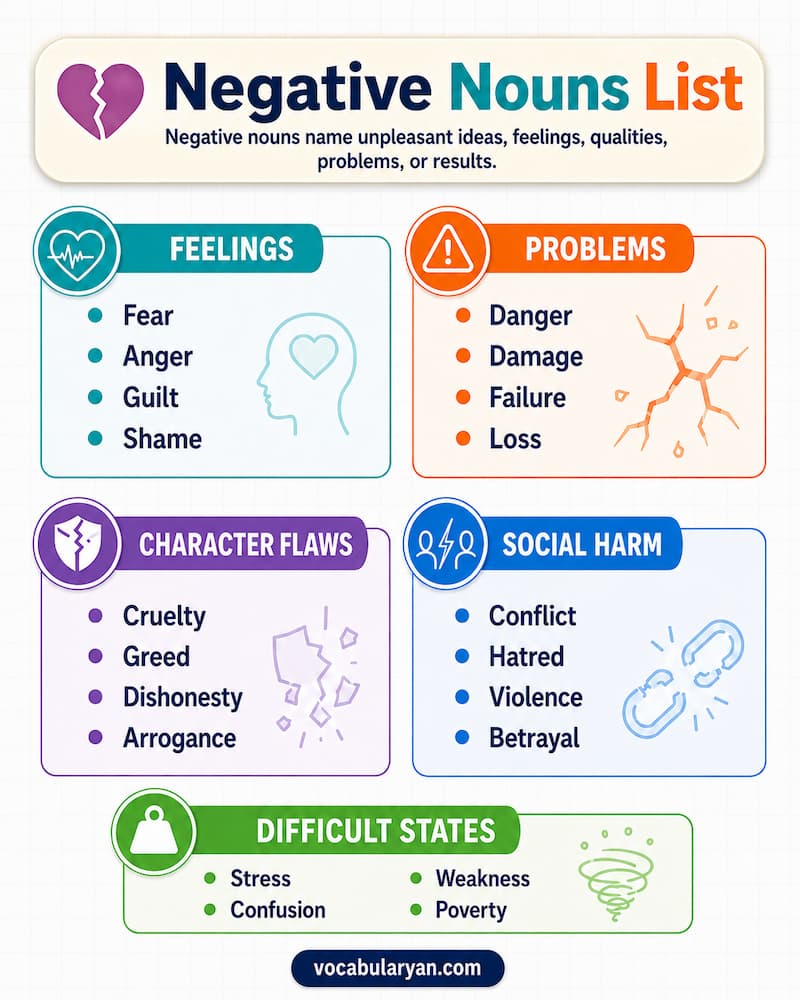
A negative noun names something unpleasant, harmful, or immoral, whether a feeling, a person, an act, or a disaster. Grief, liar, betrayal, greed, and ruin all qualify, since the word itself names something unwanted. They give criticism and emotion a precise name, which a vague problem cannot match.
Negative Nouns For Emotions And Feelings
Bad feelings range from a faint unease to total despair, and English names every depth between.
Sadness And Grief
- Grief: Deep sorrow, especially after a loss.
- Sorrow: Heavy, prolonged sadness.
- Misery: Wretched unhappiness and suffering.
- Despair: A total loss of hope.
- Anguish: Severe mental or emotional pain.
- Heartbreak: Crushing grief from loss or rejection.
- Heartache: Lingering emotional pain.
- Melancholy: A quiet, settled sadness.
- Gloom: A mood of darkness and low spirits.
- Woe: Great sorrow or distress.
- Despondency: A state of dejection and lost hope.
- Desolation: Bleak emptiness and abandonment.
- Dejection: Low spirits after disappointment.
- Sadness: A general state of unhappiness.
- Unhappiness: A lasting absence of contentment.
- Loneliness: Sadness from isolation.
- Hopelessness: A conviction that nothing will improve.
- Distress: Acute suffering or strain.
- Regret: Sorrow over something done or missed.
- Remorse: Deep guilt over a wrong.
- Disappointment: The letdown of an unmet hope.
- Bereavement: The grief of losing someone to death.
- Wretchedness: A condition of deep misery and distress.
Fear And Anxiety
Fear has a sudden form and a slow-burning one, and separate nouns mark each.
- Fear: A response to danger or threat.
- Dread: Intense fear of something ahead.
- Terror: Overwhelming, paralyzing fear.
- Horror: Shock mixed with deep fear and disgust.
- Panic: Sudden, uncontrollable fear.
- Anxiety: Persistent unease about what might happen.
- Apprehension: Nervous expectation of trouble.
- Worry: Anxious dwelling on problems.
- Nervousness: A jittery, on-edge state.
- Unease: Vague discomfort or disquiet.
- Disquiet: A restless feeling of anxious unease.
- Phobia: An irrational, intense fear.
- Fright: A sudden shock of fear.
- Trepidation: Wary fear before an ordeal.
- Foreboding: A sense that something bad is near.
- Misgiving: A feeling of doubt or worry.
- Insecurity: Self-doubt and a feeling of exposure.
- Paranoia: Unfounded distrust and suspicion.
- Alarm: Sudden fear at a perceived danger.
- Angst: A deep, gnawing anxiety about life.
Anger And Resentment
- Anger: Strong displeasure or hostility.
- Rage: Violent, uncontrolled anger.
- Fury: Wild, intense anger.
- Wrath: Fierce, often vengeful anger.
- Outrage: Anger at a perceived offense or injustice.
- Indignation: Anger at unfairness or insult.
- Resentment: Bitter ill will over a grievance.
- Bitterness: Lasting anger and disappointment.
- Hostility: Open antagonism and aggression.
- Hatred: Intense dislike or loathing.
- Loathing: Deep disgust and hatred.
- Contempt: Scornful disregard for someone beneath respect.
- Spite: A petty desire to hurt or annoy.
- Animosity: Strong, often mutual hostility.
- Antagonism: Active opposition and dislike.
- Irritation: Mild, nagging anger.
- Frustration: Distress at being blocked or thwarted.
- Vengeance: The desire or act of revenge.
Negative Nouns For People
Human faults harden into roles, and English names the offender as readily as the offense.
- Liar: Someone who tells falsehoods.
- Cheat: Someone who deceives to gain an advantage.
- Hypocrite: Someone who condemns in others what they do themselves.
- Traitor: Someone who betrays a trust, cause, or country.
- Coward: Someone who lacks courage in the face of danger.
- Bully: Someone who intimidates the weaker.
- Tyrant: A cruel, oppressive ruler.
- Villain: A wicked or criminal person.
- Criminal: Someone who breaks the law.
- Thief: Someone who steals.
- Crook: A dishonest person or petty criminal.
- Swindler: Someone who cheats others out of money.
- Con artist: A practiced deceiver who tricks people for gain.
- Manipulator: Someone who controls others through unfair means.
- Tormentor: Someone who inflicts suffering on another.
- Oppressor: Someone who keeps others down by force.
- Predator: A person who exploits the vulnerable.
- Brute: A savage, unfeeling person.
- Monster: A cruel or inhuman person.
- Fanatic: Someone with extreme, uncompromising zeal.
- Bigot: Someone intolerant of different views or groups.
- Snob: Someone who looks down on supposed inferiors.
- Egotist: Someone obsessed with their own importance.
- Narcissist: A person consumed by self-admiration.
- Miser: Someone who hoards money and hates spending.
- Glutton: Someone given to excess in eating or appetite.
- Slob: A lazy, untidy person.
- Saboteur: Someone who deliberately wrecks plans or property.
- Culprit: The person responsible for a wrong.
- Offender: Someone who commits an offense.
- Scoundrel: A dishonest, unprincipled person.
- Rogue: A dishonest or mischievous person.
- Wretch: A despicable or pitiable person.
- Pest: An annoying, persistent person.
- Nuisance: A person or thing that causes trouble.
- Menace: A threatening, dangerous person.
- Outcast: Someone rejected by society.
- Deserter: Someone who abandons a duty or post.
- Imposter: Someone who pretends to be another.
- Accomplice: A partner in wrongdoing.
- Instigator: Someone who provokes trouble.
- Extremist: Someone who holds fanatical, often dangerous views.
- Vandal: Someone who destroys property for no reason.
- Hoodlum: A violent troublemaker or thug.
- Lout: A rough, ill-mannered, aggressive man.
Negative Nouns For Actions And Wrongdoing
Wrongdoing spans a wide range of severity, and the precise noun marks how grave an act is.
- Betrayal: The breaking of trust or loyalty.
- Her betrayal of the team came out when the emails leaked.
- Deceit: The act of deliberately misleading.
- The whole scheme rested on deceit and forged signatures.
- Lie: A deliberate false statement.
- One small lie unraveled the entire alibi.
- Theft: The taking of what belongs to another.
- Security footage caught the theft in under a minute.
- Robbery: Taking property by force or threat.
- The robbery left two tellers shaken but unhurt.
- Burglary: Breaking into a building to steal.
- A string of burglaries put the whole street on edge.
- Mugging: A violent robbery on the street.
- A late-night mugging near the station rattled the area.
- Fraud: Deception carried out for unlawful gain.
- Investigators uncovered years of accounting fraud.
- Murder: The unlawful killing of a person.
- The trial reopened after new evidence in the murder.
- Assault: A violent physical attack.
- He faced charges of assault after the brawl.
- Abuse: Cruel or violent treatment of another.
- The shelter takes in survivors of domestic abuse.
- Corruption: The misuse of power for private gain.
- Bribery and corruption hollowed out the ministry.
- Bribery: Offering payment to influence dishonestly.
- The contract was won through bribery, not merit.
- Extortion: Forcing payment through threats.
- The gang ran an extortion racket across the docks.
- Blackmail: Demanding money under threat of exposure.
- He paid for months before reporting the blackmail.
- Treason: Betrayal of one’s own country.
- Leaking the defense plans amounted to treason.
- Sabotage: Deliberate destruction to obstruct something.
- The outage was traced to deliberate sabotage.
- Vandalism: Wanton destruction of property.
- Overnight vandalism wrecked the new playground.
- Slander: A spoken falsehood that harms reputation.
- She sued the host for slander after the broadcast.
- Perjury: Lying under oath.
- The witness was later charged with perjury.
- Negligence: A harmful failure to take proper care.
- The collapse was blamed on years of negligence.
- Cowardice: A shameful lack of courage.
- Abandoning the crew was an act of pure cowardice.
- Cheating: Acting dishonestly to gain an advantage.
- He was expelled for cheating on the final.
- Plagiarism: Passing off another’s work as one’s own.
- The paper was retracted for plagiarism.
- Exploitation: Unfair use of others for profit.
- The report condemned the exploitation of migrant workers.
- Oppression: The keeping down of people by force.
- Generations lived under harsh oppression.
- Persecution: Sustained hostility toward a person or group.
- Families fled the persecution of the regime.
- Torture: The infliction of severe pain to punish or coerce.
- Survivors testified about systematic torture.
- Kidnapping: Seizing and holding someone unlawfully.
- The kidnapping sparked a nationwide search.
- Arson: The criminal setting of fires.
- The warehouse blaze was confirmed as arson.
- Smuggling: Moving goods illegally across borders.
- Customs broke up a smuggling ring at the port.
- Embezzlement: Theft of funds placed in one’s trust.
- The treasurer confessed to embezzlement.
- Trespass: Entering property without permission.
- Repeated trespass finally drew a complaint.
- Harassment: Persistent unwanted, hostile behavior.
- She kept a careful log of the workplace harassment.
- Intimidation: Frightening someone into compliance.
- Voters reported open intimidation at the gates.
- Treachery: A betrayal of faith or trust.
- His treachery cost the rebels their leader.
- Manipulation: Controlling others through unfair influence.
- The cult relied on guilt and manipulation.
- Misconduct: Improper or unethical behavior.
- The officer was suspended for misconduct.
- Wrongdoing: Illegal or immoral behavior.
- The audit turned up no financial wrongdoing.
- Crime: An act punishable by law.
- Petty crime rose sharply that winter.
- Violence: The use of force to harm.
- The protest stayed peaceful despite threats of violence.
Negative Nouns For Vices And Character Flaws
- Greed: An excessive desire for wealth or more.
- Cruelty: A disposition that takes pleasure in causing pain.
- Arrogance: An inflated sense of one’s own importance.
- Vanity: Excessive pride in one’s looks or worth.
- Pride: Arrogant self-importance in its negative sense.
- Envy: Resentful longing for what others have.
- Jealousy: Insecurity and possessiveness over a rival.
- Malice: A wish to do harm to others.
- Dishonesty: A habit of lying and deceiving.
- Deceitfulness: A disposition to mislead.
- Hypocrisy: Pretending to virtues one lacks.
- Selfishness: Concern only for oneself.
- Gluttony: Habitual overindulgence in food or drink.
- Laziness: A strong aversion to work or effort.
- Idleness: Habitual avoidance of activity.
- Sloth: Persistent laziness and inactivity.
- Stubbornness: An unreasonable refusal to change.
- Recklessness: A careless disregard for danger.
- Carelessness: A lack of due attention.
- Ignorance: A lack of knowledge or awareness.
- Stupidity: A lack of intelligence or sense.
- Foolishness: Unwise, ill-judged behavior.
- Rudeness: Disrespectful, ill-mannered behavior.
- Insolence: Bold, contemptuous disrespect.
- Impudence: Shameless rudeness.
- Pettiness: Preoccupation with trivial grievances.
- Callousness: An unfeeling indifference to others.
- Heartlessness: A complete lack of compassion.
- Brutality: Savage, violent harshness.
- Ruthlessness: A pitiless drive to win at any cost.
- Wickedness: Deliberate evil.
- Depravity: Moral corruption and degradation.
- Immorality: A disregard for right and wrong.
- Cynicism: A sour distrust of others’ motives.
- Apathy: A draining lack of interest or care.
- Conceit: An overblown opinion of oneself.
- Snobbery: Contempt for those seen as inferior.
- Intolerance: A refusal to accept difference.
- Prejudice: Unfair, preformed judgment.
- Bigotry: Stubborn intolerance of other groups.
- Vindictiveness: A persistent urge for revenge.
Negative Nouns For Trouble, Hardship, And Disaster
Misfortune scales from the deeply personal to the historic, and one noun can name either end.
- Chaos: Total disorder and confusion.
- The power cut threw the airport into chaos.
- Disaster: A sudden event causing great damage.
- The flood was the worst disaster in the region’s history.
- Catastrophe: A disastrous, often fatal event.
- A small leak became a full catastrophe by morning.
- Calamity: A grievous misfortune.
- The drought was a slow calamity for the farms.
- Ruin: Complete destruction or collapse.
- One bad harvest spelled ruin for the estate.
- Devastation: Severe, widespread damage.
- The storm left a trail of devastation along the coast.
- Havoc: Widespread destruction and disorder.
- The toddlers wreaked havoc in the gift shop.
- Turmoil: A state of great disturbance.
- The resignation threw the cabinet into turmoil.
- Crisis: A time of acute danger or difficulty.
- The hospital ran the ward through a staffing crisis.
- Emergency: A serious situation demanding fast action.
- Crews treated the chemical spill as a public emergency.
- Hardship: Severe suffering or deprivation.
- The family endured years of hardship after the closure.
- Poverty: The state of being extremely poor.
- Decades of poverty scarred the mining towns.
- Famine: Extreme, widespread scarcity of food.
- Relief convoys raced to reach the famine zone.
- Drought: A long, damaging shortage of rain.
- The drought cracked the reservoir bed wide open.
- Plague: A deadly, fast-spreading affliction.
- A plague of rumors did as much harm as the illness.
- Epidemic: A sudden, widespread outbreak of disease.
- The clinic braced for a winter flu epidemic.
- Misfortune: Bad luck or an unlucky event.
- A run of misfortune drained their savings.
- Adversity: A difficult or hostile situation.
- She built the charity in the face of real adversity.
- Suffering: Prolonged pain or distress.
- The report documented the suffering in the camps.
- Affliction: A cause of persistent pain or grief.
- Chronic debt was the family’s lasting affliction.
- Burden: A heavy, oppressive responsibility.
- The loan became a burden he carried for a decade.
- Plight: A dangerous or unfortunate situation.
- The refugees’ plight finally reached the headlines.
- Tragedy: An event causing great suffering or loss.
- The mine tragedy united the whole valley in grief.
- Conflict: Serious disagreement or armed struggle.
- The border conflict dragged on for years.
- War: Armed conflict between groups or nations.
- A decade of war emptied the villages.
- Strife: Bitter, often violent disagreement.
- Years of civil strife wrecked the economy.
- Discord: A lack of harmony and open disagreement.
- Money brought nothing but discord to the family.
- Unrest: Disturbance and agitation among people.
- Fuel prices sparked weeks of unrest.
- Upheaval: A sudden, violent disruption.
- The takeover caused months of upheaval.
- Collapse: A sudden, complete failure.
- The bank’s collapse wiped out thousands of accounts.
- Failure: A lack of success; a breakdown.
- The launch ended in costly failure.
- Downfall: The ruin of power or status.
- Hubris was the leader’s downfall.
- Setback: A reversal that halts progress.
- A funding setback delayed the cure by years.
- Decline: A steady worsening or loss.
- The town watched the slow decline of its industry.
- Hazard: A source of danger.
- The frozen steps were a serious hazard.
- Peril: Serious and immediate danger.
- The climbers were in real peril by nightfall.
- Threat: A signal of likely harm.
- The aging dam posed a constant flood threat.
- Danger: Exposure to harm or loss.
- The bridge stayed closed while the danger lasted.
- Damage: Physical or moral harm done.
- The scandal did lasting damage to her name.
- Destruction: The act or state of being destroyed.
- The fire left only destruction behind.
- Loss: The pain of being deprived of something.
- The community never recovered from the loss.
- Bloodshed: Violence resulting in killing.
- The truce finally ended the bloodshed.
- Mayhem: Violent, chaotic disorder.
- The final whistle was followed by mayhem in the stands.
Negative Nouns And Their Neutral Twins
The same trait wears a kind name or a cruel one depending on who is judging.
| Negative noun | Neutral or flattering twin |
|---|---|
| Obstinacy | Determination |
| Cunning | Shrewdness |
| Nosiness | Curiosity |
| Stinginess | Thrift |
| Timidity | Caution |
| Bluntness | Honesty |
| Bossiness | Leadership |
| Aggression | Assertiveness |
| Impulsiveness | Spontaneity |
| Rashness | Boldness |
| Naivety | Trust |
| Gullibility | Openness |
| Rigidity | Discipline |
| Obsession | Dedication |
| Cockiness | Confidence |
| Smugness | Self-assurance |
| Hesitancy | Prudence |
| Pickiness | Selectiveness |
| Fussiness | Attentiveness |
| Showiness | Flair |
How Negative Nouns Shape Tone In Writing
A negative noun states a judgment as fact, which gives it more force than an adjective hung on a neutral word. Calling an act a betrayal settles the matter in a way that disloyal behavior does not. That force cuts both ways, so a noun like failure or coward brands a whole person or outcome, and careful writers choose it only when the label is fair. In reporting, the safest nouns name the act rather than the motive, since fraud describes conduct while villain describes character.
FAQs
Q1. What is a negative noun?
A negative noun names something unpleasant, harmful, or immoral, such as a feeling, a person, an act, or a situation. Words like fear, bully, betrayal, and disaster all qualify. The negative sense lives in the noun itself, not in any adjective attached to it.
Q2. What are some examples of negative nouns?
Frequent ones name bad emotions such as grief, dread, and rage, bad people such as liar, traitor, and tyrant, wrongdoing such as theft, fraud, and abuse, vices such as greed, arrogance, and envy, and trouble such as chaos, poverty, and ruin. Each pins down a precise kind of harm.
Q3. Are emotions like fear and sadness negative nouns?
Yes, when the emotion itself is unwanted. Fear, sadness, grief, and anxiety are abstract nouns with a clearly negative sense, so they count. Positive emotions like joy and hope are abstract nouns too, but they belong outside the negative group.
Q4. What is the difference between an abstract noun and a negative noun?
Abstract describes form: a noun for an idea or feeling you cannot touch, whether good or bad. Negative describes tone: a noun with an unfavorable meaning. Many words overlap, so cruelty is both abstract and negative, while kindness is abstract but positive, and ruin is negative without being purely abstract.
Q5. What are negative connotation nouns?
Negative connotation nouns name a trait with built-in disapproval even when a flattering synonym exists. Obstinacy and determination describe the same persistence, and stinginess and thrift describe the same caution with money, but one judges while the other praises.