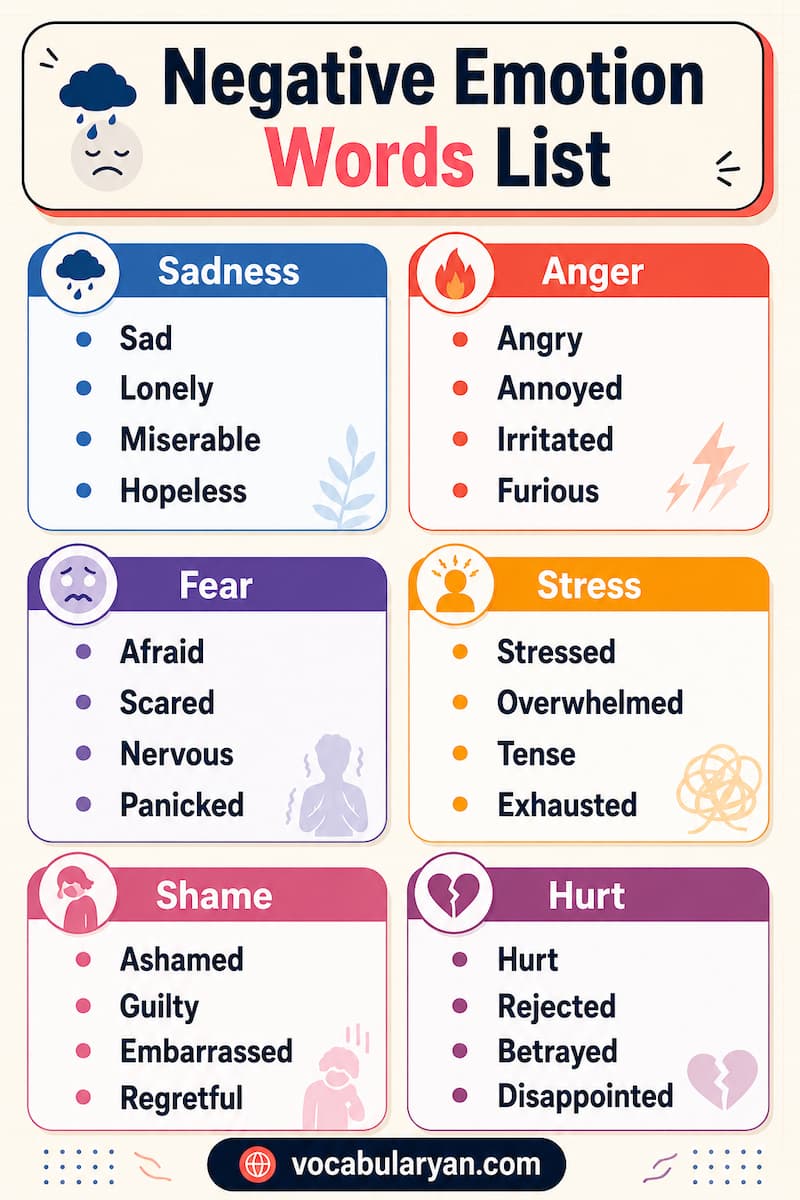
Emotion has its own vocabulary, and that vocabulary runs across parts of speech. Grief is a noun, the name of the thing itself. Grief-stricken is the adjective that describes the person carrying it. Grieve is the verb that puts the emotion into motion. Knowing all three gives a writer or speaker real range: the ability to name the feeling, describe the person, and show what it makes them do. The negative emotion words ahead are grouped by emotional family, with nouns, adjectives, and key verb forms in each section, every entry labeled by part of speech and defined.
💡 Quick answer
Negative emotion words are nouns, adjectives, and verbs that name or describe an unpleasant emotional state. Nouns name the emotion itself (grief, dread, shame), adjectives describe the person feeling it (grief-stricken, fearful, ashamed), and verbs show it in action (grieve, dread, resent). Grouping them by emotional family makes the right form quick to reach.
Negative Emotion Words List for feeling vocabulary
Sadness And Grief
The widest emotional family in English, running from a faint blue ache to total loss.
Grief(n.): deep sorrow, especially from loss.
Her grief was too large for condolences to touch.
Sorrow(n.): a feeling of deep distress.
A quiet sorrow followed him through the house.
Sadness(n.): the state of feeling unhappy.
The sadness in his voice was impossible to miss.
Melancholy(n.): a lingering, gentle sadness.
A familiar melancholy arrived with the shorter days.
Dejection(n.): low spirits after disappointment.
Dejection settled over the team before anyone spoke.
Despondency(n.): deep discouragement and hopelessness.
Months of silence deepened her despondency.
Heartbreak(n.): the pain caused by a devastating loss or disappointment.
The heartbreak arrived slowly, then all at once.
Heartache(n.): a dull, persistent emotional pain from loss or disappointment.
The heartache of the breakup stayed for months.
Woe(n.): great sorrow or distress.
The tale was full of woe and bad timing.
Sad(adj.): feeling unhappy and low.
He felt sad without knowing quite why.
Sorrowful(adj.): filled with deep sorrow.
A sorrowful look crossed her face at the news.
Grief-stricken(adj.): overwhelmed by grief.
The grief-stricken family stood at the graveside.
Bereft(adj.): desolately sad through loss.
She felt completely bereft in the weeks after.
Forlorn(adj.): lonely and hopelessly sad.
A forlorn expression met every cheerful word.
Wistful(adj.): gently sad, longing for what is lost.
He grew wistful whenever the old song played.
Crestfallen(adj.): suddenly and visibly deflated by disappointment.
He turned crestfallen when his name was skipped.
Grieve(v.): to feel or express grief.
She grieved quietly, telling no one.
Mourn(v.): to feel or show deep sorrow for a loss.
The city mourned for days after the accident.
Lament(v.): to express grief or deep regret.
He lamented the chances he had never taken.
Anger And Resentment
Anger(n.): a strong feeling of displeasure.
The anger in her voice was controlled but clear.
Rage(n.): violent and uncontrolled anger.
A cold rage had replaced the initial shock.
Fury(n.): intense, passionate anger.
She left in a fury and did not return his calls.
Resentment(n.): bitter indignation at unfair treatment.
Resentment had been building for years before it showed.
Hostility(n.): unfriendly or aggressive feeling.
A low hostility hummed through the negotiation.
Indignation(n.): righteous anger at injustice.
She spoke with quiet indignation about the ruling.
Irritation(n.): mild anger at a nuisance.
A flicker of irritation crossed his face.
Wrath(n.): deep, righteous, or punishing anger.
The wrath in his letter was carefully chosen.
Angry(adj.): feeling strong displeasure.
She was angry in the particular way that did not shout.
Furious(adj.): violently and intensely angry.
He was furious when the promise was broken.
Bitter(adj.): soured by lasting resentment.
A bitter edge crept into everything he said.
Irate(adj.): intensely and vocally angry.
An irate customer demanded to speak to a manager.
Resentful(adj.): feeling deep, lasting grievance.
She stayed resentful long after the argument ended.
Seething(adj.): boiling with barely contained anger.
He sat seething through the whole meeting.
Livid(adj.): furiously and visibly angry.
She was livid when she found out.
Resent(v.): to feel bitter indignation about.
He resented being passed over without explanation.
Fume(v.): to feel intense, barely controlled anger.
She fumed silently for the rest of the drive.
Seethe(v.): to be inwardly furious.
He seethed but said nothing at the table.
Fear And Dread
Fear sharpens focus; dread is its slower, heavier cousin.
Fear(n.): an unpleasant emotion caused by threat or danger.
Fear hit him the moment the lights went out.
Dread(n.): a great fear or apprehension of what is coming.
A familiar dread arrived with the morning of the test.
Terror(n.): extreme and overwhelming fear.
Terror froze her to the spot.
Anxiety(n.): worry and nervousness about what may happen.
Anxiety crept in around three in the morning.
Panic(n.): sudden, overwhelming fear.
Panic spread through the crowd at the first shout.
Apprehension(n.): unease about what is to come.
A low apprehension stayed with him all week.
Trepidation(n.): trembling apprehension.
She opened the envelope with trepidation.
Phobia(n.): an intense, irrational fear of something specific.
His phobia made the dentist’s chair impossible.
Fearful(adj.): filled with fear.
She was fearful of what the scan would show.
Terrified(adj.): in a state of intense, overwhelming fear.
He was terrified standing at the edge.
Anxious(adj.): worried and uneasy about what may come.
She felt anxious the whole morning before the call.
Apprehensive(adj.): fearful of what lies ahead.
He was apprehensive about the move.
Dread-filled(adj.): heavy with a sense of coming harm.
She woke dread-filled without knowing why.
Panicky(adj.): close to losing control with fear.
He felt panicky when the exit was blocked.
Dread(v.): to anticipate with great fear.
She dreaded the conversation she knew was coming.
Fear(v.): to be afraid of.
He feared the silence more than the argument.
Tremble(v.): to shake with fear or agitation.
Her hands trembled as she read the verdict.
Shame And Regret
Shame turns inward on the self; regret turns backward on the act.
Shame(n.): a painful feeling of humiliation and wrongness.
Shame sat in his chest all through the meeting.
Guilt(n.): the feeling of responsibility for a wrong.
Guilt woke her at two in the morning.
Remorse(n.): deep regret and guilt for a wrong done.
He felt genuine remorse for the first time in years.
Regret(n.): sorrow over something done or left undone.
The regret was quiet but permanent.
Embarrassment(n.): self-conscious distress from a mistake.
A flush of embarrassment colored her cheeks.
Humiliation(n.): loss of dignity in front of others.
The public humiliation stayed with him for years.
Disgrace(n.): loss of reputation through shameful conduct.
The scandal brought disgrace on the whole department.
Ashamed(adj.): feeling shame about something done or said.
She was ashamed of how she had spoken to him.
Guilty(adj.): feeling responsible for a wrong.
He felt guilty for missing the call.
Remorseful(adj.): filled with remorse for a wrong done.
He was remorseful and wanted to make it right.
Embarrassed(adj.): self-conscious and flustered.
She was embarrassed when her name was mispronounced.
Mortified(adj.): intensely embarrassed.
She was mortified when the mic caught the aside.
Contrite(adj.): sincerely sorry and willing to make amends.
He arrived contrite and said so immediately.
Regret(v.): to feel sorry about something past.
She regretted every word of that conversation.
Rue(v.): to bitterly regret.
He rued the day he signed without reading.
Repent(v.): to feel deep remorse and wish to change.
She repented not the act but the cost of it.
Loneliness And Rejection
Loneliness(n.): the pain of being without connection.
Isolation(n.): the state of being cut off from others.
Rejection(n.): the feeling of being cast aside or unwanted.
Alienation(n.): a sense of being a stranger among others.
Abandonment(n.): the feeling of being deserted.
Estrangement(n.): the state of being distanced from those once close.
Lonely(adj.): aching for company and connection.
Isolated(adj.): cut off from others.
Rejected(adj.): feeling cast aside or unwanted.
Abandoned(adj.): feeling deserted and uncared for.
Alienated(adj.): feeling unable to connect with those around.
Estranged(adj.): pushed apart from those once close.
Adrift(adj.): unmoored, without a sense of belonging.
Withdraw(v.): to pull away from others.
Pine(v.): to feel a deep longing for something or someone.
Envy And Bitterness
Envy(n.): resentful longing for another’s advantages.
Jealousy(n.): fear of losing what one has to a rival.
Covetousness(n.): intense desire for what belongs to another.
Spite(n.): a wish to hurt or annoy someone.
Grudge(n.): a persistent feeling of ill will.
Envious(adj.): feeling envy of another’s good fortune.
Jealous(adj.): resentful of a rival or a perceived threat.
Spiteful(adj.): acting from a wish to hurt.
Grudging(adj.): given or felt unwillingly.
Covetous(adj.): excessively desirous of what others have.
Envy(v.): to feel resentful longing for another’s advantages.
Begrudge(v.): to resent the good fortune of another.
Covet(v.): to desire intensely what belongs to another.
Disgust And Revulsion
Disgust(n.): strong distaste or revulsion.
Revulsion(n.): a strong sense of repugnance.
Contempt(n.): a feeling that something is worthless or beneath notice.
Loathing(n.): intense dislike and disgust.
Abhorrence(n.): deep moral hatred.
Disdain(n.): the feeling that something is unworthy.
Haunted(adj.): disturbed persistently by something painful.
She was haunted by what she had not said.
Suffer(v.): to endure pain or distress.
He had been suffering quietly for longer than anyone knew.
Agonize(v.): to suffer mental anguish over a choice.
She agonized over the decision for weeks.
How To Use Negative Emotion Words Accurately
Precision matters more here than anywhere else in vocabulary, because the wrong word undersells or overstates a feeling either way. The scale runs from mild irritation to blind rage, from disappointment to devastation, and matching the word to the actual pitch of the emotion is what makes writing feel true. A few words carry clinical weight that casual use erodes: depression is a medical condition, not a bad afternoon; trauma is a lasting psychological wound from a severe event, not a frustrating experience; grief is specific to loss, not disappointment. Noun, adjective, and verb forms of the same emotion each do different work. The noun names the thing (rage), the adjective describes the person holding it (enraged), and the verb shows it moving (she raged). Using all three across a passage gives an emotion its full presence on the page.
FAQs
Q1. What are negative emotion words?
Negative emotion words are nouns, adjectives, and verbs that name, describe, or express an unpleasant emotional state. Nouns name the emotion itself (grief, dread, shame), adjectives describe the person feeling it (grief-stricken, fearful, ashamed), and verbs put it into action (grieve, dread, resent).
Q2. What is the difference between negative emotion words and negative feeling adjectives?
Negative feeling adjectives are one part of the broader set. Emotion words span parts of speech: grief and anguish are nouns, devastated and resentful are adjectives, and mourn and fume are verbs. Knowing all three forms gives a speaker or writer more range than adjectives alone.
Q3. What are some strong negative emotion words?
For nouns: anguish, torment, despair, dread, and desolation. For adjectives: devastated, traumatized, grief-stricken, and seething. For verbs: agonize, seethe, dread, and lament. The strongest words name a specific emotional state at a specific pitch rather than a general feeling.
Q4. How do I choose the right negative emotion word?
Match the word to the actual scale of the feeling. Irritation fits a minor nuisance; fury fits real injustice. Sadness fits disappointment; devastation fits a shattering loss. The noun, adjective, and verb forms of the same emotion each serve a different purpose, so choosing the right part of speech matters as much as choosing the right word.
Q5. Can I use negative emotion words in everyday English?
Yes, and precision makes everyday expression clearer. Instead of “I feel bad,” knowing whether you feel guilty, regretful, ashamed, or embarrassed names the exact feeling and communicates it more honestly. In writing, the same precision creates empathy rather than vague sympathy.
I’m Ethan Walker, cofounder of Vocabularyan.com. Over 12 years in ESL and English learning, I’ve worked closely with vocabulary practice, learner writing, phrase use, and the sentence habits that shape fluent expression. I write with a practical eye for the English learners meet every day, from study notes to conversations and online writing.