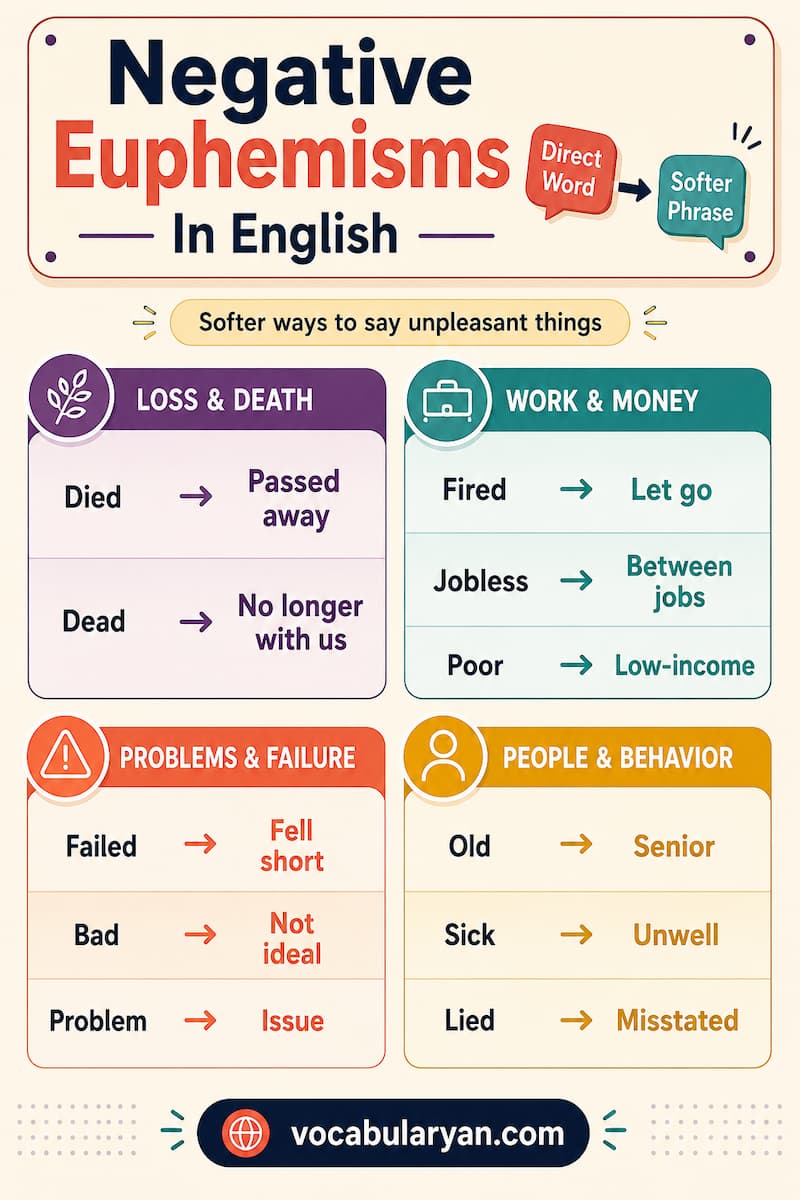
Language has always looked for softer ways to say hard things. Passed away sits more gently in a sympathy card than died. Let go sounds less brutal in a meeting room than fired. These are euphemisms: words and phrases that replace a harsh, blunt, or uncomfortable truth with something milder, vaguer, or more polite. English has hundreds of them, spread across every domain where human discomfort gathers, death, money, war, appearance, failure, and power. Understanding negative euphemisms means understanding both when they serve kindness and when they serve concealment. The entries ahead are grouped by topic, each showing the euphemism alongside the direct word it replaces and a note on what the softening achieves or hides.
💡 Quick answer
Negative euphemisms in English replace harsh or uncomfortable words with milder alternatives. Passed away replaces died; let go replaces fired; collateral damage replaces civilian casualties. They soften difficult news, maintain politeness, and avoid taboo words, but in political and corporate language they can also obscure the truth. Knowing both the euphemism and the direct word gives a clearer picture of what is actually being said.
Negative Euphemisms in English for softened wording
Euphemisms For Death And Dying
Death gathers more euphemisms than almost any other subject in English, reflecting the discomfort of naming it directly.
Passed away(instead of died): the most common and broadly accepted softening of death.
We regret to inform you that your father has passed away.
Passed on(instead of died): implies continuation, softening the finality.
Gone to a better place(instead of died): implies spiritual comfort rather than loss.
Lost(instead of died): frames death as an absence rather than an event.
She lost her husband last winter.
No longer with us(instead of dead): a gentle distancing from the fact.
Departed(instead of died): formal and literary, implying a journey rather than an end.
Left us(instead of died): gentle and personal, as though the person chose to go.
At rest(instead of dead): implies peace and the end of suffering.
Laid to rest(instead of buried): softens the physical reality of burial.
Final resting place(instead of grave): avoids the word grave entirely.
Gone to sleep(instead of died, for children): protective but potentially confusing.
Taken too soon(instead of died young): frames early death as an injustice.
Succumbed(instead of died from): clinical and somewhat distancing.
He succumbed to his injuries overnight.
Terminal(instead of dying): medical, replacing the direct word with a timeline.
End of life(instead of dying): clinical framing that removes the personal weight.
Put to sleep(instead of euthanized, for animals): softens a deliberate act.
Euphemisms For Work And Job Loss
Workplace language generates euphemisms wherever money and dignity meet.
Let go(instead of fired): removes the personal judgment from dismissal.
After twelve years, she was simply let go.
Downsizing(instead of laying off workers): frames job losses as a structural decision.
Restructuring(instead of mass layoffs): implies improvement rather than loss.
Rightsizing(instead of cutting jobs): implies the cuts are a correction rather than a harm.
Made redundant(instead of fired, UK): shifts blame from the person to the role.
Released(instead of fired): implies the employee is being freed rather than removed.
Transitioning out of the role(instead of being fired): softens dismissal into a process.
Between jobs(instead of unemployed): frames joblessness as a temporary gap.
Exploring new opportunities(instead of unemployed): reframes loss as possibility.
Voluntary separation(instead of resigned under pressure): suggests free choice.
Performance improvement plan(instead of final warning before firing): clinical framing of a threat.
Redeployment(instead of demotion or job change): implies movement rather than loss.
Early retirement(instead of forced out): implies a reward rather than a removal.
Organizational efficiency(instead of cutting costs by losing people): abstracts human loss into a process.
Non-renewal of contract(instead of not being hired again): passive framing avoids blame.
Euphemisms For War And Violence
Military and political language reaches furthest for euphemism, since the reality it covers is most severe.
Collateral damage(instead of civilian casualties or deaths): the most widely cited military euphemism.
Collateral damage was acknowledged but not quantified.
Friendly fire(instead of killing your own troops by accident): the word friendly does the obscuring.
Neutralize(instead of kill): clinical verb that removes the moral weight.
The order was to neutralize the target.
Take out(instead of kill): informal, almost domestic in its softening.
Pacify(instead of suppress by force): implies peace rather than violence.
Armed intervention(instead of military attack or invasion): reframes aggression as a response.
Special military operation(instead of war or invasion): political framing to minimize scale.
Enhanced interrogation(instead of torture): the most criticized modern military euphemism.
Extraordinary rendition(instead of abduction for interrogation): bureaucratic language masking a serious act.
Boots on the ground(instead of soldiers sent to fight): abstracts people into a logistical term.
Surgical strike(instead of targeted bombing): implies precision while minimizing harm.
Casualties(instead of people killed): clinical plural that removes individual weight.
Theater of operations(instead of war zone): dramatic framing that distances from reality.
Shock and awe(instead of overwhelming bombardment): marketing language applied to violence.
Detention facility(instead of prison or internment camp): neutral language for a severe reality.
Euphemisms For Personal Appearance
Appearance euphemisms soften descriptions that would otherwise cause offense or embarrassment.
Big-boned(instead of overweight): implies a structural explanation rather than a judgment.
Full-figured(instead of overweight): more flattering framing of the same fact.
Horizontally challenged(instead of overweight): ironic and now often used humorously.
Heavyset(instead of fat): neutral-leaning but still a softening.
Pleasantly plump(instead of overweight): positive spin on what is usually a criticism.
Vertically challenged(instead of short): ironic, usually used lightly.
Petite(instead of short, for women): positive framing rather than neutral.
Getting on(instead of old): gentle aging euphemism.
Of a certain age(instead of old): implies the person is past a socially visible milestone.
Well-worn(instead of old-looking): implies character rather than deterioration.
Follically challenged(instead of bald): ironic softening.
Thinning on top(instead of going bald): understated and polite.
Distinguishéd(instead of old or grey-haired): complimentary reframe of aging.
Euphemisms For Ability And Intelligence
Learning differences(instead of learning disabilities): frames the distinction as variation rather than deficit.
Special needs(instead of disabled): well-intentioned but now considered patronizing by many.
Differently abled(instead of disabled): emphasizes ability rather than limitation.
Intellectually challenged(instead of having an intellectual disability): clinical softening.
Not the sharpest tool in the shed(instead of unintelligent): humorous euphemism.
Slow(instead of unintelligent): common but reductive.
Struggle with(instead of is bad at): frames difficulty as effort rather than failure.
Not academically inclined(instead of performing poorly at school): polite reframe.
Has room to grow(instead of performs poorly): workplace and school report framing.
Developing(instead of behind in progress): implies forward movement rather than a gap.
Exceptional(instead of significantly above or below average): ambiguous in education contexts.
Euphemisms For Personal Failings And Behavior
Economical with the truth(instead of lying): one of the most elegant English euphemisms for dishonesty.
The minister was, at best, economical with the truth.
Misspeaking(instead of lying publicly): implies an error rather than a deliberate falsehood.
Overindulging(instead of drinking too much): frames excess as a lapse rather than a pattern.
Substance use issue(instead of addiction): clinical framing that reduces stigma.
Work hard, play hard(instead of drinks excessively): reframes a failing as an energy trait.
Colourful past(instead of criminal record or bad history): implies character rather than wrongdoing.
Bit of a character(instead of difficult or rude): fond framing for someone hard to deal with.
Between relationships(instead of recently divorced or single after a breakup): softens loss.
Doesn’t suffer fools gladly(instead of rude and impatient): reframes rudeness as discernment.
Free spirit(instead of unreliable or irresponsible): flattering frame for a difficult trait.
Selective with the truth(instead of dishonest): implies choice rather than character.
Having a moment(instead of losing one’s temper): minimizes an outburst.
Tired and emotional(instead of drunk): UK press euphemism, now widely understood.
Euphemisms For Institutions And Authority
Institutions reach for euphemism wherever the reality of what they do would provoke resistance.
Correctional facility(instead of prison): implies rehabilitation rather than punishment.
Detention center(instead of prison or holding facility): neutral framing for a punitive one.
Processing center(instead of detention facility for migrants): bureaucratic abstraction.
Residential school(instead of forcible assimilation institution): institutional language masking a serious harm.
Care home(instead of nursing home): implies warmth where the reality is more clinical.
Alternative school(instead of school for students with behavioral issues): softens the distinction.
Law enforcement officer(instead of police officer): formal euphemism for institutional distance.
Revenue enhancement(instead of tax increase): political framing to minimize resistance.
User fees(instead of charges for previously free services): consumer framing of a government charge.
Investment(instead of spending): political language that implies return.
Euphemisms For Medical Situations
Medicine uses euphemism to protect patients while sometimes creating distance from difficult truths.
Negative outcome(instead of patient death): clinical language that removes the human fact.
Passed(instead of died, in medical notes): even clinical records use softening.
Discomfort(instead of pain): nurses and doctors often understate pain in reassurance.
Procedure(instead of surgery or operation): minimizes the invasiveness of what is done.
Growth(instead of tumor): neutral until a diagnosis is confirmed.
Mass(instead of tumor): clinical softening of a frightening word.
Poor prognosis(instead of unlikely to survive): clinical framing that softens a death sentence.
Positive for(instead of has the disease): clinical double reversal.
Lost the battle(instead of died of cancer): war metaphor that implies the patient failed.
Challenging case(instead of case likely to result in death): protects the team rather than the patient.
Management of symptoms(instead of no cure available): implies ongoing treatment rather than admission of limits.
Political And Corporate Euphemisms
This domain generates some of the most studied and debated euphemisms in English.
Tax relief(instead of tax cuts): implies suffering relieved rather than obligation reduced.
The proposal offered tax relief to the highest earners.
Job creators(instead of wealthy individuals or corporations): flattering political framing.
Investment in infrastructure(instead of public spending): neutralizes the political charge.
Reform(instead of cuts to services): implies improvement rather than reduction.
Streamlining(instead of cutting services or staff): efficiency language masking loss.
Negative growth(instead of economic contraction or recession): double negation softens a fact.
Pre-owned(instead of used): consumer softening that implies less wear.
Previously enjoyed(instead of used): positive spin on second-hand ownership.
Proactive retention(instead of holding someone against their wishes): clinical euphemism.
Enhanced vetting(instead of increased surveillance or restriction): implies improvement.
Robust debate(instead of serious disagreement or argument): political softening.
Regrettable incident(instead of serious harm or atrocity): minimizes severity through vagueness.
Repatriation(instead of deportation): implies voluntary return where force is involved.
Phased withdrawal(instead of retreat or defeat): military-political framing of a loss.
When Euphemisms Become Dishonest
Euphemism serves kindness when it softens news that would wound without purpose: passed away for died, between jobs for unemployed. It crosses into dishonesty when it is used to obscure accountability, hide harm, or make something unacceptable seem acceptable. The test is whether the listener, if they knew the direct word, would feel deceived. Collateral damage does not tell a grieving family what happened. Enhanced interrogation does not describe what was done to a prisoner. Negative patient outcome does not tell a doctor’s family how their relative died. The strongest indicator of a manipulative euphemism is that the people most affected by the reality it names are the ones least served by the softer language. Writers, readers, and citizens who know both the euphemism and the direct word are harder to deceive.
Euphemism
Direct word
What it hides
Collateral damage
Civilian deaths
The human cost of an attack
Enhanced interrogation
Torture
The severity and illegality of the act
Negative patient outcome
Patient death
Accountability for what happened
Downsizing
Mass layoffs
The scale of job losses
Special military operation
War
The legal and political weight of conflict
Extraordinary rendition
Abduction
The absence of legal process
Tax relief
Tax cuts for the wealthy
Who benefits and who does not
Ethnic cleansing
Genocide
The name and gravity of the crime
FAQs
Q1. What are negative euphemisms in English?
Negative euphemisms are words or phrases that replace harsh, blunt, or uncomfortable expressions with milder alternatives. Passed away replaces died; let go replaces fired; collateral damage replaces civilian casualties. They soften difficult realities out of kindness, politeness, or, in political and corporate language, to obscure accountability.
Q2. What are some common English euphemisms?
Widely used ones are passed away (died), let go (fired), between jobs (unemployed), correctional facility (prison), downsizing (mass layoffs), collateral damage (civilian deaths), and economical with the truth (lying). Each softens a direct, uncomfortable fact by replacing it with a vaguer or more polite expression.
Q3. What is the difference between a euphemism and a dysphemism?
A euphemism replaces a harsh word with a gentler one: passed away for died. A dysphemism does the opposite, replacing a neutral word with a harsher or more offensive one: croak or kick the bucket for died. Both shift the connotation of the same fact, one upward toward politeness, the other downward toward bluntness or mockery.
Q4. When is it acceptable to use euphemisms?
Euphemisms serve genuine purposes in sensitive conversations, medical settings, bereavement, and polite social contexts where the direct word would cause unnecessary distress without adding clarity. They become problematic when used to minimize harm, avoid accountability, or obscure the true nature of an act, particularly in political, military, or institutional language.
Q5. What is the most famous English euphemism?
Passed away for died is probably the most widely used. In political language, collateral damage for civilian deaths is the most cited and criticized, since it replaced a direct human fact with a technical abstraction. George Orwell’s essay Politics and the English Language (1946) remains the most influential analysis of how euphemisms in political writing obscure truth rather than soften it.
I’m Ethan Walker, cofounder of Vocabularyan.com. Over 12 years in ESL and English learning, I’ve worked closely with vocabulary practice, learner writing, phrase use, and the sentence habits that shape fluent expression. I write with a practical eye for the English learners meet every day, from study notes to conversations and online writing.