
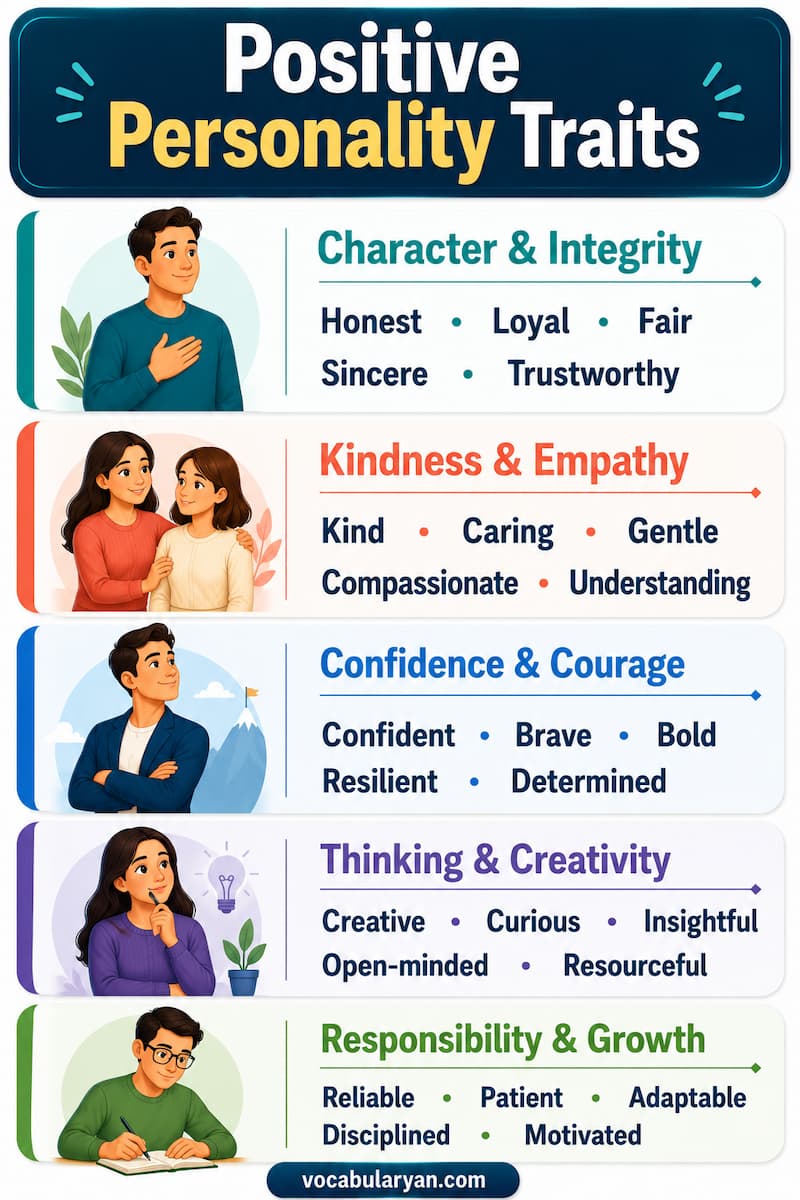
Personality is the pattern you can’t hide. It’s the energy someone brings to a room, the way they listen, the curiosity that pulls them toward new ideas, the warmth that makes others feel at ease. Unlike character, which is built through deliberate choices, personality is the natural, consistent style a person carries through life. The traits below are grouped by what kind of personality quality they name, from warm and social to energetic and driven, so you find the right one for a profile, a story, a tribute, or a self-description. Each trait carries a meaning and an example sentence to borrow.
Positive Personality Traits at a Glance
Short on time? Grab a trait for the quality you mean, then read the fuller groups below.
| The kind of personality… | Try these traits |
|---|---|
| Warm and relational | Warm, empathetic, sociable, affectionate |
| Energetic and lively | Enthusiastic, animated, spirited, vibrant |
| Curious and open | Curious, creative, imaginative, open-minded |
| Steady and reliable | Disciplined, focused, consistent, dependable |
| Calm and grounded | Easygoing, patient, balanced, mellow |
| Confident and expressive | Assertive, charismatic, outspoken, magnetic |
Warm and Relational Personality Traits
These are the traits that make someone a pleasure to know. They name the natural quality of a person who draws others in and holds them there.
- Warm: naturally friendly and comfortable to be around.
- “Her warm manner made new people feel as though they’d known her for years.”
- Empathetic: naturally attuned to how others feel.
- “He has an empathetic way of listening that makes people feel heard.”
- Sociable: genuinely at ease and happy with people.
- “She’s sociable without being loud, the person everyone gravitates to.”
- Affectionate: naturally open with warmth and care.
- “He’s affectionate in a genuine way that puts everyone at ease.”
- Nurturing: naturally inclined to support growth in others.
- “Her nurturing nature made her the first call whenever anyone struggled.”
- Charming: naturally drawing people in with ease.
- “His charming manner won the room over before he’d finished the introduction.”
- Approachable: naturally inviting and open to approach.
- “Her approachable style made even difficult conversations go smoothly.”
- Personable: naturally warm and agreeable in manner.
- “He’s personable with everyone, from the newest intern to the board.”
- Generous: naturally giving of time, attention, and care.
- “Her generous spirit showed in the way she made time for everyone.”
- Loyal: naturally true and steady in relationships.
- “His loyal nature meant his friendships lasted decades.”
Energetic and Lively Personality Traits
Some people arrive and the energy in a room rises. These traits name the natural liveliness and drive that makes someone magnetic.
- Enthusiastic: naturally full of energy and excitement.
- “Her enthusiasm for the project pulled the whole team in.”
- Animated: naturally expressive and lively in manner.
- “He grew animated the moment the conversation reached something he loved.”
- Spirited: naturally full of fire and life.
- “Her spirited approach turned a dull brief into something worth hearing.”
- Vibrant: naturally bright and full of living energy.
- “A vibrant presence in every room he entered.”
- Playful: naturally lighthearted and quick to enjoy.
- “Her playful wit made even the hardest meetings bearable.”
- Adventurous: naturally drawn to new experiences.
- “His adventurous spirit meant no invitation was ever turned down.”
- Dynamic: naturally energetic and always in motion.
- “Her dynamic approach kept the team on its toes.”
- Exuberant: naturally overflowing with joy and energy.
- “His exuberant reaction to good news was impossible not to share.”
- Spontaneous: naturally free and ready to act without overthinking.
- “She’s spontaneous, the one who books the trip before the meeting ends.”
- Lively: naturally bright and full of go.
- “A lively mind that turned small talk into real conversation.”
Curious and Open Personality Traits
These traits name the naturally inquisitive, imaginative side of a person who stays fascinated by the world.
- Curious: naturally driven to learn and understand more.
- Creative: naturally generating fresh approaches and ideas.
- Imaginative: naturally building new possibilities in the mind.
- Open-minded: naturally receptive to different views and ways.
- Reflective: naturally pausing to examine experience and meaning.
- Insightful: naturally seeing beneath the surface of situations.
- Inventive: naturally finding new ways to approach problems.
- Intuitive: naturally reading situations and people with accuracy.
- Perceptive: naturally noticing what others miss.
- Philosophical: naturally drawn to the deeper questions behind events.
Steady and Reliable Personality Traits
These traits name the consistent, dependable side of personality. The person you count on to do what they said, on time, every time.
- Disciplined: naturally steady and self-governed in habits.
- Focused: naturally locking attention on what matters.
- Consistent: naturally the same in any setting or pressure.
- Dependable: naturally following through without being chased.
- Methodical: naturally working through tasks in order.
- Organized: naturally keeping track and maintaining order.
- Diligent: naturally thorough and attentive in work.
- Punctual: naturally respectful of time, others’ and their own.
- Reliable: naturally showing up when and as expected.
- Hardworking: naturally giving full effort to whatever they take on.
Calm and Grounded Personality Traits
These traits name the naturally steady, unhurried side of personality: the person who doesn’t rush, doesn’t rattle, and brings the temperature down.
- Easygoing: naturally relaxed and free of tension.
- “His easygoing nature made even rushed days feel manageable.”
- Patient: naturally calm and willing to wait.
- “She’s patient in a way that keeps the team steady under pressure.”
- Balanced: naturally steady across every demand.
- “His balanced perspective stopped the team from overreacting.”
- Mellow: naturally gentle, relaxed, and unhurried.
- “Her mellow manner made the office feel quieter just by being in it.”
- Grounded: naturally calm and sure within themselves.
- “He stayed grounded when everyone else was guessing.”
- Serene: naturally at peace and undisturbed.
- “Her serene presence steadied the conversation.”
- Tolerant: naturally accepting of difference and difficulty.
- “His tolerant nature meant friction rarely got a chance to build.”
- Composed: naturally gathered and settled under stress.
- “She was composed at the point where most people would have cracked.”
- Level-headed: naturally steady and sensible under pressure.
- “A level-headed person in a crisis is worth more than ten strong opinions.”
- Unflappable: naturally impossible to rattle or throw off.
- “His unflappable calm became the team’s anchor.”
Confident and Expressive Personality Traits
These traits name the naturally outward, self-assured side of personality, the person whose presence you feel.
- Assertive: naturally direct and firm in expressing views.
- Charismatic: naturally drawing others in with presence and energy.
- Outspoken: naturally ready to say what needs saying.
- Magnetic: naturally compelling and hard to look away from.
- Confident: naturally at ease with themselves and their abilities.
- Expressive: naturally communicating feeling and thought openly.
- Persuasive: naturally winning others to their view.
- Self-assured: naturally settled and certain in who they are.
- Commanding: naturally taking the lead in a room.
- Articulate: naturally precise and compelling in speech.
Personality vs Character: The Key Difference
Both matter, and they’re worth telling apart.
Personality is the natural style a person was born with and shaped early. It shows up without effort: the extrovert’s ease with strangers, the introvert’s depth in quiet conversation, the natural curiosity that turns every dinner into a seminar. Personality is largely consistent and largely automatic.
Character is what a person builds through deliberate choices over time. Honesty when it costs. Courage when it’s inconvenient. Loyalty through a long, hard stretch. Character is earned rather than natural.
A charismatic person (personality) who consistently acts with integrity (character) is the full picture. You can have a warm personality without strong character, or strong character in a quiet, introverted style. Both are real and both matter: personality shapes how someone shows up, character shapes what they do when they get there.
Personality Traits in Different Settings
The same personality trait reads differently depending on where it shows up.
| Trait | How it shows at work | How it shows in relationships |
|---|---|---|
| Curious | Asks better questions, researches deeper | Stays genuinely interested in others |
| Warm | Makes colleagues feel valued | Builds closeness with ease |
| Assertive | States needs and opinions directly | Expresses feelings without games |
| Easygoing | Adapts without complaint | Keeps peace in hard stretches |
| Enthusiastic | Lifts team energy and momentum | Makes shared experiences richer |
| Disciplined | Delivers on commitments | Shows up steadily, not just in the good times |
The trait doesn’t change. What changes is the situation that reveals it. A curious person is curious at a meeting and at a dinner table, the setting just gives the trait a different stage.
How to Describe Someone’s Personality Precisely
A general personality note warms someone briefly. A precise one shows you really see them.
- ❌ “She has a great personality.”. Warm, but nothing to hold.
- ✅ “She’s naturally curious. She asks the question no one else thought to ask, and then she actually listens to the answer.”. One trait, one true pattern.
Name the trait, then name the behavior that proves it. That habit turns a polite label into a portrait worth keeping.
Positive Personality Traits A to Z
One trait and meaning for each letter, so you scan and choose at once.
| Letter | Trait | Meaning |
|---|---|---|
| A | Adventurous | Naturally drawn to new experiences |
| B | Balanced | Steady across every demand |
| C | Curious | Naturally driven to learn more |
| D | Disciplined | Naturally steady in habits |
| E | Empathetic | Naturally attuned to others’ feelings |
| F | Focused | Naturally locking onto what matters |
| G | Generous | Naturally giving of time and care |
| H | Hardworking | Naturally giving full effort |
| I | Imaginative | Naturally building new possibilities |
| J | Jovial | Naturally cheerful and good-humored |
| K | Kind-natured | Naturally warm by disposition |
| L | Lively | Naturally bright and full of go |
| M | Magnetic | Naturally compelling to others |
| N | Nurturing | Naturally supporting others’ growth |
| O | Open-minded | Naturally receptive to different views |
| P | Personable | Naturally warm and agreeable |
| Q | Quietly confident | Naturally sure without needing an audience |
| R | Reflective | Naturally pausing to examine experience |
| S | Sociable | Naturally at ease with people |
| T | Tolerant | Naturally accepting of difference |
| U | Unflappable | Naturally impossible to rattle |
| V | Vibrant | Naturally bright with living energy |
| W | Warm | Naturally friendly and open |
| X | (e)Xpressive | Naturally communicating feeling openly |
| Y | Youthful-spirited | Naturally bright and full of wonder |
| Z | Zestful | Naturally full of eager, lively energy |
FAQs
Positive personality traits are the natural, consistent qualities in a person’s style: warmth, curiosity, enthusiasm, empathy, and steadiness. Unlike character traits, which are built through deliberate moral choices, personality traits show up naturally and consistently across situations. They shape how a person communicates, connects, and moves through the world.
Personality traits are the natural style a person carries: extraversion, curiosity, warmth. Character traits are the moral qualities a person builds through choices: honesty, courage, loyalty. Personality shapes how someone shows up; character shapes what they do once they’re there. Strong people typically have both working together.
The Big Five, known by the acronym OCEAN, are the five broad dimensions of personality that psychology research has found across cultures: Openness to experience, Conscientiousness, Extraversion, Agreeableness, and Neuroticism. Each is a spectrum, not a category. A high score in Agreeableness points to warmth and cooperation; a low score in Neuroticism points to emotional stability and calm.
Use disciplined, focused, reliable, curious, and collaborative. Each names a quality that translates directly to work performance. A resume lands better when you tie each trait to a result: “Curious by nature, she identified the research gap that shifted the whole strategy.”
Core personality traits are largely stable in adulthood, but how and where you express them shifts with practice and environment. A naturally introverted person won’t become an extrovert, but they can develop stronger social skills. Traits like discipline, focus, and curiosity can be deepened through deliberate habit, even when they don’t come naturally.
Research points to confidence, curiosity, empathy, decisiveness, and resilience as the traits most strongly linked to effective leadership. Charisma draws people in; empathy keeps them; discipline delivers results. The strongest leaders combine natural presence with the character to use it well.