
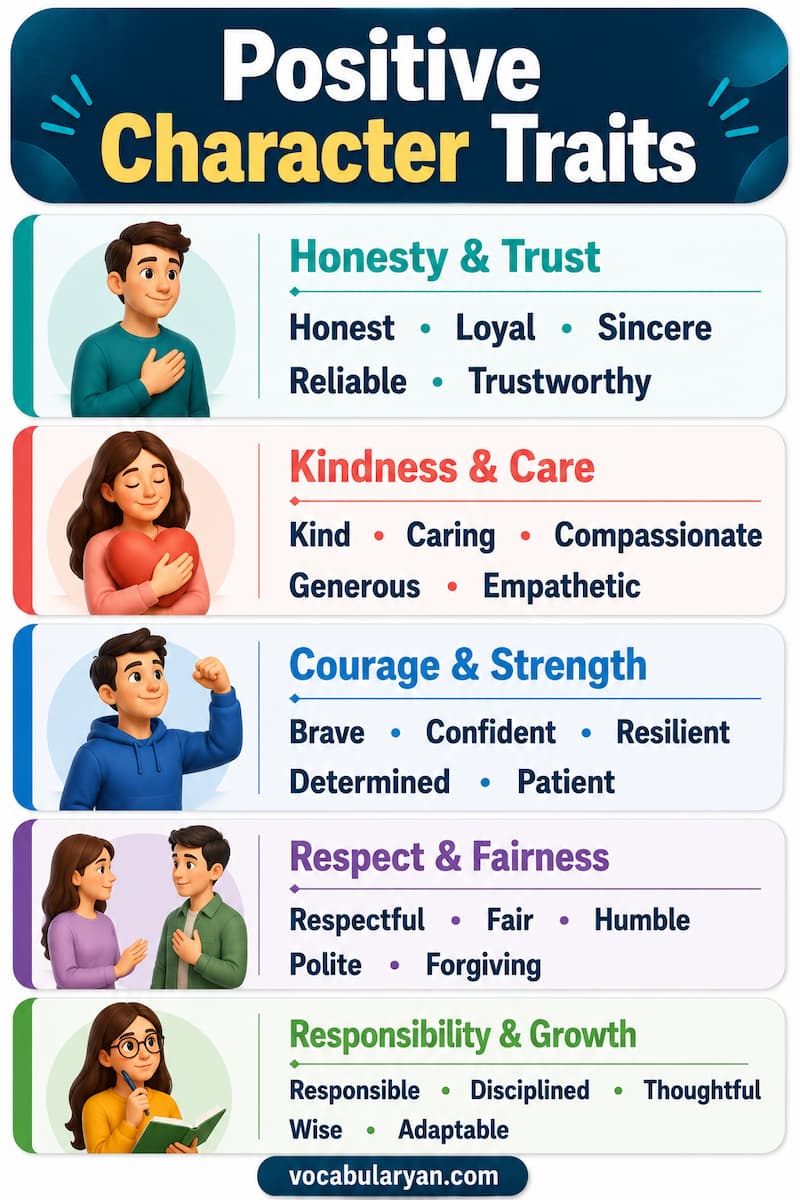
A person’s character is the sum of what they do when no one is watching. It’s not their talent, their looks, or their luck, but the qualities they bring to every room they enter: the honesty that holds under pressure, the kindness that shows up uninvited, the courage that acts before the fear fades. The traits below are grouped by the kind of goodness they name, from wisdom and integrity to warmth and resilience, so you find the right one for a tribute, a story, a self-assessment, or a letter of recommendation. Each trait carries a meaning and an example to borrow. Name the exact quality, and your words carry real weight.
Positive Character Traits at a Glance
Short on time? Grab a trait for the quality you mean, then read the fuller groups below.
| The kind of character… | Try these traits |
|---|---|
| Moral and ethical | Honest, principled, just, trustworthy |
| Warm and social | Compassionate, generous, loyal, kind |
| Brave and strong | Courageous, resilient, determined, bold |
| Wise and thoughtful | Wise, curious, open-minded, discerning |
| Steady and self-governed | Disciplined, patient, humble, reliable |
| Uplifting to others | Encouraging, inspiring, supportive, empowering |
Moral and Ethical Character Traits
These are the traits that hold when it costs something. They name integrity, the part of a person that doesn’t shift under pressure.
- Honest: truthful even when it’s inconvenient.
- “She was honest about the mistake before anyone else noticed it.”
- Principled: guided by strong moral values.
- “He stayed principled when the easier path was to look away.”
- Just: fair and even-handed in every situation.
- “A just leader gives everyone the same measure of regard.”
- Trustworthy: reliable enough to be counted on fully.
- “She’s trustworthy, which is rarer than being talented.”
- Accountable: owning one’s actions without excuse.
- “He was accountable for the error and fixed it without being asked.”
- Ethical: acting in line with strong moral principles.
- “Every decision she made had an ethical clarity behind it.”
- Upright: morally straight and dependable.
- “His upright manner earned him the kind of trust that takes years.”
- Sincere: genuine and free of pretense.
- “Her sincere apology carried real weight because of it.”
- Authentic: true to oneself and honest with others.
- “Authentic people don’t perform warmth, they carry it.”
- Conscientious: careful and thorough in doing right.
- “His conscientious approach meant nothing was left to chance.”
Warm and Social Character Traits
These traits govern how a person treats others, the ones that make someone a genuinely good friend, colleague, or partner.
- Compassionate: feeling for those who suffer and acting on it.
- “She gave a compassionate ear long after the rest had moved on.”
- Generous: giving freely and gladly of time, help, and care.
- “He’s generous in the way that asks for nothing back.”
- Loyal: true to people and principles through hard times.
- “She stayed loyal when loyalty had a cost.”
- Kind: warm and caring in everyday action.
- “Small acts of kindness built the trust over years.”
- Empathetic: understanding what another feels from the inside.
- “His empathetic response made her feel genuinely seen.”
- Warm: openly friendly and natural to be around.
- “Her warmth drew people in the moment she entered.”
- Considerate: mindful of how actions affect others.
- “A considerate person notices what others need before being asked.”
- Welcoming: open and inclusive toward newcomers.
- “His welcoming manner made the new team member feel at home.”
- Forgiving: willing to release a wrong and move forward.
- “Forgiving doesn’t mean forgetting, but she chose peace anyway.”
- Gracious: warm and courteous in every interaction.
- “Even under criticism, she remained gracious and measured.”
Brave and Strong Character Traits
Courage is not the absence of fear. These traits name the willingness to act when acting costs something.
- Courageous: facing fear and moving forward anyway.
- Resilient: bouncing back from hardship without losing yourself.
- Determined: set on seeing something through to the end.
- Bold: ready to act and speak without waiting for permission.
- Tenacious: holding on long after others let go.
- Persevering: pushing through repeated setbacks with steady will.
- Gritty: tough and full of staying power.
- Fearless: facing challenges without stepping back.
- Unshakeable: steady and firm when everything else moves.
- Decisive: making calls with confidence and committing to them.
Wise and Thoughtful Character Traits
Wisdom is character applied to judgment. These traits name the qualities of a person who thinks before they act and learns as they go.
- Wise: applying experience and reflection to good judgment.
- “She was wise enough to know the difference between opinion and fact.”
- Curious: driven to learn and understand more.
- “His curious mind turned every setback into a question worth answering.”
- Open-minded: willing to consider views that differ from your own.
- “An open-minded colleague makes the whole team sharper.”
- Discerning: quick to notice what matters and what doesn’t.
- “Her discerning eye saved the project from a costly misstep.”
- Reflective: learning from experience through honest self-examination.
- “He was reflective enough to admit when a strategy failed.”
- Perceptive: reading people and situations accurately.
- “Her perceptive nature meant she saw the problem before it surfaced.”
- Thoughtful: pausing to consider before responding.
- “A thoughtful answer landed better than a fast one.”
- Insightful: seeing the deeper truth beneath what’s visible.
- “His insightful note changed the whole direction of the discussion.”
- Prudent: careful and sensible in decisions.
- “A prudent leader weighs consequences before acting.”
- Creative: bringing new approaches to problems and ideas.
- “Her creative solution was the one no one else had considered.”
Steady and Self-Governed Character Traits
These traits name the inner discipline that sustains a person over time: the patience, the humility, and the reliability that show up day after day.
- Disciplined: consistent and self-governed in habits.
- Patient: calm and steady while waiting or enduring.
- Humble: aware of limits and free of arrogance.
- Reliable: following through on commitments without being chased.
- Self-aware: understanding one’s own strengths and blind spots.
- Balanced: steady across the demands of a full life.
- Composed: settled and sharp under pressure.
- Focused: locking attention on what matters.
- Adaptable: adjusting without losing direction.
- Self-controlled: governing impulses and emotions well.
Traits That Uplift Others
Some character traits don’t live in what a person does for themselves but in what they give to the people around them.
- Encouraging: giving others real heart to continue.
- Inspiring: moving others to want to reach higher.
- Supportive: staying alongside someone through difficulty.
- Empowering: giving others the confidence to lead themselves.
- Uplifting: raising the spirit of every room they enter.
- Mentoring: guiding others from experience and care.
- Affirming: naming the strengths in others out loud.
- Collaborative: building something together rather than alone.
- Inclusive: making sure no one is left out or unseen.
- Generous-spirited: sharing success, praise, and opportunity.
Character vs Personality: The Difference
People use the two words interchangeably, but they name different qualities. Knowing the difference sharpens how you use either.
- Personality is the outward pattern: the natural style, energy, and manner a person was largely born with. An extrovert’s warmth, an introvert’s depth, the sense of humor that shows up without effort.
- Character is the inward pattern: the values and virtues a person builds through choices. Honesty when it’s hard. Kindness when it’s costly. Courage when it’s inconvenient.
Personality shapes how a person shows up. Character shapes what they do when they get there. A person with a warm personality but weak character flatters easily; a person with a quiet personality but strong character holds firm under pressure. Both matter, but character is the one built deliberately.
How to Praise a Character Trait Specifically
A general compliment warms someone for a moment. A specific one stays with them. The difference is naming the exact trait and the real moment it showed.
- ❌ “She’s a great person.”. Warm, but nothing to hold onto.
- ✅ “She’s empathetic. When the new colleague arrived lost, she was the one who noticed and stayed late to help.”. One trait, one true moment.
Name the trait and then name the act that proved it. That habit turns a vague compliment into a tribute worth remembering.
Positive Character Traits for Different Contexts
The same trait name lands differently depending on where you use it.
| Context | Traits that land best |
|---|---|
| A letter of recommendation | Conscientious, reliable, principled, collaborative, discerning |
| A eulogy or tribute | Loyal, generous, wise, loving, principled, courageous |
| A story’s protagonist | Resilient, curious, determined, empathetic, flawed-but-growing |
| A self-assessment | Honest, self-aware, adaptable, accountable, focused |
| A child’s report card | Kind, curious, considerate, persevering, responsible |
| A relationship tribute | Warm, forgiving, loyal, empathetic, affirming |
The truest trait name fits the context. “Decisive” serves a letter of recommendation; “warm” serves a wedding speech. Match the trait to the moment and the reader feels it.
Positive Character Traits A to Z
One trait and meaning for each letter, so you scan and choose at once.
| Letter | Trait | Meaning |
|---|---|---|
| A | Accountable | Owning actions without excuse |
| B | Bold | Ready to act without waiting |
| C | Courageous | Facing fear and acting anyway |
| D | Determined | Set on seeing a goal through to the end |
| E | Empathetic | Understanding what another feels |
| F | Forgiving | Releasing a wrong and moving on |
| G | Generous | Giving freely and gladly |
| H | Humble | Aware of limits and free of arrogance |
| I | Insightful | Seeing the deeper truth beneath |
| J | Just | Fair and even-handed |
| K | Kind | Warm and caring in action |
| L | Loyal | True through hard times |
| M | Mindful | Fully present and attentive |
| N | Noble | High in character and fair in action |
| O | Open-minded | Willing to consider other views |
| P | Principled | Guided by strong moral values |
| Q | Quietly strong | Steady without needing an audience |
| R | Resilient | Bouncing back from hardship |
| S | Sincere | Genuine and free of pretense |
| T | Trustworthy | Reliable enough to be counted on fully |
| U | Upright | Morally straight and dependable |
| V | Virtuous | Good and moral in character |
| W | Wise | Applying experience to good judgment |
| X | (e)Xemplary | A model others look to |
| Y | Yielding-not | Firm in values under pressure |
| Z | Zealous | Full of eager, driving energy for good |
FAQs
Positive character traits are the stable qualities that define how a person acts over time: honesty, courage, kindness, loyalty, and wisdom are among the most valued. Unlike personality, which is partly inborn, character traits are built through choices and practice. The strongest ones show in what a person does when it costs them something.
Honesty, integrity, and trustworthiness form the moral core. Empathy, kindness, and loyalty define how a person treats others. Courage, resilience, and determination shape how they face adversity. No single trait stands alone, a person’s character is the pattern across all of them over time.
Personality is the natural outward style a person was born with, extroversion, humor, warmth. Character is what they build through choices, honesty when it costs, kindness when it’s inconvenient, courage when it’s hard. Personality shapes how a person shows up; character shapes what they do when they get there.
Use conscientious, reliable, principled, collaborative, and discerning. Each names a quality a hiring manager or decision-maker values and can picture in action. A letter lands harder when it ties each trait to a real example: “She is conscientious, no detail passed without her attention.”
Choose one trait to focus on for a month. Name what actions it requires, what you say when it’s hard, how it changes a decision. Practice builds the habit, and habit builds the trait. Surrounding yourself with people who already embody the trait you’re building accelerates the process significantly.
Kindness, honesty, perseverance, curiosity, and responsibility are the five most teachers and psychologists point to. Each one builds both personal resilience and the capacity for good relationships. Named early and practiced daily, they shape the adult the child becomes.