
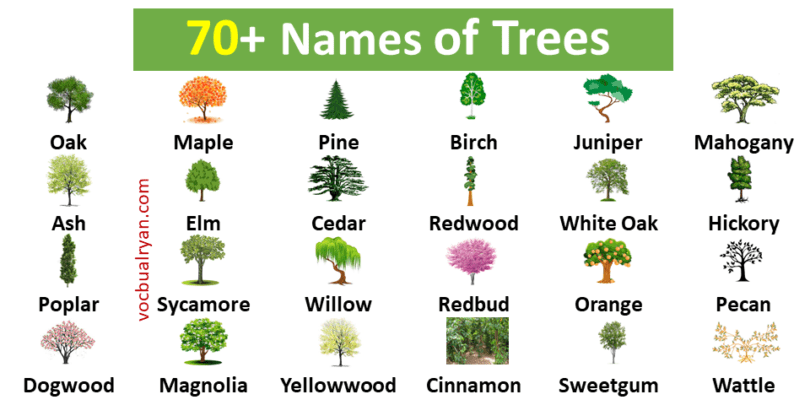
Trees are the largest plants on Earth. The seven main categories in English are fruit trees, nut trees, flowering trees, evergreens, deciduous trees, tropical trees, and iconic ancient trees, from apple to redwood.
English has seven main tree categories: fruit trees, nut trees, flowering trees, evergreens, deciduous trees, tropical trees, and iconic ancient trees. Every category has trees from different regions of the world, giving learners over 60 common tree names to know.
Common Tree Names With Pictures
Each family is defined by the tree’s main use or shape. Fruit, nut, and flowering are the three families planted for food and beauty. The other four are evergreens, deciduous trees, tropical trees, and iconic ancient trees like the baobab and redwood.
Fruit Tree Names in English
Fruit trees are the trees planted for the edible fruits they produce, from mangoes to apples to figs.
Mango Tree: medium to large evergreen tree with dense dark-green leaves, native to South Asia. It produces the sweet fleshy fruit known as the “king of fruits” through summer, and its wood is used for furniture, boats, and musical instruments across India and Southeast Asia.
Apple Tree: small to medium deciduous tree with white or pale-pink spring blossoms and glossy green leaves. It bears crisp red, green, or yellow apples in autumn, and it is the most widely cultivated fruit tree in temperate regions of the world.
Orange Tree: small evergreen tree with glossy dark-green leaves and fragrant white flowers. It produces round juicy oranges through winter and spring, and it is grown commercially in Brazil, the United States, Spain, and India, with Valencia and navel as the popular varieties.
Lemon Tree: small thorny evergreen tree with dark-green leaves and lightly scented white flowers. It produces bright yellow lemons year-round in warm climates, and the fruit is used everywhere from cooking to cleaning to cocktail garnishes.
Guava Tree: small tropical tree with peeling bark and unlobed oval leaves. It produces round pink or white-fleshed guavas with a strong sweet smell, and it is widely grown in India, Mexico, Brazil, and the Caribbean.
Papaya Tree: tall single-trunked tropical tree with a crown of large deeply-lobed leaves at the top. It produces oval orange-fleshed papayas at the base of the leaves, and it grows quickly, fruiting within a year of planting.
Fig Tree: small deciduous tree with broad lobed leaves and a rough grey trunk. It produces sweet pear-shaped figs that ripen in late summer, and it has been cultivated in the Mediterranean and Middle East for over 11,000 years.
Cherry Tree: small deciduous tree famous for its clouds of pale pink or white spring blossoms. It bears sweet or sour red cherries in early summer, and Japanese sakura viewing (hanami) is a spring tradition centered around cherry blossoms.
Peach Tree: small deciduous tree with narrow lance-shaped leaves and pink spring blossoms. It produces fuzzy round peaches with sweet yellow or white flesh in summer, and it originated in China before spreading to Persia, Europe, and the Americas.
Plum Tree: small deciduous tree with white spring blossoms and oval leaves. It produces round smooth-skinned plums in yellow, red, or purple, and the fruit is eaten fresh, dried into prunes, or fermented into East European plum brandy.
Pomegranate Tree: small deciduous tree with narrow shiny leaves and orange-red trumpet flowers. It produces round red pomegranates full of jewel-like seeds in autumn, and the tree has been a symbol of fertility and abundance in Mediterranean and Persian cultures for millennia.
Avocado Tree: medium evergreen tree with dark-green oval leaves, native to Mexico and Central America. It produces the buttery green-fleshed avocado year-round in tropical climates, and Mexican Hass is the variety most widely sold in supermarkets worldwide.
Nut Tree Names in English
Nut trees are the trees grown for the hard-shelled edible seeds inside their fruits.
Almond Tree: small deciduous tree with pale pink or white spring blossoms. It produces almonds inside a green fleshy husk that dries and splits open, and California grows over 80% of the world’s almond supply.
Walnut Tree: large deciduous tree with compound leaves and a straight trunk. It produces walnuts inside a green husk and a hard woody shell, and its dark rich wood is prized for gunstocks, fine furniture, and musical instrument bodies.
Cashew Tree: small tropical tree native to Brazil with leathery evergreen leaves. It produces a strange fruit called the cashew apple with a curved nut hanging outside, and the nut requires careful processing to remove the toxic shell before eating.
Chestnut Tree: large deciduous tree with long serrated leaves and greenish-cream summer flowers. It produces sweet chestnuts inside a spiny green burr that opens in autumn, and roasted chestnuts are a traditional Christmas food across Europe.
Hazelnut Tree: small deciduous tree or large shrub with heart-shaped leaves. It produces small round hazelnuts (also called filberts) in autumn, and Turkey grows most of the world’s hazelnut crop that goes into Nutella and Ferrero Rocher.
Pecan Tree: large deciduous tree native to the southern United States with long compound leaves. It produces oval pecans inside a thin hard shell, and pecan pie is the classic dessert of the American South.
Flowering Tree Names With Pictures
Flowering trees are the ornamental trees planted for their showy spring or summer flowers.
Cherry Blossom: small ornamental cherry tree famous for its clouds of pale pink or white spring flowers. It is the national flower of Japan, celebrated in the hanami cherry-blossom viewing tradition, and Washington DC’s Tidal Basin is famous for its cherry-blossom festival.
Jacaranda: medium tropical tree with feathery fern-like leaves and clouds of purple trumpet-shaped spring flowers. It carpets streets in violet blossoms in Buenos Aires, Sydney, Johannesburg, and Los Angeles from October through November.
Magnolia: medium tree or large shrub with glossy leathery leaves and huge waxy white, pink, or purple flowers that appear before the leaves in spring. It is one of the oldest flowering plant families, predating bees by 20 million years.
Dogwood: small deciduous tree with a flat-topped crown and showy white or pink flowers in early spring. It is the state tree of Missouri and Virginia, and its dense hard wood was used to make weaving shuttles and golf-club heads.
Redbud: small deciduous tree that produces bright pink-purple flowers directly on its bare branches in early spring, before the heart-shaped leaves come out. It is a favorite in American Midwest landscaping and a spring signal in native woodlands.
Frangipani: small tropical tree with thick fleshy branches and heavily perfumed white, pink, or yellow flowers. It is worn in Hawaiian leis, planted at Buddhist temples across Southeast Asia, and prized for its heady evening fragrance.
Gulmohar: medium tropical tree with feathery leaves and crowns of bright red-orange flowers in summer. It is called the “flame of the forest” for its dramatic bloom, and it lines streets across India, Sri Lanka, and the Caribbean.
Crape Myrtle: small deciduous tree with smooth peeling bark and long clusters of crinkled crepe-like flowers in white, pink, purple, or red. It blooms all summer, and it is the most popular ornamental tree in the American South.
Bottlebrush: small evergreen Australian tree with narrow leaves and bright red flower spikes shaped like bottle brushes. It attracts native honeyeater birds and rainbow lorikeets, and it is planted in warm-climate gardens worldwide.
Wisteria: climbing tree-like woody vine with hanging clusters of fragrant purple, pink, or white pea-shaped flowers in spring. Trained as a small tree, it forms dramatic garden centerpieces, and Japan’s Ashikaga Flower Park is famous for its wisteria tunnels.
Evergreen Tree Names in English
Evergreen trees keep their leaves or needles throughout the year, replacing them slowly.
Pine: tall coniferous tree with long needle-like leaves in bundles of two, three, or five. It produces woody cones and grows across North America, Europe, and Asia, providing timber for construction, paper pulp, and Christmas trees.
Spruce: tall coniferous tree with short stiff needles attached individually to the branch. Its wood is prized for musical instruments (violins, guitars, piano soundboards), and Norway Spruce is the traditional European Christmas tree.
Fir: tall coniferous tree with flat soft needles and cones that stand upright on the branches. Douglas Fir and Balsam Fir are the most popular Christmas trees in North America for their strong scent and needle retention.
Cedar: tall coniferous tree with fragrant reddish-brown wood and small needle-like leaves in clusters. Cedar of Lebanon is the national tree of Lebanon and marks the country’s flag, and cedar wood repels moths in storage chests and closets.
Cypress: tall narrow evergreen with scale-like leaves and small round cones. Italian Cypress lines Tuscan hillsides and marks Mediterranean cemeteries, and Bald Cypress grows in the Louisiana bayous with roots called “knees” rising above the water.
Juniper: small evergreen tree or shrub with prickly needle-like leaves and blue-black berry-like cones. Juniper berries flavor gin (the word comes from Dutch jenever), and the wood is used for pencils, fence posts, and cedar-lined closets.
Holly: small evergreen tree with glossy dark-green spiky leaves and bright red winter berries. It is the classic Christmas decoration in Europe and North America, and only female holly trees produce the famous berries.
Hemlock: tall coniferous tree with short flat needles and small drooping cones. Eastern Hemlock and Western Hemlock are major North American timber trees, and the name is unrelated to the poison-hemlock plant that killed Socrates.
Eucalyptus: tall Australian evergreen with peeling bark, long grey-green leaves, and aromatic oil. It is the koala’s only food, grows rapidly for pulp and firewood, and its oil is used in cough drops, cleaning products, and traditional medicine.
Olive: small gnarled evergreen tree with silver-green oval leaves and small greenish-white flowers. It has been cultivated in the Mediterranean for 6,000 years, produces olives for eating and pressing into olive oil, and can live for over 2,000 years.
Deciduous Tree Names With Pictures
Deciduous trees shed all their leaves once a year, then grow new ones in spring.
Oak: broad-leaved deciduous tree with lobed leaves and hard dense wood. It produces acorns that feed pigs, deer, and squirrels, and oak is the classic wood for whiskey barrels, ship-building, and heirloom furniture across Europe and North America.
Maple: medium to large deciduous tree with five-pointed palm-shaped leaves that turn brilliant red, orange, and yellow in autumn. Sugar Maple is tapped for maple syrup in Canada and the northeastern United States, and its leaf is on the Canadian flag.
Birch: medium deciduous tree with distinctive white peeling papery bark and small triangular leaves. Silver Birch is planted for landscaping across Europe, and Paper Birch bark was used by Native Americans to build lightweight canoes.
Elm: large deciduous tree with a graceful vase shape and asymmetrical toothed leaves. American Elms once lined the streets of every US town before Dutch elm disease devastated the population in the mid-20th century.
Ash: tall deciduous tree with compound leaves and light strong wood. Ash wood is used for baseball bats, hockey sticks, tool handles, and traditional English longbows, and the emerald ash borer beetle now threatens ash trees across North America.
Poplar: tall fast-growing deciduous tree with triangular leaves that flutter in the slightest breeze. Its soft light wood is used for pallets, plywood, and matchsticks, and its rapid growth makes it a favorite for shelterbelts and rural windbreaks.
Willow: medium deciduous tree with long narrow leaves and drooping branches, especially the famous Weeping Willow. Willow bark is the natural source of aspirin (salicin), and cricket bats are traditionally made from Willow.
Sycamore: large deciduous tree with distinctive mottled peeling bark and broad palm-shaped leaves. It grows near rivers and streams in North America, has one of the largest leaves of any temperate tree, and hollow old sycamores can shelter wildlife.
Beech: tall deciduous tree with smooth grey bark and glossy oval leaves that turn coppery-bronze in autumn. Beech nuts feed forest wildlife, and beech wood is used for kitchen tools, furniture, and traditional German smoked-food fires.
Aspen: medium deciduous tree with round leaves on flat stalks that shimmer and rustle in the wind, giving the “quaking aspen” its name. It grows in cold climates across North America, and Pando in Utah is a single aspen grove sharing one root system across 106 acres, and is the largest single organism on Earth.
Tropical Tree Names in English
Tropical trees are trees native to the warm humid climates of Asia, Africa, and South America.
Banyan Tree: large tropical tree with aerial roots that grow down from the branches, thicken into trunks, and turn one tree into a small forest. It is the national tree of India, sacred in Hindu tradition, and one banyan in Kolkata spreads over 3 acres.
Peepal Tree: medium tropical tree with heart-shaped leaves ending in a long drip-tip point. It is sacred in Hinduism, Buddhism, and Jainism (the Buddha is said to have gained enlightenment under a peepal), and mature peepals live for over a thousand years.
Neem Tree: medium evergreen tropical tree with compound serrated leaves and small white flowers. It is called the “village pharmacy” in India for its use in traditional medicine, natural pesticide, toothbrushes, and cosmetics, and every part of the tree has a use.
Ashoka Tree: small evergreen tropical tree with long dark-green leaves and clusters of fragrant orange-yellow flowers. It is sacred in Buddhism (the Buddha was born under one) and Hinduism, and it is a popular ornamental tree across South and Southeast Asia.
Tamarind Tree: medium tropical tree with feathery compound leaves and pale yellow flowers. It produces sticky brown pods with tangy pulp used in Indian curries, Thai pad thai, Mexican candies, and Worcestershire sauce, and it can live for over 150 years.
Teak Tree: large tropical hardwood tree with big oval leaves and small white flowers, native to South and Southeast Asia. Its dense oily wood is prized for boat decks, outdoor furniture, and luxury flooring, and Myanmar and India are the main sources.
Mahogany Tree: large tropical tree with feathery compound leaves and small white flowers, native to the Americas and West Africa. Its rich reddish-brown wood is used for fine furniture, musical instruments, and boats, and heavy trade has made the tree endangered in the wild.
Rubber Tree: medium tropical tree native to the Amazon rainforest, tapped for the white latex sap that becomes natural rubber. It is now grown on plantations across Southeast Asia (Thailand, Indonesia, Malaysia), which produce most of the world’s natural rubber supply.
Jackfruit Tree: large evergreen tropical tree with glossy leathery leaves and the world’s largest tree-borne fruit, weighing up to 50 kilograms. Native to South India, the fruit tastes like a mix of banana, mango, and pineapple, and unripe jackfruit is a popular vegan meat substitute.
Coconut Palm: tall tropical palm with a curved trunk topped by a crown of long feathery fronds. It produces coconuts year-round, and every part of the tree (trunk, fronds, husk, meat, water, oil) has a traditional use in Pacific, Caribbean, and Indian coastal cultures.
Iconic and Ancient Tree Names
Iconic and ancient trees are the trees famous for their size, age, or unique appearance.
Baobab: iconic African tree with a swollen water-storing trunk and short branches at the top, giving it the nickname “upside-down tree.” Baobabs can live 3,000 years, store thousands of liters of water in the trunk, and are found across the savannas of sub-Saharan Africa and Madagascar.
Redwood: giant California evergreen and one of the tallest trees in the world, reaching 380 feet (115 meters). Coast Redwoods grow in a narrow strip along the California and Oregon coast, and the tallest known tree (Hyperion) is a Redwood at 379 feet.
Sequoia: giant California evergreen and one of the largest trees in the world by volume. General Sherman in Sequoia National Park is the biggest tree on Earth, at 275 feet tall and 36 feet wide at the base, and Sequoias can live over 3,000 years.
Ginkgo: living-fossil tree with fan-shaped leaves that turn brilliant yellow in autumn, the last surviving species of a plant family that dates back 270 million years. Ginkgos are planted as street trees in Tokyo, Seoul, and New York for their pollution tolerance and hardy nature.
Yew: small evergreen tree with dark-green flat needles and red berry-like cones, famous for its extreme longevity. Ancient yews in English churchyards are estimated at over 2,000 years old, and traditional English longbows were made from yew wood.
Kapok: giant Amazon and West African rainforest tree with a buttressed trunk that reaches 200 feet tall. Its seed pods release cotton-like fibers used to fill pillows and life jackets, and the Mayans considered the kapok sacred, believing it linked the underworld, earth, and heavens.
Tree Names That Look Similar
Some tree names look almost identical or describe close relatives that learners mix up.
Deciduous vs Evergreen
| Term | Meaning |
|---|---|
| Deciduous | Sheds all its leaves once a year (in autumn for most species) |
| Evergreen | Keeps its leaves (or needles) throughout the year |
Oak, maple, and birch are deciduous. Pine, fir, and cedar are evergreen. Some tropical trees (like mango and neem) are called evergreen even though they slowly replace leaves year-round.
Pine vs Fir vs Spruce
| Tree | Needles | Cones |
|---|---|---|
| Pine | Long, in bundles of 2, 3, or 5 | Woody, hang down |
| Fir | Flat, soft, attached individually | Upright, stand on branch |
| Spruce | Short, stiff, attached individually | Woody, hang down |
Feel the needle: pine bundles are the giveaway. Look at the cone: firs point up, pines and spruces hang down. Touch a spruce needle: it will prick your finger; a fir needle is soft.
Peepal vs Banyan
| Term | Leaf | Roots |
|---|---|---|
| Peepal | Heart-shaped with a long drip-tip | Grow underground |
| Banyan | Oval, glossy, thick | Aerial roots grow down from branches and form new trunks |
Both are sacred fig trees in India. The peepal is the Bodhi Tree of Buddhist tradition. The banyan is the national tree of India and forms the “one tree, many trunks” grove shape.
Palm vs Coconut Palm vs Date Palm
| Term | Trunk | Fruit |
|---|---|---|
| Palm | General term for over 2,500 tropical species | Varies by species |
| Coconut Palm | Curved smooth trunk | Coconuts |
| Date Palm | Straight rough trunk | Sweet brown dates |
Coconut palms grow along tropical coasts. Date palms grow in hot dry Middle Eastern deserts and oases.
FAQs
Q1. What is the difference between deciduous and evergreen trees?
Deciduous trees shed all their leaves once a year, and grow new leaves in spring. Evergreen trees keep their leaves or needles throughout the year, replacing them slowly rather than all at once. Oak, maple, and birch are deciduous. Pine, cedar, spruce, and eucalyptus are evergreen.
Q2. Which tree provides the most shade?
The banyan tree is famous worldwide for its enormous shade coverage. Its aerial roots grow down from the branches, thicken into new trunks, and expand the canopy outward until a single tree can cover several acres. The Great Banyan in Kolkata’s botanical garden shades over 3 acres and is considered the widest tree on Earth.
Q3. What is the difference between peepal and banyan trees?
Both peepal and banyan are sacred fig trees in India but look quite different. The peepal has heart-shaped leaves with long drip-tips and no aerial roots. The banyan has oval glossy leaves and famous aerial roots that grow down from the branches and become new trunks. The Buddha reached enlightenment under a peepal; the banyan is India’s national tree.
Q4. Which trees are used most for wood or furniture?
Teak, mahogany, oak, walnut, cherry, and maple are the trees most prized for wood and furniture. Teak is used for boat decks and outdoor furniture for its water resistance. Mahogany and walnut are used for luxury indoor furniture. Oak is the classic for whiskey barrels and traditional furniture. Cherry and maple are used for kitchen cabinetry.
Q5. What are the tallest trees in the world?
The tallest trees in the world are Coast Redwoods, growing along the California and Oregon coasts. The current record holder is Hyperion at 380 feet (116 meters) tall. Giant Sequoias are shorter but larger by volume. The tallest tropical tree is a species of yellow meranti in Borneo that reaches over 330 feet.
Q6. Are bananas and bamboos trees?
Neither banana nor bamboo is technically a tree. Bananas grow on giant herbaceous plants with a “trunk” made of tightly rolled leaf sheaths rather than wood. Bamboo is a member of the grass family, though some bamboo species grow as tall as trees. Both are called trees in everyday English, but botanically they are not.

Leave a Comment