
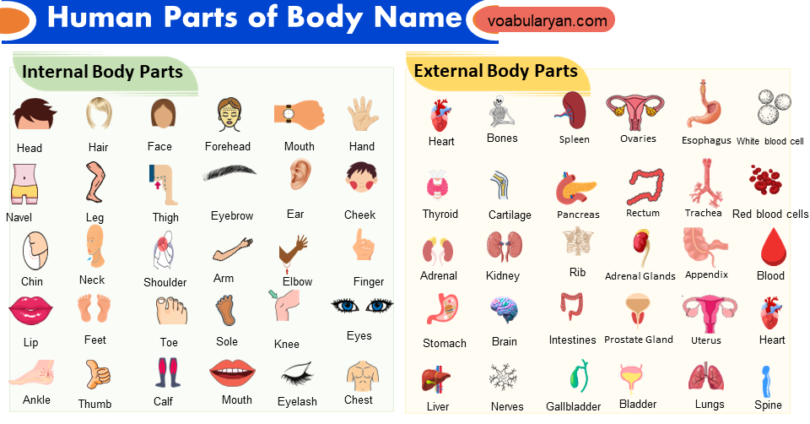
The human body has around 80 named parts a learner meets in everyday English, from the head, face, and neck at the top down to the legs and feet at the bottom, with a full set of organs and systems working inside. Each name here comes with a picture, the English spelling, and a plain line of what the part is and what it does.
The 12 main body parts on the outside are the head, face, neck, shoulders, chest, back, arms, hands, waist, hips, legs, and feet. The main internal organs are the brain, heart, lungs, liver, kidneys, and stomach, and the body’s 11 systems (nervous, respiratory, circulatory, digestive, skeletal, muscular, immune, endocrine, urinary, reproductive, and integumentary) group those organs by function.
Common Human Body Parts With Pictures
Every category names parts of the body by region, so you can find the English name of a specific part whether you are pointing to the outside of your face, describing a symptom to a doctor, or reading a health lesson at school.
Head and Face Body Parts Names
Head and face body parts are the words for everything from the top of the skull down to the chin, plus every feature on the front of the face.
Head: round upper part of the human body that houses the brain and all the sense organs.
Skull: bony framework of the head that protects the brain and shapes the face.
Face: front of the head from the forehead down to the chin, showing eyes, nose, mouth, and every expression.
Forehead: flat area above the eyebrows and below the hairline, and the first place a parent puts a hand to feel for a fever.
Temple: flat sides of the head between the forehead and the ear, where you can feel a pulse under the skin.
Hair: thin threads that grow from the scalp in every colour from blonde to jet black, cut and styled in every culture.
Scalp: skin covering the top of the head, home to the roots of every hair.
Eye: organ of sight, protected by the eyelid and lashes and set inside a bone socket in the skull.
Eyebrow: strip of short hairs above the eye that shows expression and keeps sweat from running down into the eye.
Eyelash: short curved hairs along the edge of the eyelid that catch dust before it reaches the eye.
Eyelid: thin skin fold that closes over the eye to blink, protect it, and let it rest during sleep.
Nose: central part of the face used to breathe and to smell, with two nostrils that open into the airway.
Nostril: either of the two openings in the nose through which air passes in and out.
Ear: organ of hearing on each side of the head, made of an outer flap, a canal, and an inner working part inside the skull.
Cheek: soft fleshy area on either side of the face between the eye and the mouth.
Cheekbone: raised bone under the eye that gives the upper cheek its shape and structure.
Jaw: two bones that form the frame of the lower face and move to open and close the mouth.
Chin: pointed lower end of the face below the mouth, formed by the front of the jawbone.
Dimple: small dent that forms in the cheek or chin of some people when they smile.
Mouth: opening in the face used for eating, drinking, speaking, and breathing.
Lips: soft red edges around the mouth, used in speaking clearly and in guiding food into the mouth.
Teeth: hard white structures inside the mouth used to bite, cut, and grind food before swallowing.
Tongue: muscular organ inside the mouth that tastes food, shapes speech sounds, and pushes food back for swallowing.
Gums: pink flesh around the base of the teeth that keeps them fixed in the jaw.
Neck and Shoulder Body Parts
Neck and shoulder body parts join the head to the torso and give the upper body its range of movement from side to side and up and down.
Neck: column of muscle and bone that joins the head to the torso and turns the head in every direction.
Nape: back of the neck at the base of the skull, where hair meets the top of the collar.
Throat: front of the neck and the passage inside where food and air travel down from the mouth.
Adam’s Apple: small bump at the front of the throat, larger in men than women because of the shape of the voice box behind it.
Shoulder: joint where the arm meets the top of the torso, letting the arm swing forward, back, up, and around.
Collarbone: long thin bone between the neck and the shoulder that you can see and feel just below the skin.
Armpit: hollow area under the shoulder where the arm joins the torso.
Arm and Hand Body Parts Names
Arm and hand body parts do most of the daily work of the body, from lifting and writing to eating, gesturing, and greeting.
Arm: whole upper limb from the shoulder down to the wrist, made up of the upper arm, elbow, and forearm.
Upper Arm: section of the arm between the shoulder and the elbow, home to the biceps and triceps muscles.
Bicep: large muscle at the front of the upper arm that flexes when you bend the elbow to bring a weight up.
Tricep: muscle at the back of the upper arm that straightens the elbow when you push or throw.
Forearm: section of the arm between the elbow and the wrist, made up of two long bones side by side.
Elbow: middle joint of the arm where the upper arm meets the forearm, bending only in one direction.
Wrist: joint between the forearm and the hand that turns and bends so the hand can point in every direction.
Hand: end of the arm that grips, points, waves, writes, and does most of the daily work in a person’s life.
Palm: flat inside surface of the hand between the wrist and the base of the fingers.
Knuckle: bony bump at each finger joint that shows most clearly when the hand makes a fist.
Finger: any of the five long jointed parts of the hand, made up of the thumb, index, middle, ring, and little finger.
Thumb: short thick finger set apart from the other four, the reason humans can grip so many kinds of objects.
Fingernail: hard flat covering at the tip of each finger, made of keratin and cut with clippers or a nail file.
Cuticle: thin strip of skin at the base of the fingernail where the nail meets the finger.
Torso Body Parts Names
Torso body parts run from the shoulders down to the hips, with the chest at the front, the back behind, and the abdomen below.
Torso: main trunk of the body from the shoulders to the hips, not counting the head, arms, or legs.
Chest: front upper part of the torso between the neck and the abdomen, the area over the heart and lungs.
Breast: either of the two soft rounded areas on the front of the chest, larger in women where they produce milk after childbirth.
Nipple: small raised centre of each breast, where milk comes out in nursing mothers.
Ribs: twelve pairs of curved bones that form the ribcage around the chest and protect the heart and lungs inside.
Ribcage: frame of ribs, spine, and breastbone that shields the organs of the chest.
Back: entire rear surface of the torso from the shoulders down to the top of the hips, along either side of the spine.
Spine: long chain of small bones running down the middle of the back that keeps the body upright and protects the spinal cord.
Waist: narrower middle section of the torso between the ribs and the hips, where you fasten a belt.
Abdomen: front area of the body between the chest and the pelvis, and the medical word for the belly.
Belly: everyday word for the front of the abdomen, especially the rounded soft area between the ribs and the hips.
Navel: small round hollow in the middle of the belly, marking where the umbilical cord was attached at birth.
Hip: wide joint on either side where the leg meets the pelvis, giving the body the swing of walking.
Groin: fold where the abdomen meets the top of each thigh.
Buttocks: two rounded fleshy parts below the waist and behind the hips, used for sitting.
Leg and Foot Body Parts Names
Leg and foot body parts do the work of walking, running, jumping, and standing, and each name marks a specific joint, bone, or muscle group along the way.
Leg: whole lower limb from the hip down to the foot, made up of the thigh, knee, and lower leg.
Thigh: section of the leg between the hip and the knee, home to some of the largest muscles in the body.
Hamstring: group of three muscles at the back of the thigh that bends the knee and moves the leg backward.
Knee: middle joint of the leg between the thigh and the shin, letting the leg bend when you sit, kneel, or climb.
Kneecap: small round bone at the front of the knee that protects the knee joint underneath.
Shin: front bone of the lower leg between the knee and the ankle, thinly padded and quick to bruise on impact.
Calf: large muscle at the back of the lower leg that flexes when you rise onto your toes or run.
Ankle: joint between the lower leg and the foot that turns the foot up, down, and side to side.
Foot: flat platform at the end of the leg that supports the body’s weight and pushes off the ground with each step.
Heel: rounded back of the foot that strikes the ground first when you walk.
Sole: underside of the foot, the part that touches the ground when you stand.
Arch: curved lower shape of the sole between the heel and the ball of the foot, a natural spring that absorbs shock.
Toe: any of the five short jointed parts at the front of the foot that help with balance and pushing off during walking.
Toenail: hard flat covering at the tip of each toe, thicker than a fingernail and cut straight across.
Skin and Body Coverings
Skin and body coverings are the outermost surfaces of the body, growing continuously as hair, nails, and new layers of skin replace old ones.
Skin: outer covering of the whole body, the largest organ, and the barrier that protects everything underneath from injury, dirt, and germs.
Pore: any of the tiny openings in the skin through which sweat and oil come to the surface.
Wrinkle: small crease or line in the skin that forms with age or repeated facial expression.
Beard: hair that grows on the lower face and chin of adult men.
Moustache: hair that grows on the upper lip of adult men, cut and styled in dozens of shapes.
Internal Organs of the Human Body
Internal organs are the working parts inside the body that keep it alive, from the brain in the skull to the lungs and heart in the chest and the stomach, liver, and kidneys in the abdomen.
Brain: soft grey organ inside the skull that thinks, remembers, senses, and controls every other part of the body.
Heart: muscular pump in the centre-left of the chest that pushes blood around the body every second of life.
Lungs: two spongy organs in the chest that pull oxygen from the air and release carbon dioxide with every breath.
Trachea: tube from the throat down to the lungs that moves air in and out with every breath, also called the windpipe.
Esophagus: muscular tube from the throat to the stomach that pushes swallowed food down into the digestive system.
Stomach: J-shaped organ in the upper abdomen that mixes swallowed food with acid and enzymes to begin digestion.
Small Intestine: long coiled tube after the stomach where most nutrients and vitamins are absorbed into the bloodstream.
Large Intestine: wider shorter tube after the small intestine that absorbs water and forms solid waste for elimination.
Liver: large reddish-brown organ on the upper right of the abdomen that filters blood and produces bile for digesting fat.
Gallbladder: small green sac tucked under the liver that stores bile and releases it into the small intestine after meals.
Pancreas: long flat organ behind the stomach that produces insulin and digestive enzymes.
Kidneys: two bean-shaped organs on either side of the spine that filter blood and produce urine to remove waste.
Bladder: muscular sac in the lower abdomen that stores urine until it is released.
Spleen: fist-sized organ on the upper left of the abdomen that filters blood and stores white blood cells for the immune system.
Appendix: small tube-shaped pouch at the start of the large intestine, prone to inflammation and removal in appendicitis.
Diaphragm: dome-shaped muscle below the lungs that drives every breath by pulling down and pushing up.
Body Systems and Their Parts
Body systems are groups of organs that work together for one function, from the nervous system that controls thought to the immune system that fights illness.
Nervous System: brain, spinal cord, and nerves that control thought, movement, sensation, and reflexes across the whole body.
Respiratory System: nose, throat, trachea, and lungs that bring oxygen in and push carbon dioxide out with every breath.
Circulatory System: heart and blood vessels that pump blood around the body to deliver oxygen and nutrients to every cell.
Digestive System: mouth, esophagus, stomach, intestines, liver, and pancreas that break food into nutrients the body can absorb.
Skeletal System: 206 bones of the adult skeleton that give the body its shape, protect the organs, and give the muscles something to pull against.
Muscular System: three types of muscle in the body: skeletal muscle that moves the limbs, smooth muscle in the organs, and cardiac muscle in the heart.
Immune System: white blood cells, antibodies, lymph nodes, and spleen that fight infection and remember past illnesses.
Endocrine System: glands that release hormones into the blood, from the thyroid and adrenals to the pituitary and pancreas.
Urinary System: kidneys, ureters, bladder, and urethra that filter waste from the blood and remove it as urine.
Reproductive System: organs in men and women that produce children, different between the sexes but paired in purpose.
Integumentary System: skin, hair, and nails that cover the body and act as the first defence against injury and infection.
Male and Female Reproductive Body Parts
Male and female reproductive body parts are the organs that differ between the sexes and work together to produce children.
Female Reproductive Parts
Breasts: two rounded organs on the front of the chest that produce milk after childbirth for nursing an infant.
Ovaries: two small almond-shaped organs on either side of the pelvis that produce eggs and the hormones oestrogen and progesterone.
Uterus: pear-shaped muscular organ in the pelvis where a fertilised egg grows into a baby during pregnancy, also called the womb.
Cervix: narrow lower end of the uterus that opens into the vagina and widens during childbirth.
Vagina: muscular canal from the cervix to the outside of the body, involved in menstruation, intercourse, and childbirth.
Vulva: outer visible part of the female reproductive system, made up of the labia and the opening to the vagina.
Fallopian Tubes: two thin tubes that connect the ovaries to the uterus, along which a released egg travels each month.
Male Reproductive Parts
Penis: external male organ used for urination and reproduction, made of soft tissue that fills with blood during erection.
Testicles: two egg-shaped organs inside the scrotum that produce sperm and the male hormone testosterone.
Scrotum: pouch of skin below the penis that keeps the two testicles at a temperature slightly cooler than the body.
Prostate: walnut-sized gland below the bladder that produces part of the fluid in semen.
Urethra: tube from the bladder to the outside of the body, shared by the urinary and reproductive systems in men and used only for urine in women.
Body Parts That Look Similar
Some body-part words are close in meaning or share a common word root, and telling them apart pays off when you visit a doctor or read a health lesson.
Forearm vs Upper Arm
| Term | Section | Bones |
|---|---|---|
| Upper Arm | Shoulder to elbow | One long bone (humerus) |
| Forearm | Elbow to wrist | Two long bones (radius and ulna) |
Palm vs Sole
| Term | Body part | Feel |
|---|---|---|
| Palm | Inside of the hand | Soft skin, deep creases |
| Sole | Bottom of the foot | Thicker skin, weight-bearing surface |
Stomach vs Abdomen vs Belly
| Term | What it means |
|---|---|
| Stomach (medical) | The internal digestive organ in the upper abdomen |
| Abdomen | The whole front area of the body between the chest and the pelvis |
| Belly (everyday) | The outer front of the abdomen, and the loose word people use for the whole area |
Calf vs Shin
| Term | Location | What it is |
|---|---|---|
| Shin | Front of the lower leg | Long bone (tibia) close under the skin |
| Calf | Back of the lower leg | Large muscle group (gastrocnemius and soleus) |
FAQs
Q1. What are the 12 main parts of the human body?
The 12 main parts of the human body are the head, face, neck, shoulders, arms, hands, chest, back, waist, hips, legs, and feet. Together they form the outer structure a doctor names in an everyday health check, and each region has many smaller named parts a learner meets in vocabulary lessons.
Q2. What is the difference between external and internal body parts?
External body parts are the parts you can see from the outside, such as the head, face, arms, hands, legs, and skin. Internal body parts are the organs inside the body that you cannot see without a scan or an examination, such as the brain, heart, lungs, liver, and kidneys.
Q3. What are the main internal organs of the human body?
The main internal organs of the human body are the brain, heart, lungs, liver, kidneys, stomach, small intestine, large intestine, pancreas, spleen, gallbladder, and bladder. Together they keep the body alive by thinking, pumping blood, breathing, digesting food, filtering waste, and storing chemicals the body needs.
Q4. What are the 11 body systems?
The 11 body systems are the nervous, respiratory, circulatory, digestive, skeletal, muscular, immune, endocrine, urinary, reproductive, and integumentary (skin, hair, nails) systems. Each system is a group of organs working together for one function, from thinking and moving to breathing, digesting, and defending against illness.
Q5. What is the difference between the stomach and the abdomen?
The stomach is a single internal organ in the upper abdomen that mixes swallowed food with acid to begin digestion. The abdomen is the whole front area of the body between the chest and the pelvis, and it houses the stomach along with the liver, intestines, kidneys, and other organs.
Q6. What is the difference between the forearm and the upper arm?
The upper arm is the section between the shoulder and the elbow, with one long bone (the humerus) and the biceps and triceps muscles. The forearm is the section between the elbow and the wrist, with two long bones (the radius and ulna) side by side and the muscles that move the wrist and fingers.

Leave a Comment