
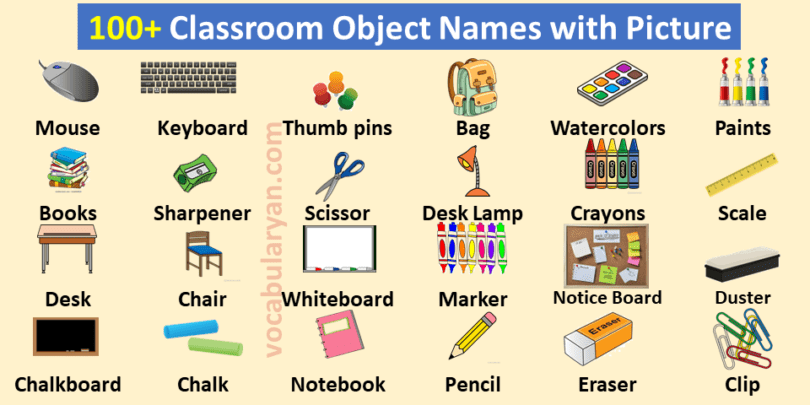
English classroom objects are the everyday items students and teachers use in school. The 10 main categories are furniture, writing supplies, paper and book supplies, math tools, science lab equipment, art supplies, boards, technology, personal items, and utility items.
English classroom objects have 10 main categories: furniture (desk, chair, bookshelf), writing supplies (pen, pencil, marker, highlighter), paper supplies (notebook, textbook, folder), math tools (ruler, protractor, compass), science lab (microscope, beaker, test tube), art supplies (paintbrush, palette, crayons), boards (whiteboard, chalkboard, smartboard), technology (computer, tablet, projector), personal items (backpack, water bottle, lunch box), and utility items (clock, tissues, trash can).
Common Classroom Objects With Pictures
Each category is defined by what the object is used for. Furniture, writing supplies, and paper supplies are the three most-used every day. The other seven are math tools, science lab equipment, art supplies, boards, technology, personal items, and utility items.
Classroom Furniture Names
Classroom furniture is the pieces students and teachers sit on, write on, and store their books in.
Desk: flat-topped piece of furniture that a student uses during class, with a small drawer or shelf underneath for books and supplies. “Maria opened her desk and pulled out her math textbook before the lesson started.”
Student Chair: small hard chair matched to the height of a school desk, made of plastic, wood, or metal. “The teacher asked the students to push their chairs under their desks at the end of the lesson.”
Teacher’s Desk: larger desk at the front of the classroom, used by the teacher to grade papers, plan lessons, and keep the class register. “Mr. Kumar leaned against the teacher’s desk while explaining the day’s homework.”
Bookshelf: tall wooden shelf against the classroom wall, holding textbooks, reading books, and reference material. “The bookshelf at the back of the room has picture books arranged by reading level for the children to borrow.”
Cabinet: tall storage furniture with doors, used to keep supplies, art materials, and completed student work. “The art cabinet was full of paintbrushes, glue sticks, and sheets of colored paper for the next project.”
Locker: tall narrow metal cupboard with a door and combination lock, used by students to store their coats, books, and bags between classes. “James stopped at his locker between math and science to swap his textbooks and grab his lunch box.”
Podium: tall stand at the front of the room, used by the teacher to place books, notes, or a laptop while giving a lesson. “The teacher stood at the podium and read the morning announcement to the whole class.”
Writing and Drawing Supplies
Writing and drawing supplies are the small tools students use to write, sketch, mark, and erase on paper.
Pen: everyday writing tool with ink inside a plastic or metal barrel, used for permanent writing on paper. “Please sign your name at the top of the test paper with a blue or black pen before you start.”
Pencil: wooden or mechanical writing tool with a graphite tip, used for writing and sketching that can be erased. “Sarah sharpened her pencil twice during the drawing class because the tip kept breaking.”
Ballpoint Pen: most common type of pen, with a small rotating ball at the tip that rolls quick-drying ink onto the paper. “The teacher handed each student a ballpoint pen to fill in the answer sheet.”
Fountain Pen: more traditional pen with a metal nib that draws ink from a cartridge or bottle, producing thicker flowing letters. “His grandfather gave him a fountain pen for his tenth birthday, along with a bottle of blue-black ink.”
Marker: thick pen with a felt tip, used for writing on paper, on the whiteboard, or on posters and drawings. “The teacher used a red marker to write the date and lesson title on the whiteboard.”
Highlighter: fluorescent-inked pen in yellow, pink, green, or orange, used to mark words in books and notes without covering them. “He used a yellow highlighter to mark the main dates on his history notes.”
Chalk: small stick of white or coloured pressed calcium carbonate, used to write on a chalkboard or on the playground. “The teacher wrote the day’s spelling words on the chalkboard with a piece of white chalk.”
Crayon: short waxy colouring stick in paper wrapping, in every colour of the rainbow, used by young children for drawing and colouring. “The kindergarten students used red and green crayons to colour the picture of the Christmas tree.”
Colored Pencil: wooden pencil with a coloured lead, used for detailed drawing and shading in art and science diagrams. “For the biology diagram, she used a green colored pencil for the leaves and brown for the trunk.”
Eraser: small block of soft rubber (or a pencil-end tip), used to remove pencil marks from paper. “He borrowed an eraser from his friend after he made a mistake in his math problem.”
Sharpener: small handheld tool with a metal blade inside a plastic case, used to sharpen the tip of a pencil or crayon. “The pencil sharpener next to the teacher’s desk is shared by the whole class.”
Pencil Case: small zip-up pouch or hard box, used to store pens, pencils, erasers, and other small writing supplies. “Ali’s pencil case had two blue pens, three sharpened pencils, an eraser, and a small ruler inside.”
Paper and Book Supplies
Paper and book supplies are the pages, books, and organizers students write in and store their work in.
Notebook: bound book of blank ruled pages, used by students to take notes, write assignments, and work through problems. “The teacher told the class to open their notebooks and copy down the four main rules of grammar.”
Textbook: thick hardback or paperback book on a specific subject, given by the school and used across the whole academic year. “Please turn to page forty-two in your English textbook and read the passage silently.”
Workbook: paperback book with exercises and blank spaces for students to write their answers directly into the pages. “The math workbook had ten new problems on fractions for the students to solve at home.”
Loose Paper: unbound sheets of ruled or blank paper, used for homework, essays, or extra practice outside a notebook. “The teacher handed out a sheet of loose paper to each student for the surprise vocabulary quiz.”
Sticky Notes: small colourful squares of paper with a light glue strip on the back, used to mark pages or leave short reminders. “She stuck a yellow sticky note on page thirty of the novel to remember a striking quote.”
Index Cards: small stiff rectangular cards, used to write vocabulary words on one side and definitions on the other for study. “Before the vocabulary test, he practiced with index cards until he knew all the definitions by heart.”
Folder: thin cardboard or plastic case, used to store and organize loose papers and handouts by subject. “Please keep all your history handouts in the blue folder so you can find them for the exam.”
Binder: larger ring-mechanism folder with rings inside, used to store hole-punched paper across multiple subjects. “Her three-ring binder had dividers for math, science, English, and social studies.”
Math and Geometry Tools
Math and geometry tools are the specialised instruments used to measure, calculate, and draw shapes in math class.
Ruler: long flat strip of plastic, wood, or metal marked with centimeters or inches, used to measure length and draw straight lines. “Draw a straight line five centimeters long using your ruler.”
Protractor: flat half-circle plastic tool marked with degrees from 0 to 180, used to measure and draw angles. “Use the protractor to measure the angle of each corner of the triangle.”
Compass: metal or plastic drawing tool with two arms joined at the top, one holding a pencil and one with a sharp point, used to draw circles and arcs. “She used a compass to draw a perfect circle around the center point of her diagram.”
Set Square: flat triangular tool in transparent plastic, in 30-60-90 or 45-45-90 angle forms, used to draw parallel and perpendicular lines. “The set square makes it easier to draw a right angle without measuring.”
Calculator: small handheld electronic device with buttons for numbers and math operations, used for arithmetic and scientific calculations. “Scientific calculators are allowed in the math exam, but not graphing calculators or phones.”
Abacus: ancient counting tool with rows of sliding beads on wooden or metal rods, used to teach young children arithmetic. “The teacher showed the class how to count from one to twenty using the abacus.”
Science Lab Equipment
Science lab equipment is the specialised tools used in chemistry, biology, and physics experiments at school.
Microscope: optical instrument with lenses and a stage, used to magnify tiny objects too small to see with the naked eye. “Under the microscope, the drop of pond water was full of moving single-celled organisms.”
Test Tube: narrow glass or plastic tube with a rounded closed bottom, used for small amounts of liquid during experiments. “Each pair of students received a test tube of pale blue copper sulfate solution.”
Beaker: cylindrical glass container with a small pouring spout and volume markings on the side, used to mix and heat liquids. “Pour 100 milliliters of water into the beaker before adding the salt.”
Bunsen Burner: gas burner with an adjustable blue flame, used in chemistry labs for heating substances, named after German scientist Robert Bunsen. “The teacher lit the Bunsen burner and placed the beaker of water on top to boil.”
Safety Goggles: transparent plastic protective eyewear with an elastic strap, worn in the science lab to protect the eyes from splashes and fumes. “Every student must wear safety goggles before starting the acid-and-base experiment.”
Graduated Cylinder: tall narrow glass tube with volume measurement lines on the side, used to measure the exact volume of a liquid. “The graduated cylinder reads 25 milliliters when you look at the bottom of the meniscus.”
Pipette: thin glass or plastic tube with a small bulb at the top, used to draw up and release exact small volumes of liquid. “Use the pipette to transfer exactly 5 milliliters of solution from the beaker to the test tube.”
Art and Craft Supplies
Art and craft supplies are the materials students use to paint, draw, and sculpt in art class.
Paintbrush: wooden or plastic handle with a tuft of bristles at the end, used to apply paint to paper, canvas, or clay. “She rinsed her paintbrush in the water jar before switching from blue paint to yellow.”
Palette: flat oval or rectangular tray with small wells, used by an artist to mix and blend paint colors. “The art teacher squeezed a small amount of each color onto the palette for the children to mix.”
Canvas: stretched cotton or linen fabric on a wooden frame, used as the painting surface for oil and acrylic paintings. “For the final project, each student painted a self-portrait on a small canvas.”
Easel: three-legged wooden or metal stand that keeps a canvas or drawing board at a comfortable angle. “The art teacher set up an easel for each student before the still-life drawing class began.”
Clay: soft mouldable earth material in grey, red, or white, used by children for sculpting shapes and pots. “The children rolled the clay into long snakes and coiled them up to make small pots.”
Watercolors: set of solid paint blocks or tubes of water-based paint, used with a wet brush for soft transparent painting. “She used blue and green watercolors to paint a picture of the sea at sunrise.”
Boards and Display Items
Boards and display items are the large surfaces at the front and walls of the classroom used to show lessons and student work.
Whiteboard: large flat white board mounted at the front of the classroom, written on with dry-erase markers and wiped off after each lesson. “The teacher wrote the four vocabulary words on the whiteboard for the class to copy into their notebooks.”
Chalkboard: large flat dark green or black board mounted at the front of the classroom, written on with chalk and wiped with a duster. “The old chalkboard at the back of the room is still used for the daily attendance list.”
Smartboard: interactive electronic whiteboard connected to a computer, used by the teacher to display and touch-write on lesson materials. “The teacher played a video on the smartboard and paused it to explain each scene to the class.”
Bulletin Board: cork or fabric board on the wall, used to pin student work, class announcements, and posters. “The bulletin board next to the door has this month’s student artwork and the class schedule.”
Globe: round three-dimensional model of the Earth on a stand, used to show geography, countries, and continents. “The teacher spun the globe and asked the class to find the country of Brazil.”
Map: flat printed image of a country, region, or the world, used in geography, history, and social studies. “The map of Europe on the wall shows every country coloured differently for quick identification.”
Classroom Technology Names
Classroom technology is the electronic devices used by teachers and students for lessons, research, and multimedia.
Computer: desktop electronic device with a screen, keyboard, and mouse, used for typing, research, and educational software. “The computer lab has twenty desktops available for students to complete their research projects.”
Laptop: portable computer with a folding screen, used by students and teachers for coursework, presentations, and note-taking. “Each Year 7 student was given a school laptop to take home for online homework.”
Tablet: flat handheld touchscreen device (like an iPad), used for reading e-books, taking notes with a stylus, and running educational apps. “The younger children each get a tablet for their morning reading and math practice.”
Projector: ceiling-mounted or portable device that displays computer images and videos on a large screen or wall. “The teacher connected her laptop to the projector to show the documentary about ancient Egypt.”
Speakers: small or medium audio devices connected to a computer or tablet, used to play sound, music, and video for the class. “The speakers in the classroom are wired to the teacher’s laptop for playing English listening exercises.”
Headphones: cup-shaped or in-ear listening device connected to a computer or tablet, used for private listening in language and music classes. “In the language lab, every student wore headphones to listen to the French pronunciation exercises.”
USB Drive: small portable storage device that plugs into a USB port, used to save and transfer files between computers. “He saved his English essay onto his USB drive so he was able to print it in the school library.”
Personal Items and Classroom Utilities
Personal items and classroom utilities are the everyday items students bring to school and the general items every classroom needs.
Backpack: padded bag with two shoulder straps, used by students to carry books, notebooks, laptops, and lunch between home and school. “Her backpack was so heavy on the first day of term that she needed both hands to lift it onto the peg.”
Water Bottle: reusable plastic or metal bottle with a lid, used by students to bring drinking water to school. “The teacher reminded the children to fill their water bottles at the fountain before break time.”
Lunch Box: small hard or soft container with a lid, used to bring a packed lunch from home to school. “His lunch box had a cheese sandwich, an apple, and a small bag of crisps for the morning break.”
Trash Can: medium waste bin kept next to the teacher’s desk or by the door, used for paper waste and empty containers. “Please throw your paper cups and used tissues in the trash can before you leave the room.”
Clock: round wall clock with hour, minute, and second hands, used by students and teachers to track lesson time. “The clock above the whiteboard showed 2:45, five minutes before the end of the last lesson.”
Tissues: box of soft disposable paper, kept on the teacher’s desk for students with a runny nose or a small spill. “The teacher offered him a tissue when he started sneezing during the reading exercise.”
Fire Extinguisher: red metal cylinder mounted on the classroom or corridor wall, used to put out small fires in an emergency. “The fire extinguisher next to the door is checked every six months by the school safety officer.”
Classroom Objects That Look Similar
Some classroom objects and their names look close but describe different tools or products.
Pen vs Pencil vs Highlighter
| Term | Ink | Use |
|---|---|---|
| Pen | Permanent ink | Final writing, signatures, exams |
| Pencil | Erasable graphite | Rough work, sketching, math |
| Highlighter | Fluorescent transparent ink | Marking words in books and notes |
Pens are for final work. Pencils are for work that can be erased. Highlighters mark without covering.
Notebook vs Textbook vs Workbook
| Term | Content | Who Writes In It |
|---|---|---|
| Notebook | Blank pages | The student |
| Textbook | Printed lessons | Nobody (only reading) |
| Workbook | Printed exercises with blank answer spaces | The student in the blank spaces |
Notebooks are empty and belong to the student. Textbooks are printed and belong to the school. Workbooks are printed but designed for the student to write in.
Ruler vs Protractor vs Compass
| Tool | Shape | Purpose |
|---|---|---|
| Ruler | Straight strip | Measure length and draw straight lines |
| Protractor | Half-circle | Measure and draw angles |
| Compass | Two-armed hinge | Draw circles and arcs |
Rulers do lengths. Protractors do angles. Compasses do circles.
Chalkboard vs Whiteboard vs Smartboard
| Board | Writing Tool | Technology |
|---|---|---|
| Chalkboard | Chalk | None (traditional) |
| Whiteboard | Dry-erase marker | None (modern, no tech) |
| Smartboard | Finger or stylus | Interactive digital display |
Chalkboards use chalk that is wiped off with a duster. Whiteboards use markers wiped off with a felt eraser. Smartboards are computer-connected touchscreens.
FAQs
Q1. What are the most common classroom objects in English?
The most common classroom objects in English are desk, chair, whiteboard, chalkboard, pen, pencil, notebook, textbook, eraser, ruler, and calculator. These are the everyday items every student and teacher uses during a normal school day, and they are the first classroom vocabulary that ESL learners memorise.
Q2. What is the difference between a notebook and a textbook?
A notebook is a bound book of blank ruled pages that the student writes in, taking notes and doing exercises. A textbook is a printed book of lessons on a specific subject, given by the school and used across the whole year. The notebook is owned by the student; the textbook is owned by the school.
Q3. What is the difference between a chalkboard, whiteboard, and smartboard?
A chalkboard is dark green or black and written on with chalk (traditional). A whiteboard is white and written on with dry-erase markers (modern, no tech). A smartboard is an interactive touchscreen connected to a computer, used to display and touch-write on lesson content (modern digital). All three are mounted at the front of the classroom.
Q4. What is the difference between a ruler, protractor, and compass?
A ruler is a straight strip marked in centimeters or inches, used to measure length and draw straight lines. A protractor is a half-circle marked in degrees, used to measure and draw angles. A compass is a two-armed drawing tool with a pencil on one arm, used to draw circles and arcs.
Q5. What science equipment is used in a school laboratory?
The common science equipment in a school laboratory is microscope (for examining tiny objects), test tube and beaker (for holding liquids), Bunsen burner (for heating), safety goggles (for eye protection), graduated cylinder (for measuring liquid volume), and pipette (for transferring small liquid amounts). All students should wear safety goggles before starting any experiment.
Q6. What is the difference between a pen, pencil, and highlighter?
A pen writes with permanent ink and is used for final work, signatures, and exams. A pencil writes with graphite and can be erased, making it right for rough work, sketching, and math. A highlighter has fluorescent transparent ink and is used to mark words in books and notes without covering them.

Leave a Comment