
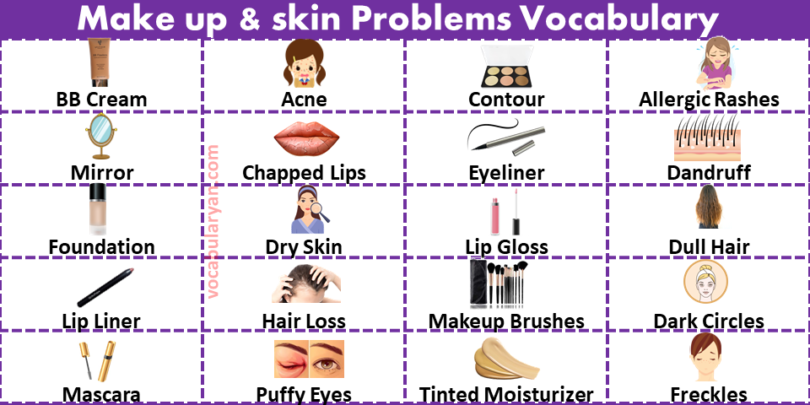
English makeup and skin vocabulary names face makeup, eye makeup, lip makeup, tools, skin types, skin problems, and skin conditions. Each product has its own name, purpose, and place in a beauty routine, and each skin word describes a specific type or concern.
English makeup and skin vocabulary has eight main areas: face makeup (foundation, concealer, primer, powder, blush, bronzer, highlighter), eye makeup (eyeshadow, eyeliner, mascara, kajal, brow products), lip makeup (lipstick, lip liner, gloss, balm), makeup tools (brushes, sponges, palettes), skin types (oily, dry, combination, normal, sensitive, mature), common skin problems (acne, wrinkles, dark spots, hyperpigmentation), and skin conditions (eczema, psoriasis, rosacea).
Common Makeup and Skin Vocabulary With Pictures
Each family is defined by product area or skin concern. Face, eye, lip, and tools are the four main makeup categories in a full routine. Skin types, common skin problems, and skin conditions are the three main skin categories in personal care and dermatology.
Face Makeup Product Names
Face makeup products are the base and colour products applied to the whole face or specific facial areas.
Foundation: liquid or cream base product applied all over the face to even out skin tone and cover minor imperfections. Foundation comes in shades from light ivory to deep espresso and finishes from matte to dewy, and it is the starting layer for most full makeup looks.
Concealer: thicker more pigmented product applied in small dabs over foundation to cover specific blemishes, dark circles, and redness. Concealer works where foundation alone cannot hide a spot or a shadow, and it is sold in liquid, cream, and stick form.
Primer: thin gel or lotion applied to freshly washed skin before foundation to smooth the surface. Primer fills pores, evens texture, controls oil, and helps foundation and other face makeup last through a full day without breaking down.
BB Cream: short for “beauty balm,” a lightweight tinted moisturizer with light coverage and skincare benefits. BB cream combines moisturizer, primer, foundation, and sunscreen in one product for a natural everyday look with minimal effort.
CC Cream: short for “colour correcting,” a light-coverage tinted product that neutralises redness, dullness, or yellow tones in the skin. CC cream gives more coverage than BB cream but less than foundation, and works well for uneven skin tone.
Tinted Moisturizer: hydrating cream with just a hint of colour, giving the skin a fresh natural look with light coverage. Tinted moisturizer is worn on no-makeup days, at the gym, or as a quick base under blush and mascara.
Compact Powder: pressed powder in a small round case with a mirror and puff, sold in shades matched to skin tone. Compact powder is used to set foundation, control shine, and touch up makeup during the day.
Loose Powder: finely milled powder sold in a jar, applied with a large fluffy brush for a soft matte finish. Loose powder is used to set foundation at home and to bake makeup under the eyes into a crease-free finish.
Blush: pigmented pink, peach, coral, or berry product applied to the apples of the cheeks for a healthy flush of colour. Blush comes in powder, cream, liquid, and stick form and gives the face life and warmth.
Bronzer: matte or shimmer product in warm brown or bronze shades, applied to the areas of the face that would naturally catch the sun. Bronzer adds warmth and a sun-kissed glow to the cheeks, forehead, and jawline.
Highlighter: shimmery or luminous product in gold, silver, pink, or champagne shades, applied to the high points of the face like cheekbones, brow bone, and cupid’s bow. Highlighter catches the light and gives the skin a lit-from-within glow.
Contour: matte darker shade applied under the cheekbones, along the jawline, and on the sides of the nose to create shadow and definition. Contour uses light and shadow to sculpt the face and works with highlighter for a chiseled look.
Setting Spray: fine mist sprayed over finished makeup to lock everything in place for hours. Setting spray melts powder into the skin, adds a fresh dewy finish, and prevents makeup from smudging, fading, or transferring throughout the day.
Setting Powder: translucent or lightly tinted powder pressed onto foundation and concealer to prevent creasing and shine. Setting powder is the final step of the base routine and keeps oily areas matte and smooth for many hours.
Eye Makeup Product Names
Eye makeup products are the pigmented and shaping products applied to the eyelids, lashes, and brows.
Eyeshadow: pigmented powder, cream, or liquid applied to the eyelids for colour, depth, and dimension. Eyeshadow comes in every shade and finish from soft neutral matte browns to bold glittery blues, and it can be blended into countless looks.
Eyeshadow Palette: flat compact case with multiple eyeshadow shades arranged side by side. Palettes come in sizes from small four-pan neutrals to large sixty-shade rainbows, and a good palette gives everything needed to build daytime, evening, or party looks.
Eyeliner: dark line drawn along the upper or lower lash line to define the eye and change its shape. Eyeliner is sold in pencil, gel pot, liquid pen, and felt-tip forms, from soft everyday brown to dramatic winged black.
Kajal: soft black eye pencil traditional to South Asia and the Middle East, applied along the inner rim (waterline) of the eye. Kajal makes the eyes look larger and more defined, and it has been worn for beauty and cultural reasons for thousands of years.
Mascara: thick pigmented liquid brushed onto the eyelashes to make them look longer, fuller, and darker. Mascara comes in black, brown, blue, and even colourless versions, and it is the single most-worn eye makeup product in the world.
False Eyelashes: strip or individual lashes glued along the natural lash line for extra length and volume. False eyelashes come in every style from natural everyday looks to dramatic drag-queen flutter, and they are a staple of wedding and photo-shoot makeup.
Brow Pencil: thin sharp pencil in shades matched to natural brow colour, used to fill sparse areas and shape the brow. Brow pencil draws fine hair-like strokes and works well for beginners learning eyebrow makeup.
Brow Gel: colourless or tinted mascara-style wand that combs brow hairs into place and keeps them there. Brow gel is the finishing step in brow makeup and keeps unruly hairs from moving out of shape all day.
Brow Pomade: creamy pigment sold in a small pot, applied to the brows with an angled brush for a bold sculpted look. Brow pomade gives the strongest brow definition and is a favorite for special-occasion and photo-shoot makeup.
Lip Makeup Product Names
Lip makeup products are the colour and care products applied to the lips.
Lipstick: pigmented stick of waxy colour applied to the lips, sold in every shade from soft nude pink to deep vampy red. Lipstick comes in matte, satin, cream, and gloss finishes, and it is the classic finishing touch on any lip look.
Lip Liner: thin sharp pencil in shades matched to lipstick, used to outline the lips before filling with colour. Lip liner defines the lip shape, prevents lipstick bleeding into fine lines, and can be used alone for a matte-lip-underliner effect.
Lip Gloss: colourless or lightly tinted shiny liquid applied alone or over lipstick for a glassy juicy finish. Lip gloss makes the lips look fuller and more youthful, and it comes in sticky, non-sticky, and plumping formulas.
Lip Balm: waxy soothing product applied to dry chapped lips for moisture and protection. Lip balm is the everyday no-makeup lip product, and modern versions add sunscreen, tint, and even collagen-boosting ingredients.
Lip Stain: highly pigmented water- or ink-based lip colour that soaks into the lips for a long-lasting flush. Lip stain feels weightless and dries down, giving the effect of a bitten-lip flush that lasts through eating and drinking.
Lip Tint: lightweight sheer product similar to lip stain but less intense, giving a natural my-lips-but-better colour. Lip tints originated in Korean beauty and are the go-to for a fresh, no-effort everyday lip look.
Lip Plumper: cool-tingling or slightly stinging product applied to the lips to temporarily swell them into a fuller shape. Lip plumper uses ingredients like cinnamon oil, menthol, or peptides to create the plumping effect for about an hour.
Makeup Tools and Brushes
Makeup tools are the brushes, sponges, and accessories that apply, blend, and store makeup.
Makeup Brush: soft-bristled tool with a wooden or metal handle, used to apply and blend makeup products. Brushes come in dozens of shapes: foundation brush, powder brush, blush brush, kabuki brush, fan brush, and small eye brushes, each designed for a specific product and technique.
Beauty Sponge: egg-shaped soft foam sponge, dampened before use and dabbed against the skin to blend foundation and concealer. The most famous version is the pink Beautyblender, and this tool has replaced the flat foundation brush for many modern makeup artists.
Eyelash Curler: small metal tool with rubber pads, gently pressed on the base of the upper lashes to curl them upward. Eyelash curlers are used before mascara to open up the eye and make lashes look longer and more lifted.
Tweezers: slim metal tool with two arms that meet in a point, used to pluck stray eyebrow hairs. Good tweezers have a slanted grip that catches even the finest hairs, and they are a bathroom-drawer staple worldwide.
Makeup Palette: flat plastic or metal case with multiple product pans inside (such as eyeshadow, blush, or contour) in one place. A well-built palette is refillable, has a large mirror inside the lid, and travels well from home to work to holiday.
Makeup Bag: small zip-up or drawstring bag, made of nylon, canvas, or vegan leather, storing a personal makeup collection. Makeup bags come in every size from a small clutch for lipstick and powder to large travel cases for a full kit.
Makeup Mirror: small round or rectangular mirror with a stand or handle, and some models add built-in LED lights for even lighting. Makeup mirrors show detail more accurately than a bathroom mirror, and lit versions imitate daylight, evening, and office light.
Sharpener: small handheld tool with a metal blade, used to sharpen eyeliner and lip liner pencils to a fine point. A good makeup sharpener has two sizes of hole for standard and jumbo pencils and produces neat shavings for the finest lines.
Skin Types With Names
Skin types describe how a person’s skin naturally behaves in terms of oil, moisture, and sensitivity.
Oily Skin: skin type that produces more sebum than average, giving the face a shiny, greasy appearance especially on the forehead, nose, and chin. Oily skin has more visible pores and is prone to acne, but ages more slowly than dry skin.
Dry Skin: skin type that produces less sebum than average, feeling tight, rough, or flaky. Dry skin needs richer moisturizers and cream cleansers, and it is more prone to fine lines and sensitivity than oily skin.
Combination Skin: most common skin type, oily in the T-zone (forehead, nose, chin) and normal or dry on the cheeks. Combination skin needs different products in different areas or a balanced routine that neither strips oil nor over-moisturizes.
Normal Skin: skin type with balanced sebum production, few visible pores, and no persistent problems. Normal skin is the rarest skin type in adults, and it needs a straightforward maintenance routine of cleanser, moisturizer, and sunscreen.
Sensitive Skin: skin type that reacts quickly to products, weather, and stress with redness, stinging, or itching. Sensitive skin needs fragrance-free, alcohol-free products, and it is common in people with rosacea, eczema, or seasonal allergies.
Mature Skin: skin type of adults in their forties, fifties, and beyond, marked by fine lines, wrinkles, thinner texture, and less elasticity. Mature skin needs richer moisturizers, gentle retinol, and daily sunscreen to protect against further ageing damage.
Common Skin Problems With Pictures
Common skin problems are the everyday concerns most people meet at some age, from acne to dark spots.
Acne: skin condition marked by pimples, blackheads, whiteheads, and cysts, caused by clogged pores and bacteria. Acne is most common on the face, chest, and back during the teen years but can affect adults, especially women, at any age.
Pimples: raised red or white bumps on the skin caused by inflamed clogged pores. Pimples appear one at a time on any face area, and a single pimple clears within a week if left alone or treated with spot treatment.
Blackheads: small dark spots on the skin caused by clogged pores where the trapped oil oxidises and turns black on contact with air. Blackheads are most common on the nose, chin, and forehead where sebum production is highest.
Whiteheads: small white or flesh-coloured bumps caused by clogged pores that stay closed at the top, so the oil inside does not oxidise. Whiteheads are similar to blackheads but stay under a thin layer of skin.
Wrinkles: deep permanent lines or creases in the skin, most visible on the forehead, around the eyes, and around the mouth. Wrinkles form gradually with age, sun exposure, and repeated facial expressions like smiling or frowning.
Fine Lines: small shallow lines in the skin, and the first visible signs of ageing. Fine lines appear before deep wrinkles form, mostly around the eyes and mouth, and they can be softened with moisturizer, sunscreen, and retinol.
Dark Circles: discolouration under the eyes with shades from purple-blue to grey-brown. Dark circles have many causes: fatigue, genetics, thin under-eye skin, and iron deficiency, and they are hidden with concealer or brightening eye cream.
Dark Spots: small dark patches on the skin caused by too much melanin production in one area. Dark spots come from sun exposure, hormonal changes, or leftover marks from old pimples, and they are treated with vitamin C, retinol, and daily sunscreen.
Hyperpigmentation: general term for any darkening of the skin caused by excess melanin production. The word applies to dark spots, sun spots, post-acne marks, and melasma alike, and it is one of the most common skin concerns worldwide.
Melasma: brown or grey-brown patchy discolouration, most visible on the cheeks, forehead, chin, and upper lip. Melasma is triggered by pregnancy hormones (called the “mask of pregnancy”), birth control, and sun exposure, and it is more common in women with darker skin tones.
Redness: general flush or blotchy pink-to-red colour in the skin, from a temporary reaction or a lasting condition. Redness can be caused by sunburn, spicy food, cold weather, alcohol, allergic reaction, or an underlying condition like rosacea.
Dryness: lack of moisture in the skin, leading to a tight uncomfortable feeling, flakiness, and mild itching. Dryness worsens in winter and in air-conditioned rooms, and it is treated with richer moisturizers and hydrating serums.
Dullness: lack of radiance or glow in the skin, with a flat greyish or yellowish tone. Dullness is caused by dead skin cell buildup, dehydration, poor sleep, or a diet low in fresh food, and it is treated with exfoliation and hydration.
Puffiness: swelling or fluid retention in the skin, most visible under the eyes and along the jawline. Puffiness comes from poor sleep, salty food the night before, allergies, or lymphatic sluggishness, and it is reduced with cold compress and gentle massage.
Enlarged Pores: skin pores that appear larger than average, especially on the nose, chin, and cheeks. Enlarged pores are caused by genetics, oily skin, sun damage, or ageing, and they are minimised with niacinamide, salicylic acid, and clay masks.
Ingrown Hairs: hairs that curl back and grow into the skin instead of out through the pore, causing red inflamed bumps. Ingrown hairs are common after shaving, waxing, or in areas of tight clothing, and they can be prevented with gentle exfoliation.
Sun Damage: cumulative harm from years of unprotected sun exposure, showing as dark spots, wrinkles, leathery texture, and loss of firmness. Sun damage is the number one cause of premature skin ageing worldwide, and it is prevented with daily broad-spectrum sunscreen.
Freckles: small flat brown or tan spots that appear on sun-exposed skin like the face, arms, and shoulders. Freckles are more common in people with fair skin and red or light-brown hair, and they darken in summer and fade in winter.
Milia: tiny hard white bumps that form when keratin gets trapped under the surface of the skin. Milia are most common around the eyes, on the cheeks, and on the nose, and they cannot be squeezed like whiteheads (dermatologist removal is safer).
Chapped Lips: dry, cracked, at times bleeding lips caused by cold weather, dehydration, wind, or licking the lips. Chapped lips are treated with lip balm, sipping water throughout the day, and avoiding the habit of licking the lips.
Skin Conditions and Diseases
Skin conditions and diseases are medical diagnoses that need dermatologist care and long-term treatment.
Eczema: chronic inflammatory skin condition marked by dry, itchy, red patches that come and go. Eczema (also called atopic dermatitis) affects children on the elbows, knees, and cheeks, and it is triggered by stress, allergens, and irritating fabrics.
Psoriasis: chronic autoimmune condition causing thick red patches covered in silvery-white scales, most visibly on the elbows, knees, scalp, and lower back. Psoriasis is not contagious, comes and goes in flare-ups, and is treated with topical creams, light therapy, or oral medication.
Rosacea: chronic condition of persistent redness, visible small blood vessels, and pus-filled bumps on the central face (cheeks, nose, forehead, chin). Rosacea is triggered by alcohol, spicy food, hot drinks, sun, and stress, and it is more common in fair-skinned adults over thirty.
Dermatitis: general term for inflammation of the skin causing red itchy rashes. Dermatitis has many types: contact dermatitis from irritants (nickel, detergents), atopic dermatitis (the same as eczema), and seborrheic dermatitis (dandruff on the scalp and face).
Vitiligo: long-term condition where patches of skin lose their natural pigment and turn white. Vitiligo can affect any body area, spread over time, and is a visible autoimmune condition made famous by singer Michael Jackson and model Winnie Harlow.
Hives: raised itchy red or pale welts on the skin, appearing suddenly and disappearing within hours in most cases. Hives (called urticaria) are an allergic reaction to food, medication, insect stings, or stress, and they can be treated with antihistamines.
Makeup and Skin Words That Look Similar
Some makeup and skin words look almost identical but name different products or conditions.
Foundation vs BB Cream vs Tinted Moisturizer
| Product | Coverage | Skin Care Benefits |
|---|---|---|
| Foundation | Medium to full | None (pure makeup) |
| BB Cream | Light to medium | Moisturizer, primer, SPF |
| Tinted Moisturizer | Sheer to light | Hydration only |
Foundation is pure makeup with the highest coverage. BB cream is the multitasker. Tinted moisturizer is the lightest option and closest to bare skin.
Blush vs Bronzer vs Highlighter
| Product | Colour | Applied To |
|---|---|---|
| Blush | Pink, coral, berry | Apples of the cheeks |
| Bronzer | Warm brown, tan | Areas the sun would hit |
| Highlighter | Gold, silver, champagne shimmer | High points of the face |
Blush adds warmth of colour. Bronzer adds warmth and depth. Highlighter adds shine and light. Together they create a sculpted glowing look.
Blackheads vs Whiteheads vs Milia
| Term | Cause | Look |
|---|---|---|
| Blackheads | Clogged pores open to the air, oil oxidises | Small dark spots on nose and chin |
| Whiteheads | Clogged pores closed at the top | Small white bumps |
| Milia | Keratin trapped under skin | Tiny hard white bumps that will not squeeze out |
Blackheads and whiteheads are types of acne (oil in pores). Milia are keratin cysts and need dermatologist removal.
Wrinkles vs Fine Lines
| Term | Depth | Where They Appear |
|---|---|---|
| Fine Lines | Shallow | First around eyes and mouth |
| Wrinkles | Deep permanent creases | Forehead, around eyes, around mouth |
Fine lines are the early stage; wrinkles are the deeper, permanent form. Fine lines can be softened with skincare; wrinkles are harder to reverse without treatments.
FAQs
Q1. What are the main makeup products in English?
The main makeup products in English are foundation (base), concealer (spot cover), primer (pre-base), powder (setting), blush (cheek colour), mascara (lash colour), eyeliner (eye definition), eyeshadow (lid colour), lipstick (lip colour), and setting spray (finish). These ten products form the foundation of most makeup routines.
Q2. What are the different types of skin problems?
Common skin problems in English are acne, pimples, blackheads, whiteheads, wrinkles, fine lines, dark circles, dark spots, hyperpigmentation, melasma, dryness, dullness, puffiness, enlarged pores, ingrown hairs, sun damage, freckles, milia, and chapped lips. Skin conditions like eczema, psoriasis, and rosacea are separate medical diagnoses.
Q3. What is the difference between foundation and concealer?
Foundation is a base product applied all over the face to even out skin tone. Concealer is a thicker, more pigmented product applied in small dabs over foundation to hide specific spots that foundation cannot fully cover: dark circles, blemishes, or redness. Foundation goes first; concealer goes on top.
Q4. What is the difference between blush and bronzer?
Blush is pink, coral, or berry-toned and applied to the apples of the cheeks to add colour and healthy flush. Bronzer is warm brown or tan and applied to the areas of the face the sun would naturally hit (forehead, cheekbones, jaw) to add warmth and depth. Blush brings colour; bronzer brings shadow.
Q5. What is the difference between wrinkles and fine lines?
Fine lines are shallow, faint lines in the skin, the first visible signs of ageing that appear around the eyes and mouth. Wrinkles are deeper, permanent creases in the skin that form over time on the forehead, around the eyes (crow’s feet), and around the mouth. Fine lines can develop into wrinkles as the skin ages.
Q6. What are the main skin types in English?
The main skin types in English are oily (excess sebum, shiny face), dry (lack of sebum, tight or flaky), combination (oily T-zone, normal or dry cheeks), normal (balanced, few problems), sensitive (reacts to products with redness or stinging), and mature (older skin with fine lines and thinner texture).

Leave a Comment