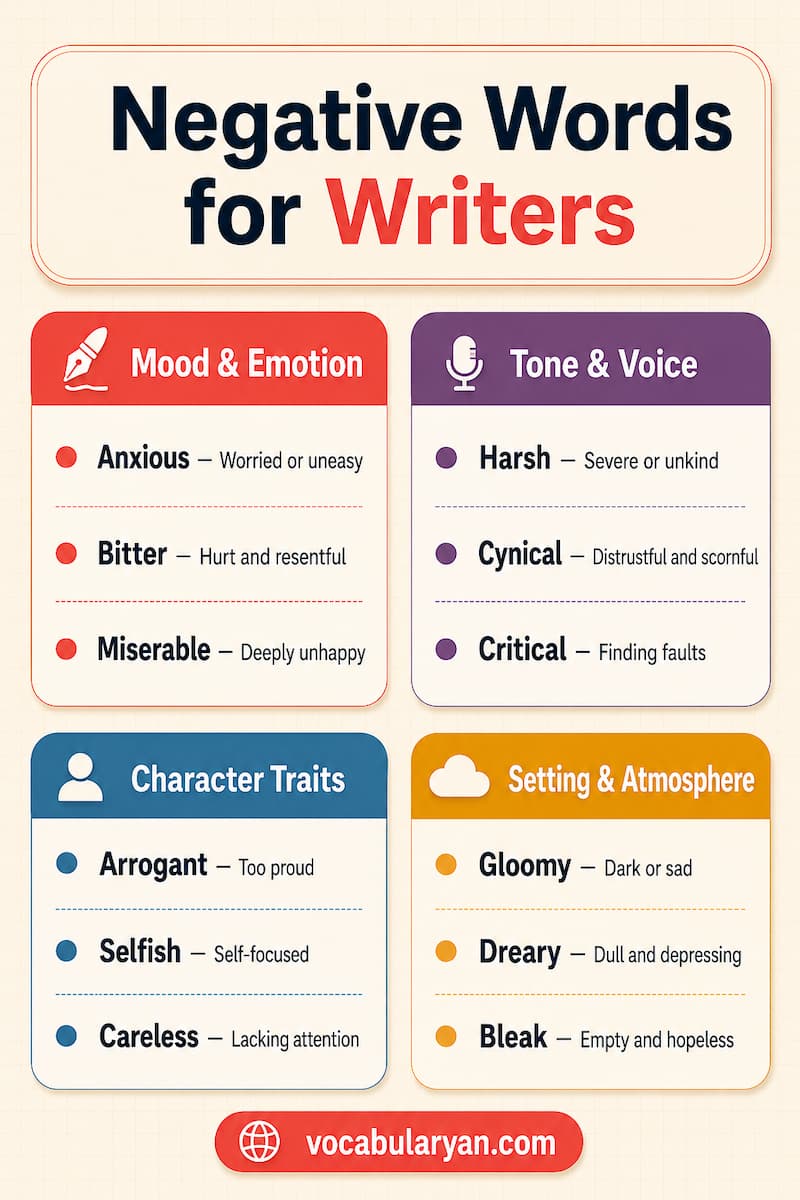
Every story runs on negative vocabulary. The villain’s menace, the setting’s dread, the character’s fatal flaw, the moment everything falls apart: all of them need precise, charged words to land with the weight they deserve. The difference between a reader who flinches and one who merely reads is often a single word, the choice of harrowing over upsetting, of seething over angry, of looming over present. Negative words for writers are the tools that build tension, reveal character, and create the atmosphere a story needs to feel real. The vocabulary ahead is organized by the job it does in a story, so the right word is findable at the moment of composition rather than in a later search.
💡 Quick answer
Negative words for writers are precise, charged words organized by their craft function: character flaws (arrogant, remorseless, paranoid), conflict (volatile, fractured, combustible), atmosphere (foreboding, sinister, oppressive), emotion (harrowing, seething, desolate), strong action verbs (lash, betray, shatter), and dialogue in conflict (snapped, accused, dismissed). Choosing the precise word over the general one is what separates a sentence that informs from one that immerses.
Negative Words for Writers with stronger word choice
Words For Character Flaws And Dark Inner States
A character’s flaw is the engine of a story, and the precise word for it shapes every scene they inhabit.
Arrogant: convinced of one’s own superiority, blind to others’ worth.
Craft note: arrogance reads best when shown through a specific dismissal, not labeled.
Remorseless: feeling no guilt for harm caused.
Craft note: the most chilling villains stay remorseless even when given the chance to feel otherwise.
Paranoid: convinced of threat without evidence.
Craft note: paranoia justifies itself in the character’s mind, which makes it hard to argue with.
Jealous: resentful of another’s advantage, position, or connection.
Craft note: jealousy corrodes from the inside and warps every perception it touches.
Vindictive: devoted to revenge past all proportion.
Craft note: vindictiveness gives a character a through-line that reads as obsession.
Bitter: soured by unresolved past hurt.
Craft note: bitterness is grief that has hardened into a fixed stance.
Cowardly: failing to act when action was required.
Craft note: cowardice lands hardest when the cost of inaction falls on someone else.
Ruthless: pursuing goals without mercy for anyone in the way.
Craft note: ruthlessness reads as strength until the story shows what it costs.
Manipulative: bending others through hidden pressure.
Craft note: manipulation works best in fiction when the reader sees it before the victim does.
Self-loathing: directed contempt turned inward.
Craft note: self-loathing explains choices without excusing them.
Obsessive: fixated to the exclusion of all else.
Craft note: obsession drives plot by making a character unreliable about everything adjacent to the fixation.
Deceptive: hiding reality through lies or omission.
Craft note: the most effective deception is one the reader almost believes.
Reckless: careless of risk and consequence.
Craft note: recklessness generates conflict fast but needs cost to avoid reading as bravado.
Guilt-ridden: carrying guilt that distorts every present choice.
Craft note: guilt-ridden characters make decisions the reader understands even while disagreeing.
Treacherous: capable of betrayal without warning.
Craft note: treachery works best when the reader had reason to trust the character.
Words For Conflict And Tension
These words describe the state of a relationship, a scene, or a situation in which conflict lives.
Volatile: liable to sudden and dangerous eruption.
A volatile alliance that neither party trusted to hold.
Fractured: cracked by damage that has not been repaired.
A fractured family that gathered out of duty rather than love.
Combustible: so tense that a small event can ignite it.
A combustible atmosphere in the meeting room before a word was spoken.
Irreconcilable: too damaged to be brought back into agreement.
An irreconcilable disagreement that ended the partnership.
Hostile: openly antagonistic and braced for a fight.
A hostile silence that met every suggestion he made.
Escalating: worsening by degrees toward a breaking point.
An escalating argument that nobody had the standing to stop.
Simmering: building pressure that has not yet broken.
A simmering resentment that had been growing since the summer.
Explosive: reaching a point where containment fails.
An explosive confrontation that left nothing the same afterward.
Unresolved: carrying old damage that continues to shape present choices.
An unresolved grievance that surfaced in every disagreement.
Bitter(of a conflict): acrimonious and without any goodwill.
A bitter dispute that outlasted the original cause.
Strained: under pressure that has weakened the connection.
A strained relationship held together by necessity.
Adversarial: structured as opposition.
An adversarial dynamic that made every conversation a contest.
Smoldering: burning steadily beneath the surface.
A smoldering anger that never quite went cold.
Tense: tight with unspoken threat or pressure.
A tense exchange that neither character wanted to start.
Words For Setting And Dark Atmosphere
Setting vocabulary does double work when it carries the story’s emotional temperature.
Foreboding(adj.): heavy with a sense that harm is near.
A foreboding stillness settled over the village before the storm.
Sinister(adj.): suggesting hidden evil or dark purpose.
Something sinister lay behind the perfectly maintained exterior.
Oppressive(adj.): weighing down on the spirit.
An oppressive heat that made thought slow and tempers short.
Eerie(adj.): strangely unsettling without a named cause.
An eerie silence where birds should have been.
Desolate(adj.): empty and stripped of all comfort.
A desolate road with nothing at the end of it.
Bleak(adj.): cold, bare, and without hope.
A bleak winter landscape that matched the character’s mood.
Ominous(adj.): hinting that something threatening is coming.
An ominous sky that had been building since morning.
Brooding(adj.): darkly heavy in atmosphere.
A brooding mansion that dominated the valley.
Claustrophobic(adj.): so enclosed it produces a sense of entrapment.
A claustrophobic corridor where the walls seemed to narrow.
Menacing(adj.): actively threatening through presence.
A menacing figure at the edge of the light.
Haunting(adj.): lingering with a sad or uneasy quality.
A haunting ruin that stayed with her long after the visit.
Suffocating(adj.): so airless and close it removes the ability to think.
A suffocating atmosphere in which every word was monitored.
Grim(adj.): harsh and without any softening.
A grim institutional corridor that offered no warmth.
Forbidding(adj.): stern and unwelcoming in aspect.
A forbidding gate that made visitors reconsider.
Words For Emotion And Psychological States
The most vivid emotional vocabulary names a specific shade rather than a general category.
Harrowing(adj.): intensely distressing, leaving a mark.
A harrowing account that the reader could not set aside.
Seething(adj.): boiling with barely held anger.
He sat seething through the speech, unable to leave.
Bereft(adj.): desolately emptied by loss.
She was bereft in a way that company made worse.
Tormented(adj.): in prolonged, unrelenting suffering.
He was tormented by what he had seen and could not unsee.
Anguished(adj.): in severe emotional pain.
An anguished cry came from the room beyond the wall.
Despairing(adj.): stripped of all hope.
She gave a despairing look at the locked door.
Inconsolable(adj.): beyond any comfort, past the reach of others.
An inconsolable protagonist resists the plot’s easy fixes.
Hypervigilant(adj.): exhaustingly alert to threat after trauma.
He became hypervigilant, reading danger into every neutral expression.
Hollow(adj.): emptied of feeling by loss or shock.
She answered in a hollow voice that scared him more than tears.
Shattered(adj.): broken past the point of immediate recovery.
He was shattered by the revelation and could not pretend otherwise.
Wretched(adj.): deeply miserable and without dignity.
She felt wretched in a way that made movement difficult.
Numb(adj.): deadened to feeling by overload or shock.
He was numb, going through actions he could not feel.
Haunted(adj.): disturbed by the persistent presence of something past.
She was haunted by the version of events she could not stop replaying.
Raw(adj.): painfully new and undefended.
The loss was still raw, and she was not ready for company.
Dark And Precise Action Verbs
A strong negative verb delivers more force than any adjective. These are the ones that carry scenes.
Shatter: to break irreversibly.
One sentence shattered the trust they had taken years to build.
Betray: to break faith in a way that causes harm.
He betrayed the only person who had defended him.
Lash: to strike or attack with force.
She lashed out before he had finished the sentence.
Crumble: to fall apart under pressure.
His composure crumbled the moment she said the name.
Seize: to take suddenly and forcefully.
Fear seized him before the sound had fully registered.
Recoil: to draw back in horror or revulsion.
She recoiled from what she saw on the screen.
Flinch: to shrink from a blow or threat.
He flinched at the gentleness in her voice, unprepared for it.
Spiral: to descend rapidly into something worse.
He spiraled once the first certainty was gone.
Unravel: to come apart by degrees.
The story she had told herself unraveled in a single afternoon.
Stalk: to follow with predatory intent.
He stalked the corridors, waiting for the chance.
Snarl: to speak with animal hostility.
She snarled a reply and walked out.
Condemn: to pass the harshest verdict.
The silence condemned him more completely than any words.
Devour: to consume entirely and without restraint.
Guilt devoured everything she had managed to build.
Hollow out: to empty something of its substance.
Years of compromise had hollowed out his original purpose.
Wound: to injure in a way that leaves something lasting.
The comment wounded him in a way that a shout would not.
Words For Dialogue In Conflict
How characters speak in a difficult scene reveals character faster than any description.
Snapped(v.): answered curt and sharply.
“Leave it,” she snapped, and the conversation was over.
Accused(v.): charged with wrongdoing directly.
“You knew,” he accused, stepping closer.
Dismissed(v.): brushed aside as unworthy of response.
He dismissed the objection with a wave.
Mocked(v.): ridiculed with contempt.
“Of course you would think that,” she mocked.
Threatened(v.): promised harm as a means of control.
“Come back and I will make sure you regret it,” he threatened.
Pleaded(v.): asked with urgency and desperation.
“Just let her go,” she pleaded, voice cracking.
Demanded(v.): required without asking.
“Where have you been?” he demanded.
Hissed(v.): spoke through clenched teeth, with intensity.
“Not here,” she hissed, pulling him by the arm.
Spat(v.): spoke with hostility and contempt.
“I don’t owe you anything,” he spat.
Barked(v.): gave a short, harsh command.
“Enough,” the general barked, and the room went still.
Murmured(menacingly): spoke quietly in a way that made the quiet threatening.
“I remember everything,” she murmured, without looking up.
Lied(v.): stated something false with intent.
“I never said that,” he lied, meeting her eyes without blinking.
Interrupted(v.): broke into speech as an act of dominance.
“That’s enough,” she interrupted, before he could finish the argument.
Deflected(v.): turned the question away without answering it.
He deflected every direct question with a counter-question.
Words For Negative Story Beats And Outcomes
These words name the specific negative turning points a plot moves through.
Betrayal(n.): the breaking of trust in a way that changes everything.
The betrayal came from the least expected direction, which is where it always does.
Collapse(n.): the falling apart of a plan, relationship, or person.
The collapse of the alliance left both sides exposed.
Catastrophe(n.): a sudden, devastating turn of events.
The catastrophe arrived in the second act and was irreversible.
Downfall(n.): the undoing of a character by their own flaw.
Pride set the downfall in motion long before the story reached it.
Revelation(n., dark): a discovered truth that damages what was believed.
The revelation rewrote every earlier scene in the reader’s memory.
Rupture(n.): a sudden break in a relationship or agreement.
The rupture happened in a single conversation and was total.
Unraveling(n.): the gradual coming-apart of a person or plan.
The unraveling was slow enough to miss and total enough to be unrepairable.
Reckoning(n.): the moment a character faces the consequences of their choices.
The reckoning came in the penultimate chapter and was long overdue.
Isolation(n.): a character’s separation from help, connection, or escape.
Isolation is what turns pressure into unbearable pressure.
Estrangement(n.): the drift apart of people who were once close.
The estrangement happened so gradually neither could name the moment.
Disillusionment(n.): the loss of a belief that had given direction.
Disillusionment is the more interesting version of despair.
Entrapment(n.): a situation from which there appears to be no exit.
Entrapment is the condition that forces the climactic choice.
Negative Words To Use With Caution
Some negative words are so overused or so imprecise that they weaken rather than strengthen a sentence.
The weak word is not always wrong; sometimes a plain word lands harder than a strong one, the way died hits differently from passed away. The test is whether the specific word adds something the general one cannot.
FAQs
Q1. What are negative words for writers?
Negative words for writers are precise, charged vocabulary organized by their craft function: character flaw words (arrogant, remorseless, vindictive), conflict words (volatile, combustible, irreconcilable), atmosphere words (foreboding, sinister, oppressive), strong action verbs (shatter, betray, spiral), and words for dark story beats (betrayal, downfall, reckoning). Each category serves a different storytelling purpose.
Q2. What are the strongest negative verbs for fiction writing?
The strongest negative verbs name the action and its emotional weight at once, without needing an adverb: shatter, betray, devour, unravel, spiral, recoil, lash, condemn, wound, and hollow out. They do more work than a plain verb plus an adverb, so betray hits harder than cruelly deceive and shatter lands more sharply than badly damage.
Q3. How do I choose between similar negative words in fiction?
Match the word to the specific shade of the moment. Seething suits contained fury; furious suits released anger. Harrowing suits distress that leaves a mark; upsetting suits milder discomfort. The test is whether the specific word adds something the general one cannot, and whether the stronger word is actually earned by the moment in the story.
Q4. What negative words create the best atmosphere in fiction?
Foreboding, sinister, ominous, eerie, oppressive, and brooding are the strongest atmosphere words because each names a specific quality of threat rather than generic darkness. They work best before the threat has materialized, setting a tone that makes subsequent events feel inevitable rather than sudden.
Q5. What negative words should writers avoid overusing?
The most overused negative words in fiction are angry, sad, scared, bad, evil, and dark, all of which are so general they carry almost no weight. Each has a family of precise alternatives: seething or livid for angry, desolate or bereft for sad, terrified or petrified for scared. Reserve the plain word for moments that need its plainness, and reach for precision when the scene deserves the full weight of the vocabulary.
I’m Ethan Walker, cofounder of Vocabularyan.com. Over 12 years in ESL and English learning, I’ve worked closely with vocabulary practice, learner writing, phrase use, and the sentence habits that shape fluent expression. I write with a practical eye for the English learners meet every day, from study notes to conversations and online writing.