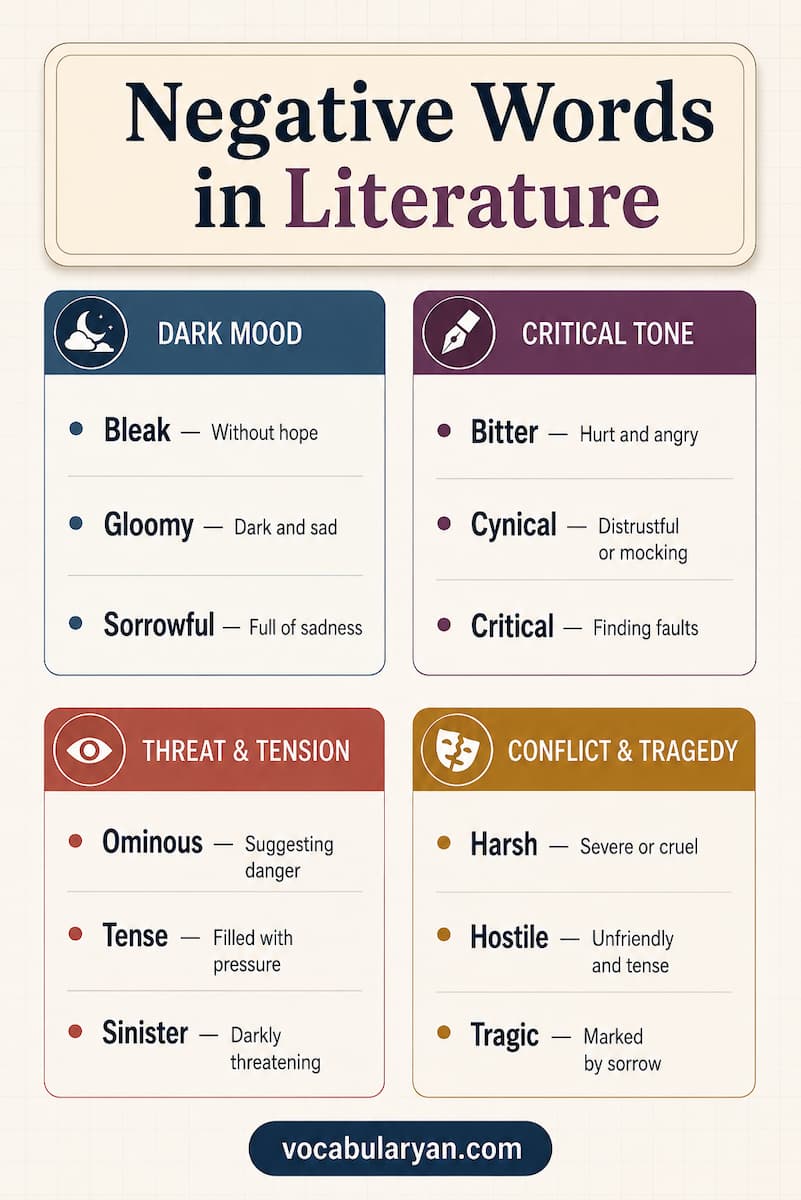
Literature does its most powerful work in the dark. The words that name a tragic flaw, describe a foreboding atmosphere, or capture a character’s nihilistic worldview are the vocabulary a reader needs to understand what a text is doing and why it lands so hard. Negative words in literature fall into several distinct categories: the tone words used in literary analysis, the formal terms for tragic structures and devices, the vocabulary for the dark themes canonical texts return to again and again, and the critical language used to examine how negativity functions in a work. The vocabulary ahead is organized by the literary angle it serves, with meanings and literary examples throughout.
💡 Quick answer
Negative words in literature include tone words used in literary analysis (sardonic, elegiac, nihilistic), negative literary terms and devices (hubris, nemesis, catharsis, dramatic irony), words for dark themes (alienation, corruption, mortality, despair), and critical vocabulary for analyzing texts (subversive, dystopian, unreliable, transgressive). Each category serves a different literary and analytical purpose.
Negative Words in Literature for tone and conflict
Negative Tone Words In Literary Analysis
These words describe the narrator’s or author’s attitude as identified in literary analysis.
Sardonic(adj.): grimly mocking, with bitter humor beneath the surface.
The sardonic tone of Swift’s A Modest Proposal makes the horror more effective, not less.
Elegiac(adj.): mournfully lamenting what has been lost.
Fitzgerald gives The Great Gatsby an elegiac quality, mourning a dream already past.
Nihilistic(adj.): treating all meaning as absent or illusory.
A nihilistic undertone runs through much of Hemingway’s early work.
Bitter(adj.): sharp with resentment that has not found resolution.
The bitter retrospective narration of Rebecca colors every memory the narrator recalls.
Cynical(adj.): distrustful of human motive and idealism.
A cynical view of institutional power shapes the tone of 1984 throughout.
Despairing(adj.): stripped of hope in a way that shapes every observation.
The despairing final pages of Of Mice and Men arrived as inevitable rather than sudden.
Mournful(adj.): expressing grief with a formal solemnity.
A mournful tone pervades Hardy’s Tess of the d’Urbervilles.*
Melancholy(adj.): touched by a lingering, pensive sadness.
Keats deploys a melancholy tone in the Ode to a Nightingale to explore beauty and loss.
Bleak(adj.): cold and stripped of any comfort or hope.
McCarthy sustains a bleak tone across the entirety of The Road.*
Scathing(adj.): delivering the sharpest possible critique.
Dickens turns scathing in his portraits of Chancery in Bleak House.*
Indignant(adj.): expressing righteous anger at injustice.
An indignant tone drives the moral argument of Uncle Tom’s Cabin.*
Foreboding(adj.): heavy with the sense of coming harm.
A foreboding tone is established from the opening paragraph of Wuthering Heights.*
Ominous(adj.): hinting at threat that has not yet arrived.
The ominous calm before violence is a recurring tonal device in Cormac McCarthy.
Caustic(adj.): corrosively critical, burning everything it touches.
Voltaire’s caustic wit makes Candide one of literature’s sharpest satirical texts.
Contemptuous(adj.): treating the subject with open disdain.
A contemptuous narrator voice signals unreliability in several Nabokov texts.
Negative Literary Terms And Devices
These are the formal terms used to name structures, devices, and concepts associated with the dark or negative in literature.
Tragic flaw(n.): the character weakness that causes a hero’s downfall; also called hamartia.
Othello’s tragic flaw is jealousy, easily exploited because it comes from love.
Hamartia(n.): the Greek term for the fatal error or flaw in a tragic hero.
Hamartia in Oedipus is the pride that drives him to pursue a truth he cannot survive.
Hubris(n.): excessive pride that blinds a character to their limits and invites nemesis.
Hubris shapes the arc of Macbeth from the moment he chooses ambition over restraint.
Nemesis(n.): the force of retribution that punishes hubris; also a formidable opponent.
In Greek tragedy, nemesis arrives precisely because the hero cannot see it coming.
Catharsis(n.): the emotional purging that tragedy produces in the audience.
Aristotle argued that catharsis justifies the suffering in tragedy: it purifies the audience.
Pathos(n.): the quality that evokes pity or sadness in the reader.
The pathos of Lennie’s death in Of Mice and Men depends on the reader’s full understanding of his innocence.
Dramatic irony(n.): when the audience knows something the character does not.
Dramatic irony builds unbearable tension in Romeo and Juliet as Juliet sleeps and Romeo despairs.
Tragic hero(n.): a protagonist of noble stature brought down by a fatal flaw.
Lear is the archetypal tragic hero, his downfall rooted in pride and a failure of judgment.
Anagnorisis(n.): the moment of recognition in which the tragic hero understands the truth.
Anagnorisis arrives for Oedipus all at once, and the knowledge is total and ruinous.
Peripeteia(n.): the sudden reversal of fortune in a tragedy.
The peripeteia in Macbeth comes with Birnam Wood and the revelation about Macduff.
Dystopia(n.): an imagined society in which oppressive systems cause widespread suffering.
Orwell’s Oceania is the defining dystopia of the twentieth century.
Anti-hero(n.): a protagonist lacking conventional heroic qualities, often morally compromised.
Raskolnikov is the anti-hero at the center of Crime and Punishment.*
Villain(n.): the antagonist whose actions drive the conflict against the protagonist.
Iago remains literature’s most studied villain precisely because his motives are never fully explained.
Gothic(adj./n.): a literary mode characterized by darkness, decay, and supernatural terror.
The Gothic tradition reaches from The Castle of Otranto through Dracula and Rebecca.*
Irony(n.): a contrast between what is stated and what is meant, or between expectation and reality.
Sophoclean irony makes the audience complicit in the tragedy’s unfolding.
Words For Dark Themes In Literature
The recurring themes that organize the darkest canonical texts each have a precise name.
Alienation(n.): estrangement from society, others, or the self.
Kafka makes alienation literal in The Metamorphosis and structural in everything else.
Despair(n.): the complete absence of hope.
Beckett’s characters live in pure despair and find a way to go on regardless.
Mortality(n.): the condition of being subject to death.
Mortality is the organizing pressure behind much of Keats’s poetry.
Corruption(n.): the degradation of what was once good.
The corruption of the American Dream is the central theme of The Great Gatsby.*
Oppression(n.): the systematic crushing of freedom and dignity.
Literary oppression takes economic form in Dickens, racial form in Morrison.
Nihilism(n.): the rejection of all meaning, value, and purpose.
Turgenev’s Bazarov introduces nihilism as a character position rather than an abstract philosophy.
Disillusionment(n.): the loss of a belief that had given direction.
Disillusionment drives the development of the bildungsroman protagonist across the genre.
Betrayal(n.): the breaking of trust in a way that reshapes everything after it.
The betrayal at the center of Atonement is narrated and re-narrated until its meaning changes.
Exile(n.): forced or chosen removal from home, community, or identity.
Exile is both literal and spiritual in Joyce’s Dubliners and A Portrait of the Artist.*
Grief(n.): deep sorrow, especially from loss.
C.S. Lewis described his own grief with precision in A Grief Observed.*
Fate(n.): a predetermined and inescapable outcome.
Fate in Oedipus Rex operates as the ultimate dramatic irony: the character who most resists it enacts it.
Injustice(n.): the absence of fair treatment.
Social injustice is the engine of the naturalist novel from Zola to Dreiser.
Isolation(n.): separation from connection and community.
Isolation defines the condition of the Gothic protagonist from Frankenstein to Heathcliff.
Dehumanization(n.): the reduction of persons to objects or animals.
Dehumanization is the central horror of the Holocaust literature of Levi and Wiesel.
Transgression(n.): the crossing of a moral or social boundary.
Literary transgression acquires meaning from what it violates.
Words For Conflict And Antagonism In Literature
These words name the specific forms that opposition and conflict take in literary texts.
Antagonist(n.): the force or character that opposes the protagonist.
Foil(n.): a character who contrasts with another to highlight their qualities.
Oppressor(n.): a character or force that crushes others through superior power.
Adversary(n.): one who works actively against the protagonist.
Conflict(n.): the central opposition that drives the plot forward.
Tension(n.): the sustained pressure between opposing forces in a narrative.
Rivalry(n.): ongoing competition between characters for the same goal.
Persecution(n.): sustained harassment by a more powerful force.
Vendetta(n.): a prolonged, personal campaign of revenge.
Tyranny(n.): absolute and oppressive power exercised by one over others.
Moral ambiguity(n.): uncertainty about the rightness or wrongness of actions.
Internal conflict(n.): a struggle within the character between opposing drives.
Irreconcilable difference(n.): opposing positions that cannot be brought together.
Power struggle(n.): a contest for dominance between characters or forces.
Estrangement(n.): the growing distance between characters once close.
Critical Vocabulary For Analyzing Negative Elements
These are the terms a student or critic uses to describe and analyze how negativity functions in a text.
Subversive(adj.): working to undermine established order or values from within.
The subversive comedy of Pride and Prejudice operates beneath its conventional romance.
Transgressive(adj.): violating accepted moral or social norms.
Transgressive fiction uses violation to expose the limits of what a culture permits.
Unreliable narrator(n.): a narrator whose account cannot be fully trusted.
Stevens in The Remains of the Day is the defining unreliable narrator of the late twentieth century.
Dystopian(adj.): relating to a degraded society in which systems of control cause suffering.
Atwood’s Gilead is a dystopian society built from real historical precedents.
Fatalistic(adj.): treating outcomes as predetermined and beyond any character’s control.
A fatalistic reading of Hardy places his characters inside a system that will not yield.
Subtext(n.): the underlying meaning that differs from the surface statement.
Pinter’s plays work almost entirely through subtext, the threat living beneath the mundane.
Moral corruption(n.): the degradation of ethical values in a character or society.
Moral corruption in Lord of the Flies arrives incrementally and is complete before anyone names it.
Disillusionment arc(n.): a character’s movement from belief to loss of belief.
The disillusionment arc is the engine of the naturalist novel.
Satirical(adj.): using irony, exaggeration, or mockery to criticize.
A satirical mode allows Orwell to make political critique feel universal.
Absurdist(adj.): depicting a world in which meaning and reason are absent.
The absurdist logic of The Trial refuses to explain itself, which is the point.
Tragic irony(n.): irony in which the audience foresees the protagonist’s ruin before they do.
Tragic irony makes the final act of Antigone both predictable and devastating.
Uncanny(adj.): strangely familiar in a way that produces unease; Freud’s term for the disturbing familiar.
The uncanny quality of The Turn of the Screw comes from the narrator’s unreliability.
Naturalist(adj.): depicting characters shaped by environment and heredity beyond their control.
A naturalist perspective denies its characters the agency that tragedy grants.
Existential(adj.): concerned with questions of existence, freedom, and meaning.
Camus frames The Stranger as an existential exploration of absurdity and death.
The Language Of Literary Tragedy
Beyond the Greek terms covered in literary devices, tragedy has its own emotional and formal vocabulary.
Doom(n.): a fixed and inescapable fate.
The doom of the House of Atreus is transmitted across generations and cannot be outrun.
Lament(n.): a formal expression of grief for what has been lost.
The lament is one of literature’s oldest forms, from the Book of Job to the elegies of Tennyson.
Elegy(n.): a mournful poem written for the dead.
Milton’s Lycidas is the English elegy against which all others have been measured.
Dirge(n.): a slow, mournful song expressing grief.
Songs in Shakespeare’s tragedies often function as dirges, releasing what dialogue cannot.
Ruin(n.): the state of complete destruction, personal or material.
Lear’s ruin is total: family, kingdom, reason, and finally breath.
Catastrophe(n.): in classical drama, the final action of a tragedy.
The catastrophe of Hamlet clears the stage of almost every major character.
Tragic waste(n.): the sense that something admirable has been unnecessarily destroyed.
A. C. Bradley’s idea of tragic waste captures why Hamlet’s death feels different from Claudius’s.
Lamentation(n.): the expression of passionate grief.
The lamentation in King Lear over Cordelia is Shakespeare’s most purely grief-stricken writing.
Reversal(n.): a turn from good fortune to bad; the everyday English term for peripeteia.
The reversal in tragedy is never merely plot: it expresses the order of things.
Fatal(adj.): causing or deserving death or ruin.
The fatal flaw is not merely a weakness but a quality that defines the character at their best.
Inexorable(adj.): unable to be stopped or altered by any appeal.
The inexorable march of fate is what separates Greek tragedy from melodrama.
Negative Words In Canonical Literary Texts
Some of literature’s most famous negative language belongs to specific texts and speakers.
Word or phrase
Text
Function
Melancholy
Hamlet
Names the condition that both protects and paralyzes him
Nothingness
Sartre, Being and Nothingness
Central philosophical negative
Darkness
Conrad, Heart of Darkness
Moral and literal condition of the journey
Despair
Dostoevsky throughout
The ground condition of consciousness
Corruption
Macbeth
What power does to a man capable of nobility
Alienation
Kafka throughout
The structural condition of modern life
Nihilism
Turgenev, Fathers and Sons
Bazarov’s stated position; the novel tests it
Absurd
Camus, The Myth of Sisyphus
The central philosophical negative of existentialism
Oppression
Morrison throughout
The lived condition of the characters she writes
Tragedy
Aristotle, Poetics
The formal structure that gives suffering meaning
FAQs
Q1. What are negative words in literature?
Negative words in literature include tone words used in literary analysis (sardonic, elegiac, nihilistic), formal literary terms for tragic structures (hubris, hamartia, catharsis), vocabulary for dark themes (alienation, corruption, despair), and critical terms for analyzing negative elements in texts (subversive, dystopian, unreliable narrator). Each category serves a different purpose in reading, writing about, and discussing literature.
Q2. What are the most important negative tone words for AP Literature?
The most frequently tested AP Literature tone words for negative registers are sardonic, cynical, bitter, caustic, contemptuous, elegiac, foreboding, melancholy, nihilistic, and scathing. Each names a specific authorial attitude rather than a general unpleasantness, which is what makes them useful in literary analysis.
Q3. What is the difference between tragic flaw and hubris?
Hubris is one specific type of tragic flaw, the excessive pride that blinds a character to their limits and invites divine or natural retribution. Hamartia is the broader Greek term for any fatal error or character weakness that causes a tragic downfall. All hubris is hamartia, but not all hamartia is hubris: Hamlet’s flaw is not pride but a paralysis of will.
Q4. What are key terms for analyzing dark themes in literature?
Core terms are alienation, disillusionment, corruption, oppression, nihilism, mortality, betrayal, exile, and fate. Each names a specific thematic concern that recurs across canonical texts and allows a student to connect a text’s particular darkness to a broader literary conversation about what literature does with suffering.
Q5. What is the difference between tone and mood in literary analysis?
Tone is the author’s or narrator’s attitude toward the subject, revealed through word choice and narrative stance, such as sardonic, elegiac, or bitter. Mood is the emotional atmosphere that the writing creates in the reader, such as foreboding, melancholy, or tense. Tone belongs to the speaker; mood belongs to the text’s effect on the reader.
I’m Ethan Walker, cofounder of Vocabularyan.com. Over 12 years in ESL and English learning, I’ve worked closely with vocabulary practice, learner writing, phrase use, and the sentence habits that shape fluent expression. I write with a practical eye for the English learners meet every day, from study notes to conversations and online writing.