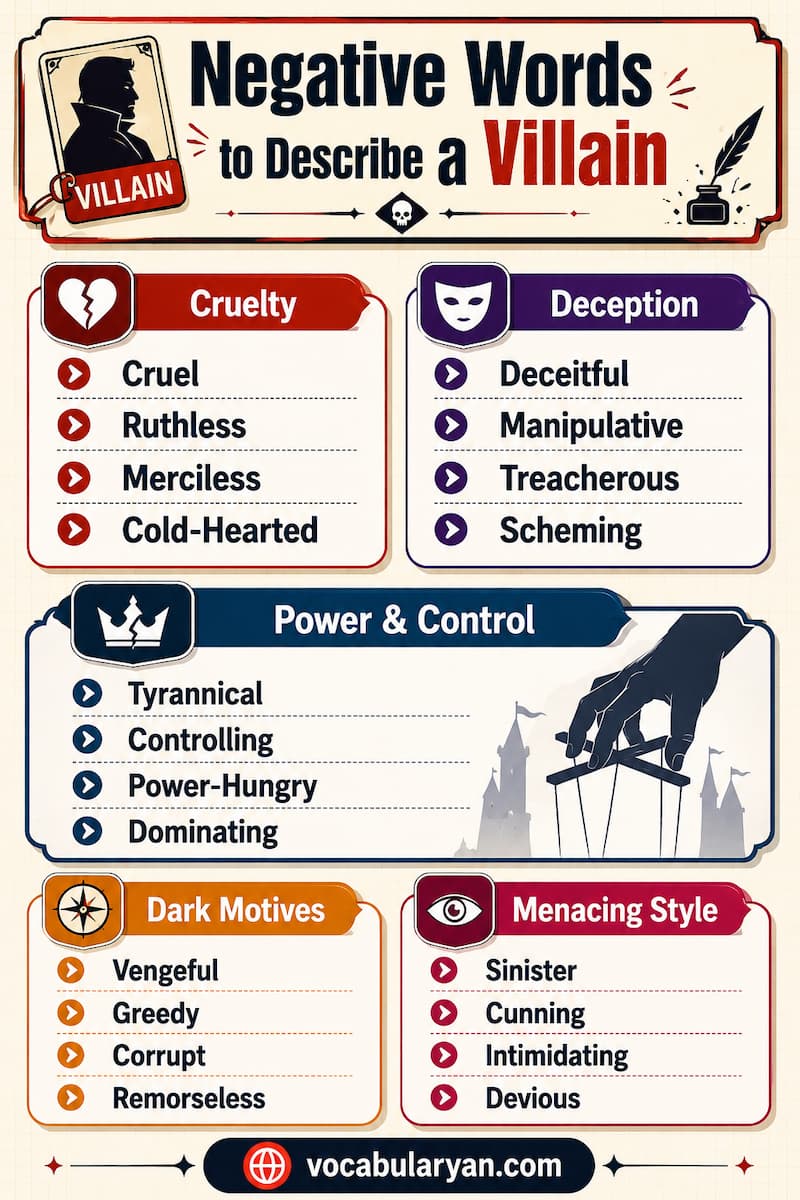
A great villain needs the right vocabulary, or the menace rings hollow. Call him cruel and the reader nods; call him cold-blooded, calculating, and smiling, and the reader leans back. Negative words to describe a villain run from the broadly evil to the precisely chilling, naming a foe’s wickedness, methods, presence, and even the look in their eyes. The sharpest choices suggest control rather than mere rage, which is what separates a true threat from a cartoon. The words ahead are grouped by what they capture, with meanings throughout, a set of villain nouns, and the qualities that make a villain feel real.
💡 Quick answer
Negative words to describe a villain are adjectives and nouns that paint an antagonist as evil, cruel, cunning, menacing, or power-mad, such as sinister, sadistic, calculating, and ruthless. The strongest ones name a precise threat rather than generic evil, and a villain reads as more frightening when the word suggests cold control.
Negative Words to Describe a Villain
Words For Evil And Wickedness
Start with the broad strokes of evil, then sharpen from there.
Evil: profoundly immoral and malicious.
His evil was patient, the kind that waited years for the right moment.
Wicked: morally bad and given to harm.
A wicked grin spread as the plan fell into place.
Malevolent: wishing active harm on others.
Something malevolent watched from the far end of the hall.
Nefarious: wicked and criminal in intent.
His nefarious dealings reached every port in the region.
Diabolical: fiendishly evil and cruel.
The trap was diabolical in its cold precision.
Sinister: suggesting hidden evil or threat.
A sinister calm settled over him before the order.
Vile: morally repugnant and contemptible.
He committed acts too vile to repeat aloud.
Depraved: morally corrupt and degraded.
Years of power had left him utterly depraved.
Corrupt: rotten to the moral core.
The judge was corrupt long before the first bribe.
Monstrous: shockingly evil or inhuman.
What he did to the village was monstrous.
Demonic: suggestive of a devil’s malice.
A demonic glee lit his face at the screams.
Fiendish: wickedly cruel and cunning.
The puzzle was a fiendish test designed to fail.
Heinous: utterly odious and wicked.
The crime was heinous even by the war’s standards.
Iniquitous: grossly unjust and wicked.
He built an empire on iniquitous deals.
Villainous: characteristic of a scoundrel.
A villainous scheme unfolded behind the smiles.
Dastardly: wicked and cowardly at once.
His dastardly plot targeted the defenseless.
Malignant: spreading evil like a disease.
A malignant influence rotted the council from within.
Black-hearted: deeply and irredeemably evil.
Only a black-hearted man would burn the orphanage.
Devilish: showing cunning, mischievous evil.
A devilish plan, elegant and merciless.
Unholy: profanely and darkly evil.
They struck an unholy bargain in the dark.
Perverse: turned against all that is right.
He took a perverse delight in others’ ruin.
Reprehensible: deserving utter condemnation.
His reprehensible orders shocked even his allies.
Words For Cruelty And Sadism
Cruel: taking pleasure in causing pain.
He was cruel in small, daily ways no one could prove.
Sadistic: enjoying others’ suffering.
Her sadistic games left no marks but deep scars.
Ruthless: pursuing aims without mercy.
He was ruthless, sacrificing allies without a blink.
Merciless: granting no pity at all.
The siege was merciless, sparing neither old nor young.
Brutal: savagely violent.
His methods were brutal and meant to be seen.
Vicious: fierce and intent on harm.
A vicious streak surfaced whenever he was crossed.
Savage: wild and pitiless in violence.
The reprisal was savage, far beyond the offense.
Barbaric: primitively and shockingly cruel.
He revived punishments long thought too barbaric.
Pitiless: showing no compassion.
Her pitiless gaze never wavered at the plea.
Bloodthirsty: eager for killing.
The warlord was bloodthirsty, always hungry for more.
Inhuman: lacking all human compassion.
The experiments were inhuman by any measure.
Torturous: inflicting prolonged agony.
He devised torturous ways to extract confessions.
Heartless: acting without a shred of compassion.
A heartless decree evicted the sick in winter.
Vindictive: bent on cruel revenge.
His vindictive memory forgave no slight.
Abusive: cruel and harmful in treatment.
He was abusive to everyone beneath him.
Predatory: hunting the weak for pleasure or gain.
His predatory charm fixed on the most vulnerable.
Remorseless: feeling no regret for harm.
He stayed remorseless, even at the trial.
Callous: hardened to suffering.
A callous shrug met every report of the dead.
Wanton: cruel without cause or restraint.
The destruction was wanton, beauty smashed for sport.
Tormenting: inflicting steady, deliberate pain.
He had a tormenting habit of dangling false hope.
Words For Cunning And Scheming
The cleverest villains threaten the hero’s mind before the body.
Cunning: clever in a deceitful way.
Devious: scheming and underhanded.
Scheming: constantly plotting for advantage.
Manipulative: controlling others unfairly.
Calculating: coldly planning every move.
Conniving: secretly cooperating in deceit.
Machiavellian: cunning and amoral in pursuit of power.
Deceitful: practiced at misleading.
Deceptive: skilled at creating false impressions.
Treacherous: betraying trust without warning.
Duplicitous: double-dealing and two-faced.
Sly: secretly cunning.
Crafty: shrewdly deceptive.
Insidious: harmful in a slow, hidden way.
Cynical: exploiting others without scruple.
Underhanded: acting in secret, dishonest ways.
Slippery: evasive and impossible to pin down.
Wily: full of clever tricks.
Furtive: secretive and stealthy.
Subversive: working in secret to undermine.
Words For Menace And Intimidation
Menace is felt before it is explained, and these words supply the weight of presence.
Menacing: giving off a clear threat.
His menacing silence emptied the room.
Threatening: warning of imminent harm.
A threatening message arrived before each attack.
Intimidating: frightening through presence or power.
He was intimidating without ever raising his voice.
Imposing: large and forbidding in presence.
An imposing figure filled the doorway.
Formidable: powerful and hard to oppose.
She proved a formidable and patient enemy.
Terrifying: causing intense fear.
His reputation alone was terrifying.
Dreadful: inspiring dread.
A dreadful hush followed wherever he walked.
Fearsome: causing fear by look or reputation.
The fearsome general was rumored never to sleep.
Ominous: hinting that harm is near.
His ominous smile promised worse to come.
Forbidding: stern and unwelcoming.
The forbidding fortress matched its master.
Hulking: massive and physically threatening.
A hulking enforcer blocked the only exit.
Looming: hanging over as a constant threat.
His looming influence touched every decision.
Brooding: darkly and threateningly silent.
He sat brooding in the corner, watching everyone.
Hostile: openly antagonistic.
A hostile stare met the new arrival.
Domineering: overpowering in manner.
His domineering presence silenced the board.
Unnerving: quietly disturbing and off.
There was something unnerving in his patience.
Chilling: inducing a fearful cold.
His chilling calm was worse than any shout.
Stealthy: moving unseen toward harm.
A stealthy killer, he was gone before the alarm.
Words For Power, Ego, And Tyranny
Power-hungry: craving control above all.
Megalomaniacal: obsessed with one’s own greatness.
Supremacist: believing in one’s right to dominate.
Insatiable: never satisfied in appetite for power.
Overbearing: oppressively dominant.
Words For Coldness And Lack Of Remorse
Nothing chills a reader like a villain who simply does not care.
Cold: emotionally void.
Cold-blooded: calmly and calculatedly violent.
Cold-hearted: lacking warmth or sympathy.
Unfeeling: without emotional response.
Detached: eerily uninvolved.
Emotionless: showing no feeling at all.
Conscienceless: having no moral sense.
Soulless: empty of human feeling.
Apathetic: indifferent to suffering.
Indifferent: unmoved by others’ pain.
Dispassionate: chillingly free of emotion.
Aloof: distant and untouchable.
Icy: frigid in manner.
Stony: hard and unmoved.
Hollow: empty of warmth within.
Robotic: mechanical and without feeling.
Words For A Villain’s Sinister Appearance
Sinister-looking: appearing evil or threatening.
Scarred: marked by old wounds.
Gaunt: thin and hollow-faced.
Hooded: face shadowed and concealed.
Shadowy: half-hidden in darkness.
Pale: bloodless and unsettling.
Cadaverous: corpse-like.
Skeletal: gauntly thin as bone.
Hawkish: sharp-featured and predatory.
Steely-eyed: cold and unyielding in gaze.
Cruel-mouthed: with a hard, pitiless mouth.
Scowling: fixed in a dark frown.
Sneering: curled with contempt.
Reptilian: cold and snake-like.
Wolfish: hungry and predatory in look.
Grim: stern and joyless.
Disfigured: marred in a frightening way.
Towering: tall enough to loom over others.
Strong Nouns For A Villain
Sometimes a single noun damns a character more sharply than any adjective.
Fiend: a wickedly cruel person.
Scoundrel: a dishonest, unprincipled person.
Miscreant: a villain or wrongdoer.
Tyrant: a cruel, oppressive ruler.
Brute: a savage, unfeeling person.
Monster: a cruel or inhuman being.
Rogue: a dishonest, untrustworthy person.
Knave: a dishonest, crafty man.
Scourge: one who brings ruin and suffering.
Despot: an absolute, oppressive ruler.
Predator: one who exploits the vulnerable.
Marauder: a raider who plunders.
Tormentor: one who inflicts suffering.
Oppressor: one who keeps others down by force.
Wretch: a despicable person.
Reprobate: an unprincipled, immoral person.
Mastermind: the brain behind a wicked plot.
Antagonist: the force opposing the hero.
Malefactor: one who does evil or harm.
Villain: the wicked antagonist of a story.
Words That Make A Villain Believable
The villains that haunt readers are never pure evil; they are persuasive, wounded, and certain they are right.
Charismatic: magnetic and persuasive despite the menace.
His charismatic warmth made the betrayal land harder.
Charming: winning in a way that masks the danger.
He was charming right up to the moment he wasn’t.
Persuasive: able to make evil sound reasonable.
So persuasive that good people followed him willingly.
Intelligent: clever enough to outthink the hero.
An intelligent foe who anticipated every move.
Disciplined: controlled and patient in pursuit.
His disciplined restraint made him deadlier.
Principled: loyal to a twisted code of his own.
Oddly principled, he never broke his own dark rules.
Wounded: shaped by a real, sympathetic injury.
A wounded past explained, though never excused, the cruelty.
Justified: convinced of his own righteousness.
He felt entirely justified, which made him chilling.
Tragic: doomed by a flaw the reader can pity.
A tragic figure, ruined by the love he could not save.
Tormented: haunted by guilt or loss.
Beneath the menace lived a tormented man.
Loyal: devoted, but to the wrong cause.
Fiercely loyal, he would burn the world for his god.
Idealistic: chasing a noble goal by monstrous means.
An idealistic dream had curdled into atrocity.
Relatable: sharing fears the reader knows.
He wanted what anyone wants, only without limits.
Wronged: pushed toward evil by genuine injustice.
Once wronged, he repaid the world a thousandfold.
Vulnerable: cracked by a hidden weakness.
One vulnerable spot kept him from pure monstrosity.
Human: flawed in ways that feel uncomfortably real.
His worst trait was how human he remained.
Common Villain Archetypes At A Glance
Most memorable villains fit a recognizable mold, then break it.
Archetype
Defining drive
The Tyrant
Absolute control through fear
The Mastermind
Outsmarting everyone from the shadows
The Sadist
Cruelty pursued as pleasure
The Zealot
A cause that excuses any atrocity
The Corruptor
Turning the good to his side
The Anti-Villain
A right goal by monstrous means
The Monster
Pure, unknowable menace
The Manipulator
Control through charm and lies
How To Describe A Villain Without Cliché
The strongest villain words name a specific menace rather than a generic evil. A reader feels little from wicked but tenses at sadistic, cold-blooded, or smiling. Pair a hard descriptor with a concrete action, so a ruthless villain orders the bridge burned with the refugees still on it. Avoid the cartoon, since a villain who only sneers and gloats reads as a joke; the ones that frighten stay calm, sound reasonable, and believe they are right. Choose words that suggest control, not just rage.
FAQs
Q1. What are the best words to describe a villain?
Strong choices are sinister, malevolent, ruthless, sadistic, cunning, and cold-blooded, since each names a precise kind of threat. Vivid options like nefarious, diabolical, and Machiavellian add menace and style. The best word fits the villain’s particular cruelty rather than labeling them generically evil.
Q2. What adjectives describe an evil villain?
For pure wickedness, reach for evil, wicked, vile, depraved, monstrous, heinous, and diabolical. For their methods, use ruthless, manipulative, and calculating. For presence, menacing, terrifying, and imposing all work. Mixing a moral word with a method word builds a fuller portrait.
Q3. What is a strong noun for a villain?
Strong villain nouns are fiend, scoundrel, miscreant, tyrant, brute, and mastermind, each with its own flavor. A fiend stresses cruelty, a mastermind stresses cunning, and a tyrant stresses abused power. A single well-chosen noun can define a character on introduction.
Q4. How do I describe a villain without sounding clichéd?
Skip the cartoon menace of sneering and cackling. Pair a precise adjective with a concrete action, so a cold-blooded villain finishes his coffee before giving the order. The most frightening villains stay calm, sound reasonable, and believe they are justified, so describe control rather than rage.
Q5. Can a villain have positive traits?
Yes, and the best ones do. Charm, intelligence, loyalty, and a wounded past make a villain believable and even sympathetic. Those qualities raise the stakes, since a charming, justified villain unsettles a reader far more than a figure who is simply evil.
I’m Ethan Walker, cofounder of Vocabularyan.com. Over 12 years in ESL and English learning, I’ve worked closely with vocabulary practice, learner writing, phrase use, and the sentence habits that shape fluent expression. I write with a practical eye for the English learners meet every day, from study notes to conversations and online writing.