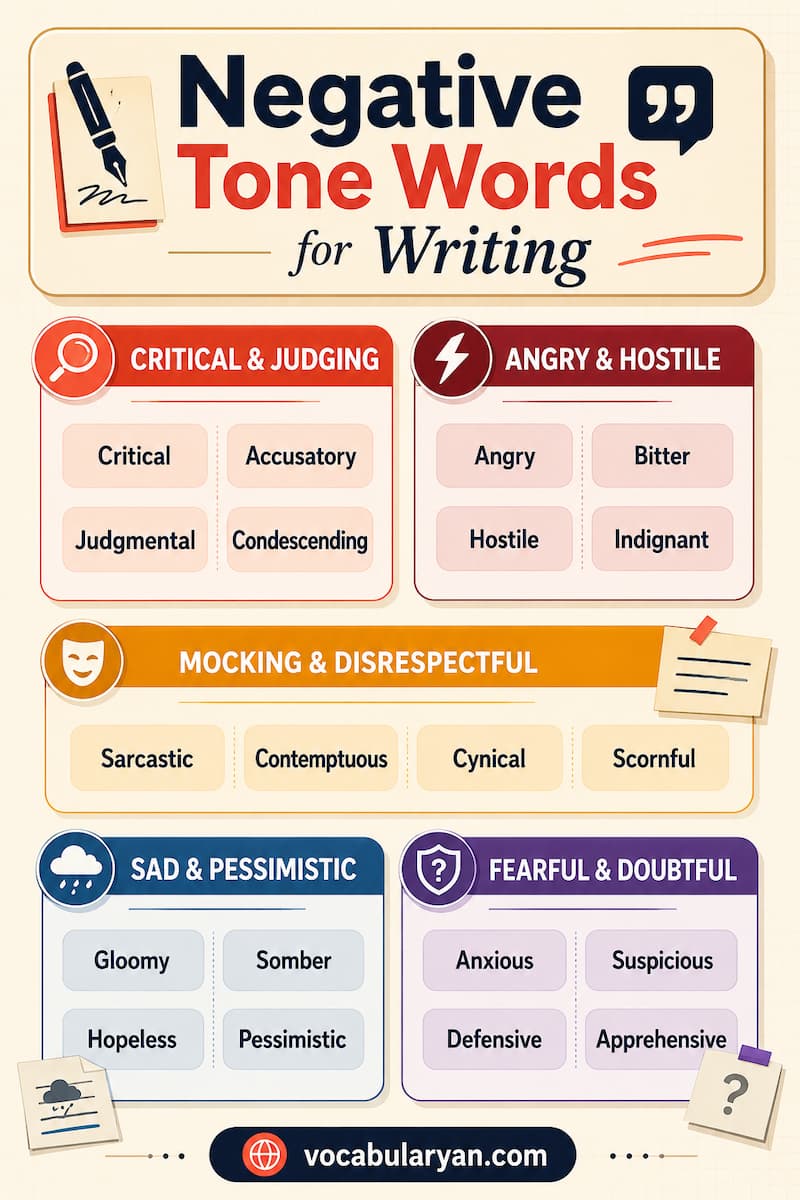
Tone is the writer’s attitude made audible on the page. A bitter narrator and a mournful one can describe the same event and produce entirely different effects: the first accuses, the second grieves. Negative tone words name those unfavorable or emotionally dark attitudes, the stance a narrator takes toward characters, events, and the reader. They differ from mood words, which belong to the scene and the atmosphere it creates. Tone belongs to the voice doing the telling. The words ahead are grouped by the kind of attitude they express, with meanings and sentence examples throughout, so the right tone is quick to find and easy to deploy with precision.
💡 Quick answer
Negative tone words describe the writer’s or narrator’s unfavorable attitude toward a subject, character, or reader, such as bitter, sardonic, contemptuous, ominous, and despairing. Tone is the voice behind the words; mood is the atmosphere those words create in the scene. Grouping tone words by attitude type makes the right one quick to reach.
Negative Tone Words for Writing with examples
Dark Emotional Tones
These tones put the narrator’s emotional state at the center, shading everything through grief, bitterness, or despair.
Mournful: expressing deep grief and sorrow.
The mournful narration lingered over every lost detail of the house.
Melancholy: touched by a pensive, gentle sadness.
A melancholy voice drifted through the novel’s closing pages.
Sorrowful: full of sorrow without hope of relief.
The letter was sorrowful, each sentence a small surrender.
Bitter: sharp with resentment over past hurt.
A bitter tone ran through every observation she made.
Anguished: in severe, prolonged emotional pain.
The confession was anguished, the words dragged out reluctantly.
Despairing: stripped of hope and conveying it.
The final chapter was despairing, the last option exhausted.
Wistful: gently sad, longing for what is gone.
The memoir’s wistful tone made the past feel irretrievable.
Elegiac: mournful in the manner of a lament for the dead.
The poem’s elegiac mood honored what the war had taken.
Heavy: weighed down by unspoken grief or dread.
The prose was heavy, each paragraph arriving like bad news.
Somber: grave and subdued, without lightness.
A somber register suited the events that followed.
Bleak: cold and stripped of any hope.
The narrator’s bleak view left no room for redemption.
Doleful: sad with a plaintive, expressive quality.
A doleful voice described the empty rooms.
Funereal: dark and solemn as a funeral.
The funereal pacing matched the weight of the subject.
Lugubrious: excessively mournful, almost ostentatiously sad.
The lugubrious tone tipped from grief into self-pity.
Rueful: expressing regret with a wry, knowing sadness.
A rueful tone acknowledged the mistakes without excuse.
Heartrending: conveying grief that strains the reader.
The testimony was heartrending, each word chosen for its cost.
Critical And Hostile Tones
Here the narrator turns a hard eye on the subject, from mild disapproval to open contempt.
Contemptuous: treating the subject as beneath serious regard.
A contemptuous passage dismissed the opponent without argument.
Scornful: expressing open disdain.
The review was scornful, enjoying its own cruelty.
Disdainful: coldly regarding the subject as unworthy.
A disdainful narrator never let the characters forget their smallness.
Condescending: talking down to characters or reader.
The condescending tone assumed the reader needed everything explained.
Accusatory: charging or blaming directly.
The editorial was accusatory, naming names in every paragraph.
Hostile: openly unfriendly and antagonistic.
A hostile voice met every character introduction with suspicion.
Harsh: unsparing and without softening.
The critique was harsh, finding no quarter worth giving.
Scathing: bitingly critical without mercy.
A scathing review dismantled the book premise by premise.
Disparaging: running the subject down as worthless.
The disparaging narration undercut every noble gesture.
Derisive: mocking in a way that diminishes.
A derisive aside appeared in every other paragraph.
Vitriolic: savagely and bitterly hostile.
The polemic turned vitriolic in its final section.
Censorious: strongly disapproving and quick to criticize.
A censorious narrator weighed every character and found them wanting.
Indignant: expressing righteous anger at injustice.
The indignant tone carried genuine moral authority.
Reproachful: expressing disappointment and blame.
The letter was reproachful without being cruel.
Judgmental: passing verdict on everyone and everything.
A judgmental narrator made the novel uncomfortable to inhabit.
Detached And Cold Tones
Distance is its own kind of darkness; a cold, clinical voice can unsettle more than open hostility.
Detached: emotionally uninvolved, observing without feeling.
Clinical: precise and cold, stripping emotion from the subject.
Cold: emotionally absent, offering no warmth.
Dispassionate: calmly analytical, free of feeling.
Flat: without emotional variation, deliberately drained.
Matter-of-fact: delivering darkness without emphasis or affect.
Indifferent: conveying unconcern about the subject or outcome.
Aloof: keeping a superior distance from the material.
Austere: unadorned and severe, admitting no sentiment.
Reserved: withholding emotional response.
Impersonal: refusing personal investment in the subject.
Sterile: scrubbed clean of warmth or humanity.
Dry: deliberately without affect, often uncomfortably so.
Remote: far from the emotional reality of the events described.
Withholding: holding back what the reader is reaching for.
Tense And Ominous Tones
Unease does not need to name itself; these tones press the reader forward by making stillness feel dangerous.
Ominous: suggesting that something bad is coming.
An ominous quiet fell over the opening pages.
Foreboding: heavy with dread of the near future.
A foreboding note sounded in every second sentence.
Sinister: implying hidden evil or threat.
The narrator’s sinister calm made the scene more unsettling than any shout.
Menacing: carrying a clear and present threat.
A menacing tone turned the description of ordinary objects dark.
Suspenseful: tight with anxious anticipation.
The suspenseful pacing held the reader at the edge of every scene.
Tense: strained and braced for something to break.
A tense economy of words left nothing to feel safe about.
Unsettling: quietly and persistently disturbing.
The unsettling calm of the narration made the violence worse.
Chilling: inducing a cold, creeping dread.
The chilling matter-of-fact tone was more frightening than hysteria.
Dark: lacking light or hope, weighted with threat.
The novel’s dark register never lifted after the first chapter.
Haunting: lingering in the mind with uneasy persistence.
A haunting image recurred at intervals throughout the narrative.
Eerie: strange and unsettling without explanation.
An eerie stillness pervaded the narration.
Threatening: signaling harm directly.
A threatening undertone ran beneath every pleasantry.
Oppressive: weighing on the reader with unrelenting pressure.
The oppressive accumulation of detail crushed any hope.
Despairing And Defeated Tones
Despondent: deeply discouraged and without hope.
Hopeless: certain that nothing good is possible.
Defeated: resigned after the last option fails.
Resigned: accepting a bad outcome without resistance.
Fatalistic: treating doom as fixed and inevitable.
Nihilistic: treating all meaning as absent.
Desolate: empty of warmth or comfort.
Bereft: hollowed out by loss.
Jaded: dulled past the point of caring.
Disillusioned: stripped of every illusion, bitterly clear.
World-weary: exhausted by experience, past surprise.
Broken: shattered and past repair.
Helpless: unable to act or change anything.
Hollow: empty at the core, going through motions.
Ironic And Cynical Tones
The most controlled negative tones; irony and cynicism wound by seeming not to care.
Sardonic: grimly mocking with biting humor.
A sardonic aside undercut the hero’s speech without a word of protest.
Sarcastic: saying the opposite of what is meant, cutting.
The narrator’s sarcastic praise made the target look worse than insult.
Ironic: meaning the opposite of the literal words.
An ironic tone put the official account under quiet pressure.
Cynical: distrustful of motive, refusing all idealism.
A cynical narrator trusted no one and was usually right.
Wry: dry and aware, twisting the knife with a faint smile.
A wry observation delivered the sharpest line in the chapter.
Acerbic: sharp and direct, with a biting edge.
The acerbic commentary left no illusion uncut.
Caustic: corrosively critical, burning whatever it touches.
A caustic passage stripped the ceremony of every pretension.
Barbed: sharp and pointed, designed to wound.
A barbed comment closed the scene before the reader could recover.
Mordant: darkly satirical, finding death in the comedy.
A mordant wit shaped every observation in the satire.
Flippant: treating serious things with deliberate lightness.
A flippant narrator made the horror harder to absorb.
Sneering: superiority worn openly as disdain.
A sneering voice dismissed every character who tried.
Droll: amusingly odd in a dry, deadpan way.
The droll narration made catastrophe faintly comic.
Negative Tones In Nonfiction And Criticism
Nonfiction has its own tonal register, where the author’s attitude toward the subject is rarely neutral.
Damning: presenting evidence that condemns without appeal.
Polemical: aggressively argumentative in a cause.
Outraged: expressing shock and moral fury at what was found.
Skeptical: doubting claims and demanding proof.
Dismissive: treating the subject as unworthy of serious attention.
Alarmist: presenting threat in the most urgent, frightening terms.
Confrontational: challenging the reader or subject directly.
Pessimistic: expecting the worst from people and events.
Grave: deeply serious, conveying the weight of the subject.
Exasperated: worn thin by the subject’s failures.
Inflammatory: calculated to provoke strong negative reaction.
Moralizing: insisting on a moral judgment the reader did not ask for.
Relentless: pressing the same critical point without relief.
Impassioned: so strongly felt it tips toward bias.
Tone Words By Genre
The right negative tone is partly a genre decision.
The same event rewrites itself depending on the tone that carries it.
Event: A man returns to the town where he grew up.
Wistful tone: He walked the old streets slowly, as though the past had left some residue he could almost touch.
Bitter tone: He walked the old streets and found them as small and unforgiving as they had always been.
Sardonic tone: He walked the old streets, which had improved not at all since conspiring to make him who he was.
Ominous tone: He walked the old streets, and something he could not name followed every step.
The event is identical in all four. The tone decides what the reader is left feeling and where they expect the story to go.
FAQs
Q1. What are negative tone words for writing?
Negative tone words are adjectives that describe the writer’s or narrator’s unfavorable attitude toward a subject, character, or reader, such as bitter, sardonic, contemptuous, ominous, and despairing. They name the emotional or critical stance behind the prose and give a writer precise control over how the text feels to read.
Q2. What is the difference between tone and mood in writing?
Tone is the narrator’s or author’s attitude toward the subject, expressed through word choice and voice. Mood is the atmosphere the writing creates in the reader, built through setting, imagery, and accumulated detail. A detached, clinical tone and an ominous, menacing tone can each create a different mood; the tone belongs to the speaker, while the mood belongs to the scene.
Q3. What are some common negative tone words?
Frequently used ones are bitter, sardonic, contemptuous, ominous, bleak, cynical, mournful, and scathing. Each names a distinct attitude: sardonic mocks, contemptuous dismisses, mournful grieves, scathing attacks. The strongest tone words are precise enough to do only one of those things at a time.
Q4. How do I choose the right negative tone word?
Match the tone to the narrator’s relationship with the subject. A character who has been wronged earns a bitter or reproachful tone; a narrator who sees through everyone suits sardonic or cynical. Match it also to the genre: ominous and foreboding belong to thrillers and horror, while elegiac and mournful belong to literary fiction and tragedy.
Q5. Can a piece of writing have more than one tone?
Yes, and the best writing usually does. A mournful tone and a sardonic one can coexist when a narrator grieves what they also find absurd. Tone shifts as the narrative moves through different registers, and controlling those shifts is one of the marks of a confident writer. The danger is inconsistency without purpose; a tone should shift when the material demands it, not by accident.
I’m Ethan Walker, cofounder of Vocabularyan.com. Over 12 years in ESL and English learning, I’ve worked closely with vocabulary practice, learner writing, phrase use, and the sentence habits that shape fluent expression. I write with a practical eye for the English learners meet every day, from study notes to conversations and online writing.