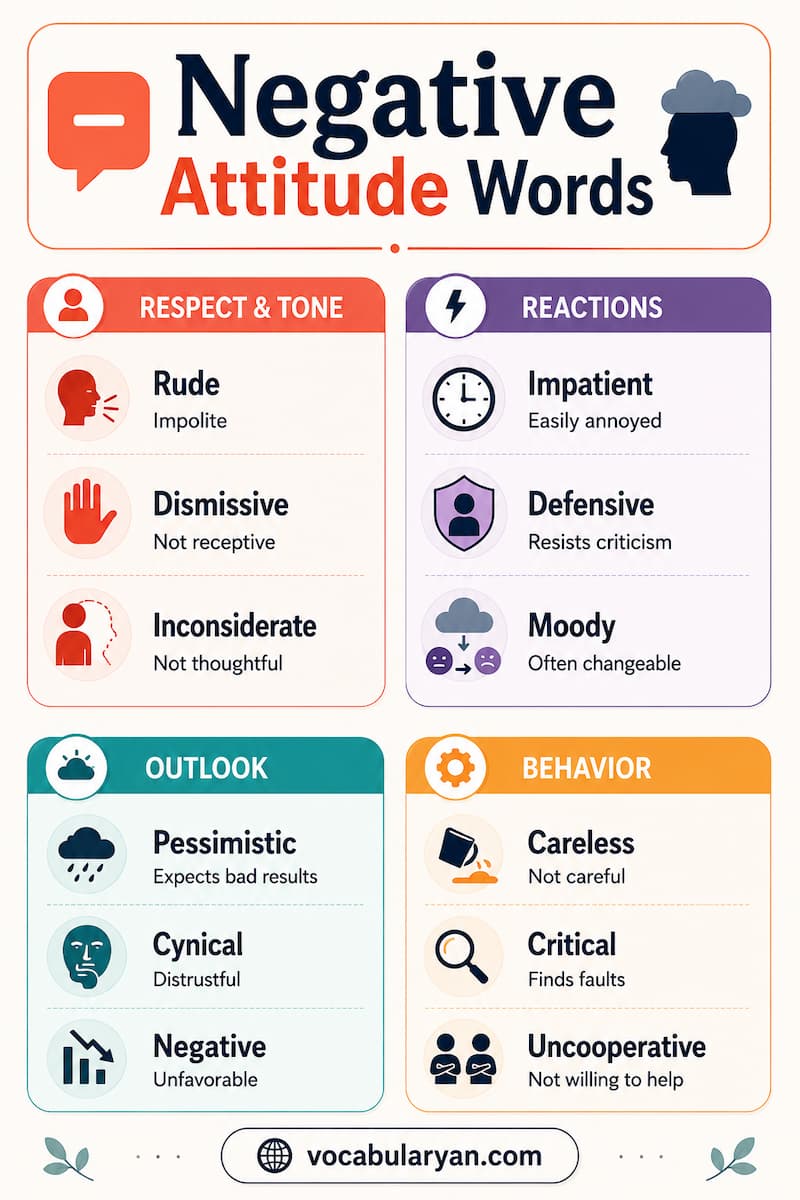
Attitude is the lens a person points at the world, and a sour one colors everything they touch. A single word can name that lens: not just unhappy, but defeatist, entitled, or dismissive. Negative words to describe attitude capture a settled stance rather than a passing mood, the way someone meets work, people, authority, and bad news. The right one pinpoints the exact slant, since a cynic, a sulker, and a know-it-all poison a room in very different ways. The words ahead are grouped by the kind of attitude they name, with meanings throughout and a table of the lines that give each one away.
💡 Quick answer
Negative words to describe attitude name an unfavorable stance or outlook, such as pessimistic, cynical, entitled, dismissive, and defiant. Unlike a passing mood, an attitude is a settled disposition that shows in how someone treats work, people, and setbacks. Grouping the words by the kind of stance makes the right one quick to reach.
Negative Words to Describe Attitude in context
Pessimistic And Defeatist Attitudes
This outlook expects the worst and quietly arranges to find it.
Pessimistic: always expecting the worst outcome.
“It’ll fail anyway,” he said before they even started.
Defeatist: assuming failure before trying.
Her defeatist shrug killed the idea in its cradle.
Hopeless: convinced nothing will improve.
He approached every fix with a hopeless sigh.
Fatalistic: resigned to a fixed, grim fate.
A fatalistic calm meant he never bothered to plan.
Gloomy: heavy with a dark, downbeat outlook.
His gloomy forecasts drained the room’s energy.
Bleak: seeing no light ahead.
She painted a bleak picture of the quarter to come.
Nihilistic: treating everything as pointless.
A nihilistic “none of it matters” ended every debate.
Despairing: drained of all hope.
He wore a despairing look at the first setback.
Doom-laden: forever predicting disaster.
Her doom-laden warnings rarely came true.
Negative: quick to see problems over possibilities.
His negative spin found a flaw in every plan.
Discouraging: quick to dampen others’ hopes.
A discouraging word met every new proposal.
Self-defeating: undermining one’s own chances.
His self-defeating outlook talked him out of trying.
Resigned: passively accepting a bad lot.
A resigned “what’s the use” replaced any effort.
Cheerless: without warmth or optimism.
Her cheerless manner flattened every celebration.
Downbeat: low and pessimistic in tone.
He gave a downbeat report even after the win.
Glass-half-empty: focused on what is lacking.
His glass-half-empty habit soured good news.
Cynical And Distrustful Attitudes
Cynical: distrustful of others’ motives.
Jaded: worn weary and unimpressed.
Distrustful: reluctant to trust anyone.
Suspicious: assuming hidden bad intent.
Sardonic: grimly mocking and scornful.
World-weary: drained of enthusiasm by experience.
Sceptical: doubting claims and people by default.
Mistrustful: slow to believe or rely on others.
Disillusioned: stripped of belief or hope.
Wary: guarded and expecting the worst of people.
Misanthropic: disliking people in general.
Guarded: closed off and slow to open up.
Paranoid: distrustful without real cause.
Disenchanted: let down and no longer hopeful.
Apathetic And Indifferent Attitudes
The most draining attitude is not anger but the shrug that says none of it matters.
Apathetic: lacking any interest or drive.
He met the deadline news with an apathetic shrug.
Indifferent: unconcerned either way.
She seemed indifferent to whether the project lived or died.
Complacent: smugly content and unwilling to improve.
Success made the team complacent and sloppy.
Lackadaisical: careless and without enthusiasm.
His lackadaisical effort showed in every rushed page.
Unmotivated: lacking the will to begin or finish.
An unmotivated intern watched the clock all day.
Half-hearted: doing the minimum without conviction.
Her half-hearted attempt fooled no one.
Disengaged: mentally checked out.
He stayed disengaged through every meeting.
Careless: giving no real attention.
A careless attitude let small errors pile up.
Lazy: avoiding effort wherever possible.
His lazy approach pushed work onto everyone else.
Negligent: ignoring duties and care.
A negligent attitude toward safety caused the spill.
Blasé: unimpressed and uninterested by habit.
She was blasé about a chance most would chase.
Nonchalant: carelessly unbothered about what matters.
His nonchalant “whatever” ended the discussion.
Detached: emotionally uninvolved in the work.
He remained detached while the team scrambled.
Listless: drained of energy and interest.
A listless crew dragged through the afternoon.
Slack: lax and undemanding of oneself.
Standards grew slack once no one was watching.
Couldn’t-care-less: openly and proudly unconcerned.
His couldn’t-care-less manner offended the clients.
Arrogant And Entitled Attitudes
Arrogant: convinced of one’s own superiority.
Entitled: expecting privileges unearned.
Superior: acting as though above everyone.
Smug: irritatingly self-satisfied.
Self-important: inflating one’s own significance.
Conceited: excessively proud of oneself.
Self-righteous: smugly certain of one’s own virtue.
Presumptuous: overstepping by assuming too much.
High-and-mighty: haughtily superior.
Pompous: stuffily self-important.
Egotistical: wrapped up in one’s own importance.
Vain: obsessed with one’s own image.
Snooty: snobbishly disdainful.
Pretentious: claiming more importance than warranted.
Know-it-all: certain one already knows everything.
Hostile And Confrontational Attitudes
Some attitudes meet the world braced for a fight.
Hostile: openly antagonistic.
He met every suggestion with a hostile glare.
Aggressive: forceful and quick to attack.
Her aggressive tone turned a chat into a fight.
Belligerent: spoiling for a fight.
A belligerent customer berated the whole desk.
Combative: eager to argue and oppose.
He took a combative stance on the smallest point.
Antagonistic: actively opposed and unfriendly.
Her antagonistic manner isolated the new hire.
Confrontational: seeking out conflict.
His confrontational style derailed every meeting.
Abrasive: harsh and grating in manner.
An abrasive reply ended the partnership.
Prickly: quick to bristle and snap.
She turned prickly at the gentlest feedback.
Defensive: quick to take offense and deflect.
He grew defensive before anyone finished speaking.
Argumentative: disputing almost everything.
His argumentative habit exhausted the room.
Quarrelsome: ready to pick a fight.
A quarrelsome mood soured the family dinner.
Truculent: defiant and eager to clash.
The truculent recruit challenged every order.
Volatile: liable to flare into conflict.
His volatile temper kept everyone on eggshells.
Caustic: bitingly hostile in speech.
Her caustic remarks cut deeper than any shout.
Snappish: curt and quick to bite.
He answered snappishly at the slightest delay.
Hot-tempered: quick to erupt over little.
One hot-tempered outburst cleared the office.
Defiant And Uncooperative Attitudes
Defiant: boldly refusing to obey.
Rebellious: rising against authority.
Insubordinate: disobedient to those in charge.
Uncooperative: refusing to work with others.
Contrarian: opposing on principle.
Obstinate: stubbornly refusing to yield.
Recalcitrant: stubbornly resistant to control.
Intransigent: unwilling to compromise.
Disobedient: failing to follow instructions.
Unruly: hard to discipline or control.
Headstrong: set on having one’s own way.
Mutinous: openly rebelling against authority.
Obstructive: deliberately getting in the way.
Stubborn: unwilling to change course.
Inflexible: rigid and unwilling to bend.
Dismissive And Condescending Attitudes
This stance treats other people, and their ideas, as barely worth the time.
Dismissive: brushing others aside as unworthy.
He waved off the proposal with a dismissive flick.
Condescending: talking down to others.
Her condescending tone made the intern shrink.
Patronizing: treating others as less capable.
He explained the obvious in a patronizing drawl.
Scornful: treating with open contempt.
A scornful laugh greeted the rookie’s plan.
Contemptuous: regarding others as beneath notice.
His contemptuous glance said more than words.
Disparaging: belittling and running others down.
Her disparaging asides undercut every speaker.
Belittling: making others feel small.
He had a belittling way of repeating your point slowly.
Derisive: mocking and ridiculing.
A derisive snort met the suggestion.
Disdainful: treating things as beneath one.
She gave the budget a disdainful once-over.
Snide: slyly disrespectful.
His snide comments chipped away at morale.
Mocking: ridiculing in tone.
A mocking echo followed every nervous question.
Sneering: curling with contempt.
He answered with a sneering half-smile.
Aloof: coolly above it all.
Her aloof manner dismissed the team without a word.
High-handed: domineering and dismissive of objections.
His high-handed rulings ignored every voice.
Resentful And Bitter Attitudes
Resentful: harboring ill will over grievances.
Bitter: soured by lasting anger.
Grudging: giving or doing unwillingly.
Begrudging: resenting another’s good fortune.
Sour: sullenly unpleasant and discontented.
Aggrieved: feeling wronged and nursing it.
Petty: fixated on trivial slights.
Vindictive: bent on getting even.
Spiteful: acting from petty resentment.
Jealous: resentful of others’ advantages.
Envious: wanting what others have.
Chip-on-the-shoulder: carrying a ready grievance.
Touchy: quick to feel slighted.
Unforgiving: refusing to let a wrong go.
Sullen And Moody Attitudes
Here the attitude lives less in words than in a cloud that follows the person around.
Sullen: silently resentful and gloomy.
Moody: given to dark, shifting moods.
Surly: bad-tempered and unfriendly.
Sulky: silently pouting over something.
Morose: gloomy and ill-humored.
Dour: stern, grim, and joyless.
Grumpy: irritable and complaining.
Glum: low and downcast.
Brooding: darkly dwelling on troubles.
Petulant: childishly sulky.
Crabby: peevish and short-tempered.
Cantankerous: argumentative and ill-natured.
Churlish: rude and surly.
Disgruntled: discontented and resentful in mood.
Telltale Lines That Reveal A Negative Attitude
An attitude often betrays itself in a single line.
Attitude
A line that gives it away
Defeatist
“Why bother, it’ll never work.”
Entitled
“I shouldn’t have to do that.”
Dismissive
“That’s a stupid idea.”
Cynical
“They’re only in it for themselves.”
Apathetic
“Not my problem.”
Defiant
“You can’t make me.”
Resentful
“Sure, must be nice for some.”
Arrogant
“I’m always right about this.”
Pessimistic
“Knowing my luck, it’ll rain.”
Uncooperative
“That’s not my job.”
Condescending
“Let me dumb it down for you.”
Ungrateful
“Is that all?”
Self-righteous
“Unlike some people, I actually care.”
Sulky
(a shrug and a silent stare)
How A Negative Attitude Shows And Spreads
A negative attitude rarely announces itself; it leaks out in tone, timing, and the small refusals. Watch for the sigh before a task, the eye-roll at an idea, the “not my job” that ends a conversation. Attitude also spreads, since one steady cynic can flatten a whole team’s energy. When describing it, point to the stance and a specific signal rather than a bare label, so a reader senses the eye-roll instead of simply hearing that someone was negative. The same disposition reads as realism or defeatism depending on whether it weighs options honestly or simply shuts them down.
FAQs
Q1. What are negative words to describe attitude?
Negative words to describe attitude are adjectives for an unfavorable disposition or outlook, such as pessimistic, cynical, dismissive, entitled, and defiant. They name a settled stance toward life, work, or people rather than a one-off bad mood, which is what makes an attitude harder to shift.
Q2. What words describe a bad attitude at work?
Common ones are apathetic, complacent, uncooperative, entitled, defensive, and dismissive. They point to someone who resists effort, feedback, or teamwork. A defeatist or know-it-all stance also drags a workplace down, since attitude spreads through a team faster than skill does.
Q3. What is the difference between attitude and personality?
Personality is the deeper, stable makeup of who a person is, while attitude is the stance they take toward something, which can shift with context. A kind person can have a cynical attitude about politics. Attitude words describe the slant; personality words describe the core.
Q4. How do I describe someone’s negative attitude without just saying “bad”?
Name the specific stance and a signal that reveals it. Instead of a bad attitude, write a defeatist sigh before every task or a dismissive wave at any new idea. The precise word plus a concrete behavior conveys the attitude far more sharply than a vague label.
Q5. Can a negative attitude ever be a good thing?
Sometimes the same stance reads as useful. Healthy skepticism catches real risks, and a critical eye improves weak plans. The line is whether the attitude weighs options honestly or simply shuts everything down; the first sharpens judgment, the second drains a room.
I’m Ethan Walker, cofounder of Vocabularyan.com. Over 12 years in ESL and English learning, I’ve worked closely with vocabulary practice, learner writing, phrase use, and the sentence habits that shape fluent expression. I write with a practical eye for the English learners meet every day, from study notes to conversations and online writing.