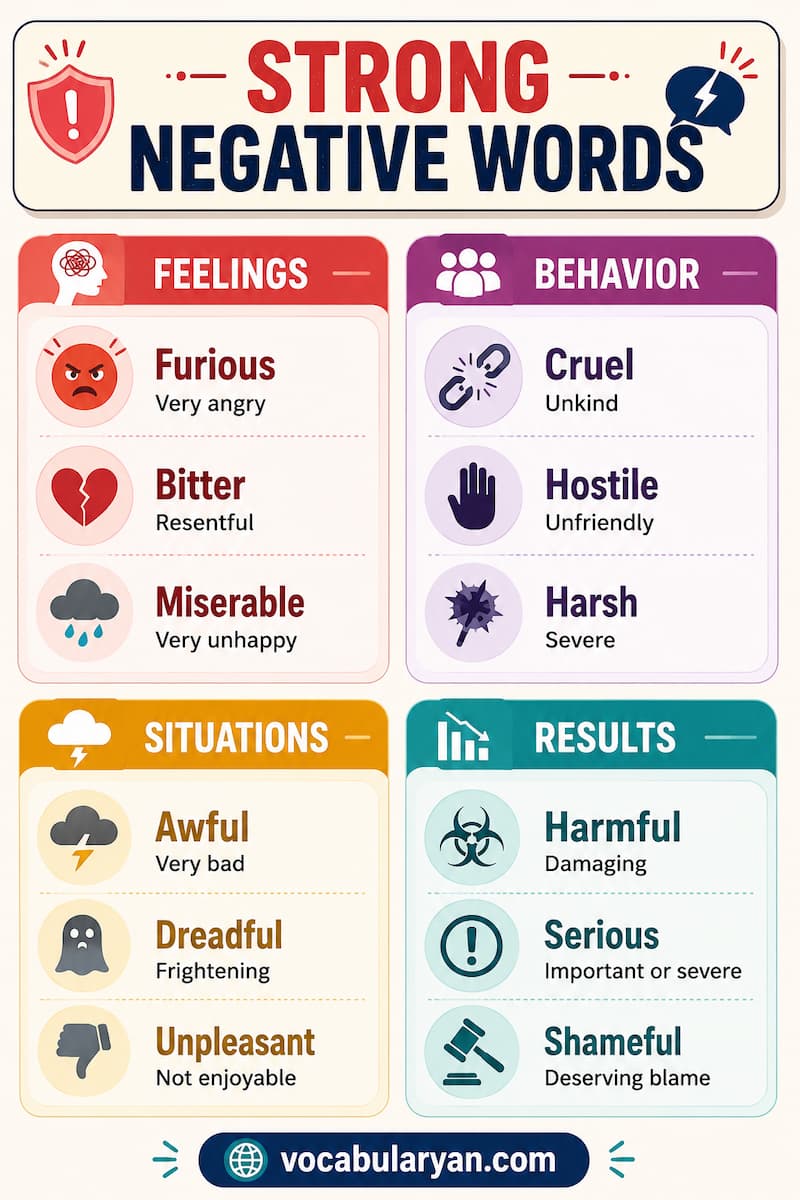
Not all negative words hit with the same force. Bad is negative; abhorrent is a verdict. Sad is negative; harrowing leaves a mark. The difference between a weak negative word and a strong one is the difference between naming something unpleasant and making the reader feel the full weight of it. Strong negative words in English are the premium end of the vocabulary spectrum: precise, vivid, and charged with enough force to do the work a plain word cannot. They appear in moral condemnation, in scenes of destruction, in the description of extreme suffering, and in the sharpest character attacks the language permits. The words ahead are grouped by the kind of force they deliver, with meanings and examples so the right one is quick to reach and deploy correctly.
💡 Quick answer
Strong negative words in English are words whose negativity carries particular force, precision, and emotional weight, such as abhorrent, loathsome, devastating, harrowing, and malevolent. They sit at the intense end of the negative vocabulary scale, reserved for moments that demand impact rather than mere description. Using them sparingly is what keeps them strong.
Strong Negative Words in English for emphatic word choice
Strong Words For Moral Condemnation
These words do not describe something as bad; they deliver a verdict on it.
Abhorrent: deeply and morally repugnant.
The treatment of prisoners was abhorrent by any standard.
Despicable: deserving of strong contempt.
His betrayal of the witness was despicable.
Reprehensible: deserving of strong censure and blame.
The decision to suppress the report was reprehensible.
Inexcusable: too wrong to admit any defense.
The delay in responding was inexcusable.
Unforgivable: so wrong that forgiveness is not possible.
What he did to the children was unforgivable.
Unconscionable: shockingly unethical and without scruple.
The pricing was unconscionable, targeting the most vulnerable.
Indefensible: impossible to justify or defend.
The decision was indefensible regardless of the pressure applied.
Contemptible: deserving only contempt.
A contemptible act of cowardice disguised as strategy.
Shameful: bringing deep shame.
A shameful record of neglect spanning two decades.
Outrageous: so wrong it provokes moral fury.
The verdict was outrageous to everyone who knew the facts.
Monstrous: shockingly evil and inhuman.
A monstrous injustice carried out in full public view.
Heinous: utterly wicked and atrocious.
The heinous nature of the crime shocked even the veterans.
Wicked: profoundly and actively immoral.
A wicked plan executed with patience and precision.
Iniquitous: grossly unjust and wicked.
An iniquitous system that punished those it claimed to protect.
Vile: morally repugnant and utterly contemptible.
His conduct was vile, even by the reduced standards of that room.
Nefarious: wicked and criminal in purpose.
A nefarious scheme that had been running for years.
Strong Words For Disgust And Revulsion
Disgust has its own intense vocabulary, where the body’s reaction and the moral one merge.
Loathsome: inspiring intense dislike and disgust.
The loathsome conditions in the facility were photographed and published.
Repulsive: causing a strong physical or moral recoil.
A repulsive combination of cruelty and self-satisfaction.
Revolting: causing nausea and strong aversion.
The smell was revolting from the moment the door opened.
Nauseating: making one sick with disgust.
The hypocrisy of the statement was nauseating.
Abominable: causing deep moral and physical revulsion.
The abominable conditions were hidden from inspectors.
Disgusting: causing powerful revulsion.
His behavior at the table was disgusting and deliberate.
Repugnant: deeply distasteful and offensive.
The suggestion was repugnant to everyone in the room.
Sickening: causing distress and moral sickness.
A sickening display of indifference to the suffering.
Foul: offensively unpleasant in the strongest degree.
A foul smell rose from the abandoned building.
Putrid: rotting and deeply offensive.
The putrid state of the relationship was impossible to hide.
Odious: extremely unpleasant and hateful.
An odious comparison that insulted everyone present.
Hideous: extremely ugly or morally offensive.
A hideous act dressed up in bureaucratic language.
Ghastly: causing horror and revulsion.
The ghastly aftermath took days to comprehend.
Gruesome: causing horror through graphic violence or detail.
A gruesome discovery that changed the direction of the trial.
Strong Words For Destruction And Ruin
When damage reaches its most extreme form, these words are the ones that carry it.
Devastating: causing overwhelming destruction or distress.
The devastating fire consumed everything in under an hour.
Catastrophic: causing sudden and extreme disaster.
A catastrophic failure in the early stages brought everything down.
Annihilating: destroying utterly and completely.
The annihilating verdict left no room for recovery.
Obliterating: wiping out entirely.
The storm had an obliterating effect on the coastline.
Ruinous: causing utter ruin.
A ruinous decision that cost the company its reputation.
Crippling: causing severe and lasting damage to function.
A crippling blow to the infrastructure arrived without warning.
Shattering: breaking something completely and irreversibly.
The revelation was shattering to everyone who had believed the story.
Irreversible: causing damage that cannot be undone.
The irreversible loss of trust defined everything that followed.
Apocalyptic: on a scale suggesting total destruction.
The apocalyptic flooding reshaped the entire region.
Lethal: causing death or total defeat.
A lethal combination of bad timing and worse judgment.
Decimating: destroying a large portion of something.
The outbreak had a decimating effect on the population.
Wrecking: causing complete wreckage of something.
A wrecking force moved through the organization.
Paralyzing: stopping all function through force or damage.
A paralyzing series of failures left no path forward.
Strong Words For Extreme Suffering
These words describe pain and distress at a level beyond ordinary words.
An insidious erosion of trust that took years to notice.
Perfidious: deceitful and untrustworthy in the deepest way.
A perfidious ally who had been passing information for months.
Strong Negative Verbs
A single strong verb delivers more force than a cluster of adjectives.
Obliterate: to destroy utterly, leaving nothing.
One decision obliterated a decade of goodwill.
Devastate: to cause overwhelming damage or grief.
The news devastated the family within minutes.
Betray: to break faith in a way that causes serious harm.
He betrayed the only person who had vouched for him.
Torment: to cause prolonged suffering.
Doubt tormented her through every sleepless hour.
Brutalize: to treat with savage cruelty.
Years of neglect had brutalized the whole system.
Humiliate: to strip of dignity in front of others.
He humiliated her deliberately and publicly.
Manipulate: to control by unfair hidden means.
She manipulated the outcome before the vote was taken.
Ravage: to cause severe, widespread damage.
The scandal ravaged every relationship he had built.
Shatter: to break irreversibly.
The revelation shattered the agreement in one afternoon.
Annihilate: to destroy entirely.
The review annihilated every claim in the report.
Desecrate: to violate or damage something sacred or respected.
The leak desecrated the privacy of everyone involved.
Condemn: to pass the harshest verdict on.
History will condemn the silence as much as the act.
Exploit: to use unfairly and harmfully for gain.
The system exploited the most trusting participants first.
Persecute: to harass relentlessly for who someone is.
The minority had been persecuted for three generations.
Strong Negative Adverbs
These adverbs intensify an action to its harshest register.
Viciously: with savage, deliberate cruelty.
Mercilessly: without a trace of pity or compassion.
Ruthlessly: with total disregard for others’ wellbeing.
Savagely: with wild and brutal violence.
Brutally: with harsh, unsparing force or honesty.
Callously: with cold indifference to suffering.
Maliciously: with deliberate intent to harm.
Treacherously: in a way that betrays trust.
Vindictively: with a determination to punish.
Devastatingly: with overwhelming destructive force.
Shamelessly: without any sense of shame or restraint.
Grotesquely: in a way that is repulsively distorted.
Despicably: in a way deserving strong contempt.
Relentlessly: without pause or mercy.
Insidiously: in a gradual, hidden, harmful way.
How To Use Strong Negative Words Without Overloading
The force of a strong word depends entirely on how rarely it appears. A page where every second sentence contains devastating, catastrophic, and abhorrent trains the reader to tune out all three. Strong negative words work on scarcity: when everything is monstrous, nothing is. Reserve the strongest words for the moments that genuinely reach that level, and let plain language carry the rest of the load. One well-placed harrowing or ruthless lands harder than five stacked adjectives fighting for the same space.
A second check is precision. Strong words often imply a specific kind of negativity: loathsome belongs to physical and moral disgust, harrowing belongs to emotional distress, nefarious belongs to criminal intent. Reaching for the strongest word rather than the most precise one produces writing that feels overwritten. The test is whether the strong word names something the plainer word cannot, since if bad or very bad would serve the same purpose, the strong word is carrying more weight than the moment deserves.
FAQs
Q1. What are strong negative words in English?
Strong negative words are words whose negativity carries particular force, precision, and emotional weight, sitting at the intense end of the vocabulary scale. Examples are abhorrent, loathsome, devastating, harrowing, malevolent, and ruthless. They go beyond naming something as bad; they deliver a verdict, provoke a reaction, or carry moral condemnation that a plain negative word cannot.
Q2. What are some of the strongest negative words in English?
For moral condemnation: abhorrent, heinous, reprehensible, and unconscionable. For disgust: loathsome, repulsive, and abominable. For destruction: catastrophic, annihilating, and devastating. For suffering: harrowing, excruciating, and agonizing. For character: malevolent, treacherous, and depraved. Each sits at the extreme end of its category.
Q3. What is the difference between a strong negative word and a regular negative word?
A regular negative word names something as unpleasant or bad: sad, bad, wrong, mean. A strong negative word delivers that judgment at maximum force and with specific moral or emotional weight: not just sad but harrowing, not just wrong but unconscionable, not just mean but malevolent. The strong word implies a scale and a verdict rather than a description.
Q4. How do I use strong negative words effectively in writing?
Use them sparingly and precisely. One strong word per passage is more effective than several competing for the same space, since scarcity is what keeps the word strong. Match the word to the specific kind of force the moment requires: harrowing for emotional distress, catastrophic for large-scale destruction, loathsome for visceral disgust. If the plain word would serve, use it; save the strong one for when the moment genuinely reaches that level.
Q5. What are strong negative verbs for writing?
Strong negative verbs that deliver maximum impact are obliterate, devastate, betray, torment, brutalize, humiliate, and persecute. Each names a harmful action with enough force that the verb alone carries the weight. They work hardest when placed without adverb support, so he betrayed hits harder than he cruelly betrayed, since the strong verb already contains the cruelty.
I’m Ethan Walker, cofounder of Vocabularyan.com. Over 12 years in ESL and English learning, I’ve worked closely with vocabulary practice, learner writing, phrase use, and the sentence habits that shape fluent expression. I write with a practical eye for the English learners meet every day, from study notes to conversations and online writing.