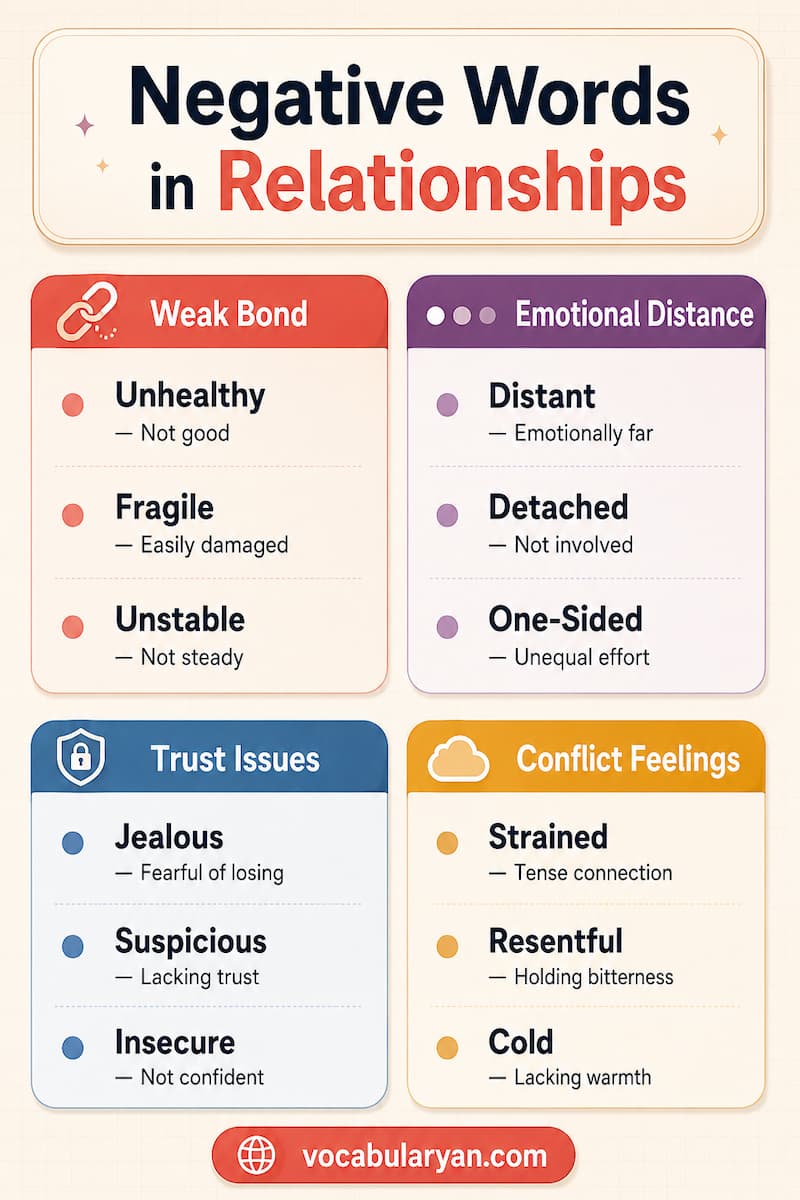
Having the right word for what is happening in a relationship is the first step toward understanding it clearly. Toxic, gaslighting, codependent, and stonewalling are not just buzzwords; they are precise names for patterns that can be hard to identify without vocabulary for them. Negative words in relationships fall into several categories: adjectives that describe a relationship’s overall character (abusive, volatile, manipulative), nouns and verbs that name specific harmful behaviors (betrayal, manipulation, gaslighting), and words that describe the emotional damage left behind (eroded, resentful, broken). The vocabulary ahead is grouped by what it describes, with meanings and examples throughout, so whatever is happening in a relationship has a name.
💡 Quick answer
Negative words in relationships name unhealthy dynamics, harmful behaviors, and the emotional damage they cause. They include words for relationship types (toxic, abusive, codependent), harmful patterns (gaslighting, stonewalling, manipulation), modern terms for specific behaviors (love bombing, ghosting, breadcrumbing), and the damage left behind (eroded, resentful, broken). Naming a pattern accurately is what makes it possible to address.
Negative Words in Relationships and emotional conflict
Words To Describe A Toxic Or Unhealthy Relationship
These words describe the overall character of a relationship, the atmosphere that surrounds it.
Toxic(adj.): harmful to one or both people involved.
The dynamic had become too toxic to sustain.
Abusive(adj.): involving a pattern of harm, whether emotional, verbal, or physical.
The relationship was abusive long before it became visible to others.
Dysfunctional(adj.): operating in ways that repeatedly cause harm.
A dysfunctional pattern had persisted for years.
Volatile(adj.): unpredictable and prone to sudden, intense conflict.
The atmosphere was volatile, every small thing a potential flashpoint.
Codependent(adj.): involving an unhealthy reliance on one another, often at the expense of each person’s wellbeing.
The codependent dynamic made it hard for either to function alone.
One-sided(adj.): effort, care, or investment flowing predominantly from one person.
The relationship was increasingly one-sided, and she knew it.
Controlling(adj.): involving one person limiting the other’s freedom and autonomy.
His behavior had become overtly controlling over several months.
Manipulative(adj.): involving the use of unfair influence to direct the other person.
A manipulative dynamic made her doubt her own perceptions.
Possessive(adj.): treating a partner as something to be owned rather than respected.
His possessive behavior isolated her from most of her friends.
Destructive(adj.): causing active damage to one or both people.
The cycle had become fully destructive to both of them.
Unhealthy(adj.): consistently failing to support either person’s wellbeing.
They both knew the relationship was unhealthy but stayed anyway.
Strained(adj.): under sustained stress that has weakened the connection.
The bond was strained by months of unresolved tension.
Hostile(adj.): marked by open antagonism and unfriendliness.
Conversations had turned openly hostile by the second year.
Fraught(adj.): full of anxiety, tension, and unresolved difficulty.
Every meeting was fraught with things neither would say.
Suffocating(adj.): leaving no room for personal space or independence.
The relationship had become suffocating, every move monitored.
Parasitic(adj.): one person draining the other’s energy, resources, or confidence.
A parasitic dynamic had left her exhausted and depleted.
Words For Harmful Communication Patterns
How people speak to each other in a relationship reveals its health more clearly than almost anything else.
Contemptuous(adj.): treating a partner as beneath serious regard.
His contemptuous tone during arguments was the most damaging thing.
Dismissive(adj.): brushing aside a partner’s feelings as unimportant.
A dismissive response met every concern she raised.
Condescending(adj.): talking down to a partner as though they are lesser.
His condescending explanations made her feel small.
Belittling(adj.): making a partner feel inferior through words.
The belittling comments arrived dressed as jokes.
Critical(adj.): finding fault with a partner persistently and without balance.
The relationship was relentlessly critical, never affirming.
Passive-aggressive(adj.): expressing hostility indirectly rather than openly.
The passive-aggressive silences were harder to handle than any argument.
Stonewalling(n./v.): withdrawing completely from communication as a response to conflict.
His habit of stonewalling left every issue permanently unresolved.
Gaslighting(n./v.): making a partner doubt their own memory or perception of events.
Years of gaslighting had made her distrust her own instincts.
Blame-shifting(n.): redirecting responsibility for one’s actions onto the partner.
Blame-shifting meant she spent years apologizing for things she had not done.
Name-calling(n.): using labels to attack a partner’s identity or worth.
Name-calling during arguments left marks that outlasted the fight.
Guilt-tripping(n.): using guilt to manipulate a partner’s choices.
Every disagreement ended with a guilt-trip she could not reason her way out of.
Criticism without repair(n.): attacking a partner without seeking resolution.
Persistent criticism without repair was the pattern that broke the trust first.
Silent treatment(n.): withdrawing communication as punishment.
The silent treatment lasted days after the mildest disagreement.
Weaponized vulnerability(n.): using shared private information against a partner.
Weaponized vulnerability turned every disclosed fear into a later threat.
Defensiveness(n.): meeting every concern with self-protection rather than engagement.
The defensiveness made it impossible to raise anything difficult.
Words For Controlling And Manipulative Behavior
Control in a relationship rarely announces itself; these words name what it looks like in practice.
Manipulation(n.): influencing a partner through unfair or deceptive means.
Manipulation operated through compliments as much as through threats.
Coercion(n.): using pressure or force to compel behavior.
Financial coercion kept her from being able to leave.
Intimidation(n.): using fear to control a partner’s behavior.
Intimidation did not require raised voices; the look was enough.
Isolation(n.): cutting a partner off from friends, family, and support.
The isolation had happened so gradually she had not noticed it happening.
Surveillance(n.): monitoring a partner’s movements, messages, or contacts.
Constant surveillance made her feel watched in her own home.
Jealousy(n.): resentment of a partner’s relationships or activities.
His jealousy extended to her friendships, her work, and her family.
Possessiveness(n.): treating a partner as property rather than as a person.
Possessiveness disguised itself as love for the first year.
Threats(n.): using promised harm to control a partner’s choices.
The threats escalated whenever she talked about leaving.
Financial control(n.): using money to limit a partner’s freedom.
Financial control left her without access to her own earnings.
Emotional blackmail(n.): using fear, obligation, or guilt to manipulate.
Emotional blackmail arrived as “if you loved me, you would.”
Monitoring(n.): tracking a partner’s activities without consent.
His monitoring of her phone was presented as concern.
Undermining(v.): weakening a partner’s confidence and self-belief.
He undermined her professionally while praising her privately.
Modern Relationship Terms For Harmful Behavior
A newer vocabulary has emerged to name behaviors that had no precise terms before.
Floodlighting(n.): sharing intense personal vulnerability too early to gain rapid emotional closeness.
Floodlighting created a false sense of intimacy that was used as leverage later.
Love bombing(n.): overwhelming a partner with attention early on to gain control.
The love bombing felt like romance until the intensity became a demand.
Ghosting(n.): ending a relationship by disappearing without explanation.
The ghosting came after three years without a single warning sign.
Breadcrumbing(n.): giving just enough attention to keep a partner engaged without real commitment.
Breadcrumbing kept her waiting for a relationship that was never coming.
Coercive control(n.): a sustained pattern of behavior used to dominate, isolate, and control a partner.
Coercive control is now recognized as a criminal offense in several countries.
Orbiting(n.): staying connected via social media after ending contact directly.
Orbiting made it impossible to move on after the breakup.
Hoovering(n.): drawing a partner back into a relationship after a breakup.
The hoovering always began with a message that seemed like genuine remorse.
Trauma bonding(n.): emotional attachment formed through cycles of harm and reconciliation.
Trauma bonding explained why leaving felt so impossible from the inside.
Future faking(n.): making promises about a shared future with no intention of following through.
Future faking kept her in the relationship for two years on promises alone.
Negging(n.): using backhanded compliments to undermine confidence.
Negging was delivered with a smile that made it hard to name at the time.
Triangulation(n.): bringing a third party into a dynamic to provoke jealousy or insecurity.
Triangulation introduced a third person every time she felt settled.
Moving the goalposts(n.): constantly changing expectations so a partner can never succeed.
Moving the goalposts meant every standard was met only to be replaced.
DARVO(n.): Deny, Attack, Reverse Victim and Offender; a manipulation pattern.
The DARVO response left her feeling guilty for raising the issue.
Words For The Emotional Damage Relationships Cause
The harm a relationship does to a person has its own vocabulary.
Eroded(adj.): worn down gradually over time.
Her confidence had been eroded so slowly she had not noticed it happening.
Diminished(adj.): made to feel smaller and of less worth.
She left the relationship feeling diminished in every way.
Broken(adj.): shattered in a way that takes time and care to repair.
He seemed broken for months after it ended.
Traumatized(adj.): deeply wounded by what was experienced.
She was traumatized in ways that affected every relationship afterward.
Depleted(adj.): emptied of energy and emotional reserves.
He was depleted, with nothing left for anyone else.
Hypervigilant(adj.): constantly alert to threat as a result of past harm.
She became hypervigilant, reading danger into neutral moments.
Anxious(adj.): persistently worried as a result of the relationship dynamic.
The constant unpredictability left her anxious even on calm days.
Isolated(adj.): cut off from support through the relationship’s influence.
By the end she was completely isolated from everyone she had known.
Mistrustful(adj.): unable to trust as a result of past betrayal.
He remained mistrustful for years after the relationship ended.
Resentful(adj.): bitter over accumulated wrongs never addressed.
Years of unresolved grievances left her resentful and closed.
Guilt-ridden(adj.): carrying guilt that was placed there rather than earned.
She was guilt-ridden over things she had not caused.
Betrayal(n.): the breaking of trust in a way that causes lasting damage.
The betrayal reshaped how she understood the relationship entirely.
Resentment(n.): long-held bitterness that has hardened into a fixed state.
Resentment had replaced affection so gradually neither had noticed.
Grief(n.): the genuine loss felt when a relationship ends or is recognized as harmful.
The grief of leaving was real even though leaving was right.
Confusion(n.): disorientation caused by mixed signals and manipulation.
The confusion was part of the design, not an accident.
Words For A Relationship That Has Broken Down
Estranged(adj.): distant or separated from someone once close.
Distant(adj.): emotionally far apart despite physical proximity.
Cold(adj.): without warmth or feeling between two people.
Fractured(adj.): cracked and damaged but not yet fully broken.
Irreparable(adj.): too damaged to be fixed.
Severed(adj.): cut off completely.
Collapsed(adj.): fallen apart under its own weight.
Ended(adj.): finished, without possibility of return.
Bitter(adj.): soured by the way things ended.
Acrimonious(adj.): marked by bitterness and ill feeling at the end.
Contentious(adj.): full of persistent disagreement and conflict.
Irreconcilable(adj.): impossible to bring into agreement.
Abandoned(adj.): left without warning or care.
Unresolved(adj.): carrying unaddressed issues that define the ending.
Broken down(adj.): failed after gradual deterioration.
A Note On Using This Vocabulary
Having a word for something is not the same as having a verdict on it. Vocabulary for unhealthy relationship dynamics is most useful for naming what is happening clearly, since clarity is what makes change or recovery possible. Some patterns named here sit in difficult emotional territory. Recognizing them in one’s own situation, whether as someone experiencing harm or as someone who has caused it, can be disorienting. If any of these words describe a situation you are in or have been in, speaking to a trusted person or a professional can help. The National Domestic Violence Hotline (1-800-799-7233) is available around the clock for anyone experiencing abuse or controlling behavior in a relationship.
FAQs
Q1. What are negative words in relationships?
Negative words in relationships name unhealthy dynamics, harmful behaviors, and the emotional effects they produce. They cover relationship types (toxic, abusive, codependent), harmful communication (gaslighting, stonewalling, contemptuous), controlling behaviors (isolation, coercion, manipulation), and emotional damage (eroded, resentful, traumatized). Naming these patterns accurately is the first step toward addressing them.
Q2. What words describe a toxic relationship?
Strong descriptors for a toxic relationship are toxic, abusive, dysfunctional, volatile, controlling, manipulative, codependent, possessive, and suffocating. Each names a different quality of harm: toxic describes the overall atmosphere, volatile describes the instability, controlling describes the power dynamic, and codependent describes the unhealthy mutual reliance.
Q3. What is gaslighting in a relationship?
Gaslighting is a form of psychological manipulation in which one person causes another to doubt their own memory, perception, or judgment. The term originates from the 1944 film Gaslight, in which a husband manipulates his wife into believing she is losing her mind. In a relationship context, it involves consistently denying or distorting reality until the other person distrusts their own experience.
Q4. What is the difference between a difficult relationship and an abusive one?
Difficult relationships involve conflict, misunderstanding, and stress that affect both people but do not involve a consistent pattern of harm directed at one person by the other. Abusive relationships involve repeated patterns of control, intimidation, or harm used by one person to maintain power over the other. The distinction lies in the pattern and in the presence of fear, control, or deliberate harm.
Q5. What words describe the emotional damage from a bad relationship?
Common ones are eroded, diminished, broken, traumatized, depleted, hypervigilant, isolated, mistrustful, and resentful. Each names a different kind of residual harm: eroded describes the gradual wearing away of confidence, hypervigilant describes the lasting alertness to threat, and trauma bonding names the attachment that forms through cycles of harm and repair.
I’m Ethan Walker, cofounder of Vocabularyan.com. Over 12 years in ESL and English learning, I’ve worked closely with vocabulary practice, learner writing, phrase use, and the sentence habits that shape fluent expression. I write with a practical eye for the English learners meet every day, from study notes to conversations and online writing.