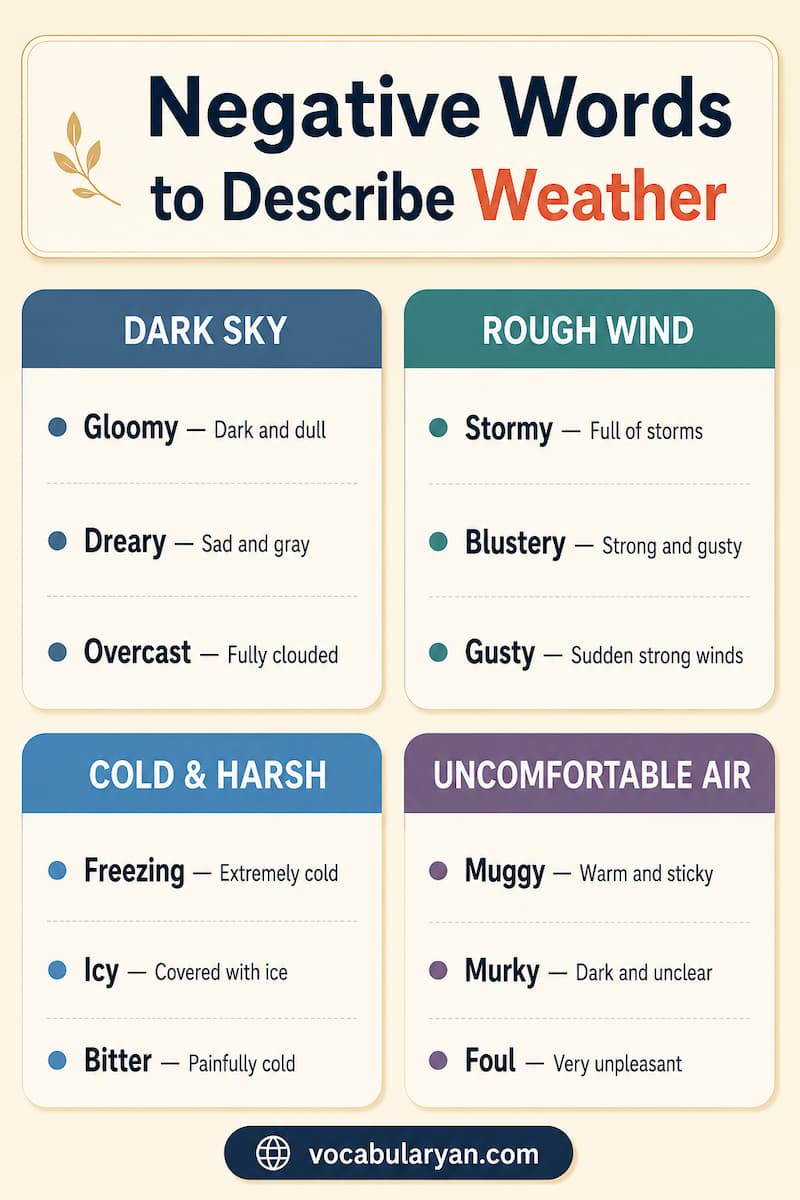
Weather has its own vocabulary at every extreme, and the right word makes the difference between a sentence that describes and one that immerses. Bitter is not the same as freezing, and torrential is not the same as rainy. Negative words to describe weather name unpleasant, threatening, and oppressive conditions across the full range of meteorological misery, from a drizzling gray morning to a catastrophic storm. They matter for conversation and travel, for weather reports and school writing, and for fiction, where weather is one of the oldest tools for setting atmosphere and mood. The words ahead are grouped by weather type, with meanings and natural examples throughout.
💡 Quick answer
Negative words to describe weather are adjectives, nouns, and verbs for unpleasant or threatening conditions, such as bitter, sweltering, torrential, howling, and ominous. They range from mild discomfort (overcast, drizzly, muggy) to severe danger (tempestuous, catastrophic, bone-chilling). Grouping them by weather type makes the right word quick to find for conversation, writing, or description.
Negative Words to Describe Weather and conditions
Words For Cold And Freezing Weather
Cold weather has a precise vocabulary that runs from merely unpleasant all the way to dangerous.
Bitter(adj.): intensely cold, cutting through clothing.
A bitter wind came off the sea and made the walk unbearable.
Freezing(adj.): at or below zero degrees, dangerously cold.
It was freezing by the time we left the stadium.
Frigid(adj.): extremely cold, with no warmth at all.
A frigid morning greeted them when the tent was opened.
Bone-chilling(adj.): cold that penetrates to the bone.
A bone-chilling frost had settled on the fields overnight.
Biting(adj.): sharply cold in a way that stings the skin.
The biting air made breathing uncomfortable.
Raw(adj.): cold, damp, and penetrating.
A raw November day with no shelter from the wind.
Harsh(adj.): unpleasantly cold and severe.
A harsh winter that lasted well into March.
Icy(adj.): very cold; also covered with ice.
An icy blast came through the gap in the door.
Bleak(adj.): cold, bare, and without comfort.
A bleak January morning with no sign of the sun.
Wintry(adj.): cold and unwelcoming in the manner of winter.
A wintry spell arrived earlier than forecast.
Frosty(adj.): below freezing, with frost on all surfaces.
A frosty start to a day that never fully warmed up.
Arctic(adj.): extremely cold, like polar conditions.
The forecast promised Arctic temperatures by the weekend.
Chilly(adj.): uncomfortably cold without being severe.
A chilly breeze made the outdoor lunch a mistake.
Numbing(adj.): so cold it removes sensation.
The numbing cold meant fingers could not grip the rope.
Piercing(adj.): cutting sharply through warmth.
A piercing wind turned the walk into an ordeal.
Words For Oppressive Heat
Heat has its own scale of misery, from uncomfortable warmth to conditions that endanger health.
Sweltering(adj.): extremely and uncomfortably hot.
A sweltering afternoon that left everyone slow and irritable.
Scorching(adj.): intensely hot, hot enough to burn.
The scorching sun made the beach unbearable by midday.
Stifling(adj.): so hot and airless that breathing is difficult.
A stifling heat hung over the city all through August.
Oppressive(adj.): hot and heavy in a way that weighs on the body.
The oppressive humidity drained energy from everyone outside.
Baking(adj.): very hot, like the inside of an oven.
A baking afternoon that sent everyone indoors.
Broiling(adj.): intensely hot, with direct scorching sun.
The workers stopped at noon to avoid the broiling heat.
Searing(adj.): burning hot, painful in intensity.
A searing heat radiated from the concrete all afternoon.
Muggy(adj.): hot, humid, and uncomfortably airless.
A muggy evening when no breeze came and sleep was difficult.
Humid(adj.): heavy with moisture, making heat feel worse.
The humid air made the temperature feel ten degrees higher.
Sultry(adj.): uncomfortably hot and close, often before a storm.
A sultry afternoon that broke into a thunderstorm at dusk.
Relentless(adj.): giving no relief from the heat.
A relentless sun beat down without a cloud in sight.
Blazing(adj.): burning intensely and brightly.
The blazing heat had cracked the path by early July.
Words For Rain And Wet Weather
Rain is one of the richest areas of negative weather vocabulary, running from a fine mist to a catastrophic downpour.
Torrential(adj.): falling in overwhelming, fast-moving sheets.
A torrential rain flooded the road within the hour.
Incessant(adj.): falling without any pause or break.
Incessant drizzle made the third day of camping a misery.
Drenching(adj.): soaking everything it touches completely.
A drenching shower caught everyone without an umbrella.
Pelting(adj.): hitting hard and fast.
The pelting rain stung exposed skin.
Lashing(adj.): beating against surfaces with force.
The lashing rain made driving dangerous.
Persistent(adj.): continuing without stopping, draining morale.
Persistent rain kept the match suspended for two hours.
Drizzly(adj.): raining finely but consistently, gray and damp.
A drizzly morning that never quite decided to stop.
Miserable(adj.): wet and cold in a way that affects mood.
A miserable day that kept everyone indoors.
Waterlogged(adj.): saturated with water beyond capacity.
The waterlogged pitch was declared unplayable.
Sodden(adj.): thoroughly soaked and heavy with water.
Sodden fields stretched in every direction after the flood.
Dreary(adj.): dull, gray, and wet in a way that feels oppressive.
Week after week of dreary rain in what was supposed to be summer.
Slate-gray(adj.): the uniform dark gray of a sky with no break in the cloud.
A slate-gray sky that pressed down all morning without lifting.
Gloomy(adj.): dark and wet with no brightness anywhere.
A gloomy sky that had not shifted all day.
Words For Wind
Howling(adj.): blowing loudly and violently.
A howling gale kept everyone awake through the night.
Blustery(adj.): gusty and rough, difficult to walk in.
A blustery afternoon that scattered the market stalls.
Gale-force(adj.): strong enough to cause damage.
Gale-force winds closed the bridge for twelve hours.
Gusty(adj.): blowing in sudden, irregular bursts.
A gusty wind made the umbrella impossible to hold.
Ferocious(adj.): violent and uncontrolled in force.
A ferocious wind ripped the roof from the outbuilding.
Fierce(adj.): powerful and punishing.
Shrieking(adj.): making a high, unpleasant sound at high speed.
Wailing(adj.): producing a long, mournful sound as it moves.
Whipping(adj.): moving fast enough to sting exposed skin.
Swirling(adj.): moving in circular, unpredictable currents.
Unrelenting(adj.): refusing to ease or drop in force.
Cutting(adj.): cold and sharp enough to slice through warmth.
Squally(adj.): coming in sudden violent gusts with rain.
Bracing(negative sense): cold and sharp beyond any refreshment.
Withering(adj.): so strong and dry it dries out anything in its path.
Words For Fog, Cloud, And Gloom
Foggy(adj.): thick with fog that reduces visibility.
A foggy morning that delayed all flights out of the airport.
Misty(adj.): light fog that blurs the edges of everything.
A misty valley that never quite cleared before dark.
Murky(adj.): dim and difficult to see through.
A murky evening on the river with no light to navigate by.
Overcast(adj.): completely covered with cloud, no sun visible.
Another overcast day with no change in the forecast.
Hazy(adj.): slightly obscured by mist, smoke, or heat.
A hazy sky that turned the sun into a pale disk.
Leaden(adj.): heavy and gray like lead, without light.
A leaden sky that pressed down on the whole landscape.
Dull(adj.): without brightness or variation, uniformly gray.
A dull afternoon that offered nothing to look at.
Sunless(adj.): without any direct sunlight.
Another sunless week in a summer that had barely begun.
Dim(adj.): with very little light.
A dim morning that never brightened past twilight levels.
Suffocating(adj.): so thick and close it feels impossible to breathe through.
A suffocating cloud cover that refused to lift.
Shrouded(adj.): wrapped or hidden in mist or cloud.
The hills were shrouded in fog and invisible by midmorning.
Cheerless(adj.): without warmth or brightness of any kind.
A cheerless gray sky that matched the mood of the day.
Grim(adj.): dark and forbidding in character.
A grim sky that signaled worse weather to come.
Words For Storms And Extreme Weather
At the extremes, weather vocabulary becomes a matter of danger as much as description.
Tempestuous(adj.): violently stormy and uncontrolled.
A tempestuous night that left trees across every road.
Treacherous(adj.): dangerous in a way that is not always visible.
Treacherous ice on the roads caused dozens of accidents.
Savage(adj.): wild and brutal in the destruction it causes.
A catastrophic flood submerged an entire district.
Devastating(adj.): causing overwhelming damage or loss.
A devastating hurricane reshaped the coastline permanently.
Raging(adj.): violent and out of control.
A raging storm tore the harbor apart overnight.
Violent(adj.): extreme in force and destructive potential.
A violent squall overturned several boats in the bay.
Severe(adj.): extreme enough to cause danger or damage.
Severe weather warnings were issued for the whole region.
Turbulent(adj.): disturbed and unpredictable.
A turbulent sky turned a pleasant afternoon dangerous.
Menacing(adj.): threatening harm before it arrives.
Menacing clouds built on the horizon all afternoon.
Ominous(adj.): hinting that something threatening is coming.
An ominous stillness preceded the storm by thirty minutes.
Cataclysmic(adj.): on a scale that causes widespread and lasting damage.
Cataclysmic flooding cut off the village for three days.
Blinding(adj.): so intense it removes visibility.
A blinding blizzard reduced sight to a few feet.
Punishing(adj.): severe enough to cause real hardship.
A punishing hailstorm stripped crops from the fields.
Weather Nouns For Bad Conditions
These nouns name the conditions themselves rather than describing them.
Blizzard(n.): a severe snowstorm with strong winds and low visibility.
The blizzard shut every road in the county.
Downpour(n.): a sudden, heavy fall of rain.
A downpour caught everyone at the outdoor event.
Deluge(n.): an overwhelming flood of rain.
A deluge turned the street into a river.
Gale(n.): a very strong wind, often damaging.
A gale had flattened the fence overnight.
Squall(n.): a sudden, brief violent wind often with rain.
A squall overturned the chairs left on the terrace.
Tempest(n.): a violent storm, especially at sea.
The tempest lasted through the night and into the morning.
Heatwave(n.): a prolonged period of abnormally hot weather.
The heatwave broke records set forty years earlier.
Drought(n.): a long period without rainfall causing water shortage.
A three-month drought destroyed most of the harvest.
Frost(n.): ice crystals formed on surfaces in freezing temperatures.
A hard frost had killed the early seedlings overnight.
Fog(n.): thick mist reducing visibility to a dangerous level.
Dense fog closed the airport for six hours.
Hail(n.): pellets of frozen rain falling during a storm.
Hail the size of marbles dented car roofs across the city.
Sleet(n.): rain mixed with snow or ice.
Cold sleet drove horizontally across the car park.
Thunderstorm(n.): a storm with thunder, lightning, and heavy rain.
A thunderstorm cleared the streets within minutes.
Whiteout(n.): a blizzard or snowstorm that removes all visibility.
The whiteout made navigation impossible.
Weather Verbs: What Bad Weather Does
Verbs put weather into motion and show what it does to the world around it.
Lash: to beat against surfaces with driving force.
Rain lashed the windows for the whole night.
Howl: to blow with a loud, wailing sound.
The wind howled through every gap in the old building.
Pound: to strike repeatedly with heavy force.
Hail pounded the roof until it sounded like applause.
Drench: to soak something completely.
A sudden shower drenched everyone before shelter was reached.
Batter: to hit repeatedly and with force.
Waves battered the harbor wall all night.
Freeze: to reach or drop to freezing temperature.
The pipes froze overnight and burst by morning.
Blanket: to cover everything completely.
Snow blanketed the city before anyone had woken.
Engulf: to surround and swallow entirely.
Fog engulfed the valley by midafternoon.
Rage: to continue with violent, uncontrolled force.
The storm raged for eighteen hours without letting up.
Descend: to fall or move downward over an area.
A cold front descended overnight and changed everything.
Blight: to damage or ruin with cold, drought, or poor conditions.
Three weeks of frost blighted the entire crop.
Sweep: to move powerfully across a wide area.
A gale swept through the region and brought down power lines.
Using Weather Words To Create Atmosphere
Weather is one of the oldest tools in fiction for creating atmosphere without announcing it. A bitter morning tells the reader something bad is coming before a character speaks. A sweltering, airless afternoon creates tension before any conflict arrives. Three principles guide it well. First, match the weather to the emotional temperature of the scene: ominous clouds and an unusual stillness before a confrontation, relentless gray drizzle during a period of stagnation. Second, use the precise word rather than the general one, since lashing rain is more vivid than heavy rain, and a leaden sky is more oppressive than a cloudy one. Third, let verbs carry the weather’s action: the storm raged, the frost blighted, the fog engulfed all put weather into motion and give it the presence of a character.
FAQs
Q1. What are negative words to describe weather?
Negative words to describe weather are adjectives, nouns, and verbs for unpleasant, threatening, or uncomfortable conditions, such as bitter, sweltering, torrential, howling, and ominous. They range from mild discomfort (drizzly, overcast, muggy) through moderate difficulty (blustery, frosty, relentless) to severe danger (catastrophic, treacherous, tempestuous).
Q2. What are some adjectives for bad weather?
Strong choices by weather type are bitter and bone-chilling for cold, sweltering and stifling for heat, torrential and drenching for rain, howling and gale-force for wind, and tempestuous and ferocious for storms. Each belongs to a specific kind of bad weather rather than to badness in general.
Q3. What is the difference between misty and foggy weather?
Mist is lighter and less dense, blurring the edges of things rather than hiding them. Fog is thick enough to seriously reduce visibility and can be dangerous, particularly for driving or navigating. Meteorologically, fog is defined as reducing visibility to under one kilometer; mist reduces it to between one and two kilometers.
Q4. What words describe stormy weather for writing?
Strong choices for fiction and descriptive writing are tempestuous, ferocious, raging, ominous, menacing, and treacherous. Verbs are equally powerful: lashed, battered, howled, engulfed, raged, and swept all put the storm into active motion. Pairing a precise adjective with a strong verb, a ferocious storm that swept the coast, gives weather the presence of an event rather than just a condition.
Q5. What are some weather nouns for bad conditions?
Core nouns for bad weather are blizzard, downpour, deluge, gale, squall, tempest, heatwave, drought, fog, hail, sleet, and thunderstorm. Each names a specific weather event with its own character: a downpour is sudden and heavy, a deluge is overwhelming, a squall is brief and violent, and a tempest implies sustained and serious storm conditions.
I’m Ethan Walker, cofounder of Vocabularyan.com. Over 12 years in ESL and English learning, I’ve worked closely with vocabulary practice, learner writing, phrase use, and the sentence habits that shape fluent expression. I write with a practical eye for the English learners meet every day, from study notes to conversations and online writing.