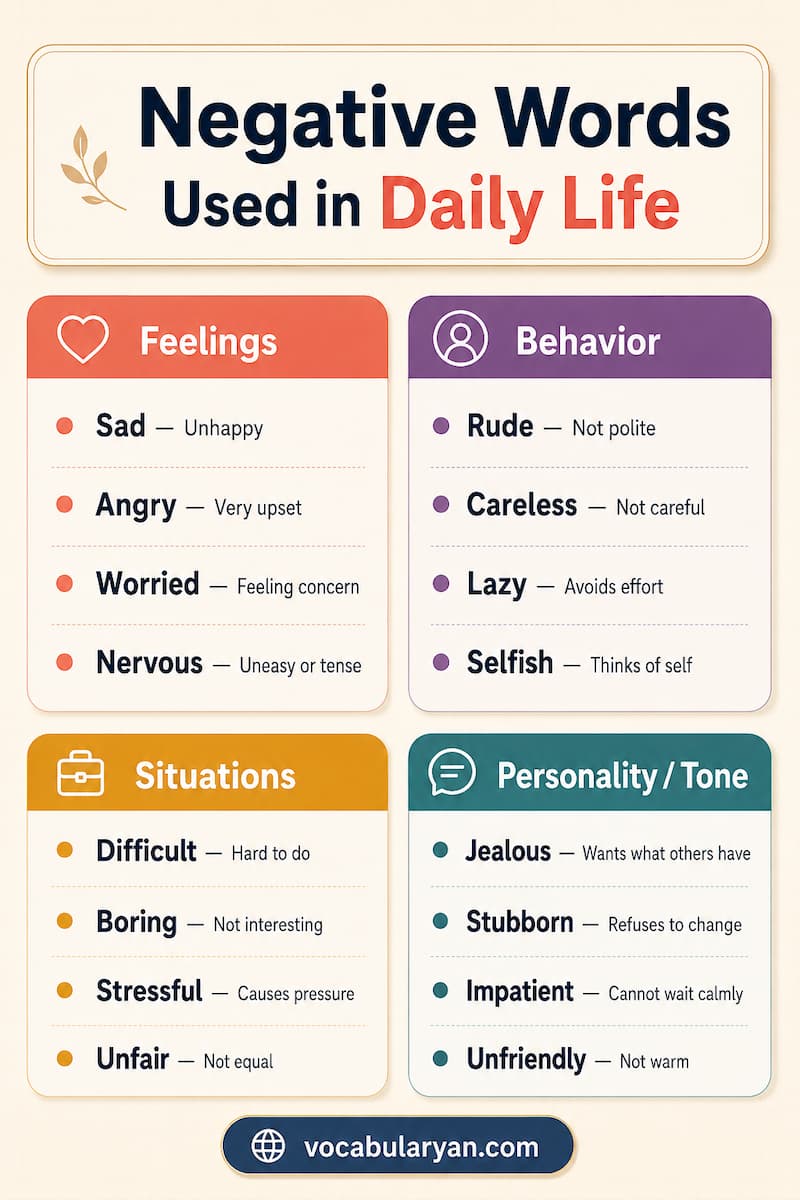
Not every negative word belongs to literature or extreme emotion. Most of the negative vocabulary people use every day is practical and immediate: the word for a plan that fell apart, a person who let you down, a day that went sideways from the start. These everyday negative words are the ones that appear in text messages, at the dinner table, in the office, and in quiet complaints to yourself on the commute home. They cover frustration, disappointment, stress, annoyance, and the ordinary friction of dealing with difficult people and imperfect situations. The words ahead are grouped by the kind of daily situation they appear in, with meanings and natural sentence examples throughout.
💡 Quick answer
Negative words used in daily life are common words for everyday frustration, disappointment, annoyance, and difficulty, such as awful, ruined, unreliable, stressed, and fed up. Unlike extreme or literary negative vocabulary, these are the words people reach for in real conversation when things go wrong, people disappoint, or a day turns difficult. Grouping them by situation makes the right one easy to find and use.
Negative Words Used in Daily Life in conversation
When Things Go Wrong
These are the words that arrive the moment a plan, an object, or a situation fails.
Ruined: completely spoiled and beyond saving.
The rain had ruined the entire afternoon.
Broken: not working or no longer intact.
The printer is broken again, of course.
Failed: did not succeed as hoped or intended.
The plan failed before it even started.
Wasted: used up with nothing to show for it.
Two hours completely wasted in traffic.
Disastrous: going badly wrong on a significant scale.
The presentation was disastrous from the first slide.
Chaotic: completely without order or control.
The morning was chaotic and we missed the train.
Delayed: held back past the expected time.
Everything is delayed and nobody knows why.
Cancelled: called off entirely.
The flight was cancelled with no rebooking offered.
Lost: no longer findable or gone entirely.
My keys are lost and I have no spare.
Missed: failed to catch, reach, or take advantage of.
He missed the deadline by two days.
Damaged: harmed so that it no longer works properly.
The package arrived damaged on both sides.
Overdue: past the time it was expected or required.
The report is overdue and the client is asking.
Behind: not keeping up with what was planned.
We are behind on everything this week.
Stuck: unable to move forward or resolve.
The whole project is stuck waiting for approval.
Overwhelmed: swamped by too much arriving at once.
She was completely overwhelmed by the end of Monday.
Describing Difficult Or Disappointing People
The everyday vocabulary for people who frustrate, let down, or irritate.
Unreliable: not to be counted on to do what they said.
He is so unreliable; this is the third time this month.
Rude: disrespectful and ill-mannered in behavior.
The receptionist was rude from the moment we arrived.
Annoying: causing persistent irritation.
The neighbor’s dog is annoying at every hour of the day.
Selfish: thinking only of their own needs.
He is so selfish he did not even ask how you were.
Inconsiderate: thoughtless of others’ needs or feelings.
She was inconsiderate, booking the car without asking.
Lazy: unwilling to make any effort.
The team is too lazy to read the brief before meetings.
Difficult: hard to deal with or please.
He is being difficult about every small decision.
Unhelpful: failing to assist when help was needed.
The customer service was completely unhelpful.
Irresponsible: failing to meet obligations or show care.
It was irresponsible to leave without letting anyone know.
Dishonest: not truthful or trustworthy.
He was dishonest about where he had been.
Disrespectful: showing no regard for others.
That comment was disrespectful and everyone noticed.
Stubborn: refusing to change position regardless of reason.
She is too stubborn to admit the first plan was wrong.
Arrogant: acting as though they are better than everyone.
He is arrogant enough to ignore advice from anyone.
Nosy: prying into things that are not their business.
She is nosy about every detail of other people’s lives.
Ungrateful: not acknowledging or appreciating help received.
He took the help and was completely ungrateful afterward.
Expressing Dissatisfaction And Complaint
The daily vocabulary of disappointment with things, services, and situations.
Awful: very bad in quality or character.
The food was awful, and the service matched it.
Terrible: extremely bad or unpleasant.
The weather has been terrible all week.
Dreadful: very bad and causing distress.
The traffic was dreadful this morning.
Poor: of a low and unsatisfactory standard.
The quality of the work was poor throughout.
Disappointing: failing to meet expectation.
The result was disappointing after all that effort.
Unsatisfactory: not good enough.
The response from the team was unsatisfactory.
Inadequate: not sufficient or good enough.
The facilities were completely inadequate for the event.
Inferior: of lower quality than expected or needed.
This batch is clearly inferior to the last one.
Substandard: below the required level of quality.
The materials used were substandard from the start.
Overpriced: costing more than it is worth.
The lunch was overpriced for what it was.
Pointless: without purpose or useful result.
That meeting was completely pointless.
Tedious: long, dull, and tiresomely repetitive.
The process is tedious but there is no shortcut.
Frustrating: causing persistent irritation and helplessness.
It is frustrating to explain the same thing three times.
Irritating: making you feel increasingly annoyed.
The constant interruptions were irritating all afternoon.
Unacceptable: too bad to be tolerated.
The delay was unacceptable and we said so.
Negative Words For Everyday Feelings
The emotional vocabulary people use in daily conversation, not for extreme suffering but for the ordinary friction of a hard day.
Stressed: under sustained pressure.
Tired: in need of rest and lacking energy.
Drained: emptied of energy by demands.
Fed up: thoroughly tired of something and out of patience.
Irritated: mildly but persistently annoyed.
Frustrated: blocked and unable to make progress.
Worried: troubled by anxious thoughts.
Anxious: uneasy about what may happen.
Burnt-out: depleted by prolonged pressure and demands.
Restless: unable to settle or relax.
Tense: physically and mentally strained.
Grumpy: irritable and inclined to complain.
Deflated: let down and emptied of enthusiasm.
Uneasy: faintly troubled without a clear cause.
Distracted: unable to focus on what matters.
Impatient: unable to wait calmly.
Moody: given to shifting, low moods.
Gloomy: dark and low in spirit.
Words For A Bad Day Or Bad Situation
Rough: difficult and unpleasant overall.
It has been a rough week and it is only Wednesday.
Tough: hard to get through.
Today was a tough one from start to finish.
Miserable: deeply unpleasant and wretched.
The commute was miserable in the cold.
Grueling: demanding to the point of exhaustion.
It has been a grueling morning with no break.
Hectic: very busy and disorganized.
Mondays are always hectic without fail.
Stressful: causing sustained mental pressure.
The whole day was stressful from the alarm onward.
Exhausting: leaving no energy by the end.
That meeting was exhausting and achieved nothing.
Unpleasant: not enjoyable or comfortable.
The whole encounter was unpleasant from the start.
Horrible: very bad and unpleasant.
The afternoon was horrible all the way through.
Draining: removing energy steadily.
Working with him is draining every single time.
Hopeless: without any prospect of improvement.
The traffic at that roundabout is hopeless every evening.
Dire: extremely serious or bad.
The situation at the office is dire right now.
Negative Words At Work
The everyday vocabulary of workplace friction, pressure, and disappointment.
Overloaded: given more work than one person can manage.
Understaffed: having too few people for the work required.
Micromanaged: controlled too closely to work effectively.
Undervalued: not appreciated or recognized appropriately.
Unproductive: failing to achieve useful results.
Inefficient: using more time or effort than necessary.
Disorganized: lacking the order needed to function well.
Demotivating: removing the will to make an effort.
Toxic(workplace): harmful to the people working in it.
Unfair: not treating people equally or according to merit.
Unreasonable: making demands that cannot be met.
Dismissive: not taking concerns or ideas seriously.
Stagnant: not growing or improving.
Thankless: receiving no recognition regardless of effort.
Relentless: never letting up regardless of effort put in.
Underpaid: not receiving fair payment for the work done.
Negative Words At Home And In Social Life
The vocabulary for daily friction in personal and social situations.
Messy: untidy and lacking order.
The kitchen was messy every morning without exception.
Noisy: too loud and disturbing to others.
The neighbors were noisy past midnight again.
Crowded: uncomfortably full of people.
The train was crowded and there was nowhere to stand.
Late: not arriving or happening on time.
He was late again without a word of notice.
Cold(social): unfriendly and unwelcoming in manner.
The welcome was cold and nobody made eye contact.
Awkward: uncomfortable and socially difficult.
The silence was awkward for longer than anyone admitted.
Strained: under pressure that has weakened the ease between people.
Dinner was strained and nobody finished their plate.
Uncomfortable: physically or socially uneasy.
The conversation was uncomfortable from the start.
Wearing: gradually tiring through persistent demands or friction.
Family gatherings are wearing when everyone argues.
Boring: dull and without interest.
The evening was boring and ended early.
Uninvited: not welcome and not asked.
The comment was uninvited and unwelcome.
Intrusive: prying into personal matters without invitation.
The questions were intrusive and she said so.
Common Negative Phrases Used Daily
Short phrases that carry negative meaning in ordinary conversation.
Not good enough: the standard was not met.
What a waste: time, effort, or money was used for nothing.
That is not fair: the situation is unjust.
I cannot take it anymore: patience has run out.
It is a nightmare: the situation is chaotic or very difficult.
This is a mess: things are disorganized and hard to fix.
It went wrong: the plan did not work out.
I am done: patience or willingness is exhausted.
That is the last straw: one final problem after too many.
It is too much: the amount or difficulty exceeds what is manageable.
Nothing is working: everything has failed or malfunctioned.
What a disappointment: the outcome fell short of expectation.
This is going nowhere: no progress is being made.
That was uncalled for: the action or comment was not justified.
I am at my wit’s end: no idea what to do next.
FAQs
Q1. What are negative words used in daily life?
Negative words used in daily life are common words for everyday frustration, disappointment, stress, and annoyance, such as awful, unreliable, stressed, fed up, ruined, and draining. They differ from extreme or literary negative vocabulary by being practical and conversational, the words people reach for in real situations rather than in formal writing or strong emotional expression.
Q2. What are some common negative words for daily conversation?
Frequently used ones are terrible, awful, frustrating, exhausting, disappointing, unreliable, and fed up. For situations: ruined, delayed, chaotic, and stuck. For people: rude, selfish, inconsiderate, and lazy. These words cover the ordinary negative experiences of a typical day without overstating them.
Q3. What negative words do people use at work?
Common workplace negative vocabulary includes overloaded, understaffed, micromanaged, undervalued, unproductive, unfair, toxic, and draining. These describe the friction of a difficult work environment rather than extreme wrongdoing, making them the practical vocabulary of everyday workplace complaint.
Q4. What is the difference between negative words in daily life and strong negative words?
Everyday negative words describe ordinary disappointment and friction: bad, terrible, annoying, stressed, unreliable. Strong negative words describe extreme moral or emotional situations: abhorrent, harrowing, despicable, devastating. The everyday versions appear in casual conversation; the strong ones appear in formal writing, moral judgments, or intense emotional expression.
Q5. How can I express negativity without sounding rude or unprofessional?
Choose words that describe the situation rather than the person. Saying the project is behind and the timeline is unrealistic is more professional than calling a colleague lazy. Phrases like this is not working, the standard was not met, or I am concerned about the progress convey the negative reality without targeting the individual, which keeps the tone constructive rather than confrontational.
I’m Ethan Walker, cofounder of Vocabularyan.com. Over 12 years in ESL and English learning, I’ve worked closely with vocabulary practice, learner writing, phrase use, and the sentence habits that shape fluent expression. I write with a practical eye for the English learners meet every day, from study notes to conversations and online writing.