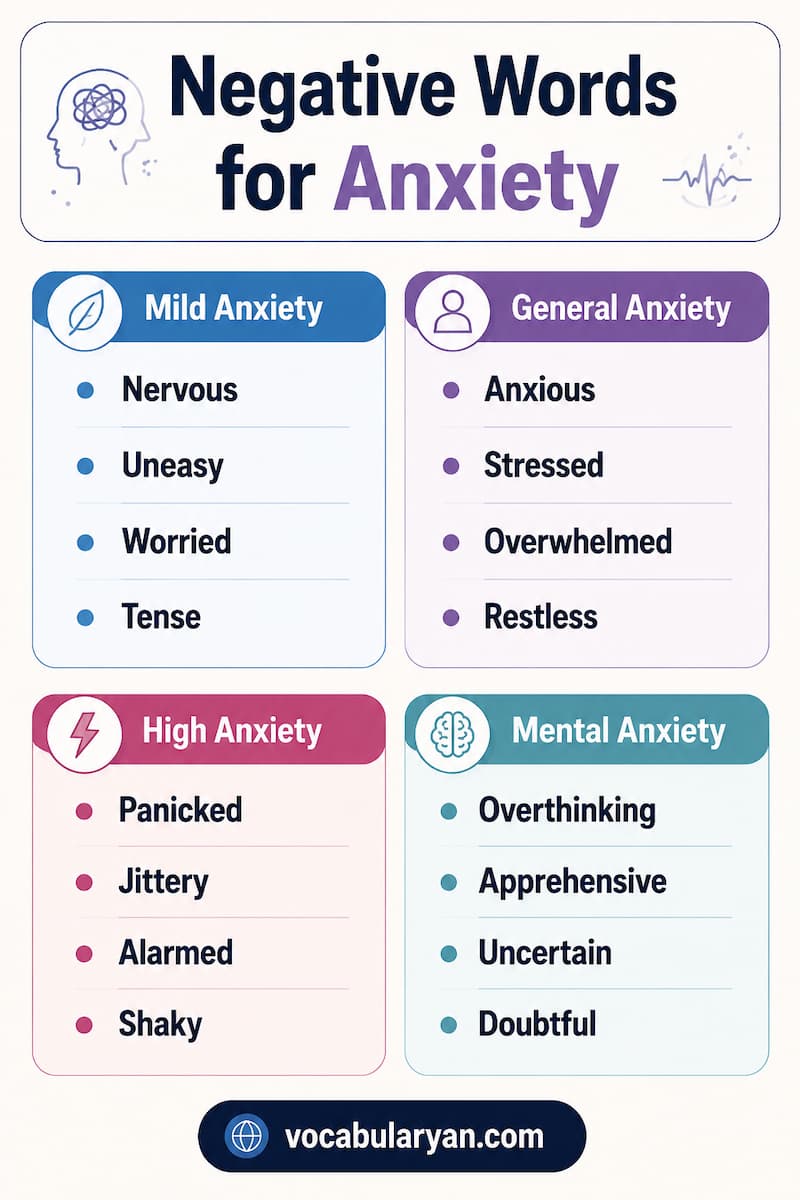
Anxiety is the mind living in the future, rehearsing problems that have not arrived yet. Unlike fear, which responds to something present and real, anxiety circles, waits, and imagines. It runs a spectrum of its own, from the ordinary worry that sits with a person before a difficult conversation all the way to the acute, body-seizing panic that stops thought entirely. Negative words for anxiety name that full range: the slow burn of chronic unease, the tightening that builds before a dreaded event, and the sharp overwhelm that arrives when the mind finally tips. The words ahead are grouped by intensity and type, with meanings throughout and a note on where anxiety ends and fear begins.
💡 Quick answer
Negative words for anxiety are nouns, adjectives, and verbs that name or describe a state of worry, unease, or nervous anticipation, such as apprehensive, dread-filled, frantic, and overwrought. Anxiety is future-oriented and anticipatory, which separates it from fear’s response to immediate danger. Grouping the words by intensity makes the right one quick to reach.
Negative Words for Anxiety vocabulary examples
Everyday Worry And Unease
At this end of the scale anxiety is quiet, a background hum rather than a shout.
Worried(adj.): troubled by circling, anxious thoughts.
She was worried by the silence from his end.
Uneasy(adj.): unsettled and faintly troubled.
Something about the arrangement left him uneasy.
Nervous(adj.): tense and mildly anxious about what may come.
She had been nervous since the message arrived.
Fretful(adj.): chronically anxious and prone to small worries.
A fretful night followed the unsettling conversation.
Concerned(adj.): troubled by care or worry about an outcome.
He was concerned but tried not to show it.
Tense(adj.): stiff and strained with suppressed anxiety.
She sat tense through the whole of the reading.
Unsettled(adj.): disturbed and unable to feel at ease.
The news left him unsettled for days.
Restless(adj.): unable to settle, driven by anxious energy.
She was restless all evening, unable to sit still.
On-edge(adj.): tense and braced for something unwelcome.
The house felt on-edge before the verdict.
Antsy(adj.): fidgety and impatient with suppressed anxiety.
He grew antsy waiting with no update.
Jittery(adj.): shaky and agitated with mild anxiety.
Too much waiting had made her jittery by noon.
Uptight(adj.): tense and anxiously controlling.
He was uptight about the smallest details.
Wary(adj.): cautiously alert, watching for what may go wrong.
She gave a wary look at the unsigned contract.
Ill-at-ease(adj.): uncomfortable and unable to relax.
He was visibly ill-at-ease throughout the meeting.
Jumpy(adj.): easily startled by small things.
She was jumpy all morning before the call.
Self-conscious(adj.): anxiously aware of being observed.
He felt self-conscious among the louder voices.
Doubtful(adj.): troubled by uncertainty and hesitation.
She was doubtful about the whole arrangement.
Persistent And Chronic Anxiety
When worry becomes a fixed condition rather than a passing state, the vocabulary shifts.
Anxious(adj.): persistently worried and uneasy about outcomes.
He felt anxious in a way that no single thing explained.
She was apprehensive about results for a full week.
Dread-filled(adj.): heavy with anticipatory anxiety.
He woke dread-filled without knowing the reason.
Troubled(adj.): emotionally distressed by persistent worry.
She looked troubled and had been for some time.
Stressed(adj.): under sustained mental and emotional pressure.
He had been stressed since the restructure began.
Strained(adj.): pushed to the limit by prolonged anxiety.
Her voice was strained after weeks of uncertainty.
Wound-up(adj.): tightly coiled with unresolved anxiety.
She was so wound-up she could not follow a sentence.
Overwrought(adj.): in a state of nervous exhaustion from anxiety.
He was overwrought by the time the answer came.
High-strung(adj.): nervously tense by nature, easily rattled.
A high-strung temperament made every delay unbearable.
Neurotic(adj.): driven by excessive, irrational worry.
His neurotic attention to the schedule exhausted the team.
Tormented(adj.): in prolonged mental distress from anxiety.
She was tormented by thoughts she could not quieten.
Agitated(adj.): restlessly disturbed by anxious energy.
He paced, agitated, unable to stop checking his phone.
Perturbed(adj.): emotionally unsettled and disturbed.
She was clearly perturbed by the lack of news.
Distressed(adj.): in active emotional pain from anxiety.
He sounded distressed on every call that week.
Fraught(adj.): filled with or causing anxiety and tension.
The negotiation was fraught from the first exchange.
Haunted(adj.): persistently disturbed by anxious thoughts.
She was haunted by what might still go wrong.
Acute Anxiety: Frantic, Overwrought, And Panicky
At the sharp end, anxiety tips into a state the body cannot hold still.
Panicky(adj.): close to losing control with sudden fear.
He felt panicky the moment the exit was blocked.
Frantic(adj.): wildly and uncontrollably distressed.
A frantic search began the moment she was not found.
Hysterical(adj.): uncontrollably distressed past any reason.
She was hysterical by the time help arrived.
Beside oneself(adj.): so distressed as to lose composure.
He was beside himself waiting for the phone to ring.
Desperate(adj.): driven to extremity by urgent anxiety.
She was desperate for any news at all.
Distraught(adj.): deeply upset and unable to be calmed.
He was distraught and could not be reached.
Unhinged(adj.): destabilized by extreme anxiety or distress.
Days of waiting had left her feeling unhinged.
Overwhelmed(adj.): swamped by more anxiety than one can carry.
He was overwhelmed by everything arriving at once.
Paralyzed(adj.): unable to act or think from acute anxiety.
She was paralyzed by the weight of the decision.
Unraveling(adj.): coming apart under the pressure of anxiety.
He was unraveling by the third sleepless night.
Breathless(adj.): unable to breathe steadily from acute distress.
She was breathless with anxiety by the time she arrived.
Consumed(adj.): completely taken over by anxious thoughts.
He was consumed by worst-case scenarios all week.
Types Of Anxiety And Worry
Anxiety takes specific forms depending on what triggers it and how it presents.
Social anxiety(n.): fear of judgment, embarrassment, or humiliation in social settings.
Anticipatory anxiety(n.): dread of a known upcoming event.
Existential anxiety(n.): unease about meaning, death, and the unknown.
Health anxiety(n.): excessive worry about having or developing illness.
Performance anxiety(n.): fear of failing while being watched or evaluated.
Separation anxiety(n.): distress at being apart from a person or place of safety.
Generalized anxiety(n.): persistent, unfocused worry about many things at once.
Catastrophizing(n.): the habit of imagining the worst possible outcome.
Rumination(n.): repetitive, circular dwelling on anxious thoughts.
Hypervigilance(n.): a state of extreme alertness to possible threat.
Paranoia(n.): irrational, extreme suspicion of threat or harm.
Phobia(n.): intense, irrational anxiety around a specific trigger.
Panic attack(n.): a sudden, acute episode of overwhelming fear and physical symptoms.
Obsession(n.): a recurring anxious thought that cannot be dismissed.
Compulsion(n.): a driven, repetitive behavior in response to anxious thought.
Anxiety Nouns: Naming The State
Anxiety(n.): a state of unease and worry about uncertain outcomes.
Anxiety crept in around three in the morning.
Worry(n.): troubled thinking about possible problems.
The worry never fully left him between calls.
Stress(n.): mental strain from demands that feel excessive.
Months of stress had worn him thin.
Dread(n.): deep, heavy anticipatory anxiety.
A familiar dread returned the night before the deadline.
Apprehension(n.): uneasy anticipation of something unwelcome.
A low apprehension stayed with her all week.
Trepidation(n.): trembling, fearful anticipation.
She opened the letter with trepidation.
Angst(n.): deep, existential anxiety and unease.
A generation defined by angst and uncertainty.
Foreboding(n.): a feeling that something bad is on its way.
A heavy foreboding settled in before the vote.
Disquiet(n.): a persistent state of anxiety and unease.
A deep disquiet had lived in him since the diagnosis.
Misgiving(n.): a doubtful, anxious feeling about a decision.
She had a misgiving the moment she agreed.
Tension(n.): mental tightness from unresolved anxiety.
Tension had been building in the household for weeks.
Unease(n.): a vague, unsettled anxiety without a clear cause.
A low unease followed him all through the morning.
Suspense(n.): anxious uncertainty while waiting for an outcome.
The suspense of waiting was worse than any answer.
Consternation(n.): anxious dismay at something alarming.
The delay spread through the team with consternation.
Perturbation(n.): a state of anxious disturbance.
His perturbation showed in every distracted reply.
Agitation(n.): restless, anxious disturbance of mind.
Agitation kept her pacing long after midnight.
Physical Signals Of Anxiety
Anxiety announces itself in the body before the mind has found the words.
Trembling(adj./n.): involuntary shaking from anxious tension.
Clammy(adj.): cold and damp with the sweat of anxiety.
Cold sweat(n.): perspiration driven by anxious dread.
Heart-pounding(adj.): with a heart racing from anxiety.
Shallow-breathing(adj.): unable to take a full breath from tension.
Tight-chested(adj.): feeling physical constriction from anxiety.
Nauseous(adj.): sickened physically by acute anxiety.
Sleepless(adj.): unable to rest from anxious thought.
Twitchy(adj.): nervously restless and unable to keep still.
Fidgety(adj.): unable to keep hands or body still.
Dry-mouthed(adj.): mouth gone dry with sudden anxiety.
Butterflies(n.): a fluttering sensation in the stomach from nerves.
Knot in the stomach(n.): a tight, nauseating sensation from dread.
Tight-throated(adj.): throat constricted by anxiety.
Pale(adj.): drained of color by sudden anxious shock.
Drained(adj.): emptied of energy by sustained anxiety.
Anxiety Verbs: What Anxiety Makes You Do
Worry: to dwell anxiously on problems real or imagined.
She worried in loops that never reached a conclusion.
Fret: to feel or express chronic anxious worry.
He fretted over the details long after the meeting.
Dread: to anticipate with deep, heavy anxiety.
She dreaded the conversation she kept putting off.
Agonize: to suffer prolonged mental anguish over a decision.
He agonized over the reply for three days.
Ruminate: to circle repeatedly over anxious thoughts.
She ruminated on the same exchange for a week.
Obsess: to think about something persistently and anxiously.
He obsessed over every possible reading of the email.
Catastrophize: to imagine the worst possible outcome.
She catastrophized before the results were even in.
Overthink: to analyze and worry beyond all usefulness.
He overthought every word of the draft.
Pace: to walk back and forth from anxious restlessness.
She paced the kitchen for an hour before calling.
Toss and turn: to lie awake unable to sleep from anxiety.
He tossed and turned until the alarm came.
Brace: to steel oneself anxiously for what is coming.
She braced for the answer before opening the message.
Spiral: to descend rapidly into worsening anxiety.
He spiraled quickly once the first worry took hold.
Anxiety Vs. Fear: The Key Difference
Anxiety
Fear
Trigger
Future, uncertain, imagined
Present, specific, real
Cause
Often unclear or multiple
A named, immediate threat
Duration
Persistent, chronic
Usually acute and passing
Direction
Inward, circling
Outward, toward the threat
Key words
Worry, dread, apprehension, angst
Terror, fright, panic, horror
FAQs
Q1. What are negative words for anxiety?
Negative words for anxiety are nouns, adjectives, and verbs that name or describe an unpleasant state of worry, tension, or nervous anticipation, such as apprehensive, dread-filled, frantic, agitated, and overwhelmed. They range from mild everyday worry to acute panic, covering both the emotional experience and the physical signals it produces.
Q2. What is the difference between anxiety and fear?
Fear is a response to a present, specific, and real threat: a raised voice, a sudden movement, an immediate danger. Anxiety is anticipatory and future-oriented, circling around something that has not arrived and may never arrive. Fear tends to be sharp and passing; anxiety is slower, more diffuse, and often harder to name.
Q3. What are words for mild anxiety?
Mild anxiety is well described by worried, uneasy, nervous, fretful, jittery, wary, antsy, and on-edge. For nouns, unease, misgiving, and low-level apprehension all name the feeling without overstating it. These fit the opening stage of a tense situation before the pressure builds.
Q4. What are words for severe or acute anxiety?
Strong choices for acute anxiety are frantic, panicky, hysterical, overwrought, distraught, overwhelmed, and paralyzed. For nouns, panic attack, hysteria, and acute distress name the clinical peak. At this intensity, anxiety has taken the body as well as the mind.
Q5. How do I describe anxiety in writing?
Show it through behavior and the body rather than labeling it. A character who spirals, ruminate, paces, and loses sleep conveys anxiety more sharply than one described as anxious. Physical details, a tight chest, dry mouth, a stomach that will not settle, give the reader a felt sense. Grade the vocabulary to the stage of the scene, saving frantic and overwhelmed for the peak and using uneasy and on-edge for the slow build.
I’m Ethan Walker, cofounder of Vocabularyan.com. Over 12 years in ESL and English learning, I’ve worked closely with vocabulary practice, learner writing, phrase use, and the sentence habits that shape fluent expression. I write with a practical eye for the English learners meet every day, from study notes to conversations and online writing.