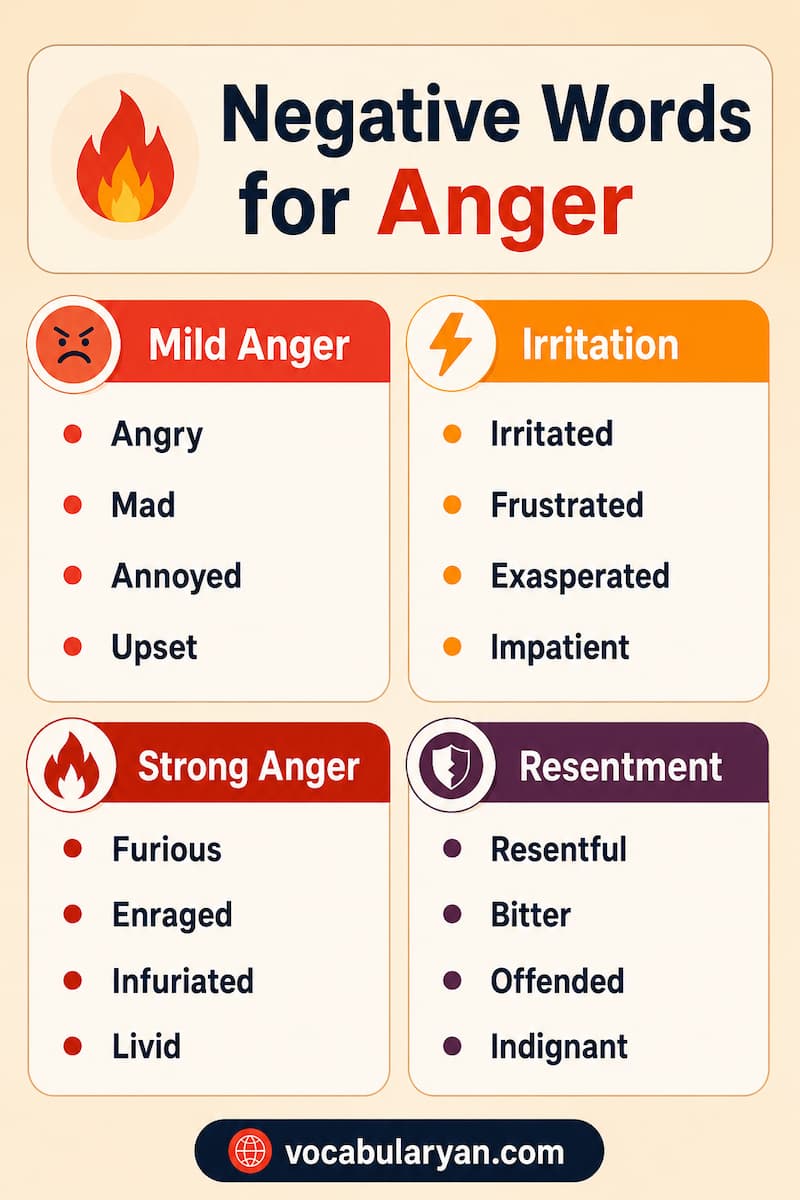
Anger is not one thing. The brief flare when someone cuts you off is nothing like the cold fury that has been building for months, and neither resembles the righteous indignation of witnessing an injustice. English gives each shade its own word, and the right one matters because furious undersells a quiet, controlled rage just as much as irritated undersells a livid outburst. Negative words for anger run from mild irritation through frustration, cold fury, hot rage, and bitter resentment to the literary register where wrath and choler live. The words ahead are grouped by shade and intensity, with all parts of speech labeled, so the exact pitch of the feeling is quick to name.
💡 Quick answer
Negative words for anger range from mild (irritated, annoyed, vexed) through the middle ground (frustrated, agitated, cross) to hot rage (furious, livid, enraged) and cold anger (seething, icy, controlled). They also cover righteous indignation, bitter resentment, and literary anger vocabulary. Choosing the right word means matching it to the shade and intensity of the feeling.
Negative Words for Anger with examples
Mild Anger: Irritated, Annoyed, And Vexed
These words name an anger that stings briefly without taking hold.
Annoyed(adj.): mildly angry at a nuisance or disruption.
She was annoyed by the third interruption in an hour.
Irritated(adj.): stirred to impatience by something grating.
He grew irritated waiting with no explanation given.
Vexed(adj.): mildly angered and troubled.
She felt vexed by the contradictory instructions.
Peeved(adj.): slightly annoyed and put out.
He was peeved about being left off the list.
Displeased(adj.): quietly dissatisfied and annoyed.
She looked displeased but said nothing during the meeting.
Ruffled(adj.): mildly unsettled and annoyed.
The comment left him visibly ruffled.
Nettled(adj.): irritated as if stung.
She was nettled by the offhand remark.
Piqued(adj.): irritated, especially by wounded pride.
He felt piqued at being corrected in public.
Snappish(adj.): short-tempered and quick to bite.
She turned snappish the moment she was tired.
Tetchy(adj.): easily irritated over small things.
He grew tetchy by the end of the long afternoon.
Peevish(adj.): querulous and fretful with mild anger.
A peevish tone crept into his replies.
Grumpy(adj.): sulkily irritable.
He was grumpy before his first coffee.
Testy(adj.): impatient and easily annoyed.
She gave a testy reply and moved on.
Cross(adj.): briefly and openly annoyed.
He was cross about the last-minute change.
Middle Anger: Frustrated, Agitated, And Heated
Here the anger has real weight and shows in the voice and body.
Frustrated(adj.): blocked and aggravated past patience.
She felt frustrated when the same error kept reappearing.
Agitated(adj.): restlessly stirred up by building anger.
He paced, agitated, waiting for a reply that did not come.
Exasperated(adj.): worn thin by repeated provocation.
She sounded exasperated by the tenth question.
Hot-tempered(adj.): quick to erupt with real force.
His hot-tempered reaction cleared the room.
Heated(adj.): made angry through argument or pressure.
The discussion turned heated before the first hour was up.
Riled(adj.): angered and stirred up.
He was visibly riled by the accusation.
Worked up(adj.): emotionally agitated and losing composure.
She was worked up and not ready to discuss it calmly.
Inflamed(adj.): intensely stirred to anger.
The crowd grew inflamed at the announcement.
Provoked(adj.): deliberately driven to anger.
He finally snapped after being provoked for too long.
Hostile(adj.): angrily unfriendly and combative.
A hostile silence greeted every new suggestion.
Belligerent(adj.): aggressively eager for a fight.
A belligerent tone entered the exchange.
Disgruntled(adj.): chronically dissatisfied and resentful.
A disgruntled employee filed the complaint.
Bristling(adj.): defensively angered, like raised hackles.
He was bristling before she finished the sentence.
Hot Anger: Furious, Livid, And Enraged
At this pitch the anger overwhelms composure entirely.
Furious(adj.): violently and intensely angry.
She was furious when the promise was broken again.
Livid(adj.): furiously and visibly angry.
He was livid when he found out what had happened.
Enraged(adj.): driven into a state of wild, uncontrolled fury.
The crowd turned enraged at the announcement.
Incensed(adj.): filled with intense, burning anger.
She was incensed by the dismissive response.
Infuriated(adj.): made intensely furious.
He was infuriated by the endless delays.
Irate(adj.): intensely and vocally angry.
An irate caller demanded to speak to the manager.
Apoplectic(adj.): so angry as to be barely coherent.
He was apoplectic by the time the meeting ended.
Ballistic(adj.): explosively and uncontrollably angry.
She went ballistic when she read the report.
Boiling(adj.): at the extreme point of hot anger.
He was boiling under a forced calm.
Raging(adj.): in the grip of uncontrolled fury.
A raging argument spilled into the corridor.
Blazing(adj.): intensely and fiercely angry.
She turned with a blazing look and said nothing.
Incandescent(adj.): brilliantly and intensely furious.
She was incandescent with rage by the end of the call.
Mad(adj.): angrily upset, especially in informal use.
He was mad enough to leave without another word.
Cold Anger: Seething, Icy, And Controlled
Cold anger is often more frightening than hot rage because it stays in control.
Seething(adj.): boiling inwardly with held anger.
Smoldering(adj.): burning slowly beneath the surface.
Icy(adj.): cold and sharp with suppressed fury.
Steely(adj.): hard and unyielding in controlled anger.
Tight-lipped(adj.): saying little because the anger is held in.
Flinty(adj.): cold and unyielding, with no warmth left.
Stony(adj.): hard and unmoved, anger frozen into silence.
Glacial(adj.): coldly furious and impassive.
Clipped(adj.): speaking with short, sharp words that betray anger.
Withering(adj.): delivering cold anger that diminishes the target.
Scathing(adj.): cutting with cold, sharp fury.
Scalding(adj.): delivering anger as burning, precise words.
Contemptuous(adj.): holding anger as cold disdain.
Controlled(adj.): keeping fury deliberate and contained.
Righteous Anger: Indignant, Outraged, And Affronted
This is the anger of injustice, felt when something violates a sense of what is right.
Indignant(adj.): angry at what feels unfair or unworthy.
She was indignant at the accusation and said so plainly.
Offended(adj.): angered by something that violates one’s standards.
He was offended by the joke and did not laugh.
Scandalized(adj.): shocked into anger by something morally wrong.
The board was scandalized by the leaked accounts.
Affronted(adj.): personally and deeply insulted.
She felt affronted by the assumption.
Appalled(adj.): deeply angered and horrified together.
She was appalled by the casual cruelty of the decision.
Aghast(adj.): struck with shock and anger.
He was aghast at the damage they had caused.
Self-righteous(adj.): convinced of one’s own justness, often to excess.
His self-righteous anger assumed everyone agreed.
Indignation(n.): anger at unfairness or injustice.
She spoke with quiet indignation that carried more weight than shouting.
Outrage(n.): fierce anger at an injustice.
The decision was met with widespread outrage.
Bitter Anger: Resentful, Acrimonious, And Rancorous
This is the anger that does not pass, settling instead into resentment and bitterness.
Resentful(adj.): holding bitter indignation at past wrongs.
Bitter(adj.): soured by lasting, unresolved anger.
Acrimonious(adj.): harshly and bitterly angry, especially in words.
Spiteful(adj.): driven by petty, lingering anger to cause harm.
Vindictive(adj.): bent on revenge for an old wrong.
Grudging(adj.): giving or acting with barely suppressed resentment.
Aggrieved(adj.): nursing a persistent sense of being wronged.
Rancorous(adj.): deeply and bitterly resentful.
Embittered(adj.): made bitter by old anger and grievance.
Sullen(adj.): silently and resentfully angry.
Festering(adj.): worsening and growing more bitter over time.
Chip-on-the-shoulder(adj.): carrying a permanent, ready grievance.
Anger Nouns: Naming The Feeling Itself
Anger(n.): a strong feeling of displeasure.
The anger in her voice was controlled but unmistakable.
Rage(n.): violent, uncontrolled anger.
A cold rage had replaced the initial shock.
Fury(n.): fierce, passionate anger.
She left in a fury and did not return his calls.
Wrath(n.): deep, righteous, or punishing anger.
The wrath in his letter was carefully chosen.
Ire(n.): anger, especially in a literary or formal register.
The decision drew the ire of the entire committee.
Exasperation(n.): irritation from repeated provocation.
His exasperation showed in every clipped answer.
Resentment(n.): bitter indignation from unfair treatment.
Resentment had been building for years before it surfaced.
Irritation(n.): mild anger at a nuisance.
A flicker of irritation crossed his face.
Hostility(n.): unfriendly and aggressive feeling.
A low hostility hummed through the whole negotiation.
Bitterness(n.): lasting anger from unresolved grievance.
Years of bitterness had hardened his voice.
Acrimony(n.): harsh and bitter feeling, especially in dispute.
The divorce proceeded with great acrimony.
Vexation(n.): a state of being annoyed and troubled.
He could not hide his vexation at the third delay.
Dudgeon(n.): strong indignation, especially in “high dudgeon.”
She stormed out in high dudgeon.
Umbrage(n.): offense and annoyance at a slight.
He took umbrage at the implication.
Pique(n.): a feeling of irritation from wounded pride.
She left in a fit of pique after the comment.
Choler(n.): a literary or archaic word for anger and irritability.
Fulminate(v.): to express vehement anger, especially in words.
She fulminated against the policy in every interview.
Smolder(v.): to feel suppressed anger that does not fully ignite.
He smoldered with a resentment he never named.
Flare(v.): to erupt suddenly in anger.
Her temper flared at the accusation.
Storm(v.): to move or speak with angry force.
He stormed out of the room and closed the door hard.
Rail(v.): to protest angrily.
She railed against the decision at every turn.
Glower(v.): to stare with dark, suppressed anger.
He glowered from across the table throughout.
Simmer(v.): to remain at a low, sustained level of anger.
The dispute simmered for weeks before it boiled over.
Lash out(v.): to strike with sudden, sharp anger.
She lashed out when the pressure finally broke.
Rankle(v.): to cause lasting irritation and resentment.
The slight rankled long after the incident was forgotten.
Literary And Expressive Anger Words
These belong to the formal, historical, and literary registers of anger.
Wrathful(adj.): full of great, punishing anger.
A wrathful letter arrived from the solicitor.
Choleric(adj.): easily and intensely angered; from the four humors.
A choleric temperament made him difficult at every meeting.
Truculent(adj.): aggressively defiant and eager to fight.
A truculent response met every attempt at compromise.
Pugnacious(adj.): combative and eager for conflict.
His pugnacious manner alienated potential allies.
Bellicose(adj.): aggressively warlike in manner.
A bellicose speech inflamed an already tense crowd.
Vitriolic(adj.): savagely bitter and cruel in expression.
The review was vitriolic and impossible to misread.
Caustic(adj.): bitingly sharp and corrosive in anger.
Her caustic reply ended the discussion entirely.
Acerbic(adj.): sharply and bitterly cutting.
An acerbic pen ran through all of his letters.
Bilious(adj.): bad-tempered and angry, suggesting a physical quality.
A bilious mood settled on him for the rest of the day.
Mordant(adj.): biting and sharply critical, especially in wit.
A mordant humor masked real anger underneath.
Ireful(adj.): full of ire; literary and archaic.
An ireful tone ran through the manifesto.
From Irritated To Apoplectic: An Anger Intensity Scale
Intensity
Words
Mild
Annoyed, irritated, peeved, vexed, grumpy
Moderate
Frustrated, agitated, exasperated, riled, heated
Strong
Furious, livid, incensed, irate, outraged
Extreme
Enraged, apoplectic, ballistic, raging, wrathful
Cold
Seething, smoldering, icy, scathing, withering
How To Choose The Right Anger Word
Intensity is only half the decision; shade matters as much. Cold anger (seething, icy, scathing) and hot rage (furious, apoplectic, ballistic) sit at similar pitches but feel entirely different on the page. Righteous indignation (indignant, appalled, affronted) belongs to injustice, while bitter resentment (resentful, rancorous, embittered) belongs to old wounds. In writing, the most frightening anger is often cold and controlled, since a character who seethes quietly unsettles a reader more than one who shouts. Match the word to the kind of anger rather than only its size, and the emotion lands precisely.
FAQs
Q1. What are negative words for anger?
Negative words for anger are nouns, adjectives, and verbs that name or describe an unpleasant state of anger. They run from mild (irritated, annoyed) through moderate (frustrated, exasperated) to intense (furious, enraged, apoplectic), with separate registers for cold anger, righteous indignation, and bitter resentment.
Q2. What is the difference between rage and fury?
Both suggest a loss of self-control, but fury implies passion and fierce intensity, while rage implies something more violent and uncontrolled. Wrath adds a sense of righteous or punishing intent. Merriam-Webster draws the distinction this way: fury stresses the violence of emotion, while wrath suggests a desire to punish or get revenge.
Q3. What are literary words for anger?
Strong literary choices are wrathful, choleric, truculent, bellicose, vitriolic, and mordant for adjectives, and ire, choler, dudgeon, umbrage, and spleen for nouns. These carry formal weight and suit written prose, oratory, and historical contexts better than everyday speech.
Q4. What is the difference between hot anger and cold anger?
Hot anger (furious, enraged, apoplectic) overwhelms composure and shows itself loudly. Cold anger (seething, icy, scathing, withering) stays controlled and deliberate, making it more precise and often more threatening. The difference is between a fire that burns visibly and one that holds its heat quietly.
Q5. How do I describe anger in writing without just saying angry?
Name the specific shade and pair it with a signal. A character who seethes gives a different impression from one who rages, and a scathing reply reveals more than a furious one. Show the anger through behavior: a clipped answer, a glower held too long, a door closed with deliberate quiet rather than a slam.
I’m Ethan Walker, cofounder of Vocabularyan.com. Over 12 years in ESL and English learning, I’ve worked closely with vocabulary practice, learner writing, phrase use, and the sentence habits that shape fluent expression. I write with a practical eye for the English learners meet every day, from study notes to conversations and online writing.