
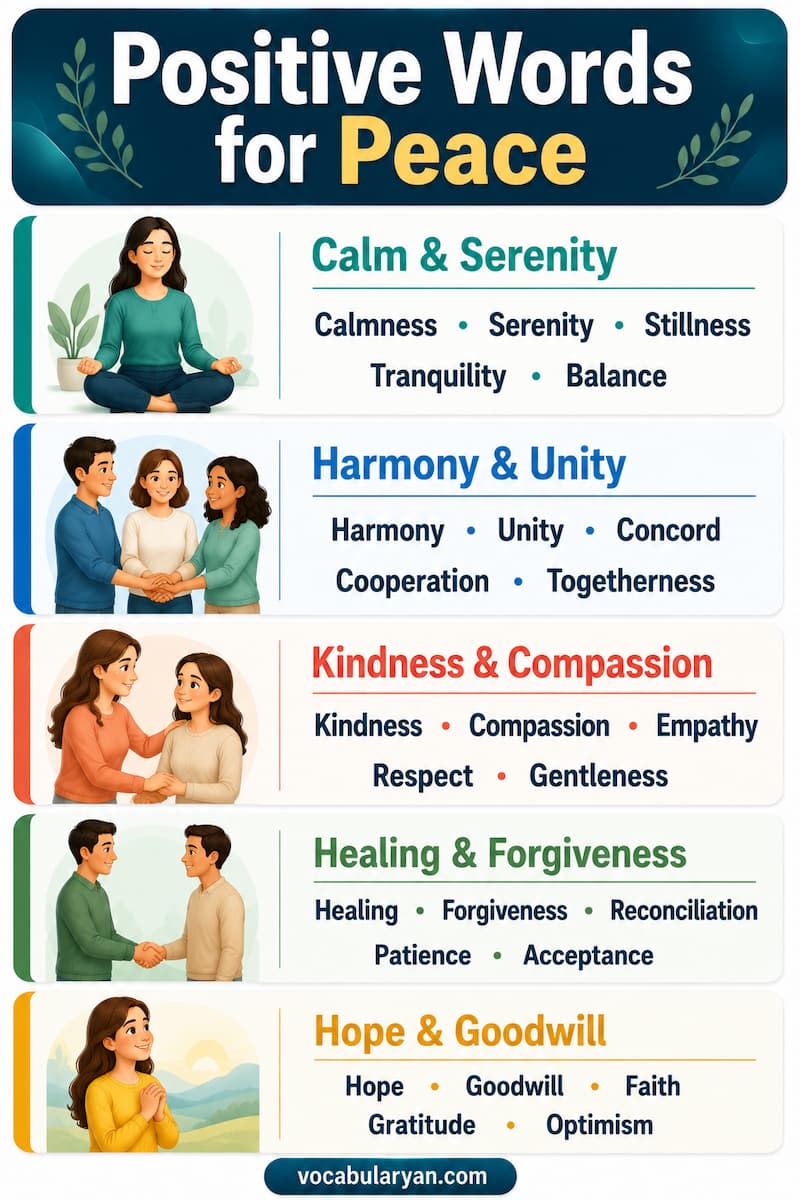
Peace means different things in different moments. There’s the calm that settles a racing mind, the quiet of a still morning, the harmony between people who once clashed. The words below are grouped by the kind of peace they name, from inner stillness to peace between people, so you can find the right one for a journal, a poem, a card, or a calm caption. Each word comes with a meaning and an example you can borrow. Choose by the kind of peace you mean, and your words will carry the quiet you feel.
Positive Words for Peace at a Glance
Short on time? Grab a word for the kind of peace you mean, then read the fuller groups below.
| The kind of peace… | Try these words |
|---|---|
| Inner peace | Serene, tranquil, content, centered |
| Calm and stillness | Calm, still, quiet, placid |
| A peaceful place | Restful, soothing, idyllic, secluded |
| Between people | Harmony, unity, goodwill, accord |
| Free of worry | At ease, untroubled, settled, relieved |
| A peaceful person | Gentle, mellow, even-tempered, composed |
Words for Inner Peace And Peace of Mind
This is the peace that lives inside, a mind free of worry and a settled heart. These words name inner peace.
- Serene: calm, clear, and untroubled within.
- “She felt serene after the long walk.”
- Tranquil: deeply calm and at rest.
- “A tranquil mind sleeps easily.”
- Content: quietly satisfied with how things are.
- “He felt content with his simple, steady life.”
- Centered: balanced and grounded inside.
- “Morning quiet left her centered for the day.”
- At peace: free of inner conflict.
- “After the talk, she felt at peace at last.”
- Settled: calm and free of restlessness.
- “His mind felt settled once the choice was made.”
- Grounded: steady and sure within.
- “She stayed grounded through the busy week.”
- Calm-hearted: peaceful at the core.
- “He has a calm-hearted way that soothes others.”
- Untroubled: free of worry and unrest.
- “Her untroubled smile said it all.”
- Restful: peaceful and free of strain.
- “The quiet evening left them restful and easy.”
Words for Calm And Stillness
This is peace as quiet, the hush of a still room, the calm after the noise fades. These words name calm.
- Calm: quiet and free of disturbance.
- “The lake was calm at dawn.”
- Still: silent and unmoving.
- “The forest was perfectly still.”
- Quiet: free of noise and bustle.
- “They enjoyed a quiet afternoon at home.”
- Placid: smooth, mild, and undisturbed.
- “The placid water mirrored the sky.”
- Hushed: soft and gently quiet.
- “The room fell hushed as she began.”
- Peaceful: calm in contrast to past noise.
- “It was peaceful once the crowds had gone.”
- Serene-quiet: a clear, lofty stillness.
- “A serene quiet hung over the valley.”
- Soothing: gently calming to the senses.
- “The soothing sound of rain helped her sleep.”
- Mellow: gently relaxed and easy.
- “The mellow evening light calmed the room.”
- Composed: calm and steady on the surface.
- “She stayed composed and quiet through it all.”
Words for a Peaceful Place Or Setting
This is peace you can step into, a calm corner, a quiet retreat. These words name a peaceful place.
- Peaceful-retreat: a place that calms you the moment you arrive.
- Serene-haven: a clear, beautifully calm spot.
- Idyllic: perfectly peaceful and lovely.
- Secluded: quiet and tucked away.
- Sheltered: safe, calm, and protected.
- Restorative: a place that renews and settles you.
- Pastoral: peaceful in a gentle, rural way.
- Unspoiled: pure, calm, and untouched.
- Cozy: snug, warm, and comforting.
- Sanctuary-like: safe and deeply peaceful.
Words for Harmony Between People
This is peace between people, the calm of getting along, the end of conflict. These words name harmony.
- Harmony: peaceful agreement between people.
- “The two teams worked in perfect harmony.”
- Unity: peaceful togetherness as one.
- “The town found unity after the hard year.”
- Goodwill: warm, peaceful feeling toward others.
- “The meeting ended in goodwill on both sides.”
- Accord: peaceful agreement and understanding.
- “They reached an accord after long talks.”
- Concord: friendly peace and agreement.
- “The neighbors lived in quiet concord.”
- Reconciliation: peace made after a conflict.
- “Their reconciliation healed years of distance.”
- Amity: friendly, peaceful relations.
- “The two nations enjoyed lasting amity.”
- Cooperation: working together in peace.
- “The project ran on real cooperation.”
- Fellowship: warm, peaceful companionship.
- “There was a deep fellowship among them.”
- Truce: an agreed pause in conflict.
- “The two sides finally called a truce.”
Words for Freedom From Worry
This is peace as relief, the weight lifting, the worry easing. These words name freedom from worry.
- At ease: relaxed and free of strain.
- Relieved: freed from a worry or burden.
- Carefree: light and free of cares.
- Reassured: calmed and set at rest.
- Comforted: soothed and made to feel safe.
- Unburdened: freed of a heavy weight.
- Lighthearted: easy and free in spirit.
- Secure: safe and free of fear.
- Eased: gently freed from tension.
- Liberated: set free from what weighed you down.
Words to Describe a Peaceful Person
This is peace as a quality in a person, the one who stays calm and brings calm. These words describe a peaceful person.
- Gentle: soft and calm in manner.
- Serene-natured: peaceful and calm by nature.
- Even-tempered: steady and rarely ruffled.
- Mild: soft-spoken and untroubling.
- Easygoing: relaxed and free of drama.
- Patient: calm and willing to wait.
- Level-headed: steady and clear under stress.
- Tolerant: accepting and slow to anger.
- Soft-spoken: quiet and gentle in speech.
- Unflappable: never thrown off or rattled.
- Agreeable: pleasant and easy to get along with.
- Forgiving: quick to let go and make peace.
Peaceful Adjectives vs Peace Nouns
It helps to know whether you need a word that describes something (an adjective) or names the feeling itself (a noun). Use an adjective to describe a person or place, and a noun to name the peace.
| Adjective (describes something) | Noun (names the feeling) |
|---|---|
| Peaceful | Peace |
| Serene | Serenity |
| Tranquil | Tranquility |
| Calm | Calmness |
| Still | Stillness |
| Quiet | Quietude |
| Harmonious | Harmony |
| Content | Contentment |
| Placid | Placidity |
| Restful | Restfulness |
Notice the pattern: The lake is serene describes the place, while Its serenity calmed her names the feeling. Both are useful, just for different jobs in a sentence.
Peace vs Calm vs Serenity: The Difference
These three words sit close together, but each leans a different way. Knowing the difference helps you pick the truest one.
- Calm is the everyday word, quiet and free of disturbance, often in contrast to nearby noise or stress.
- Peace is broader and deeper, a lasting freedom from conflict, inside you or between people.
- Serenity is the loftiest, an unclouded, graceful calm that feels almost untouchable.
So you stay calm in a storm, you make peace after a long argument, and you feel serenity watching a still sunrise. Reach for calm for a passing quiet, peace for something lasting, and serenity for a deep, shining stillness.
Affirmations for Inner Peace (Calming Self-Talk)
The words you say to yourself can settle a restless mind. Borrow any of these as a calming affirmation.
- “I am calm, and this moment is enough.”
- “I let go of what I cannot control.”
- “My mind is quiet, and my heart is at ease.”
- “I breathe in calm and breathe out worry.”
- “Peace begins with this single breath.”
- “I am safe, I am steady, I am still.”
- “I release the day and rest in this quiet.”
- “All is well in this moment.”
A good affirmation is gentle and present. Instead of “I will never worry again,” try “I am calm in this moment.” Peace grows from words that meet you where you are.
Peace Idioms And Phrases
Sometimes a phrase carries peace better than a single word. These idioms all point to calm and quiet.
- Peace of mind: freedom from worry.
- At peace: calm and free of conflict.
- Inner peace: a settled, quiet heart.
- Peace and quiet: rest free of noise and fuss.
- Calm before the storm: a quiet spell before trouble.
- Make peace: settle a conflict.
- Hold your peace: stay calm and quiet.
- A sense of calm: a settled, easy feeling.
- Rest easy: be free of worry.
- Find your center: return to a calm, steady place.
Beautiful And Rare Words for Peace
When the common words feel too plain, reach for these rarer ones. Each names a special shade of peace.
| Word | Meaning |
|---|---|
| Quietude | A deep, gentle state of quiet |
| Equanimity | Calm, even-minded steadiness |
| Repose | Restful, peaceful calm |
| Placidity | A smooth, undisturbed calm |
| Sangfroid | Cool composure under pressure |
| Halcyon | Calm, peaceful, and happy |
| Solace | Comfort and peace in hard times |
| Heartsease | Peace and ease of mind |
| Ataraxia | Deep, untroubled tranquility |
| Tranquillity | A very deep, lasting calm |
| Lull | A gentle, calming pause |
| Beatitude | Supreme peace and blessedness |
How to Pick the Right Word for Peace
The best word names the exact kind of peace. A precise word says something “peaceful” leaves vague.
- ❌ “It was a peaceful place, a peaceful mood, a peaceful day.” — One word, doing all the work.
- ✅ “It was a secluded place, a serene mood, a restful day.” — Three words, three honest shades.
See the difference. The first repeats a flat word; the second names exactly what each kind of peace was. Ask two quick questions: Where is the peace, inside you, in a place, or between people? And is it a passing calm or a lasting quiet? Then pick the word that fits. Try it now: think of a peaceful moment, and name its exact shade instead of just “peaceful.” That habit turns plain writing into words that feel as calm as the moment.
Positive Words for Peace A to Z
Most lists give A to Z with no meanings. This one gives a clear word and a meaning for each letter, so you can scan and choose at once.
| Letter | Word | Meaning |
|---|---|---|
| A | At ease | Relaxed and free of strain |
| B | Balanced | Steady and centered |
| C | Calm | Quiet and undisturbed |
| D | Dreamy | Soft, gentle, and far from stress |
| E | Even-tempered | Steady and rarely ruffled |
| F | Forgiving | Quick to make peace |
| G | Gentle | Soft and calm in manner |
| H | Harmony | Peaceful agreement |
| I | Idyllic | Perfectly peaceful |
| J | Just-right | Settled and exactly enough |
| K | Kindly | Warm and peaceable |
| L | Lull | A calming pause |
| M | Mellow | Relaxed and easy |
| N | Nirvana | Perfect peace and bliss |
| O | Orderly | Calm and free of chaos |
| P | Placid | Smooth and undisturbed |
| Q | Quietude | A deep, gentle quiet |
| R | Restful | Peaceful and easing |
| S | Serene | Clear and untroubled |
| T | Tranquil | Deeply calm and still |
| U | Untroubled | Free of worry |
| V | Visionary-calm | Peaceful and clear-minded |
| W | Whole | Settled and complete |
| X | (e)Xhale | The calm of letting go |
| Y | Yielding | Gentle and slow to anger |
| Z | Zen | Calm, clear, and centered |
FAQs
It depends on the kind of peace. For inner peace, use serene, tranquil, and content. For calm and quiet, use still, placid, and hushed. For peace between people, use harmony, unity, and goodwill. Matching the word to the kind of peace is what makes it ring true.
For deep peace, use serenity, tranquility, or equanimity. For a rarer, poetic option, halcyon and ataraxia both describe a deep, untroubled calm. Each carries more weight than plain “peace” because it names a deeper, more lasting stillness.
Calm is the everyday word for quiet free of disturbance, often after nearby stress. Peace is broader and deeper, a lasting freedom from conflict. Serenity is the loftiest, an unclouded, graceful calm. So you stay calm in a storm, make peace after an argument, and feel serenity at a still sunrise.
Use gentle, mellow, even-tempered, easygoing, and level-headed. These point to someone who stays calm and brings calm to others. To make any of them land, tie the word to a moment: “She’s even-tempered, she stayed calm when everyone else panicked.”
Use gentle, present lines such as “I am calm, and this moment is enough” or “I let go of what I cannot control.” Peace grows from words that meet you where you are, so a soft, present affirmation works better than a sweeping promise like “I’ll never worry again.”