
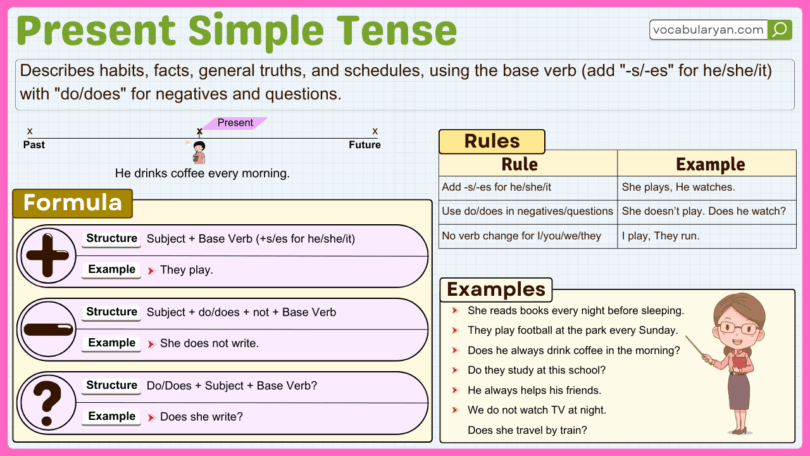
The present simple tense describes habits, repeated actions, facts, stable states, and scheduled events. “Sara works at a library” describes her regular job, not an action limited to this moment. English expresses these meanings with two form systems: ordinary verbs such as work and the irregular verb be. The subject determines the form.
- Base form: Use the unchanged verb with I, you, we, and they.
- Third-person singular: Add s or es with he, she, it, or a singular noun.
- Do and does: Use the base verb after do, does, don’t, and doesn’t.
- Verb be: Use am, is, or are without do or does.
Present Simple Tense Structure
In the present simple tense, mark third-person singular on the main verb or on does, never on both.
| Form | Structure | Example |
|---|---|---|
| Affirmative | Subject + base verb or third-person form | Sara works at a library. |
| Negative | Subject + do or does + not + base verb | Sara does not work on Sundays. |
| Question | Do or does + subject + base verb? | Does Sara work on Saturdays? |
Affirmative Sentences With Other Verbs
Use the base verb with I, you, we, they, and plural nouns.
- I read before bed.
- We visit our grandparents on Fridays.
- The students study in the library.
With a third-person singular subject, change the verb: “Sara works at a library” and “Hamza reads every evening.” The singular subject I still takes the base verb.
Present Simple Negative Sentences
Use do not or don’t with I, you, we, they, and plural nouns. Use does not or doesn’t with he, she, it, and singular nouns.
The main verb stays in its base form after doesn’t: “Sara doesn’t work on Sundays.” If you see does or doesn’t, keep the next verb in its base form.
Questions Short Answers and Question Tags
Begin a yes or no question with do or does. Put the subject next, then use the base verb.
- Do you enjoy reading? Yes, I do.
- Does Sara work here? No, she doesn’t.
- Do the buses stop here? Yes, they do.
Question tags: A positive statement takes a negative tag: “Sara works here, doesn’t she?” A negative statement takes a positive tag: “They don’t drive, do they?”
Wh Questions and Subject Questions
An object question places a wh-word before do or does: “Where does Sara work?” and “Why do they leave early?”
A subject question does not use do or does when who or what is the subject: “Who works at the library?” The answer replaces who: “Sara works at the library.”
Forms of Be With Am Is and Are
The verb be has three present simple forms and does not use do or does in ordinary negatives or questions.
| Subject | Affirmative | Negative | Question |
| I | I am ready. | I am not ready. | Am I ready? |
| He She It | She is ready. | She is not ready. | Is she ready? |
| You We They | They are ready. | They are not ready. | Are they ready? |
Use isn’t for is not and aren’t for are not. Write “I’m not late,” not “I amn’t late.”
Third Person Singular Spelling Rules
In the present simple tense, spelling depends on the final letters of the base verb.
| Rule | Examples |
| Add s to most verbs | work → works; read → reads |
| Add es after s ss sh ch x z or o | wash → washes; watch → watches; fix → fixes; go → goes; do → does |
| Change consonant plus y to ies | study → studies; carry → carries |
| Add s after vowel plus y | play → plays; enjoy → enjoys |
| Use the irregular form of have | have → has |
These changes apply to affirmative sentences only. After does or doesn’t, return to the base form: “Does she study?” and “She doesn’t study on Fridays.”
Present Simple Tense Uses
Choose the present simple when the meaning is regular, factual, stable, or controlled by a schedule.
Habits Facts States and Schedules
Habits and routines: “Maya walks to work every day” describes a repeated action.
Facts and general truths: “The Earth orbits the Sun” states an established fact.
States: Stative verbs express knowledge, possession, preference, or belief. “Omar owns a bicycle” describes a state, not an action in progress. Stable does not mean permanent forever.
Schedules: “The train leaves at 9:15” follows a timetable. Use present simple after a future time word: “I will call you when the meeting ends.”
Instructions Stories and Live Commentary
The present simple gives directions when the subject is stated: “First, you add the flour. Then you stir the mixture.” The imperative “Add the flour” gives an instruction but is not a present-simple statement.
Stories and live commentary use the tense for immediacy. “Ahmed passes the ball and Khan scores” reports each action as it happens.
Present Simple Time Expressions
Time expressions show repetition or a scheduled time.
- Repeated periods: every day, every Monday, once a week, twice a month.
- Frequency: always, frequently, rarely, never.
- Scheduled times: at 8:00, on Fridays, after lunch, when class ends.
Place a repeated period at the beginning or end of a sentence: “Every Monday, Lina attends a writing class” or “Lina attends a writing class every Monday.”
Where Adverbs of Frequency Go
Put an adverb of frequency before an ordinary main verb: “They frequently travel by train.”
Place it after be: “Sara is always punctual.” With a negative auxiliary, place it after do not or does not: “He does not always drive to work.”
The position depends on the verb form. Time phrases such as every day and once a week go at the beginning or end instead.
Present Simple vs Present Continuous
Use present simple for a routine, fact, or state. Use present continuous for an action in progress now or a temporary situation.
| Meaning | Present Simple | Present Continuous |
| Routine or action now | Mina walks to work every day. | Mina is walking to work now. |
| Stable or temporary situation | Omar works in Karachi. | Omar is working in Lahore this month. |
| State or active process | I know the answer. | I am writing the answer. |
Stative verbs such as know, believe, own, and need take the present simple when they describe a state: “I need your address,” not “I am needing your address.”
Common Errors With Do Does and Verb Endings
Missing the third-person ending:
She work at a bank. ❌
She works at a bank. ✅
Keeping s after does:
Does she works here? ❌
Does she work here? ✅
Using do with a third-person singular subject:
He don’t eat meat. ❌
He doesn’t eat meat. ✅
Using do with be:
Does she be ready? ❌
Is she ready? ✅
Spelling consonant plus y incorrectly:
Mina studys English. ❌
Mina studies English. ✅
Using a stative verb in the continuous form:
I am knowing the answer. ❌
I know the answer. ✅
Present Simple Tense Practice
Instructions: Choose the correct form or write the requested sentence.
- Amal ___ at a hospital. (work or works)
- They ___ coffee after dinner. (don’t drink or doesn’t drink)
- ___ Rana study on Saturdays? (Do or Does)
- I ___ ready for class. (am or is)
- Write the third-person singular form of carry.
- Choose the natural order: “Noah always reads before bed” or “Noah reads always before bed.”
- Choose the tense: “Look! The baby ___ now.” (sleeps or is sleeping)
- Turn “Someone teaches this class” into a subject question.
| Question | Answer |
| 1 | works |
| 2 | don’t drink |
| 3 | Does |
| 4 | am |
| 5 | carries |
| 6 | Noah always reads before bed. |
| 7 | is sleeping |
| 8 | Who teaches this class? |
FAQs
Q1: What Is the Present Simple Tense Formula?
For ordinary verbs, use subject + base verb in affirmative sentences. Add s or es for third-person singular. Negatives use subject + do not or does not + base verb.
Q2: How Do You Form a Negative in the Simple Present Tense?
Use do not or don’t with I, you, we, and they. Use does not or doesn’t with he, she, it, and singular nouns. Keep the main verb in its base form.
Q3: How Do You Ask Questions in the Simple Present Tense?
Begin with do or does, add the subject, and finish with the base verb: “Does Lina work here?” Use am, is, or are directly when the main verb is be.
Q4: What Is an Irregular Verb in the Simple Present?
The verb be is irregular because it changes to am, is, or are. The verb have also changes irregularly to has with a third-person singular subject.
Q5: What Is the Difference Between Present Simple and Present Continuous?
Present simple describes routines, facts, and states: “I work in an office.” Present continuous describes an action in progress or a temporary situation: “I am working from home today.”
You May Also Like

Leave a Comment