
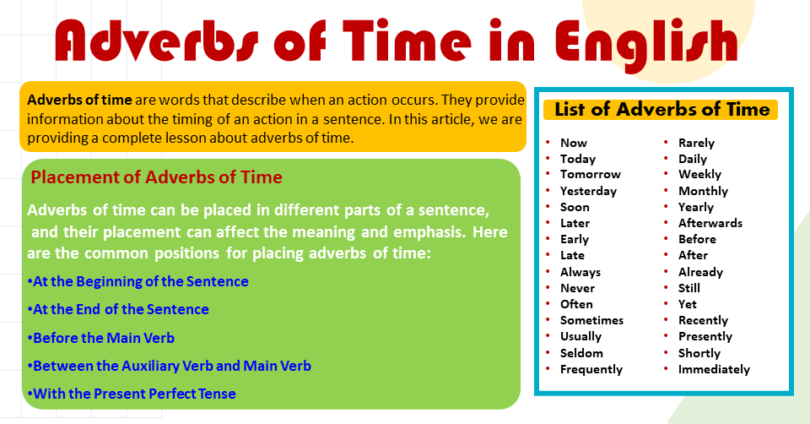
An adverb of time answers the question when, showing at what point or over what stretch of time an action happens. English groups these words into four patterns: definite time, indefinite time, duration, and sequence. A related but separate category, frequency, answers a different question, how often, and gets its own full treatment elsewhere.
What an Adverb of Time Does in a Sentence
An adverb of time modifies a verb and answers when, whether that means a specific point, an unspecified point, a stretch of duration, or a position in a sequence of events.
- Definite time adverbs: name a specific point.
- Indefinite time adverbs: name an unspecified point relative to another time.
- Duration adverbs: answer how long.
- Sequence adverbs: show the order of events.
Time answers when. Frequency answers how often. The two questions look related, but they name separate categories, and the identification method further on keeps them apart.
Take the sentence Maya has already left; she always leaves early. Already names an unspecified point relative to now, which makes it an indefinite time adverb, while always names how often Maya leaves early, which makes it a frequency adverb instead. Two similar-sounding words, two separate questions.
Types of Time Adverbs
Four patterns organize adverbs of time by the precision and shape of the time they name.
Definite Time Adverbs
A definite time adverb names a specific point: now, today, yesterday, tomorrow, tonight.
- Maya finished the report yesterday.
- We have a meeting tomorrow.
- The package arrived this morning.
A definite time adverb pairs with a matching tense: past events pair with the simple past, as in finished yesterday, while future events pair with a future form, as in will meet tomorrow.
Indefinite Time Adverbs
An indefinite time adverb names an unspecified point relative to another time: soon, later, already, still, yet, recently.
- Maya will arrive soon.
- Maya has already finished her homework.
- Have you finished the assignment yet?
Already fits positive statements, while yet fits questions and negative statements: Maya has already finished her homework uses already in a positive statement, while Maya hasn’t finished her homework yet uses yet in a negative one.
Duration Adverbs
A duration adverb answers how long an action lasts: briefly, forever, temporarily, permanently.
- Maya waited briefly before leaving.
- The store closed temporarily for repairs.
- Maya will remember that trip forever.
Sequence Adverbs
A sequence adverb shows the order of events: before, after, next, then, finally, meanwhile.
- Maya finished her homework, then she watched a movie.
- Finally, the rain stopped.
- Before dinner, Maya set the table.
A sequence adverb that opens a sentence takes a comma right after it, as in Finally, the rain stopped.
Where to Place an Adverb of Time in a Sentence
A definite time adverb opens or closes a sentence.
- Yesterday, Maya finished the report.
- Maya finished the report yesterday.
An indefinite time adverb such as already or still appears between the auxiliary verb and the main verb.
- Maya has already finished her homework.
- The sun is still shining.
A sequence adverb opens the clause it introduces by default.
- Maya finished her homework. Then she watched a movie.
Adverbs of Time vs Adverbs of Frequency
Time answers when an action happens. Frequency answers how often it happens. The two questions sound similar but name separate categories.
- Maya has already left. (time: an unspecified point)
- Maya always leaves early. (frequency: how often)
A single sentence can use both at once without the two categories overlapping: Maya has already left, and she always leaves early uses already to mark an unspecified point and always to mark a repeated pattern, each answering its own question.
A dedicated adverbs of frequency lesson covers always, often, sometimes, usually, and the rest of the frequency scale in full.
Full List of Time Adverbs
The table groups every time adverb by category, with no frequency vocabulary and no repeated words.
| Category | Time Adverbs |
|---|---|
| Definite | Now, today, yesterday, tomorrow, tonight, early, late |
| Indefinite | Soon, later, already, still, yet, recently, presently, shortly, immediately, eventually, suddenly |
| Duration | Briefly, forever, temporarily, permanently |
| Sequence | Before, after, next, then, finally, afterward, meanwhile, last |
Adverbs of Time Comparison Chart
The comparison chart organizes each category by test and example, keeping every cell to one short phrase so the chart stays readable on a small screen.
| Category | Test | Example |
|---|---|---|
| Definite | Names a specific point in time | Yesterday in Maya finished the report yesterday |
| Indefinite | Names an unspecified point relative to another time | Already in Maya has already finished her homework |
| Duration | Answers how long | Briefly in Maya waited briefly |
| Sequence | Shows the order of events | Then in Maya finished her homework, then she watched a movie |
| Frequency (related, separate category) | Answers how often | Always in Maya always leaves early |
How to Identify Adverbs of Time
Five steps convert the categories into a method you run on any sentence:
- Find the word answering when.
- Check whether it names a specific point or an unspecified one.
- Check whether it answers how long instead of when.
- Check whether it shows order rather than a point in time.
- Confirm it is not answering how often, which signals frequency instead.
Common Mistakes With Adverbs of Time
Four confusions repeat across worksheets and grammar sites, and catching them keeps you from mislabeling a time adverb you already understand.
Always and often are adverbs of time. ❌ Always and often are adverbs of frequency, since both answer how often rather than when. ✅
Maya has always wanted to visit Paris demonstrates the mid-position placement of a time adverb. ❌ Maya has already left demonstrates the mid-position placement of a time adverb, since already answers when rather than how often. ✅
Briefly and forever are frequency adverbs. ❌ Briefly and forever are duration adverbs, since both answer how long rather than how often. ✅
Maya yesterday finished the report. ❌ Maya finished the report yesterday, since a definite time adverb opens or closes a sentence rather than interrupting the verb phrase. ✅
Already and yet work interchangeably in any sentence. ❌ Already fits positive statements, while yet fits questions and negative statements, as in Maya has already finished versus Maya hasn’t finished yet. ✅
Adverb of Time Practice Questions
Test the five-step method against nine sentences before checking your answers.
- Classify yesterday in Maya finished the report yesterday.
- Classify already in Maya has already finished her homework.
- Is always an adverb of time or an adverb of frequency?
- Classify briefly in Maya waited briefly before leaving.
- Classify then in Maya finished her homework, then she watched a movie.
- Correct the error in Maya yesterday finished the report.
- Is briefly a duration adverb or a frequency adverb?
- Explain why monthly does not answer “when” in We go for a family picnic monthly.
- Choose already or yet: Maya hasn’t finished her homework ___.
Answers
- Yesterday functions as a definite time adverb, since it names a specific point.
- Already functions as an indefinite time adverb, since it names an unspecified point relative to another time.
- Always functions as an adverb of frequency, since it answers how often rather than when.
- Briefly functions as a duration adverb, since it answers how long.
- Then functions as a sequence adverb, since it shows the order of events.
- The correct sentence is Maya finished the report yesterday, since a definite time adverb opens or closes a sentence rather than interrupting the verb phrase.
- Briefly functions as a duration adverb, since it answers how long an action lasts, not how often it repeats.
- Monthly answers how often the picnic happens, which makes it a frequency adverb; a genuine time answer would name when, such as next month.
- Yet completes the sentence correctly, since the negative statement calls for yet rather than already.
FAQs
Q1. What are examples of adverbs of time?
Common examples include now, today, yesterday, tomorrow, soon, already, briefly, and then. Each names when something happens, whether at a specific point, an unspecified point, over a stretch of duration, or in a sequence of events.
Q2. What is the difference between adverbs of time and adverbs of frequency?
An adverb of time answers when an action happens, as in Maya has already left. An adverb of frequency answers how often it happens, as in Maya always leaves early. The two questions sound related, but they name separate categories.
Q3. Where do you place an adverb of time in a sentence?
A definite time adverb opens or closes a sentence, as in Yesterday, Maya finished the report or Maya finished the report yesterday. An indefinite time adverb such as already or still appears between the auxiliary verb and the main verb, as in Maya has already finished her homework.
Q4. What are duration adverbs?
Duration adverbs answer how long an action lasts rather than when it happens. Common examples include briefly, forever, temporarily, and permanently, as in Maya waited briefly before leaving.
Q5. Is “already” an adverb of time or an adverb of frequency?
Already functions as an adverb of time, specifically an indefinite time adverb, since it names an unspecified point relative to another time rather than how often something happens, as in Maya has already finished her homework.

Leave a Comment