
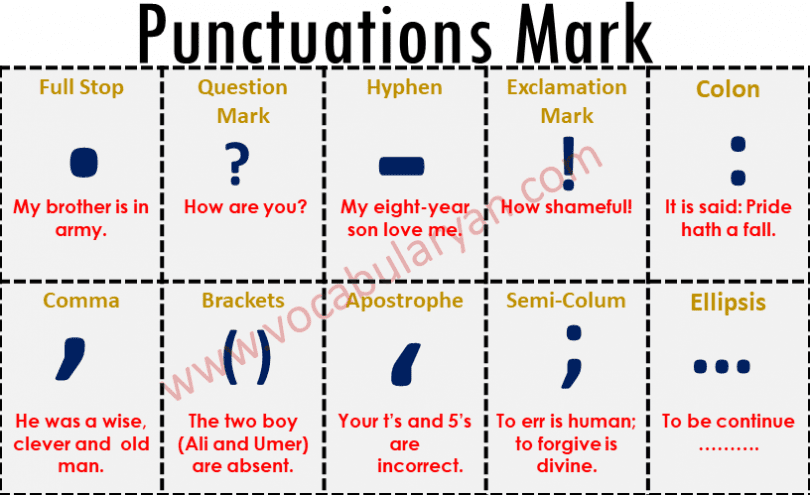
Punctuation marks show where a sentence pauses, stops, joins, or shifts, guiding a reader through meaning that word choice alone cannot express. English uses twelve standard marks, each with its own placement rules, and several, such as the dash and the hyphen, are commonly confused with one another.
What Punctuation Marks Do in Writing
Punctuation marks fall into three broad groups based on the job each one performs.
- Sentence-ending marks: the period, question mark, and exclamation mark.
- Marks that join or separate clauses: the colon, semicolon, and comma.
- Marks that join or set off words and phrases: the dash, hyphen, parentheses, quotation marks, apostrophe, and ellipsis.
A colon needs a complete independent clause before it, never a sentence fragment. A dash and a hyphen look similar but serve different purposes entirely.
Full Stop or Period (.)
A period ends a declarative sentence and marks many abbreviations.
| Rule | Example |
|---|---|
| It ends a declarative sentence. | A cynic is a man who knows the price of everything but the value of nothing. |
| It follows courtesy titles and abbreviations of rank. | Mr. Amjad Qureshi, Mrs. Salma Rahim |
| It marks many common abbreviations. | P.M., etc., i.e., Jan. |
| It follows abbreviated academic degrees. | M.B.B.S., Ph.D., LL.B. |
Colon (:)
A colon needs a complete independent clause before it, and introduces a list, an explanation, or a quotation that follows.
| Rule | Example |
|---|---|
| It introduces a list after a complete clause. | He bought the following: bread, milk, and eggs. |
| It separates two independent clauses when the second explains the first. | Maya had one goal: to finish the marathon. |
| It introduces a quotation. | The sign made one thing clear: no entry after hours. |
| It precedes examples or clarifications after a complete clause. | Maya excelled at every sport she tried: basketball, tennis, and swimming. |
Semicolon (;)
A semicolon joins two closely related independent clauses without a coordinating conjunction.
| Rule | Example |
|---|---|
| It connects closely related independent clauses. | Maya was tired; she kept working anyway. |
| It separates items in a complex list that already contains commas. | Maya has lived in Lahore, Pakistan; Dubai, UAE; and Istanbul, Turkey. |
| It joins a clause that extends the same idea. | Maya enjoys reading; her brother prefers watching movies. |
| It precedes a conjunctive adverb joining two independent clauses. | Maya wanted to go to the park; however, it started raining. |
Comma (,)
A comma separates items, clauses, and introductory words within a sentence.
| Rule | Example |
|---|---|
| It separates items in a list. | Maya bought apples, oranges, bananas, and grapes. |
| It follows an introductory word or phrase. | Yes, I will come to the meeting. |
| It separates clauses in a compound sentence. | Maya was tired, but she finished her homework. |
| It sets off a direct address. | Maya, can you help me? |
Question Mark (?)
A question mark follows a direct question, but never an indirect one.
| Rule | Example |
|---|---|
| It follows a direct question. | Where are you going? |
| It does not follow an indirect question. | Maya asked where I was going. |
| It follows a yes-or-no question. | Did you see the movie? |
| It can signal genuine uncertainty within a statement. | Are you sure this is the right decision? |
Exclamation Mark (!)
An exclamation mark shows strong emotion, surprise, or emphasis.
| Rule | Example |
|---|---|
| It shows strong emotion or surprise. | What a beautiful view! |
| It follows a command or an interjection. | Stop! Wait! |
| It adds emphasis to a short exclamation. | Congratulations! |
| It signals excitement in informal writing. | I can’t believe it! |
Dash (—)
A dash marks a break in thought, an interruption, or emphasizes an aside, and reads more informally than a comma or a colon.
| Rule | Example |
|---|---|
| It marks a break in thought or an interruption. | Maya was going to explain—then she stopped herself. |
| It emphasizes an extra point or an afterthought. | Maya needs to buy groceries—especially eggs and milk. |
| It replaces a comma or a colon for a more informal tone. | The meeting was canceled—no one had shown up anyway. |
| It sets off a parenthetical statement within a sentence. | The book—though difficult—was worth finishing. |
Quotation Marks (” “)
Quotation marks enclose direct speech, short-work titles, and words used with a special or ironic meaning.
| Rule | Example |
|---|---|
| They enclose direct speech. | Maya said, “I will be there at five.” |
| They enclose the titles of short works. | Maya read “The Gift of the Magi” for class. |
| They signal irony or a special meaning. | The “quick” fix took three days to finish. |
| They highlight a specific word or phrase. | The audience called her performance “unforgettable.” |
Parentheses ( )
Parentheses set off extra material or an aside that is not essential to the main sentence.
| Rule | Example |
|---|---|
| They add extra material not essential to the main point. | Maya visited Paris last summer (her first trip to Europe). |
| They set off a citation in academic writing. | The study showed clear improvement in test scores (Smith, 2020). |
| They enclose an abbreviation or an acronym for clarity. | The United Nations (UN) coordinates several peacekeeping missions. |
| They add a brief clarification. | Maya finally answered the phone (after three missed calls). |
Hyphen (-)
A hyphen joins two or more words into a single compound term.
| Rule | Example |
|---|---|
| It joins the parts of a compound adjective before a noun. | Maya is a well-known author. |
| It joins the parts of a compound number. | Twenty-three students attended the seminar. |
| It joins the parts of a compound noun. | Maya works as a full-time editor. |
| It joins a word split at the end of a printed line, breaking only between full syllables. | A long word like under-stand splits after a complete syllable, never in the middle of one. |
Apostrophe (‘)
An apostrophe shows possession and forms contractions.
| Rule | Example |
|---|---|
| It shows singular possession. | This is Sara’s book. |
| It forms a contraction. | Maya can’t go today. |
| It shows plural possession. | The children’s toys were scattered across the room. |
| It does not appear in a possessive pronoun. | The dog wagged its tail. |
Ellipsis (…)
An ellipsis shows that words have been left out of a quotation, or that a thought trails off without finishing.
| Rule | Example |
|---|---|
| It shows that words have been omitted from a quotation. | The report noted that the results were “significant… and warranted further study.” |
| It shows a thought trailing off, unfinished. | Maya paused and said, “I just don’t know…” |
| It signals a pause before a surprising or delayed conclusion. | Maya opened the envelope and… the letter was empty. |
Punctuation Marks Comparison Chart
The comparison chart organizes all 12 marks by test and example, keeping every cell to one short phrase so the chart stays readable on a small screen.
| Mark | Test | Example |
|---|---|---|
| Period | Ends a declarative sentence | Full stop in A cynic is a man… |
| Colon | Follows a complete clause, introduces what comes next | Maya had one goal: to finish the marathon |
| Semicolon | Joins two closely related independent clauses | Maya was tired; she kept working |
| Comma | Separates items, clauses, or introductory words | Yes, I will come |
| Question mark | Follows a direct question | Where are you going? |
| Exclamation mark | Shows strong emotion or emphasis | What a beautiful view! |
| Dash | Marks an interruption or emphasizes an aside | Maya was going to explain—then she stopped |
| Quotation marks | Enclose direct speech or a short title | Maya said, “I will be there.” |
| Parentheses | Set off nonessential extra material | Maya visited Paris (her first trip) |
| Hyphen | Joins two or more words into one term | Well-known author |
| Apostrophe | Shows possession or forms a contraction | Sara’s book |
| Ellipsis | Shows omitted words or a trailing thought | The results were “significant…” |
How to Choose the Right Punctuation Mark
Five steps convert the rules into a method you run on any sentence:
- Check whether the sentence ends, pauses, or joins two independent clauses.
- Check whether a colon’s first clause stands complete on its own.
- Check whether the sentence needs a dash for emphasis or a hyphen to join words.
- Check whether the marked material is essential or an aside.
- Confirm the mark matches the exact function needed, not just a similar-looking one.
Common Mistakes With Punctuation Marks
Four confusions repeat across everyday and academic writing, and catching them keeps you from reaching for the wrong mark.
Maya’s favorite hobbies are: reading, hiking, and painting. ❌ Maya’s favorite hobbies are reading, hiking, and painting, since a colon needs a complete independent clause before it, not a sentence fragment ending in a linking verb. ✅
Maya is a well—known author. ❌ Maya is a well-known author, since a hyphen joins the parts of a compound word, while a dash marks a break in thought. ✅
Maya was tired, she kept working anyway. ❌ Maya was tired; she kept working anyway, since a comma alone cannot join two independent clauses. ✅
Maya visited Paris [her first trip to Europe]. ❌ Maya visited Paris (her first trip to Europe), since parentheses set off nonessential material, while square brackets serve a more specialized editorial purpose. ✅
Punctuation Marks Practice Questions
Test the five-step method against eight sentences before checking your answers.
- Correct the error in Maya’s favorite hobbies are: reading, hiking, and painting.
- Correct the error in Maya is a well—known author.
- Correct the error in Maya was tired, she kept working anyway.
- Is the mark in Maya visited Paris (her first trip to Europe) a parenthesis or a bracket?
- Name the mark that shows a thought trailing off.
- Classify the mark in Maya said, “I will be there at five.”
- Correct the error in Did you see the movie.
- What does a semicolon connect?
Answers
- The correct sentence is Maya’s favorite hobbies are reading, hiking, and painting, since a colon needs a complete independent clause before it.
- The correct sentence is Maya is a well-known author, since a hyphen, not a dash, joins the parts of a compound word.
- The correct sentence is Maya was tired; she kept working anyway, since a comma alone cannot join two independent clauses.
- Parenthesis, since the round marks set off nonessential material.
- The ellipsis shows a thought trailing off.
- Quotation marks enclose the direct speech.
- The correct sentence is Did you see the movie?, since a direct question needs a question mark, not a period.
- A semicolon connects two independent clauses.
FAQs
Q1. When do you use a colon instead of a semicolon?
A colon introduces a list, an explanation, or a quotation after a complete clause, as in Maya had one goal: to finish the marathon. A semicolon joins two independent clauses without introducing one from the other, as in Maya was tired; she kept working anyway.
Q2. What is the difference between a dash and a hyphen?
A dash marks a break in thought or emphasizes an aside, as in Maya was going to explain—then she stopped herself. A hyphen joins two or more words into one compound term, as in a well-known author. The two marks look similar but serve different functions entirely.
Q3. What is the difference between parentheses and square brackets?
Parentheses set off extra material that is not essential to the main sentence, as in Maya visited Paris (her first trip to Europe). Square brackets serve a more specialized editorial purpose, inserting a clarifying word inside someone else’s quoted material.
Q4. What does an ellipsis mean in a sentence?
An ellipsis shows that words have been left out of a quotation or that a thought trails off without finishing, as in Maya paused and said, “I just don’t know…” It signals an intentional gap, not a mistake.
Q5. Why shouldn’t you put a colon directly after “is”?
A colon needs a complete independent clause before it, and a linking verb like is leaves the clause unfinished until its complement arrives. Maya’s favorite hobbies are reading, hiking, and painting needs no colon at all, since the sentence is already complete without one.

Leave a Comment