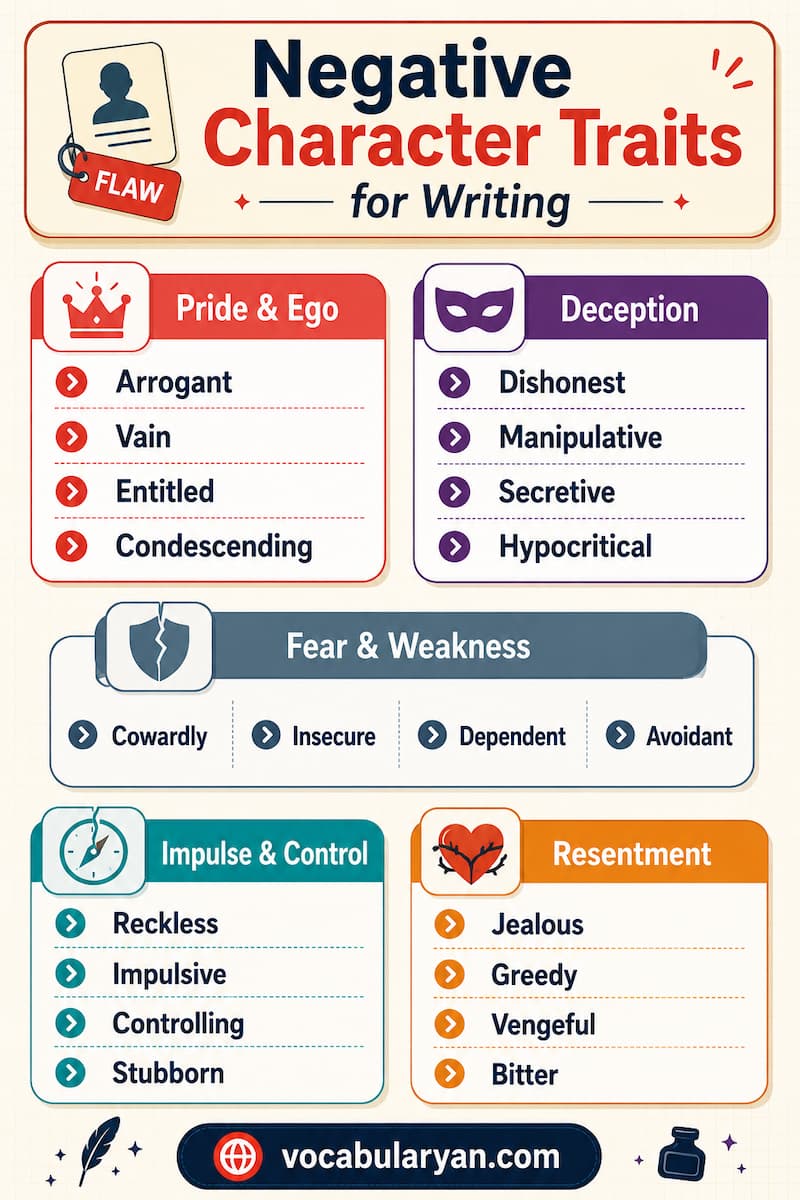
A flawless hero is forgettable. Readers remember the liar who cannot stop, the genius undone by pride, the kind soul wrecked by one private weakness. Negative character traits for writing are the flaws and wounds you hand a character on purpose, the cracks that create conflict, power a story arc, and make an invented person feel real. The right flaw does more work than any strength, since it forces hard choices and opens room to grow or fall. The traits ahead are grouped by the job they do in a story, from small relatable quirks to the fatal flaw that brings a hero down.
💡 Quick answer
Negative character traits for writing are deliberate flaws that give a character depth and drive the plot, such as arrogance, cowardice, jealousy, and cruelty. Writers sort them by role: small relatable quirks, major flaws that cause conflict, dark villain traits, and the fatal flaw that seals a downfall.
Negative Character Traits for Writing believable flaws
Minor Flaws That Make Characters Relatable
The most lovable characters own small flaws that cost little but reveal a lot.
Stubborn: Refuses to yield, sparking friction while showing conviction.
Useful for a hero whose stubbornness both saves and traps them.
Clumsy: Awkward and accident-prone, an easy source of humor and humility.
Lightens a tense scene and keeps a hero human.
Impatient: Hates waiting, pushing characters into rash but readable choices.
Moves a plot forward when someone acts before thinking.
Forgetful: Loses track of details, handy for comedy or quiet tension.
A forgotten promise can raise the stakes without a word.
Blunt: Speaks without softening, creating honest, prickly dialogue.
Gives a side character a memorable, friction-rich voice.
Sarcastic: Hides feeling behind irony, a quick flag for a guarded heart.
A defense that hints at deeper hurt underneath.
Vain: Overly concerned with image, ripe for a humbling moment.
Sets up a satisfying fall and recovery.
Awkward: Socially clumsy, instantly sympathetic.
Earns reader affection in one cringe-worthy scene.
Nosy: Pries into others’ business, a tidy engine for discovery.
Lets a curious character stumble onto the plot’s secret.
Indecisive: Struggles to choose, raising stakes at a crossroads.
Stalls a character right when a decision matters most.
Cynical: Expects the worst, a wry voice that resists easy hope.
Plays well against an idealistic companion.
Proud: Guards dignity fiercely, which complicates simple help.
Refuses the rescue that would have been easy to accept.
Restless: Cannot sit still, pushing a character toward change and risk.
Keeps a story from settling into stillness.
Naive: Trusts too easily, opening the door to betrayal and growth.
He writes off the one person who could have helped.
Callous: Indifferent to others’ pain, careless with the vulnerable.
She delivers the bad news and checks her phone.
Spiteful: Wounds out of petty resentment.
He ruins the surprise simply because he was not invited.
Obsessive: Fixates past all reason, neglecting everything else.
The case consumes her until it costs her family.
Dark Flaws For Villains And Antagonists
A memorable antagonist needs flaws deep enough to threaten the hero, not just to repel the reader.
Cruel: Takes pleasure in others’ pain, the engine of a chilling antagonist.
He lingers over suffering the way others linger over a meal.
Sadistic: Enjoys inflicting harm for its own sake.
Ruthless: Pursues goals without pity, sacrificing anyone in the way.
She trades a loyal follower for a single step forward.
Calculating: Plans every move coldly, treating people as pieces.
Remorseless: Feels no guilt, which makes a villain genuinely frightening.
He sleeps soundly the night after the betrayal.
Power-hungry: Craves control above all, never sated by what they hold.
Vindictive: Devotes themselves to revenge, even at their own ruin.
Deceitful: Lies fluently, wearing trust as a disguise.
Tyrannical: Rules through fear and domination.
Treacherous: Betrays without warning when it serves them.
Malevolent: Wishes active harm on others.
Cold-blooded: Acts with calm, total detachment.
No anger drives him, only arithmetic.
Predatory: Hunts the vulnerable for advantage.
Megalomaniacal: Obsessed with their own greatness and dominion.
Pitiless: Grants no mercy, however small the plea.
Corrupt: Sells out every principle for gain.
Domineering: Crushes any will but their own.
Heartless: Acts without a trace of compassion.
Vicious: Attacks with savage intent.
Conniving: Schemes quietly behind a pleasant face.
Abusive: Controls through cruelty and fear.
Merciless: Refuses leniency at every turn.
Brutal: Solves problems with raw, punishing force.
Bullying: Targets the weaker to feel strong.
Fatal Flaws That Lead To A Character’s Downfall
A fatal flaw is the weakness that decides a character’s ruin, usually a strength pushed too far.
Hubris: Overweening pride that blinds a character to their limits.
The classic tragic flaw: the higher they climb, the harder they fall.
Ambition: A hunger for more that outgrows conscience.
Macbeth’s engine, carrying him from honor to ruin.
Obsession: A fixation that crowds out judgment and care.
Ahab’s whale, the pursuit that swallows the pursuer.
Jealousy: A consuming envy that warps every perception.
Othello’s undoing, turning love into destruction.
Greed: An appetite no amount can satisfy.
Wealth arrives, yet the reach for more brings collapse.
Naivety: A trust so complete it invites the fatal betrayal.
The innocent who never sees the knife until it lands.
Wrath: Rage that overrides reason at the decisive moment.
One unchecked outburst seals an irreversible fate.
Blind loyalty: Devotion that follows a cause past the point of harm.
The follower who cannot see the leader’s corruption.
Cowardice: A failure of nerve that forfeits the crucial moment.
The hesitation that costs everything they meant to protect.
Vanity: Self-regard that mistakes flattery for truth.
The ruler undone by those who tell him only what he wants.
Stubborn pride: A refusal to bend that snaps the character instead.
Lear’s insistence, dividing a kingdom and a mind.
Self-doubt: Crippling uncertainty that forfeits the decisive chance.
The hero who hesitates until the window closes.
Recklessness: A disregard for consequence that finally catches up.
Icarus and the sun, the warning ignored once too often.
Savior complex: A need to rescue that destroys what it means to save.
The hero who sacrifices everyone in order to save them.
Inner Flaws And Emotional Wounds
Behind every visible flaw lies a private wound that explains it.
Fear of abandonment: A dread of being left that breeds clinginess or sabotage.
Fear of failure: An anxiety that drives avoidance or paralyzing perfectionism.
Trust issues: A guardedness that pushes away the very people who could help.
Low self-worth: A belief in one’s own inadequacy that shapes every choice.
Guilt: The weight of past wrongdoing that distorts present decisions.
Shame: A hidden conviction of being fundamentally bad.
Repression: A habit of burying feeling until it erupts.
Need for approval: A dependence on others’ praise to feel worthy.
Insecurity: A shaky sense of self that fuels jealousy and defensiveness.
Bitterness: An old hurt hardened into a worldview.
Denial: A refusal to face an obvious, painful truth.
Perfectionism: An impossible standard that stalls action and invites collapse.
Emotional numbness: A shutdown that keeps others, and growth, at bay.
Inferiority complex: A felt smallness that drives overcompensation.
Loneliness: An isolation that warps how a character reads others.
Grief: An unprocessed loss that colors every decision.
Paranoia: A suspicion that turns allies into imagined enemies.
Resentment: A buried grudge that leaks into present relationships.
Avoidance: A flight from anything hard, which lets problems grow.
Codependency: A self defined entirely through another person.
Self-loathing: A turned-inward contempt that sabotages success.
Hopelessness: A conviction that effort is pointless.
Jadedness: A weary cynicism that dismisses every good thing.
Mistrust: A reflex to doubt motives, even kind ones.
How To Show A Flaw Instead Of Naming It
Naming a flaw outright tells the reader what to think; showing it lets them conclude it themselves, which hits far harder. Instead of writing that a character is arrogant, give them an arrogant action and let the behavior speak. Compare the flat statement with the action that proves it:
Telling
Showing
She was arrogant.
She corrected the waiter’s grammar, then her date’s.
He was a coward.
He let the door close on the shouting behind him.
They were greedy.
He counted the shared tips twice and pocketed the difference.
She was insecure.
She deleted the post after three minutes and no replies.
He was cruel.
He smiled as the new hire hunted for the file he had hidden.
She was dishonest.
She rehearsed the lie in the mirror before the meeting.
Matching Flaws To The Character Arc
A flaw earns its place by shaping the character’s arc. In a redemption arc, the flaw is the obstacle the character slowly overcomes, so a selfish hero learns to sacrifice and the reader feels the change. In a fall arc, the flaw wins: pride, ambition, or obsession tightens until it destroys, which is the shape of tragedy. A flat arc keeps the flaw steady while the character changes the world around them instead. Match the flaw to the arc you want, and decide early whether the character will master the weakness, be mastered by it, or carry it unchanged to the end.
FAQs
Q1. What are negative character traits in writing?
Negative character traits are flaws and weaknesses a writer gives a character to create conflict and depth, such as arrogance, cowardice, jealousy, or cruelty. They make characters feel real, drive the plot through poor choices, and give a protagonist or villain somewhere to grow or fall.
Q2. What are good negative traits for a villain?
Villains work best with deep, active flaws: cruelty, ruthlessness, a hunger for power, and a lack of remorse. The strongest ones still keep a thread of logic or sympathy, since a villain who believes they are right unsettles a reader more than one who is simply evil.
Q3. What is a fatal flaw?
A fatal flaw, or hamartia, is the single weakness that drives a character’s downfall, such as hubris, ambition, or obsession. It often grows from a strength taken too far, which is why tragic heroes feel both admirable and doomed. Left unchecked, the flaw decides their ruin.
Q4. How do I show a character’s flaw instead of telling it?
Reveal the flaw through choices, actions, and dialogue rather than a label. Instead of stating that a character is selfish, let them take the larger share when they think no one is watching. Readers trust what a character does far more than what the narrator claims.
Q5. Should a protagonist have negative traits?
Yes. A flawless protagonist is hard to believe and easy to forget. A meaningful flaw creates internal conflict, makes success feel earned, and gives the character room to grow. The trick is balance: enough flaw to stay human, enough strength to stay worth following.
I’m Ethan Walker, cofounder of Vocabularyan.com. Over 12 years in ESL and English learning, I’ve worked closely with vocabulary practice, learner writing, phrase use, and the sentence habits that shape fluent expression. I write with a practical eye for the English learners meet every day, from study notes to conversations and online writing.