
Everyone has a few rough edges, and naming them clearly is more useful than pretending they are not there. A negative personality trait is a lasting habit of character that strains relationships, stalls growth, or wears on the people nearby. The traits gathered here run from arrogance and dishonesty to laziness and a controlling streak, grouped by the kind of flaw each one represents. Every entry has a short definition, and the trickier families add a glimpse of how the trait shows up in daily life. And because few traits are all bad, several of them double as strengths, depending on the situation.
💡 Quick answer
Negative personality traits are lasting character flaws that harm relationships or hold a person back, such as arrogance, dishonesty, laziness, cruelty, and a controlling streak. Most are expressed as adjectives like arrogant, selfish, or unreliable. Grouping them by family makes the patterns easier to spot in yourself or others.
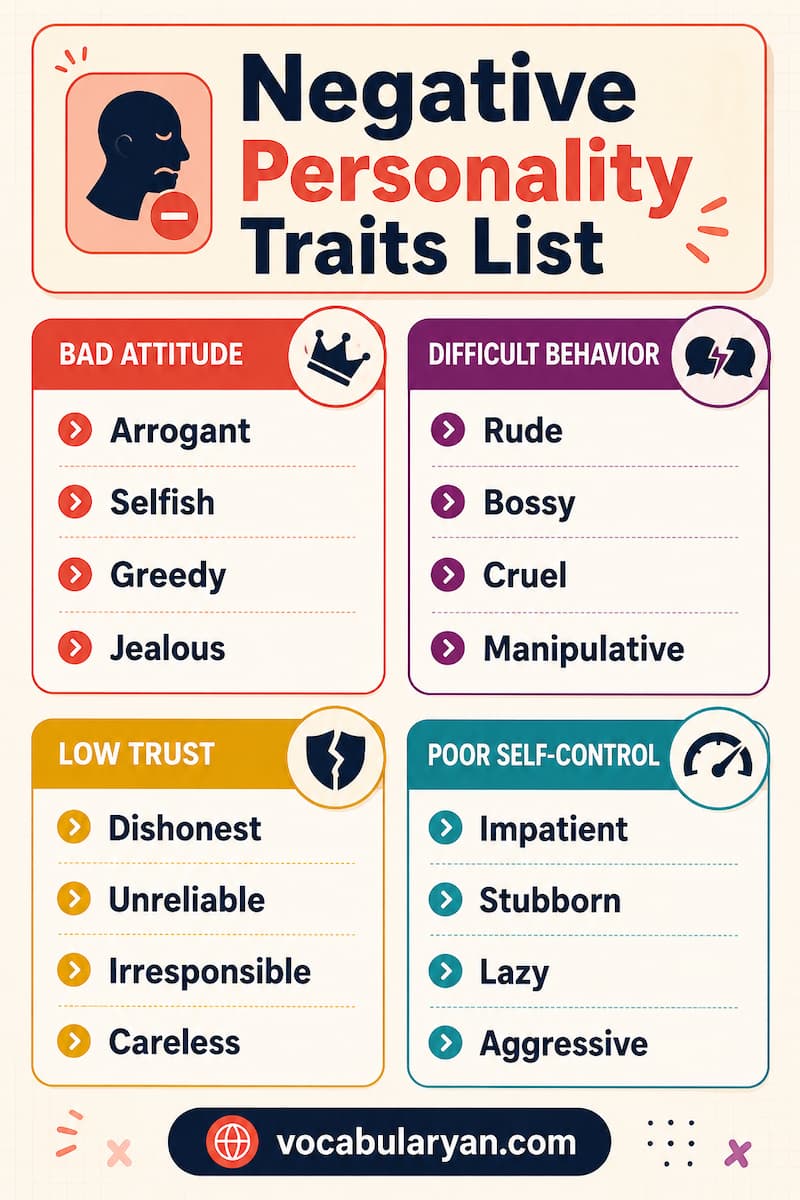
Arrogant And Self-Centered Traits
Pride turns into a flaw when it needs an audience and refuses to share the credit.
- Arrogant: Convinced of one’s own superiority and dismissive of others.
- Interrupts to correct people and rarely concedes a point.
- Conceited: Excessively proud of one’s looks, talent, or worth.
- Steers every conversation back to personal achievements.
- Egotistical: Wrapped up in one’s own importance above all else.
- Measures every event by how it affects them.
- Self-centered: Concerned only with one’s own needs and interests.
- Forgets to ask how anyone else is doing.
- Self-absorbed: Lost in one’s own concerns and blind to others.
- Misses obvious signs that a friend is struggling.
- Vain: Obsessed with appearance or personal image.
- Fishes for compliments and checks every reflection.
- Boastful: Given to bragging about achievements or possessions.
- Turns small wins into long, repeated stories.
- Pompous: Self-important in a stiff, inflated way.
- Lectures the room in a grand tone over trivial points.
- Smug: Quietly and irritatingly pleased with oneself.
- Wears a knowing smile while others scramble.
- Condescending: Talking down to others as though they were inferior.
- Explains the obvious slowly, as if to a child.
- Entitled: Believing one deserves privileges without earning them.
- Expects exceptions to rules that bind everyone else.
- Narcissistic: Excessively self-admiring and hungry for praise.
- Craves constant attention and bristles at criticism.
- Self-righteous: Smugly certain of one’s own moral superiority.
- Judges others freely while excusing the same fault at home.
- Pretentious: Claiming more importance or sophistication than is warranted.
- Name-drops and inflates plain ideas with grand words.
- Snobbish: Looking down on people of lower status.
- Treats service staff as beneath notice.
- Attention-seeking: Constantly angling to be the center of focus.
- Manufactures drama whenever the spotlight drifts away.
Dishonest And Manipulative Traits
- Dishonest: Inclined to lie, cheat, or deceive.
- Bends the truth whenever it serves the moment.
- Deceitful: Practiced at misleading others deliberately.
- Builds a convincing story to cover a simple lie.
- Manipulative: Controlling others through unfair, hidden influence.
- Uses guilt and flattery to steer decisions.
- Sneaky: Acting in a furtive, underhanded manner.
- Goes behind people’s backs rather than asking directly.
- Two-faced: Friendly in person and disloyal in private.
- Praises a colleague aloud, criticizes them by text.
- Hypocritical: Condemning in others what one does oneself.
- Preaches honesty while quietly cutting corners.
- Scheming: Constantly plotting for personal advantage.
- Treats every relationship as a move in a larger game.
- Insincere: Saying what one does not mean.
- Offers hollow compliments and empty promises.
- Calculating: Coldly planning every move for self-interest.
- Weighs people by what they can provide.
- Untrustworthy: Not to be relied on to keep word or confidence.
- Repeats secrets and breaks commitments casually.
- Passive-aggressive: Expressing hostility indirectly rather than openly.
- Agrees out loud, then quietly stalls or undermines.
- Evasive: Dodging straight answers to avoid the truth.
- Meets a direct question with a vague non-answer.
- Flattering: Praising falsely to win favor.
- Lays the compliments on thickest with those in power.
- Disloyal: Quick to betray a person or cause.
- Switches allegiance the moment it pays better.
Cruel And Unkind Traits
Unkindness ranges from cold indifference to active, deliberate harm.
- Cruel: Taking pleasure in causing pain or suffering.
- Callous: Hardened against the feelings of others.
- Heartless: Without compassion or mercy.
- Cold: Emotionally distant and unfeeling.
- Mean: Unkind, unfair, or hurtful in everyday ways.
- Spiteful: Acting out of petty resentment to wound.
- Vindictive: Bent on revenge over a real or imagined wrong.
- Malicious: Driven by a desire to harm.
- Ruthless: Pursuing aims without pity or scruple.
- Vicious: Savage and intent on harm.
- Sadistic: Deriving pleasure from another’s pain.
- Insensitive: Unaware of or unconcerned with others’ feelings.
- Unsympathetic: Offering no compassion or support.
- Hard-hearted: Unfeeling and unwilling to show mercy.
- Bullying: Intimidating those who are weaker.
- Merciless: Refusing any leniency or compassion.
Angry And Hostile Traits
- Bad-tempered: Quick to anger and hard to please.
- Short-tempered: Easily provoked into irritation.
- Irritable: Readily annoyed over small matters.
- Hot-headed: Rash and quick to lose control.
- Aggressive: Forceful and prone to attack or confront.
- Belligerent: Aggressively hostile and ready to fight.
- Combative: Eager for conflict and confrontation.
- Hostile: Openly antagonistic and unfriendly.
- Argumentative: Given to disputing almost anything.
- Confrontational: Seeking out arguments and disputes.
- Volatile: Liable to erupt in temper without warning.
- Moody: Subject to unpredictable shifts of temper.
- Sullen: Silently resentful and gloomy.
- Resentful: Harboring lasting ill will over grievances.
- Bitter: Soured by anger that will not fade.
- Defensive: Quick to take offense and deflect blame.
Controlling And Domineering Traits
A need for control often hides as helpfulness before it hardens into pressure.
- Controlling: Driven to manage and dominate others.
- Dictates choices that are not theirs to make.
- Domineering: Asserting authority in an oppressive way.
- Overrules everyone and tolerates no dissent.
- Bossy: Fond of ordering people around without the standing to.
- Hands out instructions in groups that have no leader.
- Overbearing: Heavy-handed and dismissive of others’ input.
- Steamrolls quieter voices in every meeting.
- Possessive: Treating people as belongings to be guarded.
- Resents a partner’s friendships and free time.
- Demanding: Expecting too much and rarely satisfied.
- Sets impossible standards, then withholds praise.
- Micromanaging: Over-supervising every small detail.
- Rewrites work others were trusted to finish.
- Stubborn: Unreasonably unwilling to change course.
- Refuses to revise a plan even as it fails.
- Inflexible: Rigid and unwilling to adapt.
- Treats any new approach as a personal threat.
- Authoritarian: Demanding strict obedience over cooperation.
- Rules by order rather than agreement.
- Pushy: Aggressively insistent on getting one’s way.
- Pressures people well past a clear no.
- Critical: Quick to fault-find and slow to praise.
- Notices the one flaw and ignores the nine strengths.
Lazy And Unreliable Traits
- Lazy: Unwilling to work or exert effort.
- Idle: Avoiding work or useful activity by choice.
- Complacent: Smugly content and unwilling to improve.
- Careless: Failing to give proper attention or caution.
- Negligent: Careless about duties and responsibilities.
- Unreliable: Not to be depended on to follow through.
- Irresponsible: Failing to meet duties or face consequences.
- Flaky: Prone to canceling, forgetting, or backing out.
- Disorganized: Unable to keep order or manage tasks.
- Forgetful: Frequently failing to remember obligations.
- Procrastinating: Habitually delaying what should be done.
- Indecisive: Unable to settle on a choice.
- Aimless: Drifting without purpose or direction.
- Unmotivated: Lacking the drive to begin or finish.
Negative And Pessimistic Traits
A sour outlook spreads, draining the people around it as much as the person who holds it.
- Pessimistic: Always expecting the worst outcome.
- Cynical: Distrustful of others’ motives and goodness.
- Negative: Quick to focus on problems over possibilities.
- Defeatist: Giving up before a real attempt.
- Gloomy: Persistently low and joyless in outlook.
- Whiny: Given to constant complaint.
- Self-pitying: Dwelling on one’s own misfortune.
- Ungrateful: Failing to value what one has or receives.
- Jaded: Worn cynical and unenthused by experience.
- Fatalistic: Resigned to a fixed, hopeless fate.
- Discouraging: Quick to dampen others’ hopes.
- Joyless: Unable to take pleasure in things.
- Sour: Habitually sullen and unpleasant in mood.
Insecure And Difficult Emotional Traits
- Insecure: Lacking confidence and easily threatened.
- Needy: Demanding constant reassurance and attention.
- Clingy: Unable to give others room to breathe.
- Jealous: Threatened by a rival’s advantage or closeness.
- Envious: Resentful of what others have.
- Oversensitive: Wounded by the mildest criticism.
- Thin-skinned: Easily offended.
- Anxious: Chronically worried and on edge.
- Paranoid: Distrustful and suspicious without real cause.
- Self-doubting: Persistently unsure of one’s own worth.
- Approval-seeking: Dependent on others’ approval to feel worthy.
- Self-critical: Relentlessly harsh on oneself.
- Victim-minded: Consistently casting oneself as the wronged party.
- Touchy: Quick to take offense over little.
Rude And Antisocial Traits
Poor social manners read as disrespect even when no harm is meant.
- Rude: Disrespectful and ill-mannered.
- Tactless: Blunt without regard for feelings.
- Disrespectful: Showing no regard for others.
- Inconsiderate: Thoughtless about others’ needs.
- Obnoxious: Loudly and offensively unpleasant.
- Abrasive: Harsh and grating in manner.
- Crude: Coarse and offensive in speech or behavior.
- Aloof: Distant and unwilling to engage.
- Standoffish: Unfriendly and keeping people at a distance.
- Antisocial: Avoiding others, or hostile to social norms.
- Dismissive: Brushing aside others and their views.
- Brash: Loud, tactless, and overly self-assertive.
- Judgmental: Quick to condemn others harshly.
- Gossipy: Given to spreading talk about others.
Traits That Sound Negative But Can Be Strengths
Context decides whether a trait reads as a fault or a strength.
| Trait | Possible strength |
|---|---|
| Headstrong | Determined |
| Blunt | Honest |
| Perfectionist | Conscientious |
| Competitive | Driven |
| Impulsive | Spontaneous |
| Opinionated | Confident |
| Proud | Self-respecting |
| Overcautious | Careful |
| Talkative | Outgoing |
| Serious | Focused |
| Sensitive | Empathetic |
| Reserved | Thoughtful |
| Restless | Energetic |
| Skeptical | Discerning |
How To Recognize And Work On Negative Traits
No single trait defines a person, and almost every flaw on this page has a milder, workable version. The useful move is honest observation rather than harsh self-judgment: notice when a trait shows up, what tends to trigger it, and who it affects. Most traits soften through small, repeated choices instead of grand resolutions, so one paused reply or one admitted mistake does more than a vow to change overnight. If a pattern feels stuck or distressing, a counselor or a trusted friend can help more than any checklist, and there is no shame in asking.
FAQs
Negative personality traits are enduring habits of character viewed as undesirable, such as arrogance, dishonesty, laziness, cruelty, and a controlling streak. They differ from passing bad moods because they persist across situations and shape how a person treats others over time.
Common ones are arrogant, selfish, dishonest, manipulative, lazy, unreliable, cruel, bad-tempered, controlling, and rude. Subtler ones are passive-aggressive, needy, cynical, and self-righteous. Each names a recurring pattern of behavior rather than a single bad day.
Arrogance, selfishness, dishonesty, and a quick temper top most lists, since they surface often and strain relationships fast. Laziness, rudeness, and a controlling streak follow close behind. These show up across work, family, and friendships more than rarer flaws do.
Often, yes. Stubbornness shades into determination, bluntness into honesty, and a competitive streak into drive, depending on the setting and the degree. The same intensity that causes friction in one context fuels achievement in another, so balance and timing decide which side shows.
Yes, though slowly. Traits soften through steady self-awareness and small repeated choices rather than single resolutions. Noticing the trigger, pausing before the usual reaction, and inviting honest feedback all help. For patterns that feel stuck or distressing, a counselor can offer more than any list.