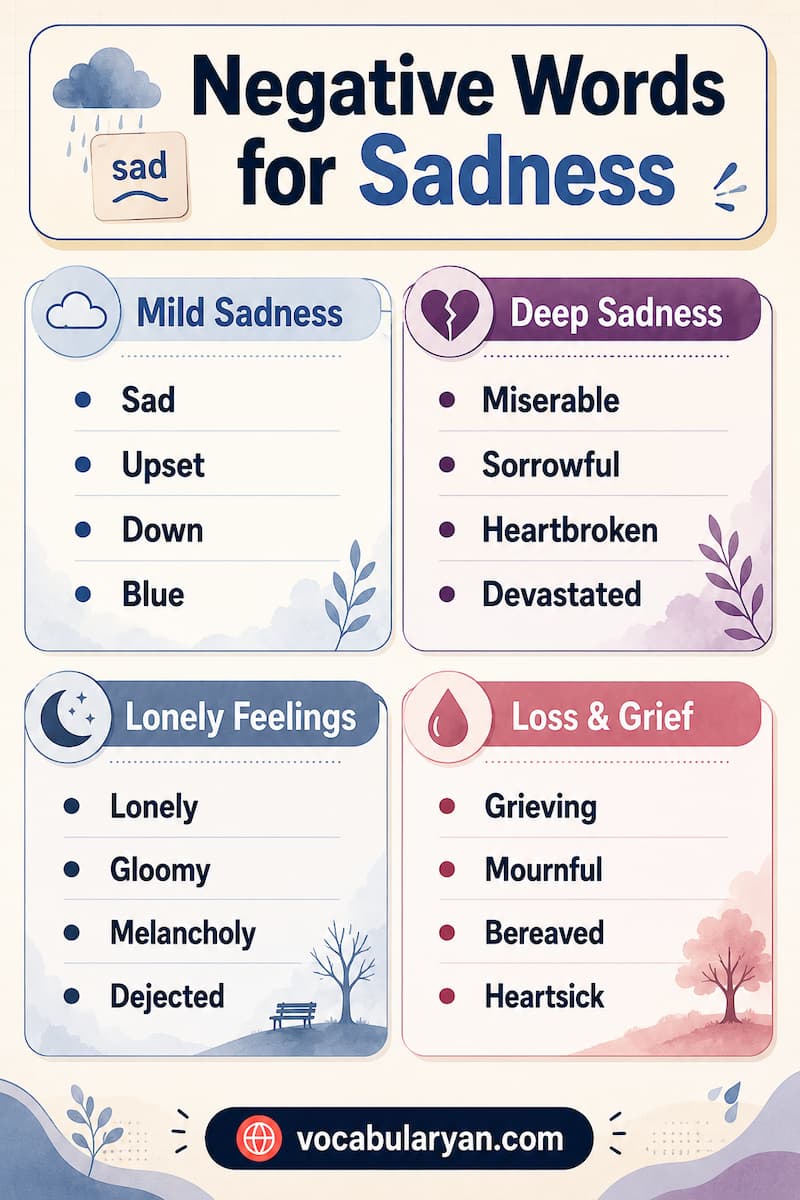
Sadness is not one thing. The quiet blue that arrives on a gray afternoon is nothing like the grief that follows a loss, and neither resembles the longing that surfaces years later at a familiar song. English gives each shade its own word, and the right one matters because sad alone flattens what deserves precision. Negative words for sadness run from mild and passing to heavy and enduring, from a glum mood to devastation, from wistfulness to desolation. The words ahead are grouped by shade and intensity, so the exact pitch of a feeling, or a scene, is quick to name.
💡 Quick answer
Negative words for sadness range from mild (blue, glum, downhearted) through the middle ground (melancholy, dejected, mournful) to heavy grief (grief-stricken, inconsolable, desolate). They also cover specific sadness types: longing, regret, despair, and literary grief. Choosing the right word means matching it to the actual shade and intensity of the feeling.
Negative Words for Sadness with emotional meanings
Mild Sadness: Blue, Low, And Downcast
These words name a sadness that sits lightly, the kind that passes with a change of weather or company.
Blue(adj.): quietly down and low in spirit.
He had been blue since the summer ended.
Low(adj.): sunk in poor, flat spirits.
She felt low through the long, dark week.
Down(adj.): feeling below one’s usual mood.
He seemed down but could not say why.
Glum(adj.): gloomy and silent with mild sadness.
A glum crowd filed out of the theater.
Downcast(adj.): looking or feeling disheartened.
She arrived downcast after the interview.
Unhappy(adj.): not content or at ease.
He was unhappy with the outcome but said nothing.
Downhearted(adj.): low in spirit and discouraged.
She felt downhearted reading the third rejection.
Dispirited(adj.): having lost enthusiasm and energy.
The dispirited team dragged through the last hour.
Cheerless(adj.): without warmth or any joy.
A cheerless afternoon stretched ahead of him.
Joyless(adj.): stripped of pleasure or happiness.
The celebration felt joyless without her there.
Dismal(adj.): causing or reflecting gloom.
A dismal mood settled in with the rain.
Gloom(n.): a sense of sadness and darkness.
Gloom hung over the office after the announcement.
Blues(n.): a mild, familiar sadness.
The winter blues arrived ahead of the solstice.
Funk(n.): a state of low, listless sadness.
He had been in a funk all week and could not shake it.
Flatness(n.): a dull, emotionless low.
A strange flatness followed the end of the project.
Deeper Sadness: Melancholy, Gloom, And Dejection
Here the sadness has weight and stays longer, coloring the whole day rather than an hour.
Melancholy(adj.): touched by a gentle, lingering sadness.
A melancholy mood settled over her each autumn.
Mournful(adj.): expressing or carrying deep grief.
A mournful tune drifted from the next room.
Sorrowful(adj.): filled with deep, genuine sorrow.
A sorrowful look crossed her face at the news.
Dejected(adj.): low and discouraged after disappointment.
The team looked dejected after the final whistle.
Crestfallen(adj.): suddenly and visibly deflated by a setback.
He turned crestfallen when his name was skipped.
Woeful(adj.): full of woe and misery.
His woeful expression said more than any words.
Heavy-hearted(adj.): weighed down by sadness.
She left the hospital heavy-hearted.
Disconsolate(adj.): unable to be comforted.
He sat disconsolate by the window for hours.
Gloomy(adj.): sunk in a dark, joyless feeling.
He sat gloomy and silent through the whole meal.
Lugubrious(adj.): excessively mournful, often with a heavy solemnity.
He delivered the news in a lugubrious tone.
Doleful(adj.): expressing sorrow with a plaintive quality.
A doleful look followed every cheerful attempt.
Subdued(adj.): quieted and low, with sadness held inward.
The mood at the table was subdued and careful.
Melancholy(n.): a deep, thoughtful sadness.
A melancholy she could not name settled in with the dusk.
Dejection(n.): low spirits after disappointment.
Dejection settled over the team before anyone spoke.
Heaviness(n.): a felt weight of sadness pressing on the spirit.
A heaviness had settled in her chest since the news arrived.
Gloominess(n.): a prevailing dark and sad atmosphere.
A gloominess had crept into the house over the winter.
Woe(n.): great sorrow or distress.
The tale was full of woe and bad timing.
Dolor(n.): a poetic word for deep sadness and grief.
The letter carried a quiet dolor between every line.
Grief And Profound Loss
These words belong to sadness at its deepest, the kind tied to loss, death, and devastation.
Grief-stricken(adj.): overwhelmed by grief.
The grief-stricken family stood together at the graveside.
Heartbroken(adj.): crushed by loss or devastating disappointment.
She was heartbroken when the call did not come.
Bereaved(adj.): suffering the loss of a loved one.
The bereaved mother sat quietly through the service.
Inconsolable(adj.): beyond any comfort or consolation.
He was inconsolable for days after the loss.
Devastated(adj.): completely destroyed emotionally by a loss.
She was devastated by the diagnosis.
Bereft(adj.): desolately sad through loss and deprivation.
He felt utterly bereft in the weeks that followed.
Distraught(adj.): deeply upset and unable to be calmed.
She was distraught and could not be reached.
Broken(adj.): shattered emotionally by loss.
He sounded broken on the phone that night.
Shattered(adj.): broken into pieces emotionally.
She was shattered by the end of the marriage.
Raw(adj.): painfully new and unhealed.
The loss still felt raw a year later.
Grief(n.): deep sorrow, especially from bereavement.
Her grief was too large for condolences to touch.
Sorrow(n.): a deep feeling of distress from loss or hurt.
A quiet sorrow had lived in him since the accident.
Bereavement(n.): the state of having lost a loved one.
Bereavement visited the family twice in one winter.
Heartache(n.): a dull, persistent emotional pain from loss.
The heartache of the breakup stayed for months.
Heartbreak(n.): the acute pain of a devastating loss.
Heartbreak arrived slowly, then all at once.
Anguish(n.): severe and prolonged emotional pain.
She tried to keep the anguish from her voice.
Desolation(n.): utter emptiness and loneliness in grief.
The desolation in his eyes said everything.
Affliction(n.): a cause of persistent grief and suffering.
The loss had become a lasting affliction.
Longing And Wistfulness
A softer, aching sadness tied to absence and the past.
Wistful(adj.): gently sad with longing for something gone.
Nostalgic(adj.): aching for the past with bittersweet sadness.
Pining(adj.): wasting with longing for someone or something.
Yearning(adj.): filled with deep, aching desire.
Homesick(adj.): longing for home with a particular sadness.
Lonesome(adj.): sad through solitude and longing.
Achingly(adv.): in a way that stirs a deep, poignant sadness.
Wistfulness(n.): a gentle sadness touched by longing.
Nostalgia(n.): a bittersweet ache for the past.
Longing(n.): a deep and persistent desire for what is absent.
Yearning(n.): an intense aching desire.
Homesickness(n.): the pain of being far from home.
Pining(n.): the act of weakening with longing.
Ache(n.): a dull, continuous emotional pain.
Regret And Remorse
Sadness pointed at the past, at choices made and chances lost.
Regretful(adj.): feeling sorrow about something done or undone.
Remorseful(adj.): filled with deep guilt for a wrong.
Rueful(adj.): feeling or expressing regret with a wry sadness.
Contrite(adj.): genuinely sorry and wishing to make amends.
Penitent(adj.): feeling and showing sorrow for wrongdoing.
Guilt-ridden(adj.): consumed by guilt over a past act.
Regret(n.): sorrow over something past that cannot be changed.
Remorse(n.): deep, painful guilt for a wrong done.
Rue(n.): bitter regret.
Contrition(n.): sincere sorrow and willingness to make amends.
Guilt(n.): the feeling of responsibility for a wrong.
Self-reproach(n.): blaming oneself for past actions.
Compunction(n.): a slight but genuine feeling of guilt.
Repentance(n.): deep sorrow and the wish to change.
Despair And Hopelessness
When sadness deepens past grief into the belief that nothing will improve.
Despairing(adj.): drained of all hope.
Hopeless(adj.): certain that nothing will improve.
Desolate(adj.): utterly empty and without comfort.
Forlorn(adj.): pitifully sad and without hope.
Defeated(adj.): brought low past the point of trying.
Broken-hearted(adj.): so deeply grieved as to be without hope.
Despondent(adj.): deeply low and without hope of change.
Pessimistic(adj.): expecting the worst always.
Despair(n.): the complete absence of hope.
Hopelessness(n.): the state of believing nothing will improve.
Resignation(n.): passive acceptance of what cannot be changed.
Abyss(n.): a depthless emotional darkness beyond ordinary grief.
Wretchedness(n.): a state of deep misery and low spirits.
Misery(n.): a condition of great unhappiness and distress.
Despondency(n.): a state of low spirits from loss of hope.
Literary And Expressive Sadness Words
These words come from literature, poetry, and formal registers, where sadness earns its most precise names.
Elegiac(adj.): expressing mournful sorrow, as in an elegy.
The film had an elegiac quality that lingered after the credits.
Plaintive(adj.): having a mournful, sad sound or quality.
A plaintive cry carried across the empty harbor.
Lachrymose(adj.): tearful or given to weeping.
He grew lachrymose at the slightest reminder.
Poignant(adj.): evoking a keen sense of sadness.
The reunion was poignant, marked by all that had been lost.
Dysphoric(adj.): in a state of unease and profound unhappiness.
A dysphoric quality ran through the whole second act.
Dolorous(adj.): feeling or expressing great sorrow.
A dolorous mood settled over the gathering.
Heartrending(adj.): causing intense grief or distress.
The testimony was heartrending and hard to follow.
Lamentable(adj.): worthy of grief and lamentation.
The loss was a lamentable end to a brilliant career.
Dirge-like(adj.): slow and mournful, like a funeral song.
The music turned dirge-like toward the close.
Funereal(adj.): dark and solemn, like a funeral.
A funereal quiet settled over the waiting room.
Saturnine(adj.): gloomy and melancholy in a fixed way.
He had a saturnine manner that rarely lifted.
Sepulchral(adj.): hollow and gloomy, suggestive of a tomb.
His sepulchral voice filled the silent hall.
Lamentation(n.): an expression of passionate grief.
The poem reads as a lamentation for the lost generation.
Dirge(n.): a slow, mournful song of grief.
The piece was played as a dirge at the memorial.
Elegy(n.): a mournful poem or song for the dead.
He wrote an elegy for his brother that nobody read.
Requiem(n.): a musical composition for the dead.
The choir performed a requiem at the close of the service.
Sadness Verbs: How Sadness Moves
Verbs put sadness into motion, showing what a person does when the feeling takes hold.
Grieve: to feel or express grief deeply.
She grieved quietly, telling no one for weeks.
Mourn: to feel and show sorrow for a loss.
The city mourned for days after the accident.
Weep: to cry from grief or sorrow.
He wept in the car where no one could see.
Lament: to express grief or deep regret aloud.
She lamented the years wasted on the wrong path.
Sorrow: to feel sorrow.
He sorrowed over the falling out long after it was over.
Despair: to lose all hope.
She nearly despaired of ever getting an answer.
Pine: to waste with longing for something absent.
He pined for the old city years after the move.
Yearn: to ache with deep desire for something lost.
She yearned for a life she had let slip past.
Ache: to feel a dull, continuous emotional pain.
He ached with a sadness he could not name.
Brood: to dwell in dark, sad thoughts.
She brooded over the conversation for days.
Rue: to bitterly regret.
He rued every word he had said that night.
Languish: to lose vitality and grow sad under difficult conditions.
She languished through the long, empty months.
Suffer: to endure sadness and pain.
He had been suffering quietly for longer than anyone knew.
Agonize: to feel mental anguish.
She agonized over what she had not said.
From Blue To Inconsolable: A Sadness Intensity Scale
The scale matters as much as the shade. Devastated belongs to a shattering loss, not a missed appointment, and reaching for the heaviest word too early leaves nowhere to go when the feeling deepens. The shade matters too: wistful carries gentle longing, while mournful carries formal weight, and each fits a different moment. In writing, the words that hit hardest tend to be the precise ones placed at the right pitch, a character who is bereft after a death, forlorn after an abandonment, rueful after a regret. One well-chosen word does more than a sentence of explanation. And two clinical words deserve care: depression names a medical condition, not a bad week, and grief is specific to loss, not general disappointment.
FAQs
Q1. What are negative words for sadness?
Negative words for sadness are nouns, adjectives, and verbs that name or describe an unpleasant emotional state of unhappiness, from mild (blue, glum) through sorrow and melancholy to deep grief (heartbroken, inconsolable, grief-stricken) and despair. They also cover specific sadness types such as longing, regret, and bereavement.
Q2. What is the difference between grief and sorrow?
Grief is tied to a specific loss, especially bereavement, and carries urgency and rawness. Sorrow is broader and quieter, a deep sadness that does not require a single cause and often implies a lingering sense of loss or guilt. Merriam-Webster draws the line this way: grief is poignant sorrow for an immediate cause; sorrow implies a sense of loss or remorse.
Q3. What are literary words for sadness?
Strong literary choices are elegiac, plaintive, dolorous, lachrymose, poignant, and sepulchral for adjectives, and lamentation, dirge, elegy, and requiem for nouns. These carry formal or poetic weight and suit written prose, poetry, and fiction better than casual conversation.
Q4. How do I describe sadness in writing without just saying sad?
Choose a word that names the specific shade: wistful for gentle longing, mournful for grief with solemnity, devastated for crushing loss, desolate for emptiness beyond comfort. Then pair it with a verb that shows the sadness in motion, so a character who broods, languishes, or weeps shows the emotion rather than naming it.
Q5. What is the difference between sadness and depression?
Sadness is a natural emotional response to loss, disappointment, or difficulty, and it passes. Depression is a clinical condition involving persistent low mood, loss of interest, and physical symptoms that extend well beyond a difficult event. Using depressed to describe ordinary sadness flattens a word that carries real clinical weight.
I’m Ethan Walker, cofounder of Vocabularyan.com. Over 12 years in ESL and English learning, I’ve worked closely with vocabulary practice, learner writing, phrase use, and the sentence habits that shape fluent expression. I write with a practical eye for the English learners meet every day, from study notes to conversations and online writing.