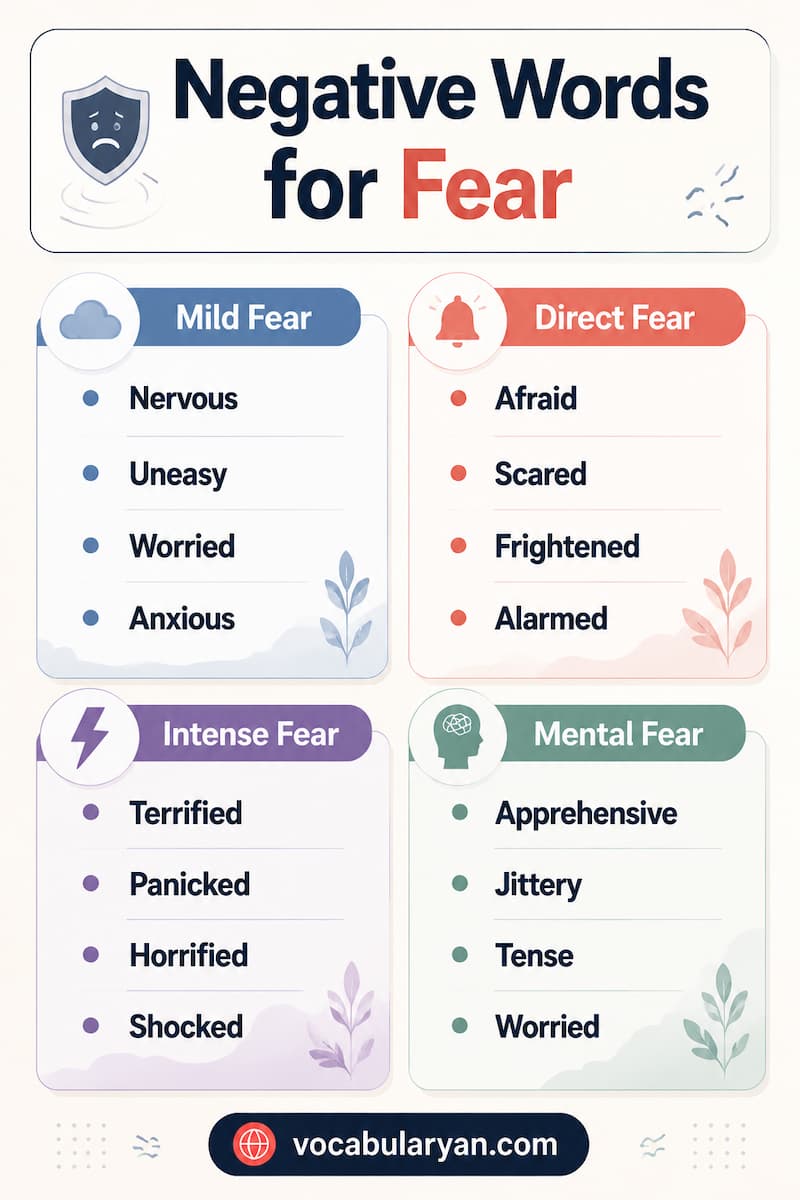
Fear is not one feeling. The flutter before a difficult conversation sits nowhere near the paralysis of genuine terror, and neither resembles the slow, heavy dread of something known to be coming. English gives each pitch its own word, and the right one matters because scared alone flattens a spectrum that runs from mild unease all the way to horror. Negative words for fear cover that full range: the body’s first warning signals, the mounting anxiety of anticipation, the specific fears that attach to places and people, and the full crash of terror. The words ahead are grouped by intensity and type, so the exact shade is always within reach.
💡 Quick answer
Negative words for fear range from mild (uneasy, wary, nervous) through moderate (anxious, apprehensive, dread-filled) to intense (terrified, petrified, horror-stricken). They also cover specific fear types such as phobia, paranoia, and existential dread, and physical responses such as trembling and cold sweat. Matching the word to the actual intensity makes fear feel precise and real.
Negative Words for Fear with examples
Mild Fear: Uneasy, Wary, And Nervous
At this end of the scale, fear has not yet announced itself. It is a quiet signal, a wariness, a tension in the shoulders.
Uneasy(adj.): unsettled and faintly troubled without a clear cause.
Something about the silence left her uneasy.
Wary(adj.): cautiously alert to possible danger.
He kept a wary eye on the stranger across the room.
Nervous(adj.): tense and mildly afraid of what may come.
She had been nervous since the message arrived.
Jittery(adj.): shaky and on edge with mild fear.
Too much waiting had made him jittery by noon.
Jumpy(adj.): startled easily by small things.
She was jumpy all evening after the strange call.
Skittish(adj.): easily alarmed and difficult to settle.
The new recruit stayed skittish around the senior staff.
Timid(adj.): lacking courage and easily frightened.
Fear reads most powerfully through the body, not the label. A character who is terrified tells the reader what to feel; a character whose hands will not hold the key, who finds the staircase suddenly very long, makes the reader feel it. Match the vocabulary to the intensity: nervous and uneasy for early threat, apprehension and dread for the build, terrified and petrified for the peak. The best fear scenes use physical verbs, flinched, froze, recoiled, cowered, and hold the noun terror until the moment it will land hardest. One well-placed shudder or a jaw gone slack often carries more than a sentence announcing how afraid the character is.
FAQs
Q1. What are negative words for fear?
Negative words for fear are nouns, adjectives, and verbs that name or describe an unpleasant state of being afraid, from mild (uneasy, wary) through moderate (anxious, apprehensive, dread) to intense (terrified, petrified, horror-stricken). They also cover specific fear types such as phobia and paranoia, and physical responses such as trembling and cold sweat.
Q2. What is the difference between fear and dread?
Fear is the general term for painful agitation at the presence of danger. Dread adds a heavy reluctance and aversion, the knowledge of something coming that one cannot face. Merriam-Webster draws the line precisely: fear implies anxiety and loss of courage; dread usually adds the idea of intense reluctance to face the thing feared.
Q3. What is the difference between terror and horror?
Terror implies the most extreme degree of fear, a total, overmastering response to immediate danger. Horror combines extreme fear with revulsion or moral shock, the response to something that violates as well as threatens. A dark room produces terror; what is found in it produces horror.
Q4. How do I describe fear in writing without just saying scared or afraid?
Work through the body and through behavior. Use physical verbs (froze, flinched, recoiled, quaked) and physical details (clammy hands, a jaw gone slack, a heart that will not slow). Grade the vocabulary to the intensity of the moment, saving terrified and petrified for peaks, and using apprehensive or uneasy for the build that precedes them.
Q5. What are words for mild fear?
Mild fear is well served by uneasy, wary, nervous, jittery, jumpy, skittish, and hesitant. For nouns, unease, wariness, misgiving, and qualm all name low-level fear without overstating it. These words fit the opening of a tense scene, where the threat has not yet fully revealed itself.
I’m Ethan Walker, cofounder of Vocabularyan.com. Over 12 years in ESL and English learning, I’ve worked closely with vocabulary practice, learner writing, phrase use, and the sentence habits that shape fluent expression. I write with a practical eye for the English learners meet every day, from study notes to conversations and online writing.