
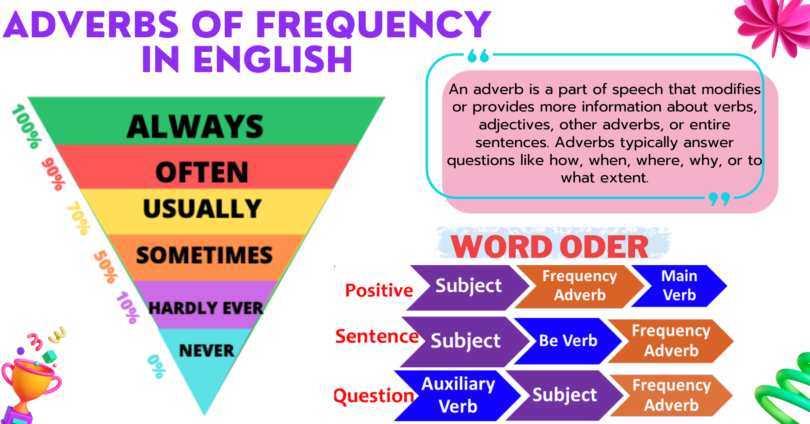
An adverb of frequency answers the question how often, showing how regularly an action happens. English splits these words into two categories: definite frequency, which names an exact interval, and indefinite frequency, which gives an approximate sense of regularity instead. Placement follows five positions, and a handful of genuine mistakes are worth naming directly.
What an Adverb of Frequency Does in a Sentence
An adverb of frequency modifies a verb and answers how often an action happens, splitting into two categories depending on how precisely it names the interval.
- Definite frequency adverbs: name an exact interval.
- Indefinite frequency adverbs: give an approximate sense of regularity.
Definite frequency names a number. Indefinite frequency names a sense of regularity instead. The five placement rules further on apply mainly to indefinite frequency adverbs, since definite ones behave more like ordinary time expressions.
Types of Frequency Adverbs
Two categories organize frequency adverbs by how precisely each one names the interval.
Definite Frequency Adverbs
A definite frequency adverb names an exact interval: hourly, daily, weekly, monthly, yearly, every hour.
- The team meets weekly.
- Maya checks the mailbox daily.
- The magazine publishes monthly.
A definite frequency adverb can also combine with a number to name a precise count: twice a week, three times a year. Both forms answer how often with an exact figure rather than a general sense of regularity.
Some words that name a single, eventual outcome, such as eventually, answer a different question and belong to the sequence category covered in the adverbs of time lesson instead, since they describe when something finally happens rather than how often it repeats.
Indefinite Frequency Adverbs
An indefinite frequency adverb gives an approximate sense of regularity rather than an exact interval. The words form a scale from constant to none.
- Always (100 percent)
- Usually (80 to 90 percent)
- Often (60 to 70 percent)
- Sometimes (30 to 50 percent)
- Occasionally (20 to 30 percent)
- Rarely or seldom (5 to 10 percent)
- Never (0 percent)
- Maya always checks her email before breakfast.
- Maya rarely skips breakfast.
These percentages describe a relative scale, not a measured statistic. No study assigns often an exact value; the ranges only show how the words rank against each other, from constant to none.
Where to Place an Adverb of Frequency in a Sentence
Five rules cover most indefinite frequency adverb placement.
Most indefinite frequency adverbs come before the main verb.
- Maya always checks her email.
- Maya rarely skips breakfast.
They follow a form of be: am, is, are, was, were.
- Maya is usually on time.
- The results were often surprising.
When a helping verb is present, the adverb follows the first one.
- Maya has never been to Paris.
- Maya should always wear a seatbelt.
For emphasis, an indefinite frequency adverb can open the sentence.
- Always wash your hands before a meal.
- Sometimes Maya walks to work instead of driving.
Less commonly, it can close the sentence instead.
- Maya visits her grandparents occasionally.
Definite frequency adverbs behave differently. They close the sentence by default, since they function more like a time expression than a mid-sentence modifier.
- The team meets weekly.
- For emphasis, they can open the sentence instead: Weekly, the team reviews its goals.
Full List of Frequency Adverbs
The table groups every frequency adverb by category, with no word repeated and no definite interval misfiled as indefinite.
| Category | Frequency Adverbs |
|---|---|
| Definite | Hourly, daily, weekly, monthly, yearly, every hour, every day, twice a week |
| Indefinite | Always, usually, often, frequently, regularly, normally, sometimes, occasionally, rarely, seldom, hardly ever, never |
Adverbs of Frequency Comparison Chart
The comparison chart organizes each category by test and example, keeping every cell to one short phrase so the chart stays readable on a small screen.
| Category | Test | Example |
|---|---|---|
| Definite | Names an exact interval | Weekly in The team meets weekly |
| Indefinite, high | Names frequent, near-constant regularity | Always in Maya always checks her email |
| Indefinite, moderate | Names occasional, mid-range regularity | Sometimes in Maya sometimes walks to work |
| Indefinite, low | Names rare or absent regularity | Never in Maya never skips breakfast |
How to Identify Adverbs of Frequency
Five steps convert the rules into a method you run on any sentence:
- Find the word answering how often.
- Check whether it names an exact interval or an approximate one.
- Check its position relative to the verb, be, or an auxiliary.
- Check that no second frequency adverb contradicts it.
- Check that it does not conflict with a stated interval elsewhere in the sentence.
Common Mistakes With Adverbs of Frequency
Four confusions repeat across worksheets and grammar sites, and catching them keeps you from mislabeling a frequency adverb you already understand.
Maya checks her email always. ❌ Maya always checks her email, since an indefinite frequency adverb comes before the main verb rather than after it. ✅
Maya always sometimes cooks dinner. ❌ Maya sometimes cooks dinner, since two frequency adverbs in one clause contradict each other. ✅
Maya always visits her grandparents every month. ❌ Maya often visits her grandparents every month, since always contradicts the stated monthly interval. ✅
Often, do you visit your grandparents? ❌ How often do you visit your grandparents? completes the question correctly, since English asks about frequency this way rather than fronting the adverb before the subject. ✅
Maya not always agrees with the plan. ❌ Maya does not always agree with the plan, since a negative sentence needs the auxiliary does before not rather than placing not directly before the frequency adverb. ✅
Adverb of Frequency Practice Questions
Test the five-step method against nine sentences before checking your answers.
- Classify weekly in The team meets weekly.
- Classify always in Maya always checks her email.
- Where does usually go in Maya is on time?
- Where does never go in Maya has been to Paris?
- Correct the error in Maya checks her email always.
- Correct the error in Maya always sometimes cooks dinner.
- Correct the error in Maya always visits her grandparents every month.
- Form a question asking how often Maya visits her grandparents.
- Correct the error in Maya not always agrees with the plan.
Answers
- Weekly functions as a definite frequency adverb, since it names an exact interval.
- Always functions as an indefinite frequency adverb, since it names near-constant regularity.
- Usually follows is: Maya is usually on time.
- Never follows the auxiliary has: Maya has never been to Paris.
- The correct sentence is Maya always checks her email, since the adverb comes before the main verb.
- The correct sentence is Maya sometimes cooks dinner, since two frequency adverbs in one clause contradict each other.
- The correct sentence is Maya often visits her grandparents every month, since always contradicts the stated monthly interval.
- How often does Maya visit her grandparents? completes the question correctly, since English asks about frequency this way rather than fronting the adverb itself.
- The correct sentence is Maya does not always agree with the plan, since the negative needs the auxiliary does before not rather than placing not directly before the frequency adverb.
FAQs
Q2. What is the difference between definite and indefinite frequency adverbs?
A definite frequency adverb names an exact interval, as in The team meets weekly. An indefinite frequency adverb gives an approximate sense of regularity instead, as in Maya always checks her email, without naming a specific number of times.
Q3. Where do you place an adverb of frequency in a sentence?
An indefinite frequency adverb comes before the main verb by default, as in Maya always checks her email, or after a form of be or an auxiliary, as in Maya is usually on time and Maya has never been to Paris. A definite frequency adverb closes the sentence by default, as in The team meets weekly.
Q4. Can you use two frequency adverbs in one sentence?
Not in the same clause. Two frequency adverbs describing the same action, as in Maya always sometimes cooks dinner, contradict each other. Use one frequency adverb per clause instead.
Q5. Why is “she always visits her grandparents every month” incorrect?
Always means near-constant regularity, while every month names a specific, less frequent interval, and the two conflict. The correct sentence replaces always with a word that matches the stated interval, such as often: She often visits her grandparents every month.
Q1. What are examples of adverbs of frequency?
Common examples include always, usually, often, sometimes, rarely, and never, which name an approximate sense of regularity, alongside daily, weekly, and monthly, which name an exact interval. Compound phrases such as hardly ever and once a week work the same way as their single-word counterparts.

Leave a Comment