
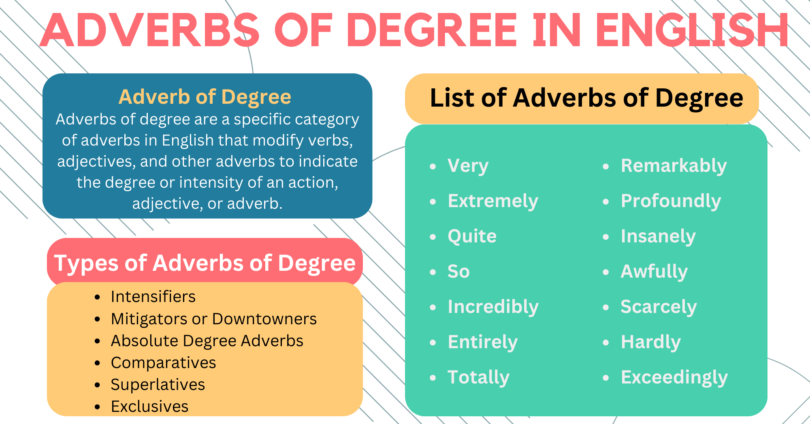
An adverb of degree answers the question how much or to what extent, showing the intensity of an adjective, a verb, or another adverb. English splits these words into two categories: intensifiers, which increase intensity, and downtoners, which decrease it. Most degree adverbs come before the word they modify, though one common word, enough, reverses that pattern entirely.
What an Adverb of Degree Does in a Sentence
An adverb of degree modifies an adjective, a verb, or another adverb, answering how much or to what extent.
- Intensifiers: increase the intensity of the word they modify.
- Downtoners: decrease the intensity of the word they modify.
Most degree adverbs come before the word they modify. Enough is the one common exception, and it comes after instead.
Types of Degree Adverbs
Two categories organize degree adverbs by whether they raise or lower intensity.
Intensifiers
An intensifier increases the intensity of the word it modifies: very, extremely, absolutely, completely, really, incredibly, so, too.
- Maya is very tired.
- The exam was extremely difficult.
- Maya was so surprised that she dropped her phone.
Too differs from other intensifiers: it signals a problem, not just a high degree. The coffee is very hot states a fact, while The coffee is too hot means the heat causes an issue, such as being undrinkable.
Some intensifiers pair specifically with extreme adjectives rather than ordinary ones. Absolutely, completely, entirely, and utterly fit words like freezing, exhausted, or fantastic, while very fits ordinary adjectives like cold, tired, or good.
- Maya is absolutely exhausted, not Maya is very exhausted in the same sense.
- The soup was completely frozen, not very frozen.
Downtoners
A downtoner decreases the intensity of the word it modifies: somewhat, rather, fairly, slightly, a bit, a little.
- The movie was somewhat interesting.
- Maya was rather surprised by the news.
- The soup is slightly too salty.
- Maya was a little tired after the trip.
Where to Place an Adverb of Degree in a Sentence
Most degree adverbs come before the word they modify.
- Maya is very tired.
- The dog ran too quickly.
Enough is the common exception. It follows the adjective, verb, or noun it modifies instead.
- Maya is not tall enough to ride the roller coaster.
- Maya worked hard enough to earn a promotion.
- We do not have enough chairs for everyone.
A to-infinitive after enough completes the thought.
- The soup was not hot enough to serve.
Formal and Informal Degree Adverbs
Some degree adverbs suit formal writing better than others.
- Formal: rather, somewhat, extremely, primarily.
- Informal: pretty, kind of, awfully, mostly.
- The results were rather surprising. (formal)
- The results were pretty surprising. (informal)
- The project is mostly finished. (informal) versus The project is primarily finished. (formal)
Full List of Degree Adverbs
The table groups degree adverbs by category, with no word repeated across groups.
| Category | Degree Adverbs |
|---|---|
| Intensifiers | Very, extremely, absolutely, completely, really, incredibly, utterly, terribly, so, too, totally, perfectly, exceptionally, remarkably, immensely, enormously |
| Downtoners | Somewhat, rather, fairly, slightly, a bit, a little, kind of, moderately, partly, almost, nearly, barely, hardly, scarcely |
Adverbs of Degree Comparison Chart
The comparison chart organizes each rule by test and example, keeping every cell to one short phrase so the chart stays readable on a small screen.
| Category | Test | Example |
|---|---|---|
| Intensifier | Increases intensity | Very in Maya is very tired |
| Intensifier, extreme pairing | Pairs with a non-gradable adjective | Absolutely in Maya is absolutely exhausted |
| Downtoner | Decreases intensity | Slightly in The soup is slightly salty |
| Placement exception | Follows the word it modifies | Enough in Maya is not tall enough |
How to Identify Adverbs of Degree
Five steps convert the rules into a method you run on any sentence:
- Find the word answering how much or to what extent.
- Check whether it increases or decreases intensity.
- Check whether it pairs with a gradable adjective or an extreme one.
- Check its position: before the word it modifies, or after it if the word is enough.
- Confirm whether the register, formal or informal, fits the context.
Common Mistakes With Adverbs of Degree
Four confusions repeat across worksheets and grammar sites, and catching them keeps you from mislabeling a degree adverb you already understand.
The movie was quiet interesting. ❌ The movie was quite interesting, since quite is the degree adverb meaning moderately, while quiet is an adjective meaning silent. ✅
Maya is not enough tall to ride the roller coaster. ❌ Maya is not tall enough to ride the roller coaster, since enough follows the word it modifies rather than coming before it. ✅
The soup was very freezing. ❌ The soup was absolutely freezing, since freezing is already an extreme adjective and pairs with absolutely rather than very. ✅
Maya was too surprised that she dropped her phone. ❌ Maya was so surprised that she dropped her phone, since so pairs with a that-clause result, while too signals an excessive degree without one. ✅
The coffee is very hot, so I cannot drink it. ❌ The coffee is too hot, so I cannot drink it, since too signals a problem the intensity causes, while very only states a fact with no implied issue. ✅
Adverb of Degree Practice Questions
Test the five-step method against nine sentences before checking your answers.
- Classify very in Maya is very tired.
- Classify slightly in The soup is slightly too salty.
- Correct the error in Maya is not enough tall to ride the roller coaster.
- Correct the error in The movie was quiet interesting.
- Is absolutely or very the better fit for freezing?
- Correct the error in Maya was too surprised that she dropped her phone.
- Classify rather as formal or informal.
- Identify the degree adverb in Maya worked hard enough to earn a promotion and name its position.
- Explain why The coffee is very hot, so I cannot drink it reads as inconsistent.
Answers
- Very functions as an intensifier, since it increases the intensity of tired.
- Slightly functions as a downtoner, since it decreases the intensity of salty.
- The correct sentence is Maya is not tall enough to ride the roller coaster, since enough follows the adjective it modifies.
- The correct sentence is The movie was quite interesting, since quite is the degree adverb, not quiet.
- Absolutely fits freezing better, since freezing is an extreme adjective and pairs with absolutely rather than very.
- The correct sentence is Maya was so surprised that she dropped her phone, since so pairs with a that-clause result.
- Rather suits formal register, while a word like pretty would suit informal register instead.
- Enough functions as the degree adverb, appearing after the verb worked rather than before it.
- Very states a fact with no implied problem, so pairing it with a consequence like I cannot drink it reads as inconsistent; too signals the problem directly instead.
FAQs
Q1. What are examples of adverbs of degree?
Common examples include very, extremely, absolutely, and completely, which increase intensity, alongside somewhat, rather, and slightly, which decrease it. Each answers how much or to what extent, as in Maya is very tired or The soup is slightly salty.
Q2. What is the difference between an intensifier and a downtoner?
An intensifier increases the intensity of the word it modifies, as in Maya is very tired. A downtoner decreases it instead, as in Maya is somewhat tired, softening the degree rather than strengthening it.
Q3. Where do you place an adverb of degree in a sentence?
Most degree adverbs come before the word they modify, as in Maya is very tired or The dog ran too quickly. Enough is the common exception and follows the word instead, as in Maya is not tall enough to ride the roller coaster.
Q4. Why does “enough” come after the word it modifies?
Enough is one of the few degree adverbs that follows rather than precedes the adjective, verb, or noun it modifies, as in tall enough or worked hard enough. A to-infinitive after enough completes the thought, as in hot enough to serve.
Q5. What is the difference between “very” and “absolutely”?
Very pairs with ordinary, gradable adjectives such as cold or tired, as in Maya is very tired. Absolutely pairs with extreme adjectives such as freezing or exhausted instead, as in Maya is absolutely exhausted, since an already-extreme adjective does not take very.

Leave a Comment